
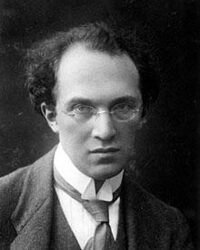
Franz Schreker
23 March 1878–21 March 1934
Franz Schreker (23 March 1878–21 March 1934) was an Austrian composer, conductor, teacher and administrator. In his lifetime he went from being hailed as the future of German opera to being considered irrelevant as a composer and marginalized as an educator. During a period when German and Austrian aesthetics were focused on the symphony, Schreker brought innovation to German opera, which at the time labored under the shadow of Richard Wagner. Though the composer was only a few years younger than Schoenberg and Zemlinsky, and a few years older than Berg and Webern, Schreker’s music remained primarily tonal, reflecting late Romantic Expressionism, Impressionism, elements of atonality and polytonality and timbral experimentation. His music in general and his operas in particular featured extensive symbolism and naturalism.
Early Life
The eldest of four surviving children, Schreker was born in Monaco—one of the many places his parents lived before settling in Linz in 1882. His father, Ignaz Schrecker, a court photographer, was originally from Golc–Jenikau in Bohemia and was born Jewish, though he later converted to Catholicism. His Catholic mother, Eleonare von Clossmann, was from Styria (in the southeast of Austria). His father’s death led the family to move to Vienna in 1888. Schreker began his professional education at the Vienna Conservatory in 1892, initially studying the violin (with Ernst Bachrich and Arnold Rosé) and later composition (with Robert Fuchs). He began conducting in 1895, and during this formative period composed a number of sets of songs and symphonic overtures. His first effort at opera was the one–act Flammen, set to text by a friend, Dora Leen, which concerned the sexual temptation of the wife of an absent crusader. Flammen was performed in 1902, after which Schreker soon began composing his first full–length opera, Der ferne Klang using his own libretto, as he would for all his subsequent operas.
After his conservatory years, he aspired unsuccessfully to a conducting position in opera. He made a lasting contribution to the music scene in Vienna when in 1907 he formed the Philharmonic Chorus, which he conducted until he left the city in 1920. The Philharmonic Chorus gave performances of Mahler’s Third and Eighth Symphonies, Delius’s Mass of Life and Sea Drift, and premieres of Zemlinsky’s Psalm XXIII, and Schoenberg’s Friede auf Erden and Gurrelieder. Schoenberg and Schreker were to remain lifelong friends. In 1909 Schreker married a seventeen-year-old soprano from the Chorus, Maria Binder. Franz and Maria Schreker had two children, Ottilie, born 1912, and Emmanuel, born 1916.
A Mainstream Success
Der ferne Klang (The Distant Sound) debuted in 1912 in Frankfurt and launched Schreker into the top rank of composers. The same year he was appointed to the faculty of the Vienna Academy of Music in the areas of counterpoint, harmony, and composition. His next opera, Das Spielwerk und die Prinzessin, enjoyed simultaneous premieres in Frankfurt and Vienna in 1913. Though not as well–received as Der ferne Klang had been, the work remained one of Schreker’s favorites. The outbreak of the World War limited opera performance including Der ferne Klang which had been performed in Leipzig, Munich, and Hamburg and was about to be performed in Prague and Paris. During this period Schreker composed two of his most successful operas, Die Gezeichneten (1913–1915) and Der Schatzgräber (1915–1918). The Frankfurt Opera House again premiered both— Die Gezeichneten (The Stigmatized) immediately after the war in April 1918 and Der Schatzgräber (The Treasure–seeker) in January 1920.
These two operas represent the high point of Schreker’s career. He was the subject of the high critical praise of respected music critic Paul Bekker who controversially compared his talent to Wagner. Der Schatzgräber was the most successful opera production of its time and was performed almost 400 times in more than 50 different theaters between 1925 and 1932. In March 1920, Schreker was appointed director of Berlin’s Hochschule für Musik. Schreker re–energized the distinguished but tradition–bound Hochschule. Among those that taught there during the Weimar years were Kestenberg, Erdmann , Busoni, Schoenberg, Schnabel, Flesch, Zemlinsky, Hindemith, Pfitzner, and Kaminski. Some of the prominent students of this era were Berthold Goldschmidt, Alois Hába, Jascha Horenstein, Ernst Krenek, Dragan Plamenac, Karol Rathaus, Artur Rodzinski, Josef Rosenstock, Hans Schmidt–Isserstedt, and Grete von Zieritz.
Reversals
Not long after his arrival in Berlin, Schreker began to experience reversals as an artist. His operas began to receive lukewarm receptions among audiences and critics. His work displayed his Austrian upbringing and sensibilities and, though his most successful operas had appealed to German audiences as well, Schreker was already becoming irrelevant to the more radical young composers. In some ways, Schreker’s music was an extension of nineteenth–century traditions, similar in many ways to Scriabin––certainly he was no an atonalist or serialist. The 1924 Cologne premiere of Irrelohe, was Schreker’s first real failure since emerging as a top composer. In the period 1924–1928, Schreker composed the operas Christophorus, and Der singende Teufel. The latter was a four–act opera dealing with the theme of a battle between the forces of light and darkness. It was staged in November 1928 in Berlin. The shorter Christophorus dealt with similarly apocalyptic themes, but its planned performance in Freiburg was never realized due to the emerging power of the Nazis. Hostile demonstrations by the National Socialists curtailed the run of his final opera Der Schmied von Gant after only five performances in Berlin in 1932.
Despite these problems, Schreker also enjoyed some important successes during this period. He became an early pioneer in the application of recording and broadcast technologies as applied to classical music. As late as 1932 he supervised the making of the first concert films. Schreker also took great interest in the development of the electronic music studio at the Hochschule. His non–operatic Kleine Suite was the first work commissioned for German radio. Along with Schoenberg’s Opus 34 (Accompanying music for a film scene), Schreker’s Vier kleine Stücke was recorded for use as film music. His last composition appears to be the Vorspiel zueiner grossen Oper for his own libretto, Memnon.
With the collapse of the Weimar Republic and the ascension of Hitler and National Socialism and the official policy of anti–Semitism, the political atmosphere became toxic for Schreker. Slow to recognize the changing climate, he was forced out of his directorship of the Hochschule für Musik. A less prestigious compensatory post at Prussian Music Academy did not work out, and sent Schreker scrambling, finally, for career opportunities outside of Nazi influence. Due to a combination of bad advice and bad luck, Schreker was unable to obtain a position either in America or elsewhere in Europe. While engaged in a protracted battle over his retirement pension, and concerned over his future—financial as well as professional—Schreker suffered a stroke in late December 1933. He suffered a series of setbacks to his health and died on 21 March 1934.
In the tense atmosphere of the early days of Hitler’s Chancellorship, Schreker’s passing went relatively unnoticed. While Anton Webern, Schoenberg and most of Schreker’s students sent notes of condolence, there was scant notice in the newspapers of the day. Aside for a few positive or neutral obituaries, several newspapers sought to frame Schreker’s rise and fall in terms consistent with the ideological tone of the Third Reich. The last publicity he was to receive in Nazi Germany was the inclusion of his music in a mocking exhibition of “degenerate” Jewish music in 1938. With his most acclaimed work more than a decade in the past and centered in Vienna, the advance of composers such as Webern, Hindemith, Berg, and Schoenberg in the musical mainstream, and the obscuring cover of pre–war events in Europe, Schreker and his music lapsed into obscurity for several decades. Schreker was almost forgotten, carried only in the memories of his now–scattered students. In 1964, a revival of Der ferne Klang in Kassel attracted some attention in the music journals and the approach of the centennial of his birth in 1978 was an occasion of a re–examination of his life and work.
As a composer, Schreker combined elements of late–19th and early 20th century styles. His music emphasized timbral expressiveness and novel orchestrations. Stylistically, he was linked with the coloristic innovations of Debussy and Richard Strauss, and shared some ties to French Symbolism. This was reflected in Schreker’s librettos, which often dealt with themes of sexuality and eroticism. In the 1910’s Schreker was considered among the musical avant–garde—and as a conductor he presented premiers of Schoenberg and Zemlinksy—but by the mid–1920’s he was considered by many to be out of fashion in comparison to the composers of the Second Viennese School. Schreker’s music employs chromaticism, polytonality and advanced orchestration techniques (such as deeply divided strings and percussion scoring)—his work often inspired by visual or auditory sensory images.
Works List
- 1894 Des Meeres und der Liebe Wellen für Singstimme und Klavier
- 1894 Die Rosen und der Flieder für Singstimme und Klavier
- 1895 Melodie für Klavier solo
- 1896 Appassionata
- 1896 Lied der Fiorina für Singstimme und Klavier
- 1896 Love Song für Streichorchester und Harfe (verloren)
- 1897 Liebeslieder
- 1898 Auf dem Gottesacker – Motette
- 1898 Der Holdestein
- 1898 Fünf Lieder aus den ‘Mutterliedern’
- 1898 Meereswogen
- 1898 Schlehenblüte
- 1898 Sonate F-dur für Violine und Klavier
- 1898 Versunken
- 1898 Zwei Lieder auf den Tod eines Kindes Op. 5
- 1899 Drei Lieder von Vincenz Zusner : I. Ein Rosenblatt
- 1899 Drei Lieder von Vincenz Zusner für Singstimme und Klavier
- 1899 Drei Lieder von Vincenz Zusner: II. Noch dasselbe Keimen
- 1899 Drei Lieder von Vincenz Zusner: III. Vernichtet is mein Lebensglück
- 1899 König Tejas Begräbnis
- 1899 Scherzo für Orchester
- 1899 Symphonie a-moll Op. 1
- 1900 Acht Lieder Op. 7
- 1900 Adagio
- 1900 Das hungernde Kind für Singstimme und Klavier
- 1900 Der 116. Psalm ( Psaume 116/Psalm 116 )
- 1900 Fünf Gedichte von Paul Heyse Op. 3
- 1900 Fünf Lieder für Singstimme und Klavier Op. 4
- 1901 Intermezzo fis-moll für Streichorchester, Opus 8 (als 4. in: Romantische Suite für Orchest Op. 8
- 1901 Zwei Lieder / Zwei Gesänge Op. 2
- 1901 Zwei Walzer Impromptus für Klavier solo Op. 9
- 1901-10 Der ferne Klang – Oper in 3 Akten
- 1901-1902 Flammen
- 1901-1902 Gebet der Agnes. from the opera ‘Flammen’ Op. 10
- 1901-1902 Gesang der Irmgard. Op.10 from the opera ‘Flammen’ Op. 10
- 1902 Ave Maria für Singstimme und Orgel (1. Vertonung)
- 1902 Schwanengesang Op. 11
- 1902/03 Ekkehard – Symphonische Ouvertüre Op. 12
- 1903 Romantische Suite für Klavier zu 4 Händen Op. 14 (Piano)
- 1903 Romantische Suite für Orchester Op. 14 (Orchestra)
- 1903-10 Der Geburtstag der Infantin – Pantomime für Streichorchester
- 1904 Phantastische Ouvertüre für Orchester Op. 15
- 1906 Vergangenheit
- 1907 Nachtstück für Orchester (Erweiterung und Arr. von: Zwischenspiel aus 3. Akt von: Der fern
- 1908 Festwalzer und Walzerintermezzo für Orchester
- 1908 Valse Lente für Orchester
- 1908-12 Das Spielwerk – Mysterium in 1 Akt
- 1908-12 Das Spielwerk und die Prinzessin – Oper in 1 Vorspiel und 2 Akten (1. Fassung) Op. 2 Oper
- 1908/09 Rokoko – Ein Tanzspiel für Orchester
- 1909 Ave Maria für Singstimme und Klavier / Orgel (2. Vertonung)
- 1909 Der Wind
- 1909 Entführung
- 1909 Fünf Gesänge
- 1909 Funf Gesange (without opus no.)
- 1909 Scherzo für Orchester (3. Satz einer geplanten Symphonie)
- 1913 Vorspiel zu einem Drama für Orchester
- 1913-15 Die Gezeichneten Op. 3
- 1914 Vorspiel zu Einem Drama- Prelude to a Drama
- 1915 Das Feurige Männlein
- 1915 Das Feurige Männlein für Singstimme und Klavier
- 1915-18 Der Schatzgräber – Vocal Score Op. 4 Vocal Score
- 1915-18 Der Schatzgräber Op. 4
- 1915-1918 Wiegenlied der Els
- 1916 Ein Tanzspiel
- 1916 Orchestration- Two Songs by Hugo Wolf
- 1916 Chamber Symphony for Piano
- 1916-1917 Kammersymphonie
- 1919 Und wie mag die Liebe
- 1919-22 Irrelohe – Oper in 3 Akten / 4 Bildern Op. x
- 1920 Kleine Suite im alten Stil / Tanzsuite für Orchester (Rev. und Arr. von: Rokoko – Ein Tanzspiel
- 1922 Fünf Gesänge für Alt / Bass und Orchester
- 1923 Der Geburtstag der Infantin – Suite für Orchester
- 1923 Zwei lyrische für Sopran / Tenor und Klavier
- 1923 Zwei Lyrische Gesänge. I. Wurzein und Halme sind dies nur
- 1923 Zwei Lyrische Gesänge. II. Das Gras
- 1924-28 Der singende Teufel Op. x
- 1925-29 Christophorus oder Vision einer Oper
- 1927 Spanisches Fest
- 1927 Vom ewigen Leben – Zwei lyrische Gesänge
- 1928 Kleine Suite für Kammerorchester (Originalkomposition für das Radio)
- 1929-32 Der Schmied von Gent
- 1929/30 Vier kleine Stücke für großes Orchester / Vier Skizzen für den Film
- 1932/33 Das Weib des Intaphernes
- 1933 Orchestration – Second Hungarian Rhapsody
- 1933 Vorspiel zu einer großen Oper
- 1??? Auf dem Gottesacker, Vergangenheit
- 1??? Ave Maria and Marienlied
- 1??? Lenzzauber
- 1??? Schlehenblute; Versunken
- 1??? Schlussgesang der alten Liese
- 1??? Wind, Violin/Clarinet/Horn/Cello/Piano, Study
- Before 1900 Auf die Nacht (incomplete)
Bibliography
Blackburn, Robert. 1978. Franz Schreker, 1878–1934. The Musical Times 119 (1621):224–228.
———. 1990. [Untitled]. Music & Letters 71 (1):128–131.
Franklin, Peter. 1982. Style, Structure and Taste: Three Aspects of the Problem of Franz Schreker. Proceedings of the Royal Musical Association 109:134–146.
———. 1989. Audiences, Critics and the Depurification of Music: Reflections on a 1920s Controversy. Journal of the Royal Musical Association 114 (1):80–91.
———. 1989. Schreker and the Problem of Opera. The Musical Times 130 (1762):730–731.
———. 1991. Distant Sounds – Fallen Music: “Der ferne Klang” as ‘Woman’s Opera’? Cambridge Opera Journal 3 (2):159–172.
———. 1994. An Open and Shut Case. The Musical Times 135 (1819):564–565.
Hailey, Christopher. Franz Schreker. In Grove music online [electronic resource] Oxford ; New York: Oxford University Press
———. 1993. Franz Schreker, 1878–1934 : a cultural biography, Music in the twentieth century. Cambridge ; New York: Cambridge University Press.
———. 2002. Franz Schreker and the Pluralities of Modernism. Tempo (219):2–7.
Heinsheimer, Hans W. 1978. Schreker Centennial. The Musical Quarterly 64 (2):244–249.
Puffett, Derrick. 1979. The Beginning of New Music? The Musical Times 120 (1636):487–488.
———. 1983. Schreker Restored. The Musical Times 124 (1688):626–627.