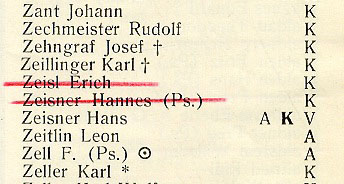
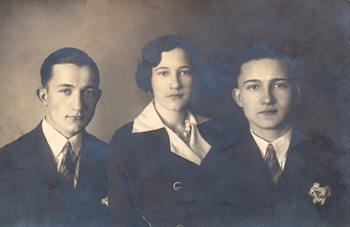
After the March 13, 1938 Anschluss, Jewish members of Austria’s society of authors, composers, and music publishers (Staatlich genehmigte Gesellschaft der Autoren, Komponisten und Musikverleger), known as the “AKM,” were blacklisted. The nature, scope, and ramifications of the AKM’s 1938-1945 history are the subject of new research in Austria, with the publication of a study expected soon. 1 This study follows on the heels of the first public exhibition of a recently discovered AKM blacklist in the Vienna City Library in 2012. 2 Name by name, this diminutive yet chilling red-lined Nazi-era artifact was a prelude to evolving persecution in Austria for those in the musical world.
AKM Directory Excerpts
Photo Credit: Vienna City Library 3
Catalogued as “A91314,” the 1937 AKM membership directory was annotated with bold red lines neatly hand-drawn through the names of Jewish AKM members, along with what appears to be a handwritten date in red of February 10, 1939, on the title page. It is not known who prepared this Nazi-era blacklist or how it ended up on the library’s shelves. Nor is it generally known whether similar lists of expelled AKM members from successive years up until 1945 are today in the AKM’s archive. Austrian scholar, Dr. Christoph Lind, found the red-lined directory in 2010 among the printed works in the Vienna City Library while he and Dr. Georg Traska were conducting research for their 2012 biography of pianist, composer, and cabaret performer, Hermann Leopoldi, who survived internment in Dachau and Buchenwald. 4
Founded in 1897, the AKM is a performing rights society engaged in the business of granting licenses and collecting copyright royalties for the public performance of the musical works of its members, and distributing such royalties. After Austria’s incorporation into the Reich, its cultural institutions rapidly implemented anti-Semitic policies. In 1938, the AKM was placed under the control of the German performing rights society, STAGMA, (Staatlich genehmigte Gesellschaft zur Verwertung Musikalischer Urheberrechte). 5 During the Nazi era STAGMA generally banned Jews from membership and was administered by the Reich Culture Chamber (Reichskulturkammer), and its Reich Music Chamber (Reichsmusikkammer), all under the direction of Joseph Goebbels and the Ministry of Propaganda. 6
“[O]n 17 March 1938, just four days after annexation, AKM’s council had been dismissed, a Commissar Chairman appointed, and a questionnaire sent to all members asking, among other matters, racial and religious questions.” 7 Béla Bartók, a member of the AKM, wrote from Budapest on April 13, 1938, regarding the changed conditions in Austria:
As regards my own affairs, I must say that things are not very good at the moment because not only has my publishing house (U.E.) gone Nazi (the proprietors and directors were simply turned out) but also the A.K.M., the Viennese Society for performing rights, to which I belong (and Kodály, too), is also being ‘nazified’. Only the day before yesterday I received the notorious questionnaire about grandfathers, etc., then: ‘Are you of German blood, of kindred race, or non-Aryan?’ Naturally neither I nor Kodály will fill in the form: our opinion is that such questions are wrong and illegal…we must insist on having nothing to do with this unlawful questionnaire, which therefore must remain unanswered….” 8
Universal Edition was one of many music publishers Aryanized or otherwise misappropriated during the Nazi era. 9 “After the Anschluss…a State Commissar was appointed by the German Ministry of Propaganda for UE and Mrs. [Jella] Hertzka [a member of the Universal Edition Board of Trustees] was compelled to sell her shares to him.” 10
A handwritten note inside the AKM directory found in the Vienna City Library explains that some members had not yet been crossed off the list because they had not submitted their completed questionnaires. The missing information was reportedly later provided by Heinrich Damisch and Helmut Wobisch, who identified Jewish AKM members. 11 Heinrich Damisch, music critic, writer, and former director of the Wiener Mozartgemeinde, despite his authorship of the 1938 anti-Semitic article Die Verjudung des österreichischen Musiklebens and other efforts, was honored post-war in Austria. 12 Helmut Wobisch, an ardent Nazi party member, was a trumpeter with the Vienna Philharmonic during and after the Nazi era, as well as managing director of the Vienna Philharmonic from 1953 to 1969. 13
According to one estimate, those persecuted by the AKM constituted approximately forty-two percent of the membership. 14 Throughout the Reich, musicians were similarly the subject of blacklisting in the Lexikon der Juden in der Musik, edited by Nazi musicologist and head of the Nazi Sonderstab Musik (a plundering task force), Dr. Herbert Gerigk and his co-editor Dr. Theo Stengel. 15
The 1935 Nuremberg racial laws were adopted in Austria on May 20, 1938. Performances of compositions by Jewish composers and authors were generally banned under the Reich.
Until 1942, catalogues that featured Jewish composers, along with printed scores by Jewish composers, were either consigned to be pulped, or marked as unavailable for sale or performance. Sales of scores by Jewish composers from antiquarian shops were to be restricted to music historians, and clearly marked with the letter ‘J’ along with a visible explanation as to its meaning. However, most publishers had taken the precaution of producing multiple copies, so that when some 30,000 printed scores and books were confiscated from Universal Edition, almost everything could be recovered later. 16
Copyright royalties due to persecuted AKM members or their heirs would primarily have resulted from performances outside Axis and occupied nations. Copyright royalties due to blacklisted AKM members and collected by the AKM inured to the benefit of the Reich under the Eleventh Decree to the Reich Citizenship Law, passed on November 25, 1941. This legislation provided the Reich with legal authority to seize the assets of persecutees living outside the Reich’s borders, including those who had been deported or gone into exile.
Post-war claim files in the United States National Archive provide evidence reflecting alleged AKM copyright losses, amid claims for a vast range of confiscated property. This was the case with Viennese librettist and playwright Alfred Grünwald, who stated, “When Hitler marched into Vienna I was taken into ‘security-custody’ – which means imprisoned and released only under the condition that I leave Austria in four weeks!”
Among his many losses, Grünwald said of the AKM:
I was member of the directorium of the A.K.M. (Oesterreichische Autorengesellschaft, Wien III. Baumanngasse 8) and in this capacity co-owner of the whole assets of this great society and entitled to a lifelong pension. One day before my arrest they forced me to renounce my membership and to declare my disinterest in the A.K.M. 17
Grünwald fled from Vienna to Paris where he “had to escape in the middle of the night,” his residence plundered, then to Morocco and eventually to the U.S. After “a life long full of work and thriftiness,” Grünwald reported on November 23, 1945, all his property had been stolen, confiscated, or forcibly sold.
Song writer and playwright Hans Jan Lengsfelder similarly wrote to the U.S. War Department Headquarters in Vienna on June 7, 1946, making a claim against the “Gesellschaft der Autoren, Komponisten und Musikverleger [the AKM] Vienna III, Baumann Strasse 8, for royalties collected for public performances of my works plus claims against the pension fund and a share in the assets of the society.” Lengsfelder also sought from “Austromechana…royalties collected for records of my works.” 18
Music publisher Franz Sobotka, who owned several music publishing houses in Vienna, which he identified as “Edition Bristol,” “Europaton Verlag,” and “Sirius Verlag,” fled Austria in mid-May 1938 with his wife, immigrating to New York, after he learned he was at risk of imminent arrest by the Gestapo. He reported to the U.S. Military Government, Headquarters Vienna, “my entire fortune was confiscated,” claiming that his music publishing houses and proceeds due to him from the AKM had been misappropriated. 19
In an effort to recover lost AKM copyright royalties, on June 9, 1941, Franz Sobotka filed suit in New York for royalties collected by the American Society of Composers Authors & Publishers (ASCAP) for the AKM, resulting from U.S. performances. Sobotka alleged that under a contract between the AKM and ASCAP, which ran from January 1, 1933 to December 31, 1938, $62,809.85 had accrued to AKM’s account. The AKM had granted to ASCAP the exclusive right to license in the U.S. the public performance rights in certain musical works.
Sobotka’s claim was complicated by the fact that the AKM had allegedly been liquidated during the Nazi era, that AKM royalties in the U.S. had been tied up as “blocked assets” and characterized as “alien property” under U.S. law in light of a wartime order freezing such assets under the Trading With the Enemy Act. 20 Although the outcome of Sobotka’s claim against the AKM is unclear, his lawsuit and the post-war claims of other persecuted AKM members raise a host of unanswered questions, including whether, and to what extent, uncompensated royalties accrued to persecuted composers, authors, and music publishers on U.S. soil, and elsewhere, during the Nazi era.
The AKM was reestablished in Austria as a new institution after World War II. The content of the AKM archive is not generally known. The study of the AKM’s 1938-1945 history, and its aftermath, currently under preparation by musicologist Hartmut Krones and commissioned by the AKM in 2013, 21 will be a welcome addition to the evolving literature regarding music suppressed during the Third Reich and the many lives of those tethered to it.
Note: To view a PDF of the entire blacklist, click here.
Posted August 2014
Carla Shapreau teaches art and cultural property law at the University of California, Berkeley, School of Law, and is a Research Associate in the Institute of European Studies at U.C. Berkeley, where she is conducting research regarding music-related losses during the Nazi era and their 21st century ramifications. Dr. Shapreau is co-author of Violin Fraud—Deception, Forgery, Theft and Lawsuits in England and America, Oxford University Press, and has written and lectured broadly on the topic of cultural property. She is also a violin maker.
5. After World War II, STAGMA was renamed GEMA (Gesellschaft für musikalische Aufführungs und mechanische Vervielfältingsrechte). David Monod, Settling Scores: German Music, Denazification, & the Americans, 1945-1953, Chapel Hill: University of North Carolina Press, 2005, pp. 116-17; “GEMA ist an allem schuld,” Der Spiegel, July 4, 1951, http://www.spiegel.de/spiegel/print/d-29194282.html.↑
6. Michael Haas, Forbidden Music: The Jewish Composers Banned by the Nazis, New Haven: Yale University Press, 2013, p. 228; Eric Levi, Music in the Third Reich, London: Macmillan Press, 1994, pp. 24-34. ↑
7. Malcolm Gilles, “Bartók and Boosey & Hawkes: The European Years,” Tempo, New Series, No. 200, Cambridge University Press Apr. 1997, p. 4.↑
8. János Demény, ed., Béla Bartók Letters, New York: St. Martin’s Press 1971, pp. 267-268 (writing to Annie Müller-Widmann in Basle, Switzerland).↑
10. Robert Montgomery and Robert Threlfall, Music and Copyright: The Case of Delius and his Publishers, Aldershot, Hampshire, England; Burlington, VT : Ashgatem 2007, p. 396, Appendix 22 (May 19, 1950 letter by Ernst Roth to Philip Emanuel explaining the history of Universal Edition under the Nazi regime). Jella Hertzka (née Fuchs) was in 1938 the widow of Emil Hertzka, former Director of Universal Edition Vienna from 1907-1932.↑
11. Elisabeth Th. Fritz-Hilscher and Helmut Kretschmer, eds., Wien, Musikgeschichte: Von der Prähistorie bis zur Gegenwart, Vol. 2, “H. Das 20 und 21 Jahrhundert (vom Ersten Weltkrieg bis zur Gegenwart),” Hartmut Krones, Vienna: Lit, 2011, p. 461. ↑
12. Eric Levi, Mozart and the Nazis: How the Third Reich Abused a Cultural Icon, New Haven: Yale University Press 2010, p. 245.↑
17. November 23, 1945 letter from Alfred Grünwald to the Property Control Officer, American Military Government, Austria, Records of the Property Control Branch of the U.S. Allied Commission for Austria, 1945-1950, (USACA) DN 1929, Roll 152, U.S. National Archives and Records Administration (NARA). ↑
18. June 7, 1946 letter from Hans Jan Lengsfelder to the U.S. War Department, Vienna, Attn. I.P. Nelson, Jr., 1 stLieut., F.A., USACA, DN 1929, Roll 217, NARA. Lengsfelder also listed claims for royalties against Verlag Max Pfeffer; Georg Marton Verlag; Verlag Ludwig Doblinger; Edition Bristol, Europaton Musikverlag and Adolf Robitschek (some of these publishing houses were also blacklisted). ↑
19. April 15, 1946 letter by Franz (aka Frank) Sobotka to U.S. Military Government, Property Control, Vienna Headquarters, USACA, DN 1929, Roll 158, NARA. ↑
20. See Markham v. Taylor, 70 F. Supp. 202, (S.D.N.Y. 1947); Propper v. Clark, 69 S. Ct. 1333 (1949).↑
21. Supra, endnote 1. After Christoph Lind discovered the red-lined AKM directory in the Vienna City Library, he and Georg Traska started a project on the history of the AKM and Austro Mechana, and they hope to gain access to the AKM’s historical records for their research soon. March 7, 2014 email communication with Dr. Georg Traska. ↑
A Review of the Conference at Arizona State University, 2013
In November 2013, a select group of international scholars met in Tempe, Arizona, to discuss the richness and diversity of music created and performed in Poland during the first half of the twentieth century. The event, hosted by the Center for Jewish Studies at Arizona State University (ASU) and co-organized with The OREL Foundation, took place over two days, both of them packed with presentations, and it concluded with a stellar concert by the ARC (Artists of the Royal Conservatory) Ensemble. Given the present-day abundance of musicological, ethnographic, and cultural studies, conferences such as this one risk becoming mere blips on the screen—but this was a gem of a blip! As sometimes happens when planning and participation align, each of the nine papers and the keynote address contextualized topics that were covered by others, and active participation in the freewheeling discussions among presenters, session moderators, and a small but engaged audience further extended the nexus of links. For the planning and forethought that made this event come together we are indebted to Robert Elias, from the OREL Foundation; Bret Werb, from the United States Holocaust Memorial Museum; Anna Holian, from ASU's Center for Jewish Studies; and ASU professors Sabine Feisst and Anna Cichopek-Gajraj. Thanks must also go to Professor Hava Tirosh-Samuelson, Director of the ASU Center for Jewish Studies, whose background and wide-ranging curiosity often nudged discussions in fruitful new directions. Professor Feisst also cajoled a fine group of student musicians into preparing an afternoon recital of music by Wanda Landowska.
Not surprisingly, the conference confirmed the difficulty of expanding the perimeters of what is acknowledged to be Central European music. During the past sixty years, fissures have appeared incrementally within those perimeters. But for every Karol Szymanowski and, more recently, Mieczysław Weinberg and Szymon Laks, who have broken through to international recognition, there are dozens of Tadeusz Zygfryd Kasserns, Józef Kofflers, and Roman Polasters who have not done as well, although they defined their times as vividly and variegatedly as did those whose names are better known. Not to mention the fact that cultural categories such as Yiddish theater music and klezmer music remain out in the cold. Given the conference title's references to plural "worlds," I expected from the outset to hear much that would be new to me. Yet I'm sure I was not alone in being astonished by the vastness of unexplored material that was shown to lie in shadows beyond the perimeters. With respect to Central European music and music-making during the first half of the twentieth century, the problem is clearly not just natural human resistance to the unfamiliar. And in this case we are further hampered by the wanton destruction and accidental loss of a shocking quantity of sources. Fortunately work can still be salvaged from the rubble, and as the scholars at this event presented their work it was heartening to hear so many of them conclude not with an explicitly final statement but, instead, with an implicit promise of work "to be continued."
Of course, all active fields of study are to some extent in medias res. In the case of Polish studies there may simply be a lower ratio of what is known to what remains unknown and of what is documented to what remains undocumented. It occurred to me that this may be a consequence of how diverse a region Poland is and was, of how wide-ranging and intersecting the cultural traditions were throughout this region, and how gnarled its political history has been. Poland is now bordered by Germany to the west; by the Czech Republic and Slovakia to the south; by Ukraine, Belarus, and Lithuania to the east; and, to the north, by the Baltic Sea, with, just a little farther east, the small Russian enclave of Kaliningrad. But this Poland is a fairly recent construction. Historically, and at its largest, the Polish-Lithuanian Commonwealth extended from the Baltic to the Black Sea, but in the late eighteenth century this region was successively partitioned by its neighbors, and after 1795 Poland did not exist as an independent state: it consisted merely of sectors—Austrian, Prussian, and Russian—in which the occupiers gradually inculcated their languages, cultures, and traditions. The Versailles Treaty, at the end of the First World War, reconstituted the Polish nation, but the newly drawn borders remained in dispute for several more years. There was a Polish-Soviet War in 1919–1921, a Polish-Lithuanian War in 1920, and a Seven-Day War between Polish and Czechoslovakian troops. And within two decades, Polish independence was again wiped out when the 1939 Non-Aggression Pact between Nazi Germany and Soviet Russia led to new invasions and occupation.
Thus the time-span under review — 1920-1960 — may be divided into three periods: the time between the restoration of Polish independence and the invasions of 1939; the years of the World War II and the occupation; and the postwar years as a Soviet satellite country. Antony Polonsky's keynote address, "Jews in Polish Cultural Life: Between Acceptance and Rejection," provided an overview Poland's political history as it intersected with the history of Poland's Jews in general and with the lives of three Polish-Jewish artists in particular. Polonsky pointed out that Jewish acculturation and integration—the process of transforming Jews "from a religious and cultural community transcending national boundaries and linked by a common faith into citizens of the countries in which they lived"—was more gradual than in countries further to the west but nevertheless followed similar paths. In Polish lands, as in Western Europe, those who believed that their national culture required protection did all they could to thwart the inclusion within that culture of anything that they thought of as "foreign." Polonsky reached back a bit further than 1920—a demarcation of change not only in the country's borders and national status, he said, but also in social sensibilities—when he spoke about the Polish-Jewish painter Maurycy Gottlieb (1856–1879), one of the first Jews to make a name for himself in the plastic arts, both at home and abroad. He then summarized the career of Julian Tuwim (1894–1953), a kind of Polish Walt Whitman, born more than a generation after Gottlieb. Tuwim exemplified the very different difficulties faced by Polish Jews in the 1920s and early 1930s. Even when his career was at its apex, Polish modernists despised him for trying to bridge the gap between high and popular culture, whereas the petite bourgeoisie for whom he was trying to write was increasingly succumbing to anti-Semitic propaganda. Polonsky described Tuwim's 1930s Bal w Operze (A Ball at the Opera) as one of the most remarkable of the apocalyptic visions that date from the years preceding the World War II.
The third artist whom Polonsky chose to speak about was Józef Koffler (1896–1944), the first Polish twelve-tone composer, at one time considered equal in importance to Szymanowski. According to Polonsky, Koffler's music, like that of other Polish composers of the interwar period, reflects the many trends—Russian, German, French, neoclassical, and folkloristic, among others — that were current at the time. Koffler's music was better known Western Europe than at home, but he stayed in Lwów even after the German and Soviet invasions, and he and his family disappeared in or around 1944. To date, most of his unpublished works remain unrecovered.
As Polonsky pointed out in concluding his talk, the historical dispute "between two visions of Poland, one pluralistic, outward looking, and European, the other nativist and hostile to foreign influences," continues to this day. Those who chose to identify Polishness narrowly with Catholicism and national victimization tended to blend their rejection of Jewish elements, whether culturally high or low, into their rejection of cosmopolitanism in general. Conversely, many Polish Jews struggled to unite their Jewishness with their Polishness, and the same difficulties still beset anyone who tries to categorize Polish artists. Being Polish or being Jewish comprised a sense of cultural belonging, as well as a degree of geographic sense of place. There was and still is an uncomfortable area in which Polishness and Jewishness are not necessarily felt to overlap, for assimilated as well as unassimilated Polish Jews, and adherence to one group could make loyalty to the other difficult, perhaps even impossible.
How this problem manifests itself in art is a question that came up a number of times during the conference. Is the dichotomy even traceable if the artist does not make it explicit. Moreover, in differentiating people by their national or religious background or adherence, are we in danger of overriding an individual's self-identity? The question also came up as to whether an artist who had not previously identified with his Jewishness but was then hunted for that very condition might turn to Jewish traditions, not out of creative need but in order to make common cause. And if so, how does one assess that person's works? Viktor Ullmann, Walter Klein, and other non-observant Jewish composers started to create works with Jewish themes only after they were incarcerated in Terezín, although what motivated them will probably remain debatable. For the time being, most scholars who are intent on recovering the work of forgotten and suppressed Jewish artists will continue, quite sensibly, to include anyone with a Jewish background, regardless of that individual's relationship to Judaism or Jewish culture.
Katarzyna Naliwajek-Mazurek's paper, "Presence, Absence, Identity, and the Musical Worlds of Polish Jews," was well placed to open the conference because she started with an overview of Poland's political history between the wars and how that history shaped its musical life. With Poland's restored independence after the First World War, Polish writers, artists, and musicians could participate in the artistic ferment that swept across Europe. In this new Poland, openness toward the West and increased secularization became possible, and many of the Polish artists and intellectuals born at the turn of the century who began their studies in Warsaw were able to expand their horizons and contacts in Vienna, Berlin, Paris, and elsewhere. Many of them participated in activities of the newly and optimistically founded Internationale Gesellschaft für Neue Musik, or IGNM (International Society for Contemporary Music). Just as they recognized their Polishness—and could celebrate it in their art if they so chose—so they could participate in the rebirth of international European culture. This period, during which Poland enjoyed what Naliwajek-Mazurek termed a "presence" within the broader European scene, was abruptly exchanged for the country's exclusion, or "absence," in and after September 1939. And after 1945, some of the survivors tried to rebuild their lives in Soviet-controlled Poland, but most went into exile.
To give depth to this history Naliwajek-Mazurek chose three musicians who helped to define Polish music in the interwar years and survived into the postwar period: Szymon Laks (1901–1983), Tadeusz Zygfryd Kassern (1904–1957), and Władysław Szpilman (1911–2000). All three completed their artistic education outside Poland, and all three adopted an internationalist neoclassical style that included folkloristic and post-impressionist elements. In Paris both Laks and Kassern were members of the local Association of Polish Musicians, but whereas Laks chose to settle in Paris and returned there after having survived Auschwitz, Kassern returned to Poland and made a life for himself at home. During the interwar years he combined a successful career in law with continuing compositional productivity and recognition. After having managed, somehow, to survive the horrors of the war years in Poland, he would have been happy to remain there even under communist rule, but he soon ran into political difficulties and in 1947 emigrated to the United States. Szpilman, who made an early name for himself as a pianist and composer of classical, popular, and film music, also managed to survive the war in Poland but, unlike Kassern, he made a successful transition to life in postwar Poland, serving from 1945 to 1963 as director of the Polish Radio's Popular Music Department and at the same time continuing a glamorous international performing career. Roman Polanski's film The Pianist, which is based on Szpilman's memoir of surviving the Warsaw Ghetto and appeared two years after his death, has inssured his status as one of the best-known Polish musicians of the twentieth century.
The historian and poet Maja Trochimczyk focused on the tragic years after 1939 in her paper, "Jewish Composers of Polish Music in 1943," a sweeping overview of musicians whose lives were permanently altered or ended altogether by the events of the 1930s and 1940s. Those who left Poland before 1939—among them Bronisław Kaper (1902–1983), Karol Rathaus (1895–1954), and Alexandre Tansman (1897–1986), all of whom found refuge in the United States—had the best chance of surviving; in exile they resumed their careers, and they remained active long enough to assure themselves a place in music history; Tansman, however, who had been living in Paris before the war, returned there after the war and lived there until his death. Of those who were caught by surprise when the German bombing began in September 1939, by far the largest number—some hundreds of thousands of refugees—fled eastward to the Soviet Union, where, despite the volatility of Soviet refugee policy, they had a significantly better chance of surviving the war than if they had stayed in Poland, or even returned home after the fighting had ceased, as some of them did. Henryk Wars (later changed to Vars) (1902–1977) and Roman Haubenstock-Ramati (1919–1994) exemplify the tribulations of this means of survival, for they owed their lives to conscription into the Anders Army, which was sent to fight in Palestine and later in Africa. Other Poles fled south to Italy or west to France. The conductor Grzegorz Fitelberg (1879–1953), father of Jerzy Fitelberg, was among those who passed through Paris on the way to final exile in the United States. According to Trochimczyk, only twelve composers managed to survive in Poland, and of those only Szpilman presently enjoys any degree of recognition. It is a hopeful sign that Kassern's works have come back into view in Poland in recent years, and Roman Palester (1907–1989), who was once regarded as a composer of talent equal to that of Szymanowski, is also getting renewed attention, thanks to a 2005 monograph on him by Zofia Helman.
Trochimczyk pointed to the end of the Warsaw Ghetto Uprising on 16 May 1943 as the ultimate demarcation point for anything that might have been considered the purveyance of Jewish music in Poland. After that, most Jewish musicians who had remained in Poland were in hiding or in ghettos and concentration camps, and few of them survived. Many of those who had not died in the Warsaw Ghetto were killed in the death camps of Treblinka, Auschwitz, Dachau. For Trochimczyk the starting point for the work of recovery is the monumental and as yet unpublished Jews in Musical Culture in Polish Lands in the Nineteenth and Twentieth Centuries: A Dictionary, courageously initiated by Leon Błaszczyk and since expanded by others. These scholars cast have cast their nets wide in order to include composers of popular and art music, song writers, conductors, cabaret performers, concert singers, instrumentalists, and music teachers. Many of these individuals would have enjoyed only local importance even in normal times, and few of those in Trochimczyk's roll-calls of names would have maintained posthumous significance. But again and again during her talk I found my sympathy involuntarily stirred by a brief description of an active, productive life turned upside down, brutally ended, and forgotten. In shining a light, however briefly, on one brutally abridged existence after another, Trochimczyk painted an extraordinarily vivid scene of human and cultural devastation.
Devastation was likewise an undercurrent in Eliyana R. Adler's paper, "Singing Their Way Home," in which she considered the validity of a redemptive reading of songs and singing among Jews during the Holocaust period. Since the end of World War II, one scholar after another has attempted to counter the accepted view of Jews as passive victims, with evidence of active resistance. Given the paucity of such militant responses as the Warsaw and other ghetto uprisings, scholarly attention shifted to actions that might be considered political or spiritual resistance. High among these was music, specifically song and singing. Adler became interested in the many references to singing in memoirs written by survivors of the thousands of Polish Jews who became permanent refugees in the Soviet Union after 1939, in particular the memoir by Chaim Shapiro, (born 1922), who was seventeen in 1939 when he left his family in Lomza. He described several instances in which songs were sung to transmit private "coded" communications to others. Whatever it attempted to portend, such singing posed no threat to those in power. There are probably as many instances of Nazi guards forcing prisoners to sing during work duty or marches. I remembered the passage in Szymon Laks's memoir, translated into English as Music of Another World, in which he called playing in the Auschwitz camp orchestra a "demoralizing" supplemental torture. In her research Adler found that prisoners who sang voluntarily did so mainly to cheer themselves up and to remind themselves of home and of happier times. Adler's conclusion, although it affirms the capacity of individuals to attempt to live "normally" even in abnormal circumstances, thus also highlighted, poignantly, how severely choices were circumscribed, indeed practically nonexistent, for all those faceless, nameless victims.
Some of the melodies and poems sung by the subjects of Adler's talk may have been among those that Joseph Toltz discussed in his paper, "Moja pieśni tyś moja moc ("My song, you are my strength"): Personal Repertories of Polish and Yiddish Songs from Youth Survivors of the Łódź Ghetto." Toltz's oral history interviews with Holocaust survivors who settled in Melbourne, Australia, after the war are part of a larger project documenting the personal meaning of music in the lives of Jewish camp and ghetto inmates during the Nazi years. Toltz takes issue with the ways in which survivor recollections are often pressed into narrative reconstructions of a communal experience—for example in the postwar publication of songbooks organized by emotional tropes such as despair, destruction, resistance or combat, and renewal. Such neat divisions of experience can lead to a blurring of individual experience. In his research Toltz wrestles with the complexities of the relationship between witness and survivor, listener and testifier. Listening, in this context – as I understood Toltz to define it – should not be a method for determining objective facts but rather an opportunity for subjective reinterpretation of the moment of recall, involving the listener, the testifier, and what is testified. In this view, musical memory is less a matter of "truth" or veracity than of a dialogic encounter in which the listener's understanding opens itself to the testifier's subjective experience. Clips of several interviews, and especially camp songs rendered by old voices that occasionally cracked in the act of remembering, gave persuasive support to Toltz's point of view.
Also dealing with a single sphere of music-making was Joel Rubin's paper, "Szpilman, Baigelman, and Barsh: The Legacy of an Extended Polish-Jewish Musical Family on Three Continents." Joel Rubin—a highly knowledgeable master klezmer musician— spoke eloquently about a multigenerational extended family of professional Jewish instrumentalists active in Poland at least since the mid-nineteenth century. During the interwar period they dispersed and carried their traditions into exile in Canada, Brazil, and the United States, which is where the most famous member of this family, Władysław Szpilman, was able to continue his career as a film and song composer. In the nineteenth and early twentieth centuries, as Rubin explained, Polish klezmorim played an important role as liaisons between shtetl Jewish culture and assimilated Polish-Jewish cultures and between popular Yiddish entertainment and art music. Klezmorim performed in all genres, from instrumental religious klezmer music to Yiddish entertainment theater, Polish folk and popular song, jazz, and chamber and symphonic music. Though there are many studies of klezmer music as practiced in the Ukraine, Belarus and, to a lesser extent, Austro-Hungarian Galicia and Romania, the klezmer tradition and the lives of klezmorin in Poland have largely been ignored. Rubin's research into this area began as historical ethnomusicology, but as he met more and more members of the Szpilman, Baigelmann, and Barsch families and learned of their activities, his project grew to include cultural history and enthnography and dealt more broadly with the diversity of music produced by several generations of professional musicians, all of whom could trace their origins to a few klezmer families. It is a compelling picture of cultural synthesis and evolution.
Over the course of the two conference days, the historical surveys and papers dealing with single genres and categories of music-making created an ever deepening informational backdrop for several papers that focused more narrowly on individual artists. In her paper, "Identity and Yiddish Nationalism in the Writings of Menachem Kipnis," Julia Riegel examined the work and aesthetics of a well-known folklorist, singer, music critic, and author. Kipnis (1878–1942), who was relatively fortunate inasmuch as he died a natural, non-violent death in the Warsaw Ghetto, is today remembered mainly for his collections of Jewish folksongs, but he ardently celebrated the contributions of all Jewish artists, whether they represented eastern European Jewish traditions or had assimilated into the world of Western European high culture, as was increasingly the case during the interwar period. Riegel believes that he himself should be positioned at the intersection of those two worlds, and this may explain some of the contradictions and idiosyncrasies in his writings. Scholarly attention has heretofore neglected Kipnis's more academic writings, yet although his unpublished papers were probably lost in the destruction of the Warsaw Ghetto, Riegel's work shows how much can be gleaned from his published works, most of which were in Yiddish and addressed primarily to Yiddish-speaking European Jews. Riegel focused on one of these works in particular, Di velt-berihmte yidishe muziker, a study of nine composers with very different musical languages, only two of whom were practicing Jews, but in all of whose works Kipnis nevertheless claimed to see something intrinsically and recognizably Jewish. In arguing for this commonality in the creations of anyone with Jewish roots, Riegl noted that Kipnis employed terms just as exclusionary and "racialist" as those used by such mid- and late-nineteenth century anti-Semites as Richard Wagner—although of course he used the same ideas to maintain a diametrically opposed view. Not only does Kipnis provide yet another instance of belief steering evidence: he also reflects the prevalence of ethnic- and race-based critical judgment at the turn of the twentieth century.
In a lecture demonstration, "Tadeusz Zygfryd Kassern's American Years," Slawomir Dobrzanski complemented Naliwajek-Mazurek's earlier discussion of this artist by focusing on the composer's postwar life in a new country and on a comparison of works written before and after emigration. The story of Kassern's physical survival in Poland, where he lived openly (in Kraków, Warsaw, and Zakopane) under an assumed name, is a remarkable one, but after immigrating to the United States he never managed to reestablish himself as a composer. Dobrzanski's performances of selected compositions by Kassern confirmed his conclusion that the composer's musical languagedid not evolve significantly as a result of living and working in a new culture. (This was also true of quite a few other émigré composers.) Although Kassern's works seem miraculously to have survived the war years intact, almost all of them remain unpublished. Plans to publish his works were under discussion in communist Poland soon after the war but were scuttled when Kassern began to speak out against Poland's increasing communization. The only works that today remain in common use are two pedagogical pieces (Candy Music Box and Teen-Age Concerto) and the Sonatina for Flute and Piano, composed in 1952. Thus in this case as in others, works remains to be done.
A third artist viewed up close, the Polish keyboardist Wanda Landowska (1879-1959), received double attention, first in Carla Shapreau's paper, "The Theft of Culture, Persecution, and the Identity of Wanda Landowska," and then in an afternoon concert, introduced by Bret Werb, in which two of her compositions were presented. Carla Shapreau, a lawyer and expert in intellectual and cultural property law, told of Landowska's extensive collections of manuscripts, rare printed music, books, and historical musical instruments, which she kept in her home in France but had to leave behind when she fled Paris after the Nazis invaded Paris in June 1940. All of her property was confiscated in September 1940 by a subdivision of the Einsatzstab Reichsleiter Rosenberg (ERR), the Nazi agency in charge of appropriating artistic and intellectual assets in non-German occupied Europe. The story of what happened to the items plundered from Landowska's home remains incomplete, for only some of the valuable items have been recovered; the whereabouts of many others are still unaccounted for. A major player in this story is the American Commission for the Protection and Salvage of Artistic and Historical Monuments in War Areas, established in August 1943 by the Roosevelt administration, and its offshoot, the so-called Monuments Men, who, after the war, assisted in tracing and restituting plundered cultural properties, including those that were "souvernired" out of the country by U.S. servicemen. It is fascinating to follow the detective work of tracing such stolen art, but equally fascinating, as Shapreau pointed out, is the matter of what the items themselves reveal about the artistic sensibilities and aesthetics of their owners.
Certainly Landowska's Polish roots are apparent in a program of two of her chamber works—Five Polish Folk Songs for harpsichord (played here on the piano), winds, and strings, and a Berceuse for piano. The two works were performed by ASU Music Department students Jordan Sera, flute; Wilson Harmon, oboe; Ryan Cerulla, bassoon; Oswaldo Zapata and Josh Coffrey, trumpet; Yerim Kim and Artur Tumayjan, violin; Daemin Kim and Sungjin Park, viola; Beth Weser, cello; Tyler Smith, double bass; and Qiyanao Zheng, piano. Bret Werb introduced each work and also provided background on Landowska's career, productivity, self-identity, and superstar status. In 1907, for example, she personally presented a manuscript of the Berceuse to the work's dedicatee, Alexandra Feodorovna, the last empress of Russia. The Five Polish Folk Songs reflect Landowska's identification with her Polish background, but this theme also led Werb to discuss the degree to which she identified with her Jewishness. Landowska's husband, Werb pointed out, had been a pioneer of Jewish ethnography and folklore, and she herself composed at least two works with Jewish themes, a Hebrew Poem for orchestra (not yet recovered) and a Rhapsodie Orientale for orchestra, which has been found. Landowska's view of her cultural identity may eventually be better understood, because Werb mentioned that a cache of Landowska documents at the Library of Congress is presently off limits but will be released after all of her music has been catalogued.
The conference ended on a high note with a concert by the Toronto-based ARC Ensemble, which presented three chamber works by Polish-Jewish composers. Jerzy Fitelberg's Sonatina for two violins (composed in 1947), performed with high-wire technical brilliance by Erika Raum and Benjamin Boman, was imaginative and completely captivating. Two piano quintets (with the additional musicians Steven Dann, Bryan Epperson, Dianne Werner, and David Louie) followed: Szymon Laks's four-movement Piano Quintet on Popular Polish Themes (arranged in 1967 from a quartet composed in 1945), a fairly slight piece, as its title suggests; and Mieczysław Weinberg's five-movement Piano Quintet op. 18 (composed in 1944). Weinberg's was by far the most substantial work on the program; a recording of it by the ARC Ensemble was released in 2006 (on RCA Red Seal), and I'm sure that I was not alone in promising that I would listen to the piece again.
After two intense days of hearing tragic life stories and long rosters of names, it was heartening to know that the three composers featured in the event-concluding concert were survivors. It is true that all three of them lost their homeland and, with the possible exception of Weinberg, also lost the chance to fulfill their early promise, but all three were among the fortunate few most of whose works survived and remain accessible to performers and scholars. Some of Fitelberg's works have yet to be published (the performance of the Sonatina for two violins was possible thanks to Simon Wynberg, the ARC Ensemble's Artistic Director, who came across the manuscript at the New York Public Library), but Weinberg's music is distributed by Edition Sikorski and peermusic classical; the latter also carries some of Fitelberg's music. All of Laks's works were recently taken up by the "Suppressed Music/Musik verfolgter und exilierter Komponisten" series published jointly by Boosey and Hawkes and Bote und Bock. This series, plus brilliant live and recorded performances by groups such as the ARC Ensemble, will surely stimulate others to search for forgotten music from this period. The story will be continued.
On June 22, 1944, baritone Karel Berman and pianist Rafael Schächter premiered Pavel Haas's Song Cycle Four Songs on Chinese Poetry for an audience of inmates in Terezín. Although many features of the work brought it acclaim, one of the most striking aspects of the cycle is its use of an ostinato pattern that becomes the basis of the first and third songs; this results in a form that is at least reminiscent of the Baroque passacaglia and may even be a direct usage of it. In his review of the work, Viktor Ullmann noted the significance of the pattern, granting it the status of an idée fixe. Only six weeks later, on August 7, Hans Krása completed his work Passacaille et Fugue, and in the subsequent two weeks Viktor Ullmann completed his last piano sonata, which concludes with a set of variations and fugue on a Hebrew folk tune. Almost exactly one month later, on September 22, Gideon Klein completed the second movement of his string trio, which consists of a set of variations on a Moravian folk tune. The close succession of the creation of these works by composers living in such intimate proximity suggests some kind of connection between the expressive character of the variations form and the nature of this particular group's expressive needs. Why did all of the major composers in the camp simultaneously find this form most suitable for musical expression?
In his meditation on compositional process, the acclaimed Czech writer Milan Kundera connects the relationship between the “architectonic clarity” of a work and its fundamental core 1. For him, the formal structure represents a “deep, unconscious, incomprehensible drive” 2. that allows him to explore and articulate the themes and motifs within his compositions, with the aim of exploring and examining the “enigma of the self.” 3. This examination of the self, he argues, is the central concern of novelists (composers) and the foundation of thematic development in his own works. Although Kundera's focus is on the novel, he extrapolates his ideas to the field of music, thus affirming the connection between his use of theme and variations as an architectural model for his writing and the analogous musical manifestations of the form. His insightful connection of the formal structure of a work with its expressive capacity offers an entry point from which to begin examining the Terezín composers' use of this form.
Kundera defines a theme as an “existential inquiry” 4. and characterizes thematic variation as a means of transforming concepts into categories of existence. His arguments about and descriptions of that process, and the central concerns in his own writing, closely correspond to those of Viktor Ullmann, who wrote about the deep connection between his experience in Terezín and his own compositional process. For Ullmann, Terezín was the ultimate school of Form; it was there that he strove to displace the ephemeral aspects of the spiritual and emotional realm of human existence through the fixed form of musical composition 5. He, like Kundera, used the formal structures of music as a means to transform the conceptual aspects of self and existence into a tangible entity.
In the tradition of Western art music, the theme and variations form does not automatically conjure a sense of the transformation of the abstract into something concrete. In many ways, it is conventionally used in the opposite manner: a concrete, recognizable theme is subjected to techniques that alter and often fragment the melody while the harmonic foundation and periodic structure remain static. In the Classical tradition, the theme is varied and shown under many guises but fundamentally retains the Urlinie upon which it is based, rarely undergoing a complete metamorphosis. If, however, we approach variation form from Kundera's modern and personal point of view, we may consider the possibility that the Terezín composers used the fundamental stasis of variation form as a foundation upon which to base their own important existential meditations – in particular those related to themes of exile and deception.
In Haas's Four Songs on Chinese Poetry, the theme of exile is prominent throughout the work. The cycle is based on four selections of poetry from ancient China, translated into Czech and reinterpreted by Bohumil Mathesius. Opening with the statement, “My home is there, far away, far away, so far away, so far away,” the text of all four songs explicitly laments the author's separation from home. The poems contain imagery of home, lost love and nostalgic memories of the sun's rays, joy and magpies. Intertwined with this imagery are evocations of feelings of coldness, darkness, sadness and yearning. The texts themselves are meditations on the theme of exile, with words such as “foreign,” “strange,” “alone” and “yearning” further illustrating the sentiment of banishment.
Although the semantic context of the text is in itself evocative of exile, Haas explores the theme further by employing music's capacity to be expressive on multiple levels simultaneously. The musical theme is a cantus firmus of four notes that corresponds to the melody associated with the word “Václave” (Wenceslas) in the “St. Wenceslas Chorale” – a work that was firmly entrenched in the Czech nationalist psyche. The chorale's ostinato returns in the third song, connecting it musically to the first song and highlighting the textual references to the yearning for home that is central to both the original hymn and Haas's songs. By using the “Wenceslas Chorale” as the musical motif over which the variations unfold, Haas adds another dimension to the depiction of exile. The nationalist associations of the hymn run deep within the Czech historical narrative, and the use of the hymn as source material is a powerful evocation of Haas's native homeland.
Haas was not the only composer to construct his variations on a melody associated with a far-off homeland. Klein's variations, too, are based on a theme from his birthplace, Moravia, and Viktor Ullmann based his variations on a poem by the Zionist poet Rachel – a poem that refers to the biblical figure of Rachel and her exile from home. The explicit references to exile in the texts associated with these melodies vary in degree, but they all refer in some way to a distant homeland. Although we cannot know whether these composers reached any definitive conclusions or were making explicit statements through their works, it is apparent that by using this material Haas, Klein and Ullmann were able to manipulate, develop and transform the references into personal meditations on their own experience of exile.
The second theme that appears to be of central importance in these variations is that of deception, specifically the kind of deception that these composers encountered directly: the false pretence that concealed the true nature of their environment. The summer during which all of these works were completed was the summer of the Red Cross's well-known visit to Terezín. Although many prisoners had been deceived by the Nazis about many aspects of the camp, the physical creation of a façade that was intended to mask the reality of Terezín to outsiders in such a blatant and fraudulent manner was a major event in the lives of the inmates. No one could have ignored its meaning. All of the variations written during the summer of 1944 reflect some aspect or aspects of deception or of the façade – and of the deeper truth concealed beneath it.
The theme of deception is evident in the choices of texts for the musical themes used in these variations; at least within the titles, there is a sense of naivety and an evocation of a bygone era. Haas's songs are based on ancient Chinese poetry, as already mentioned, and Ullmann and Klein chose simple folk tunes identified by generic, seemingly innocuous titles – “Hebrew” and “Moravian” folk tunes. Krása's choice of “Passacaglia” is even more reminiscent of a historical period and has few if any politicized associations. These titles and the musical themes that they are based upon are conventional and project a simple, classic charm. As the movements unfold, however, this aesthetic gives way to a more troubled, unsettling sensibility.
Krása's musical exploration of the theme of deception is unique within the group, as his work has no explicit programmatic associations. Yet despite this, his approach is in some ways all the more representative of this existential inquiry, owing to the lack of textual content. His simple, ten-note ostinato pattern begins in a classical manner, easily evoking a Beethovenian sensibility; in fact, the theme itself is strongly reminiscent of the opening theme from the first movement Beethoven's Cello Sonata, Op. 69. As variation techniques are employed, however, a harsher and more unsettling sentiment is revealed. Classical elegance gives way to a contrapuntal melody that regularly forms an open fifth on the downbeat – a reference to the early contrapuntal technique associated with organum. This contrast with the harmonious introduction has a jarring effect. Another theme, even more unsettling than the previous one, is then introduced; a pizzicato motif in the lower register emerges in syncopation with the main ostinato theme, and this creates a strong sense of disjointedness. With each successive variation, Krása maintains the façade of the main theme and juxtaposes it against unexpected material that suggests that things are not as they seem. Not all of the material is dark or subversive (one of the variations becomes dance-like and has a folksy fiddle-like quality), but all of it seems to be a musical representation of a veneer that conceals a deeper reality.
Ullmann's variations follow a similar pattern, although dissonance is introduced at the outset. A countermelody that opens with an augmented second immediately situates the simple Hebrew folk tune within a discordant environment. Ullmann moves quickly away from the thematic material and pursues a more dissonant trajectory in which the melody is ultimately lost completely before it is regrouped and reframed into the anthem that forms his closing fugue.
Likewise, in Klein's variations the material quickly digresses from the Moravian theme's melodic material into a world of dissonance and multiplicity. The tempi and rhythmic figures move schizophrenically between a morose, dirge-like atmosphere and the maniacal energy of a diabolical dance. After the second variation, the work takes on a much different quality that contrasts significantly with the opening material. While the periodicity of the variation form (i.e., the length of each section) remains relatively intact, the internal explorations are unrecognizable, disconnected from the melody, rhythm, mood or character of the thematic material. The folksong material disappears until the very end, when it returns with a dissonant accompaniment. The final section communicates an aggravated sense of unease, heightened by the presence of a dissonant drone in the cello's lowest range. The piece does not resolve harmonically; it ends in unease and instability. Again, it is impossible to divine the composer's specific intent from these aspects of the work, but there is a clear digression from the expected trajectory that was set up at the outset, and this suggests a façade that conceals a darker subtext. Like the other composers, Klein accesses his larger meditation on façade and deception via a simple folk melody and within the larger framework of the variation form.
Although there are no obvious conclusions to be drawn from these composers' musical explorations, the grounding of their work in a form characterized by simplicity and repetition does appear to offer a means for exploring and expressing not just the musical thematic material but also personally relevant, existential themes, such as those of exile and deception. In the conclusion to his chapter, “Dialogue on the Art of Composition,” Kundera states, “To bring together the extreme gravity of the question and the extreme lightness of the form – that has always been my ambition.” 6. His reverence for this juxtaposition brings to light the artistic value of connecting two apparently disparate elements – an ambition seemingly shared with the Terezín composers.
Posted 2/2/2013. All Rights Reserved.
—————
1 Milan Kundera, The Art of the Novel (New York: Grove Press, 1988), 72.↑
On March 4 and 5 of 2012, the OREL Foundation and the Center for Jewish Studies at Arizona State University (ASU) collaborated in sponsoring an international interdisciplinary conference in Tempe, Arizona, on the subject “Reimagining Erwin Schulhoff, Viktor Ullmann and the German-Jewish-Czech World.”
Schulhoff and Ullmann are no longer obscure names encountered only in ancillary relationships to the canonic figures of music history, as was the case a mere decade or two ago. Interest in them may have begun within the context of what, for brevity's sake, is often called Holocaust studies (both composers were incarcerated and died in Nazi camps), but closer acquaintance with their oeuvres over the past couple of decades has revealed each to have been a strong, highly individual voice in his time. Performances of their works are no longer rare, and a growing corpus of recordings attests to the acceptance of this music into the twentieth-century repertoire. As the conference organizers Hava Tirosh-Samuelson, Michael Beckerman and Robert Elias stated in their synopsis, the decision to place the music of these two men at the center of a two-day conference was based on the recognition that, among the composers who died or were otherwise suppressed by the Nazi regime, Schulhoff and Ullmann “stand out for their productivity, the quality of their musical imaginations and the unusual and fraught contexts in which they worked.”
Schulhoff, born into a German Jewish family in Prague in 1894, received traditional musical training first in his hometown and then in Vienna, Leipzig and Cologne. After having served in World War I, he joined the Communist Party. He was a chameleon-like composer who experimented with Debussyian Impressionism, Straussian post-Romanticism, Schoenbergian atonal Expressionism, jazz, ragtime, Dadaism (he helped to create the first Dada event in Dresden and was heavily involved with that movement's Berlin exponents), Neoclassicism, Janáčekian nationalism and socialist realism. In the 1920s, Universal Edition published some of his compositions, thus further encouraging performances of his works, and during the same period, Schulhoff was also active as a successful concertizing pianist and as a German-language music critic in Prague.
Ullmann, born in 1898, four years after Schulhoff, in a small town in Silesia that was then part of Austro-Hungary and is now in the Czech Republic, was also, like Schulhoff, of Jewish descent, but he was raised as a Catholic; in 1909 his family moved to Vienna, where he studied and had varied contact with members of the extended Schoenberg circle: Josef Polnauer, Eduard Steuermann, Schoenberg himself and, most of all, Alexander Zemlinsky, under whom he subsequently worked as chorus master and repetiteur at the New German Theater in Prague. In the late 1920s and early 1930s, Ullmann was active as a composer and conductor, and, like Schulhoff, he came to international attention during those years. But he was also in search of spiritual and esoteric knowledge, and when, in 1931, he became an adherent of anthroposophy, he moved to Germany and abandoned music for a couple of years. By the time he returned to Prague in 1933 to resume the life of a freelance composer, performance organizations and publishers were increasingly falling in line with Nazi policies; most of his works from this period remained unperformed in his lifetime.
Not atypically for members of their generation in that corner of Europe, Schulhoff and Ullmann grew up in shifting religious and cultural worlds, and both had early experiences as outsiders. Most crucially, they were German speakers in predominantly Czech-speaking Prague, and they were of Jewish descent, thus increasingly labeled as Jews, although both had been raised in nonobservant homes and apparently did not identify themselves as Jews. (How this might have changed after their incarceration is debatable, as is the significance of Ullmann's decision in Terezín to set Hebrew and Yiddish texts.) Both also had firsthand experience of active duty in World War I, which fundamentally changed their worldviews and the life choices that they made. Finally, both enjoyed promising early careers in the immediate postwar years and into the early 1930s, and both saw their professional options narrow to the vanishing point while they were still in their thirties, an age at which most creative individuals are just hitting their stride. Beginning in 1938, when Germany invaded Czechoslovakia, only emigration could have saved them. Schulhoff, who had become a Soviet citizen early in 1941, was arrested in June of that year as an enemy alien (rather than for his Jewish ancestry, although the latter was the cause of his father's deportation to Terezín, where he died of the harsh conditions in 1942). He was eventually transported to the internment camp of Wülzburg bei Weissenburg, in Bavaria, where many of those who weren't sent on to an extermination camp died of malnutrition and disease; he died there in August 1942, of tuberculosis. Ullmann, who tried desperately to procure emigration visas for himself and his family, was arrested on 8 September 1942 with his wife and deported to Terezín, northwest of Prague and not far from where he had been born; on 16 October 1944 he was transported to Auschwitz, where he was gassed two days later.
Since Wülzburg was a forced labor camp, it is doubtful that Schulhoff would have been able to carry on any musical activities there. Ullmann, on the other hand, was actively involved in the musical life of Terezín, where he not only served as pianist, conductor, lecturer and official camp music critic but also composed twenty-three works, including fourteen Hebrew and Yiddish choral pieces and arrangements; these remain the only works for chorus in his oeuvre, and they were undoubtedly inspired by the ready accessibility of performers — Terezín could boast of having at least ten choral groups. The Arizona conference focused primarily on the works that Ullmann produced in captivity, but some interesting comparisons were also made with his earlier compositions.
Nine talks, interspersed with musical performances; one panel discussion; and a preconcert discussion made up the four conference sessions. Anna Cichopek-Gajraj, Theodore Solis, Sabine Feisst and Ben Levy (all from ASU), as well as Michael Beckerman (New York University) served as moderators, and Beckerman also presented a stimulating keynote address. The packed, two-day event concluded with an imaginative musical program devoted to Ullmann, titled “Music, Memory and Metamorphosis.” A rewarding bonus to the final event was its venue, the Cutler-Plotkin Jewish Heritage Center in Phoenix, home of the Arizona Jewish Historical Society; the center's exhibit of documents and artifacts charting the history of Jewish pioneers in the Arizona Territory was fascinating.
The talks — most of them read from prepared papers — ranged from close studies of particular works to synthesizing overviews of the cultural and musical contexts within which Schulhoff and Ullmann were active. The ever-returning questions that engagement with this chapter of music history must grapple with threaded through the papers and fueled energetic discussions, even in cases in which a presenter's focus was tangential to the main conference themes. As often happens at thoughtfully designed scholarly meetings, a number of vexed, and frequently unresolvable, questions came increasingly and repeatedly to the fore.
The two composers' Czech-German background and the question of Jewish identity, or lack thereof, appeared in various contexts. In his keynote address, Michael Beckerman visually demonstrated the peripatetic but often intersecting geographic lines traced by Schulhoff and Ullmann's life stages — from where they were born and grew to maturity to the succession of places in which they were professionally active. The area that contained these places — Vienna, Stuttgart, Dresden, Leipzig, Berlin, Teschen and, above all, Prague — is not geographically vast but held within it a number of cultural, social and political schisms. Hillel Kieval (Washington University) addressed some historical aspects of this backdrop in his talk “Imperial Embraces: The Politics of Jewish Identity in the Bohemian Lands, 1867—1914.” The closely related theme of Jewish identity, as reflected in the life and pronouncements of Arnold Schoenberg, was addressed by Klára Móricz (Amherst College) in one portion of her talk “The Presentness of the Past, or Looking at Pre-Holocaust European Jewish History with Its Side Shows.”
One of the most interesting recurring themes was the question of how to balance the consciously crafted aspects of a composer's personal musical language or style with the influences — some possibly still identifiable today — that may have shaped it then, perhaps even without the creator's awareness. The idea of synthesizing a recognizably personal musical style seems to have become less important to many composers of Schulhoff and Ullmann's generation than it was to earlier generations, when a personal stamp — a recognizable voice — was regarded not only as the consequence of composing in a certain style but also as one of the principal objectives of composing. Mahler, whose earliest formative years, like those of Schulhoff and Ullmann, were lived in proximity to nationally distinct local cultures, went far afield in injecting “foreign” vocabulary, syntax, even jargon, into the Austro-German musical language, but whatever may have been by nature “foreign” to that style he organically synthesized into it and made the resulting mélange his own. Schulhoff, on the other hand, experimented with most of the musical trends of his time and seems to have made no attempt to disguise his models, which leads one to wonder whether he even cared about crafting an individual, coherent voice. The sober ideal that had motivated composers of earlier generations — to find a recognizably personal voice by building on the best of what had gone before — was one among many ideals thrust aside after 1918 by many composers born between 1890 and 1900.
This set of themes was addressed by Thomas Svatos (Anglo-American University, Prague, Czech Republic), Yoel Greenberg (Princeton University), and Eli Lara (Austin Peay State University, Tennessee). Svatos, in “Fashioning the Socialist Realist Sound: Erwin Schulhoff's Symphony No. 3,” explored how Schulhoff, in 1931, came so whole-heartedly to embrace Soviet realism and the socialist-realist cause. The symphony, composed in 1935, is sonically and structurally emblematic of music written in the service of extramusical ideals, and it aims at immediately recognizable affect. Any number of related narratives can be read into the work; indeed, Schulhoff at one point considered superimposing on it stories of the 1935 Eastern Slovakian uprising. Svatos also speculated on what might have happened to Schulhoff had he managed to emigrate to the Soviet Union, which he had visited in 1933; he might well have become an important player there, though he might also of course have experienced a fate similar to that of Shostakovich.
Greenberg, in “Looking Back in Anger: Schulhoff's Postwar Works for String Quartet as a Rejection of Tradition,” argued that Schulhoff's “confusing” range of styles has obscured some important qualities common to all of his works. Four stylistically divergent works for string quartet — the early, Schoenbergian, unnumbered quartet op. 25; a suite of dance movements, the Fünf Stücke, from 1923; and the two numbered string quartets (1924 and 1925), which quote and parody Mozart and Haydn — provided Greenberg with evidence of an essential quality underlying all four. As he put it, “Although appearing to be preoccupied by the present, to shift allegiance in accordance with the current stylistic fads, Schulhoff in fact used these to engage the past and conduct a consistent yet provocative and original dialogue with tradition.”
Lara, in “Dance to This: Parallels in Harmonic and Metric Organization in Alla Valse Viennese of Erwin Schulhoff's Fünf Stücke for String Quartet,” gave a delightfully extemporaneous presentation, further enlivened by her illustrating particular points on the cello, which she had brought with her. (Both Greenberg and Lara are accomplished and active string quartet players.) Schulhoff was passionate about dance, and he intentionally used ostinatos, ostinato cells and rhythmic energy to forge visceral connections with his listeners. To learn that Schulhoff believed music to be something that is “first of all, supposed to induce the physical sensation of well-being, ecstasy, even; it is never philosophy,” proved a valuable key to a more informed hearing of this composer's works.
Closely related to the question of personal style versus external influences is that of the tension between what was or might have been a composer's intention and a listener's perceptions, interpretations and, ultimately — although we usually hesitate to put it so bluntly — judgments. An artist's intention is a highly volatile combination of conscious and unconscious internal and external factors that surpasses full understanding. A composer may start with a firm initial intention, but in the course of working on the piece all manner of large and small things will alter it; collectively, the factors that influence compositional decision making are sure to extend far beyond those that shaped the work's initial concept. The game of reading meaning and intention in (and into) particular works or passages was enthusiastically played and vigorously debated, particularly in discussions centered on Schulhoff and Ullmann's liberal incorporation of quotations into their works. When are quotes meant to be heard as quotes? And, even when it can be established that they are intentional, how are we to know what meanings they were intended to convey? Not everyone agreed that authorial intention might sometimes be so elusive as to be ultimately unknowable.
Just as the process of identifying intention is full of potential pitfalls, so too is that of analyzing works or events through hindsight. Móricz, in the historiographic portion of her talk, laid out the dangers of backward causation, the practice of considering historical events principally through the lens of what we know happened afterward. Adopting Gary Saul Morson's idea of side shadows to an alternative present — those multiple possibilities that, although lost to history by not having been lived, were as much part of that past's present as they are for us in our present — Móricz declared that “treating the Holocaust as a predestined future, the shadow of which affected the years that preceded it, inevitably leads to the distortion of history.” Similar dangers attend a teleological approach to pieces that “happen” to have become a composer's last works, though at the time the composer presumably saw them against a horizon of future projects.
Yet it is difficult not to read a premonition of catastrophe into works such as those produced in the Czechoslovakia of 1941. Caleb Boyd (Arizona State University), in his “Composition as Control and Transcendence in Viktor Ullmann's Six Sonnets de Louize Labé,” discussed an Ullmann work that dates from just before the composer's arrest and deportation to Terezín; Boyd analyzed the text (this seems to have been the first time that Ullmann set French literature to music, possibly in association with his wife, who was French, but perhaps also in defiance of the Germanification of Czechoslovakia) and the use of quotations from Wagner's Tristan and Josef Suk's 1906 Asrael Symphony. The latter work, which the widely revered Czech composer wrote in homage to his teacher and father-in-law, Antonín Dvořák, afterwards came to be played at times of national mourning, and the apocalyptic meaning of the “death motive” would have been clear to audiences of the time. Caleb suggested that this pre-Terezín song cycle by Ullmann was a response to Nazi terrorism, “a musical declaration of love to his wife [through which] he would be able to transcend the portending zero hour.”
Another good candidate in the hunt for eschatological meaning is Ullmann's one-act Der Kaiser von Atlantis, oder die Tod-Verweigerung (1943—1944), on a text by Peter Kien, a fellow Terezín inmate. Alessandro Carrieri (University of Trieste, Italy), in “Music Facing the Extreme: Political Expression in Der Kaiser von Atlantis,” addressed the subtle and not-so-subtle allegorical references in the text and musical setting of the work, and how they might have been both intended and perceived. Martin Hoffmann (Bonn, Germany) postulated in “Memory and Foreboding in Viktor Ullmann's Der Kaiser von Atlantis” that the work can be seen as a literal allegory of the Nazi reality being lived by the work's creators and the other inmates of Terezín. Particularly fruitful was Hoffmann's careful semantic analysis of the Haydn melody that in 1922 was adopted as the German national anthem; everyone in Terezín, Hoffmann argued, would have recognized Ullmann's satirical use of the tune in the context of two well-known earlier uses: Smetana's unambiguous incorporation of it into his Triumphal Symphony of 1853—1854 and Bartók's highly distorted references in his Kossuth of 1904.
Inevitably, conference discussions repeatedly circled back to Schulhoff's and Ullmann's fates as victims of the Nazi genocide. This established a thematic backdrop to the paper by Francesco Lotoro (Barletta, Italy), “In Search of Lost Music: Prolegomena to a Concentration Camp Music Literature,” which was read by Bret Werb (United States Holocaust Memorial Museum, Washington, DC). Lotoro outlined an ambitious online project to catalogue all musical works produced in circumstances of imprisonment, not limited to Nazi concentration and extermination camps. This paper sparked a debate on whether music (or any art, for that matter) produced in captivity necessarily represents direct engagement with that situation — in the form of revolt, resistance, complicity or any combination thereof — or whether a prison might simply be the place in which a creator happens to create something. Is it at all useful to consider music composed in a concentration camp as a legitimate genre — Lagermusik (music of the camps), as it is sometimes called? Would the sole fact of having been thus produced suffice as a common quality?
By the time these questions were raised, Ullmann's essay “Goethe und Ghetto,” which he wrote in Terezín and in which he declared that “our efforts in regard to Art were commensurate with our will to live,” had already several times sparked discussion of creativity within the constraints of harsh incarceration. Would the likelihood that one may soon be killed free a creator's imagination or would the fear of losing even such minuscule privileges as may remain (things as basic as food, but also human contact and permission to participate in joint activities such as those permitted in Terezín) force inmates into complicity, shackle their daring or otherwise direct their creative choices?
The music of Schulhoff and Ullmann was never far from conference attention. Throughout the two-day conference, many talks were illustrated with aural examples. Schulhoff's Sonata for Violin was played in its entirety by the ASU DMA student Michelle Vallier. And the last afternoon brought a panel discussion of one of the works scheduled for that evening's concert, Ullmann's Piano Sonata No. 7, with Rachel Bergman (George Mason University), Jory Debenham (University of Lancaster, England), Sivan Etedgee (Boston) and Gwyneth Bravo (Los Angeles), who provided rich contextualization for the sonata and discussed its layers of structure and autobiographical meaning: Ullmann had dedicated the work, which he completed on 22 August 1944, just a few months before he was transferred to Auschwitz, to his three children. Steven Vanhauwaert discussed pianistic and formal aspects of the work.
The evening concert that then followed provided a satisfying and truly memorable conclusion to the conference. In the first half, Vanhauwaert performed Ullmann's Piano Sonata No. 7. Like many others in the audience, I had heard the sonata several times before but never in such a riveting and persuasive interpretation. The second half of the program was a multimedia production of Ullmann's monodrama The Lay of Love and Death of Cornet Christoph Rilke (also 1944), based on excerpts from Rilke's poem of the same name. This poem, written in 1899, in which Rilke traces the fate of a soldier in the 1660s, became a runaway bestseller after its second printing in 1912, and during World War I that edition consoled thousands of German and Austro-Hungarian soldiers in the trenches. The production of Ullmann's setting presented at the conference was conceived and directed by Bravo, who also conceived many of the filmic images; technical production and design were by Paul Sidlow. The live portions of the production were shaped by Neal Stulberg (University of California, Los Angeles), in his role as a most compelling speaker, and Vanhauwaert at the piano. In the program notes, which warrant partial reproduction here, Bravo provided a lucid explanation of the process behind the piece:
In the spirit of early cinema and Erwin Piscator's experimental theater of the 1920s, our production reimagines the theater and concert hall as a cinematic space where the performance of these works takes place inside a filmic framework, where a kaleidoscope of projected and slowly shifting montage images serves as a visual counterpoint to the poetry and music. Employing a postmodern compositional superimposition and animation of a multilayered and harmonically conceived series of visual elements, include the early prints of the Czech photographer Josef Sudek, blurred and treated filmic stills and moving frames of cavalry from Andrei Tarkovsky's Andrei Rublev, among many others. These images suggest the ghostlike presence and profound absences of early photography and cinema, where the Bohemian landscapes that serve as both the historical and poetic context of these works is refracted through the sepia-hued lens of memory, to narrate the unfolding of a dreamscape evoked by the Jugendstil aesthetic of Rilke's work.
The production, whose many themes and media stimuli make for a dense weave of texture and content, received its premiere performance at this event. A documentary is planned.
* * *
As frequently happens in the recovery of a suppressed composer's oeuvre, every performance heard at the Arizona conference brought surprises, and with them the bemused question “Why did this work disappear so completely from the repertoire?” Perhaps the most valuable aspect of the gathering was the that its participants were able to leave that question behind them, since the answers to it are in any case multiple, complex and necessarily unsatisfactory. Instead, they demonstrated that the further the pre-1945 past recedes, the better Central European music of that time is able to regain some of its original rich diversity.
A Dutch case study in the re-migration of European musicians after World War II1
Early in February 1945, violinist Samuel Swaap received a liberating note that contained the following message: "You are placed in the February 5 transport to Switzerland. In order to get things settled, you are requested to go to the meeting point at Langestrasse 3 with your baggage, today: Sunday February 4, 1945, from 7:00 pm until 11:00 pm. Only hand luggage and one suitcase is allowed, because the journey will take place in an express train and no hand luggage carrier is made available." This little note for Swaap, former concertmaster of the the Hague Philharmonic (Het Residentie Orkest, meant the end of protracted hardships in the supposedly "beautified" concentration camp of Theresienstadt (Terezín). Together with approximately 1,200 other Jews, Swaap was sent on a transport to Switzerland as part of an exchange program that was the outcome of a series of cloak-and-dagger stories and secret police games, in which personalities like Heinrich Himmler, the former Swiss president Jean-Mary Musy and the Jewish activist Recha Sternbuch each played a part. Even the Union of Orthodox Rabbis of the United States and Canada and the American Jewish Joint Distribution Committee in Switzerland were involved in a string of events that illustrate the grotesque side of Nazi power.
Among Swaap's acquaintances in this complicated exchange were several other Dutch Jewish musicians, including—to name just two fellow sufferers—Rosa Spier, the former solo harpist of the Concertgebouw Orchestra of Amsterdam, and Samuel Tromp, former associate leader of the same orchestra's second violin section. As late as August 1945 musicians were still being repatriated to the Netherlands. For some of them the process took only a few days, but for others weeks went by before they could resume their places in the orchestras and music academies in which they had played and taught before the war.
The group of Terezín survivors exemplified a category of Dutch Jewish musicians who managed to survive the National Socialist atrocities. Coming back to their home country after the war, they were confronted with new and hardly less critical difficulties, not least of which was the attempt to regain their former positions. It is important to try to classify this group within the broader perspective of the "re-migration" of the survivors of German persecution.
The subject of musicians' post-Second World War re-migration has barely been studied, in part because it was not a mass phenomenon. The number of musicians deported from Germany during the war has been estimated at 4000.2
Of these, a mere five to ten percent returned to their fatherland, and among that small number many were no longer able to function in their former positions. Statistics for other countries are not yet available and are merely a subject for speculation. Thus far, in individual biographies or in research relevant to certain institutions (conservatories, orchestras and so on), re-migration has functioned only as a coda to the issue of exile. But this does not do justice to the specificity of the subject. In the case of exile, the persecutor drove the events, whereas re-migration was a secondary, subsequent consequence for the persecuted.3
Survivors had to ask themselves crucial questions: "Can I return home?" "Do I want to return home—and if so, under what conditions?"
Some preliminary conclusions indicate that there were substantial differences from country to country. By limiting the comparison to Germany and the Netherlands, one might tentatively conclude that the number of exiles in the latter was substantially lower than in the former. And there is a crucial psychological difference: in the Netherlands the occupiers, rather than fellow countrymen, had forced the persecuted to leave the country. Thus, the question as to whether or not one ought to return to the nation that was responsible for the atrocities was irrelevant. Nevertheless, the larger moral question retained some relevance, inasmuch as fellow Dutchmen had acquiesced to the terror, willingly or unwillingly, and some of them had even benefited from the absence of the refugees or deportees.
Whatever scholarly attention has been paid so far to the exiled musicians has focused mainly on well-known names, whereas re-migration has less to do with the elite than with the relatively unknown. This survey focuses on a group of Jewish musicians who, coincidentally or not, shared to a large extent, similar wartime experiences, but who, on returning home, were confronted with different circumstances, from which they drew different conclusions.
The Nazi occupation of the Netherlands began with the invasion by German military forces on May 10, 1940. At first, much remained as before; concert life and radio programming continued after only a short break. But by the following autumn the varnish of correctness and tolerance had worn thin. Censorship was proclaimed and performances of music by Jewish composers were banned. In March 1941, all Jewish musicians were banned from music academies and orchestras. Living conditions became very harsh for these unemployed musicians. Only occasionally were financial arrangements made between individual musicians and the orchestras that had been forced to fire them. An alternative was offered—although for a total of only seventy-three seemingly lucky musicians of Jewish descent—through the creation of the Amsterdam-based Jewish Symphony Orchestra, conducted by Albert van Raalte.4
For eight months, from November 1941 until July 1942, this orchestra, like the Jewish Kulturbund in Germany, created deceptive expectations of survival. But as soon as deportations began, in the summer of 1942, the Jewish orchestra was forced to end its activities. What happened next is well known: substantial numbers of Holland's Jewish musicians were brutally killed in the gas chambers of Auschwitz and Sobibor. Nevertheless, fifty percent of Dutch Jewish orchestral musicians survived, a substantially higher percentage than members of many other professions.
In April 1941, fifty-seven so-called volljüdische (hundred-percent Jewish) musicians had been employed in the eight Dutch symphony orchestras extant at that time, a figure of more than eleven percent.5
Amazingly, twenty-nine of them survived the war. Fourteen of these were members of the Concertgebouw Orchestra, five of them played with the Hague Philharmonic and four with the Rotterdam Philharmonic Orchestra. The remaining six were employed by local symphony orchestras.
One of the musicians shunted around Europe, from one concentration or transit camp to the next, was the above-mentioned Rosa Spier (1891-1967), who had been principal harpist of the Amsterdam Concertgebouw Orchestra since 1932 and had taught at the leading music academies of Amsterdam and The Hague. After she was sacked from the Concertgebouw Orchestra, in 1941, she joined the Jewish Symphony Orchestra. She must have expected that this orchestra would survive the German atrocities, since she stipulated that, should she get a good offer from abroad, her contract could be annulled.6
This proved to be a vain hope. She went into hiding immediately after the orchestra was disbanded in mid-1942, but she was soon betrayed and deported, first to the Westerbork transit camp and then to Theresienstadt, from which, at war's end, she was sent to Switzerland.
In May 1945 Rosa Spier wrote from Switzerland to Amsterdam that she looked forward to playing again in her Concertgebouw Orchestra. In August she was finally able to return home, or rather, to the city that she had always called home. In reality, post-war Amsterdam meant a "huge deception" for Rosa Spier, as she later wrote in her as yet unpublished memoirs. Directly after her return, she was allowed to reclaim her former position in the Concertgebouw, but as early as October 1, 1945, she resigned to accept a position in the newly established radio orchestra. In this job she would earn a higher salary and, as the minutes of the orchestra's board indicate, she especially hoped to have more possibilities to perform as a soloist in her new working environment.
But matters are never as simple as they seem in the minutes of board meetings. A remarkable detail in Spier's correspondence is her application, almost two years later, to join the Concertgebouw Orchestra on a tour of Scandinavia: "Payment doesn't play any role," she wrote to the orchestra's board; clearly, she was not anticipating a permanent return to her old job. But, she said, "this travel would work as a balm for the wound which my last travel abroad—in a cattle truck—has created […], a very painful memory that is still very much alive." Her application was rejected.
What exactly had happened during the first two months, when Spier had performed again with the Concertgebouw Orchestra, remains a mystery. Not even her memoirs provide any idea of her disappointments, nor do the board's minutes or Spier's correspondence. Could it be that her former student Phia Berghout had practically taken over the position of principal harpist? Officially, Berghout was given the position only after Spier had resigned.7
Rosa Spier was but one of several Jewish musicians in the Concertgebouw Orchestra who were confronted with the postwar results of the wartime "Aryanization" of musical life in the Netherlands. Nearly twenty percent (sixteen out of eighty-eight) of the orchestra's musicians had been forced to resign,8 among them, the second and third concertmasters, the principal viola, the assistant principal cellist, the assistant principal bassoon and the first trombone. All of the vacancies that they left were filled during 1941 and 1942.
The position of assistant principal second violin also needed to be filled after the dismissal of Samuel Tromp. Tromp (1902-1987) had joined the Concertgebouw Orchestra during the 1928-29 season and was fired in June 1941, as a result of Aryanization, after which he became a member of the Jewish Symphony Orchestra. Within a few months, deportation had become inevitable; via the transit camps of Barneveld and Westerbork, he ended up in Theresienstadt as a Verdienstjude (here indicating a Jew of recognized social standing). Tromp and all the other Jewish musicians mentioned were part of the so-called "Barneveld Group," a privileged list of wirtschaftliche wertvolle Juden (economic or socially relevant Jews) of Dutch origin. They were deported as a group to the Westerbork polizeiliches Durchgangslager (police transit camp), where they also enjoyed a few small privileges, and from there to Theresienstadt, still mainly as members of a separate group of prisoners.
After the war, and following the Swiss detour, Tromp finally returned to Amsterdam, where the orchestra welcomed him back on September 11, 1945. Instead of returning to his old position, however, he was made a section player in the first violins; 9 his former position had been officially given to Piet Heuwekemeijer. Did this seemingly uncomfortable situation cause any conflicts or hard feelings? No, according to the surviving archival material. Apparently it was the newly appointed chief conductor, Eduard van Beinum, who proposed this compromise. Van Beinum had replaced Willem Mengelberg when the latter was banned from the orchestra as a result of his reprehensible compromises with the Nazis. Van Beinum suggested that Heuwekemeijer could remain in his position as section leader, whereas Tromp would achieve a sort of promotion by moving to the first violins, but as a section player with fewer responsibilities. By way of compensation, Tromp would receive a monthly bonus in order to make his salary comparable to that of his former position.10
This job rotation seems to have taken place in a friendly atmosphere. In 1946 Tromp was even named Secretary of the Concertgebouw Orchestra's Association (Vereniging Het Concertgebouworchest. He was twice elected president of this highly influential peer pressure group of orchestra musicians. In this position he had to collaborate closely with Heuwekemeijer, who became the orchestra's managing director in the 1950s.
The Association's minutes of May 16, 1945 (shortly after the liberation of Holland), mention the preparations for the first post-war concerts. They state that the musicians could only temporarily assume any given position: "The definite placing can be decided only when all colleagues are again present." Tromp had not yet returned to the Netherlands, but he must have written to the Association shortly thereafter, because on June 23 the secretary and president jointly responded to him in Switzerland: "It is very remarkable that someone who, after suffering a long time, at the start of some improvement in his personal situation first expresses the hope that all his friends have been spared the things he has experienced. Your heartfelt interest in the well-being of your colleagues is proof that the warm feelings of solidarity within the orchestra could not be destroyed by the humanly disgraceful experiences of the war." The letter ends with the words: "Some Jewish colleagues are back at their desks; they received a warm welcome. The ones still missing are the colleagues from Switzerland. We are looking forward with pleasure to your safe homecoming to our good Amsterdam."
One need not doubt the sincerity of these Association board members; even during the occupation the influential organization always acted with social conscience and fraternal sensibility. As early as 1944, post-war plans were being made, and the first point on the list of actions to be undertaken was the restoration of Jewish colleagues to their former posts. The second, and somewhat contradictory, point, however, was that orchestra members hired during the occupation should retain their new positions. These two conditions could have caused conflicts between the hired and the fired, but that was not the case; at least the orchestra's official minutes make no mention of any such problems. The strategy relevant to the job rotation of Samuel Tromp seems exemplary. Moreover, new vacancies were created in the midst of the Katharsis, the post-war purification of Dutch society; Nazi sympathizers were dismissed on the spot.
In comparison with other countries, it appears that the possibilities for Jewish instrumentalists to return to their former posts in the orchestras of the Netherlands were indeed quite good. The cases of Tromp and Spier at the Concertgebouw Orchestra seem to have been similar to those of Jewish musicians returning to other Dutch symphony orchestras. Nor should it be forgotten that those who returned were often in terrible physical and psychological condition, without means of survival, sometimes even without a roof over their heads. In general, they had lost all their possessions in the chain of events, which, for many musicians, meant that they had also been deprived of their instruments. Moreover, insurance premiums hadn't been paid in years. No one — state or city, insurance company or orchestra – accepted financial responsibility for the losses that had been incurred as a result of the wartime situation.
In other words, although these musicians were still alive, many of them were ill and impoverished. As early as the summer of 1945, the board of the Concertgebouw Orchestra discussed what the official date of re-hiring of the returning musicians (and those expected to return) should be: should it be the day on which they would actually reappear at their desks, or should the organization perhaps adhere to a more symbolic date? After ample consideration, the second option was chosen: all musicians fired during the occupation were officially re-hired as of May 8, 1945, three days after the capitulation of the German forces in Holland and the actual day of the Third Reich's official collapse.
Another difficult matter was the question of compensation for missed wages. It took years, and in some cases decades, before this complex matter could be settled to the reasonable satisfaction of all parties concerned. Closely related to this issue was the matter of pre-paid pension claims. Two and a half years after the liberation of Holland, none of the Jewish musicians had been given any compensation payments whatsoever. Confronted with this situation, the board of the Concertgebouw Orchestra established a fund in which they deposited a quarter of the monies owed. Not until halfway through 1949, however, was an official settlement reached. In the end, the wages due were paid out over four to five years. The total amount paid in compensation was first reduced by the amounts earned in the Jewish Symphony Orchestra.
Violinist Sam Swaap (1889-1971) also belonged to the Theresienstadt Group. He had made his debut as a soloist with the Concertgebouw Orchestra at the age of sixteen, and he had entered the ensemble's first violin section in 1909, remaining there until 1913. In 1914 he was named concertmaster of the orchestra of The Hague. Like other Jewish musicians, he was fired in 1941 and subsequently joined the Jewish Symphony Orchestra. In 1944 he was deported via Westerbork to Theresienstadt, and finally returned via Switzerland to The Hague and regained his former position. A single letter from him in Switzerland was sufficient for him to be re-engaged. "Of course you can regain your former position of first concertmaster the moment you arrive," responded the orchestra's board. By the time Swaap's contract for compensation was finally signed, he had retired.
It is evident that both during and after the war, the musicians of the Concertgebouw Orchestra were better off than their colleagues in The Hague, and far better off than those in other parts of Holland. The fact that fourteen of the twenty-nine surviving Jewish orchestra musicians were members of the Concertgebouw Orchestra can be explained by the great prestige that the orchestra and its conductor, Mengelberg, enjoyed with the Nazis, augmented by the great efforts made by the board time and time again to obtain privileged positions for those musicians who had been sent to the concentration camps.
The Amsterdam orchestra led not only in musical quality and international reputation, but also in setting the standards for post-war financial compensation for Jewish musicians. Nevertheless, it took years—too many years for those involved—before Amsterdam's settlements were completed, and in the end the settlements were largely symbolic.
Prof.dr. Emile Wennekes is chair professor of Post-1800 Music History and former Head of School, Media and Culture Studies at Utrecht University, The Netherlands. He has published on diverse subjects including Amsterdam's Crystal Palace, Bernard Haitink, Bach and Mahler reception, and contemporary music in the Netherlands; some books are available in translation (six European languages and Chinese). Wennekes previously worked as a journalist for leading Dutch dailies and was artistic advisor and orchestral programmer before intensifying his academic career. His current research focuses on the remigration of musicians after WW II, as well as on the topic of Mediatizing Music. He chairs the Study Group Music and Media (MaM) under the auspices of the International Musicological Society.
See for details: http://www.uu.nl/gw/medewerkers/EGJWennekes
Article published May 12, 2012
Notes
____________________________
1 This contribution is part of a larger article that will be published in the upcoming yearbook ExilArte. Unless otherwise indicated, all quotes refer to unpublished archival material in the Amsterdam City Archive and the Nederlands Muziek Instituut, The Hague. Translations are made by the author. For details: see ExilArte. The article is a collage of papers presented at conferences in Wolfenbüttel, London and San Francisco. The author wishes to express his gratitude to Johan Giskes (Amsterdam City Archive), Frits Zwart (Nederlands Muziek Instituut) and Cynthia Wilson (wwclassics) for their collaboration and support. ↑
2. Maren Köster,. 'Musik-Remigration nach 1945. Kontuoren eines neuen Forschungsfelds', Mann kehrt nie zurück, man geht immer nur fort. Remigration und Musikkultur, ed. by Maren Köster & Dörte Schmidt. München: edition text + kritik, 2005), 20. ↑
3. Dörte Schmidt, 'Über die Voraussetzungen unserer Musikkultur. Die Aktualität der Remigration als Gegenstand der Musikgeschichtsschreibung', Mann kehrt nie zurück, man geht immer nur fort. Remigration und Musikkultur, ed. by Maren Köster & Dörte Schmidt. (München: edition text + kritik, 2005), 12.
4. Micheels, Pauline. 'Het Nederlandse muziekleven tijdens de Duitse bezetting', Een muziekgeschiedenis der Nederlanden, ed. by Louis-Peter Grijp et alt. (Amsterdam, 2001), 636-643. ↑
5. Micheels, Pauline. Muziek in de schaduw van het derde Rijk. (Zutphen, 1993), 164. ↑
6. Heuwekemeijer, Piet. Van Rosa Spier tot Rosa Spier Huis. Vijftig jaar symfonieorkest. De autobiografie van Piet Heuwekemeijer. (Amsterdam 2000), 46. ↑
Józef Kropiński’s Compositions in the Buchenwald Concentration Camp
In a 1945 publication titled “The Nazi Kultur in Poland,” written in Warsaw under the German Occupation and published in London for the Polish Ministry of Information, the following summary assessment is given of the state of music in Poland at the height of the war:
Despite such difficult conditions of life, despite imposed limitations, persecutions, arrests, man-hunts and deportations to concentration camps […] music in Poland is not dead. Apart from […] public performances, which are much limited by official vetoes and regulations, many concerts devoted exclusively to Polish music are organized in private houses […]. In spite of the danger involved, they are well attended and steadily increase in number […]. [A]rtists give their services free. Polish composers continue to work and have created various new [compositions] […]. Some of them are already being performed at private concerts. Thus everything possible is being done to preserve musical life in Poland from demoralization and extinction. 1
The author’s principal concern here is to demonstrate the extent of Polish resistance in the face of Nazi oppression, especially in Warsaw and other urban centers of occupied Poland. Given the deprivations, chaos and terror that were an everyday part of Polish civilian life during the war, it is indeed difficult to imagine who would risk the consequences of organizing something as seemingly frivolous as concerts of Polish music. Yet as impressive as this effort on behalf of Polish culture may have been, Poles in fact were composing new music and organizing concerts in dramatically more improbable circumstances than the article’s author, in Warsaw, could have known about. In the Nazi concentration camps, the same need to preserve their cultural identity motivated Polish prisoners to engage in some of the most remarkable music-making of the World War II period.
Józef Kropiński was among the most prolific composers in the camp system. By narrowly focusing on his activities in Buchenwald, this essay provides not only a glimpse of Polish music during the War, but also a more detailed portrait of music-making within the Nazi camp universe, underscoring the complexity of circumstances that allowed for cultural life to flourish there from the summer of 1943 until the camp’s liberation in April 1945.
****
Józef Kropiński was born in Berlin on December 28, 1913, and moved with his family to Bydgoszcz (formerly Prussian Bromberg) after the First World War. There Kropiński attended a business high school and passed his diploma exam in 1933. Gifted and ambitious, he simultaneously pursued music studies, first at the Leon Jaworski School of Music, then at the Bydgoszcz Music Conservatory, where he studied violin. Kropiński fully participated in the city’s fairly sophisticated musical life: he was the organist at his church, gave viola lessons at the Jaworski school and, until 1938, was a member of Jaworski’s acclaimed orchestra, which was made up of the school’s faculty.
Józef Kropiński (at right) with his siblings Alfons and Sofia
Thanks to the wide range of classical music that he performed in public and the more popular pieces with which he and his brother frequently entertained their family at home, Kropiński amassed an impressive repertoire before his father redirected his professional pursuits in December 1938, encouraging him to take a job in the administration of the Polish-French Railway Society. There, Kropiński worked in the coal division, but, unable to abandon music, in a short time he became the assistant conductor of the newly formed Railway Orchestra as well as the director of the Railway choir, “Haslo.” His Railway Society responsibilities as well as his year-long military reserve training ultimately prevented him from graduating from the conservatory before the start of the war.
Like many young Polish patriots determined to do anything to undermine the Nazis, Kropiński aided in the distribution of anti-fascist leaflets after the occupation, and, on May 7, 1940, he was arrested by the Gestapo on conspiracy charges. After a brutal interrogation followed by over a year in prison, he was sent to Auschwitz on November 27, 1941, and registered as a Polish political prisoner, number 23,468. Kropiński was assigned to an Aussenkommando, or outside work detail, which meant all but certain death for prisoners, especially those who arrived at the camp during the harsh winter months. Early in April 1942, he approached the camp orchestra conductor, Franciszek Nierychło, and asked to audition for the orchestra. (According to Kropiński’s son, Waldemar, he often spoke of that audition as the hardest exam of his life.) Despite his weakened physical state and injured hands, Kropiński impressed Nierychło enough to be made a first violinist. He was also appointed copyist for the orchestra. Over the following year, he composed seven short songs in folk-like, religious and lyrical styles, in addition to a march. Four of the songs were settings of poems written by fellow inmate Kazimierz Wójtowicz.
On March 10, 1943, Kropiński was transported to Buchenwald along with nearly a thousand other inmates, most of them Polish. At least a dozen of these prisoners were talented and would figure prominently in the cultural life of their new camp. Buchenwald was a markedly different place from Auschwitz. People still died in preposterous numbers as a result of hard labor, hunger and disease, but Polish prisoners who were healthy enough to be able to work and careful enough not to draw attention to themselves could feel they might be spared being killed outright. In part this was because the camp’s criminal elite — German prisoners who served as high-ranking Kapos — had been removed from power, leaving the camp in the hands of relatively less brutal German leftists. In addition, the recent German defeat at Stalingrad had caused the SS camp commanders to make better use of their human resources, working the prisoners to death in armaments factories and stone quarries rather than simply killing them for sport. 2
Perhaps most importantly, there was the International Camp Committee (ICC). 3 The ICC was an illegal prisoner organization formed in the summer of 1943 through an accord among several covert national communist cells already working in the camp. 4 This highly organized, international communist resistance movement performed acts of sabotage in the arms industry, smuggled weapons into the camp, and saved prisoners from imminent death whenever possible. According to some estimates, the ICC may ultimately have saved thousands of lives.
Significantly, the ICC also promoted cultural events at Buchenwald. 5 Such activities were planned in the Abteilung Pathologie, or Pathology Department, which along with the Revier, or camp hospital, served as the ICC’s headquarters. Pathology was located in Block 2, an annex to the camp crematorium. There, inmates prepared “specimens” to be used at medical institutions throughout the Reich. 6 The specimens were in fact human skins removed from prisoners’ cadavers, preserved in glass containers and neatly arranged on shelves to await shipment. Tatooed dissections were most in demand. When the “specimens” were not directly serving science, they were turned into useful leather sundries such as eyeglass cases, purses and book covers, and they were given as presents to SS officers and visiting Nazi dignitaries. 7
It was in the Pathology Department, in a tiny six-by-five-foot room, that Kropiński created over a hundred original compositions in a wide range of styles and genres, including songs, marches, characteristic pieces, dances, orchestral and piano works, chamber music, an opera, an operetta and nearly four hundred arrangements of already extant music. He composed only at night and by candlelight, often working into the early hours of the morning. This allowed him to retreat from the realities of camp life and to compose music, uninterrupted, for the numerous concerts planned at the camp. Before Kropiński gained this position within the Pathology Department (it was arranged for him toward the end of 1943 by the communist writer Bruno Apitz), Kropiński had managed to create seven short compositions — songs and dances — like the following little waltz melody without words.
Example 1: Walc (played by Mariusz Adamczak)
After Kropiński had been “discovered” by the ICC and had become involved in the organization’s cultural undertakings, he achieved the astonishing average of one composition a day until the end of the war. This was accomplished even while Kropiński worked his officially assigned eleven-hour details, first in the Strumfstrickerei (sock-mending unit), then as a gunsmith in the Gustloff Werke munitions factory.
Although almost every national group organized its own illegal literary-artistic “Merry Evenings,” which were held in different barracks across the camp (Polish communists apparently organized thirty-eight such gatherings, beginning in 1943), the international Kinohalle concerts were by far the best attended and most prestigious cultural events in Buchenwald. Each nationality had its own performing group for which recruitment was zealous and rehearsals serious. As Józef Pribula characterized it in his camp memoir:
People who were hungry, beaten, overworked and maltreated started to organize themselves, searching for talent, artists. They started to think, plan things, to organize equipment, costumes […]. Practices were held in the recesses of warehouses, shacks and sheds, lavatories, washrooms. In time, the barracks concerts were moved to the movie theater, which was empty for some time. I talk here of a “movie theater,” but in reality this was a large wooden shack, in which prisoners were once shown films on fascist themes and ideology. A podium was built in this “theater” without the permission of the SS, and efforts were made to have a curtain and lighting. 8
Kinohalle interior image
Kinohalle exterior image
Photos of the exterior and interior of the barrack.
The first Kinohalle concert was held on August 1, 1943, with an all-classical music program, and between then and the spring of 1945 at least twenty-seven Kinohalle concerts were eventually organized with permission from the camp command. Most were held on Sundays, after evening roll call. At least eight complete programs for these concerts survive.
Kropiński’s value to the so-called “Polish Theater,” the group of amateur and professional Polish performers, as well as to the Kinohalle concerts more generally, cannot be overestimated. As camp poet Edmund Polak tells us:
The soul of these performances was the talented composer and violin soloist Józef Kropiński, the creator of musical scores for skits, arrangements of Polish music, as well as the author of dozens of original and pseudo-folk compositions. [He was also] a tireless reconstructor of classical works both light and serious. 9
The atmosphere among the performing inmates was collegial, intimate and supportive. The Lwów ballet master Władysław Targalski provided choreography, with help from the Soviet POW and one-time clown and juggler Jakov Nikiforov, allegedly a member of the famous Brothers Nikitin circus (memorialized in Bulgakov’s Heart of a Dog). Pribula and Czesław Ostańkowicz lent their talent as theater directors; Edmund Polak and the Czech prisoner Zdenĕk Dlouhý wrote scripts. Kropiński, Kazimierz, Tymiński, and Zdenĕk Hradec took turns conducting, while Bruno Apitz, an actor by profession, provided brilliant monologues and served as make-up artist. (This is, of course, only a very partial list.)
The Kinohalle concert programs were arranged to feature as many national groups as possible, but Germans, Czechs, Poles and Russians tended to dominate. By the end of January 1944, the ICC had taken over the organization of the concerts in order to ensure that themes of solidarity were regularly a part of the programs and that they were easily understandable through music, gesture, mime, and clear-cut character types.
To give a sense of what these concerts were like, here is the program for Kinohalle concert number 16, held on March 19, 1944, recorded in Kazimierz Tyminski’s camp diary, now housed in the Collections of the Auschwitz Museum.
At left are red triangles indicating the status of political prisoner, with letters indicating nationality. Among the offerings that day were: an overture by the camp orchestra; a performance by Russian acrobats; a monologue by Bruno Apitz; old camp songs (likely communist); jazz by the Czech jazz orchestra; “Parodies” by a French group; Czech songs performed by the group “Bohema;” the circus skit “Musik-Exzentrik,” featuring Nikiforov and other Soviet POWs; and Kropiński’s “grotesque” march, “O Pepita,” performed by the Polish group “The Seven,” with interpretive dance by Targalski. Tyminski humorously writes that “O Pepita” was so popular it was subsequently performed “about 8,758 times.” 10 Extremely popular, too, was “Kopf hoch,” the march from which the program gets its title. With Apitz’s multilingual text encouraging comrades to persevere — heads held high — and Kropiński’s defiantly jaunty tune, it immediately became a hit and was widely sung among inmates.
Music Example 2: Kopf hoch (played by Mariusz Adamczak)
Kopf Hoch, Concert program No. 16, camp diary of Kazimierz Tyminski
Image: Watercolor by Valentin Jermakowicz of Jokov the clown’s closing act.
If pieces such as Kropiński’s “O Pepita” and “Kopf hoch” raised prisoners’ spirits, it was the skit “Dream of Southern Seas” (also known as “Five from the Albatross”) that went down in camp history. 11 It premiered on June 16, 1944 during concert number 19, just before the intermission.
Image: Concert program No. 19
Dream of Southern Seas watercolor, camp diary of Kazimierz Tyminski
Polak’s scenario about a group of carefree mariners who reach a port of call and are loved by the enchanting taverner’s daughter before they once again sail off for unknown adventures, borrowed its basic narrative from a 1939 Polish ballad, “Pięciu chłopców z albatrosa” (Five Boys from the Albatross), written by the pop composer known as Ref-Ren and popularized by matinee idol singer Mieczysław Fogg. Polak’s truly inspired moment, though, was the belly dance added at the center of the tale that he himself performed. As Polak describes it:
I danced a pseudo-original “wild” dance to the sounds of a tam-tam […]. I made my own costume by hand in the water-supplies barrack and smuggled it myself into the camp along with a black wig I had made from dyed hemp “organized” from the warehouse. This was serious sabotage against the military of the Third Reich. Maybe thanks to this I helped by a fraction of a second to speed up the end of the war. I danced in a shredded rag painted with colored spots and a special supplement of asbestos insulation that helped take care of the anatomical deficiencies of the top part of my torso. My rather prominent un-Hawaiian nose was “flattened” in a special way by Bruno Apitz… 12
For some of the music for Polak’s scenario Kropiński also borrowed from the Ref-Ren ballad — as well as from a 19th-century Polish sailors’ song, “Choć burza huczy wkoło nas” (Though the storm roars around us) — but for this “Hawaiian” dance he composed his own orchestral work titled “Utwor characterystyczny” (Character piece).
Musical Example 3: Piano reduction of the work (performed by Mariusz Adamczak)
Leaving aside for the moment the work’s perhaps problematic juxtaposition of stereortypical Western musical folk tropes — static harmony and rhythmic ostinato in the bass, repeating melodic fragments — with the image of a Polynesian belly dancer in drag, we have here a rather fine piece of popular musical exoticism, which Kropiński turned out in just over an hour.
“Dream of Southern Seas” was a huge success, affording Polak the opportunity to wear a rag skirt, wig and hazardous-if-inhaled brassiere five more times before the end of the war. One can understand why. With its rhymed verses describing open seas and distant, exotic lands, the skit’s message was unequivically one of freedom. Polak writes:
Our reward was the joy of the prisoners, the smiles on their emaciated faces, their gratefulness to us for allowing them, for several minutes, to escape from reality, to sail off with the crew of the Polish ship to a fabulous Hawaiian island, to dream of hot maritime love, to forget about hunger, exhaustion, fleas. 13
During this busiest season of cultural offerings at Buchenwald, the camp faced its most hideous overcrowding as other camps further east were evacuated to the west. Buchenwald’s inmates experienced illness and a hunger that was new to even the most seasoned of prisoners. Yet a network of well-placed inmates safe-guarded at their own peril the lives of talented, generous-spirited men like Kropiński, to ensure their continued artistic creativity. As strange as it may sound, circumstances at that particular moment in time had created a perfect convergence, an “ideal” setting in which inmates readily found opportunities to create deep bonds of friendship and trust.
Kropiński was evacuated from Buchenwald on April 10, 1945, and endured a so-called “death march” before being liberated by US Armed Forces on April 24. Abandoning the camp, he took with him his violin and as many compositions as he could. By his own tally (made eight months before his death, in 1970) he returned to Bydgoszcz having salvaged 117 original compositions. The scores to his opera and several other compositions were sacrificed along the way, to build a fire to keep fellow prisoners warm.
After the war, Kropiński never composed again. In part this was because he could not secure a professional music post without a conservatory diploma. Moreover, four years in the camps brought on premature heart disease and a nervous disorder that prevented him from finishing his studies while supporting a new family. Waldemar, his son, believes he had given so entirely of his creative energies in the camp that their was nothing left. But it is also possible that Kropiński felt his music simply could not be as essential as it had been in the camp. There was no longer a need to mobilize people to work together with such solidarity, no more need to lift people’s spirits and to save one’s own life with music. For Kropiński, the battle of Polish culture against its Nazi oppressors had already been won.
Article posted March 2012. All rights reserved.
Barbara Milewski is Associate Professor of Music at Swarthmore College. She earned a PhD in Musicology from Princeton University. Her research focuses on 19th- and 20th-century Polish musical nationalism, and music of the Nazi camps, and has been generously supported by fellowships and prizes awarded by the Fulbright Program, American Musicological Society, USHMM, U.S. Department of Defense, Polish Institute of Arts and Sciences of America, and Kosciuszko Foundation. In 2008, along with colleague, Bret Werb, she produced the compact disc recording, Aleksander Kulisiewicz Ballads and Broadsides: Songs from Sachsenhausen Concentration Camp 1940-1945. She is presently writing a book that explores the musical-poetic activities of prisoners in Birkenau, Sachsenhausen and Buchenwald.
____________________________
1. The Nazi Kultur in Poland, by several authors of necessity temporarily anonymous (London: for the Polish Ministry of information by H.M. Stationery Office, 1945), p. 206. ↑
2. See, for example, Edward Stankiewicz’s account in My War: Memoir of a Young Jewish Poet (Syracuse, New York: Syracuse University Press, 2002) pp. 81-2; Kazimierz Tymiński, To Calm My Dreams: Surviving Auschwitz (Sydney: New Holland Publishers, 2011) pp. 125-6; Wacław Czarniecki and Zygmunt Zonik, WalczĄcy obóz Buchenwald (Warszawa: Książka i Wiedza, 1969) pp. 144-56, 197-208. ↑
3. In Polish: Międzynarodowy Komitet Obozowy, or MKO by its acronym. In German: Internationales Lagerkomitee Buchenwald. ↑
4. Twelve countries in all were represented by the ICC. Among the first nationalities to join were Germans, Austrians, Soviets, Czechoslovakians and French. Members of the Covert Polish Workers’ Party (PPR) joined the ICC in the fall of 1943; by year’s end Italy, Yugoslavia, Spain, Belgium, Netherlands, and Luxembourg were represented. Significantly, Jewish prisoners were also active in the International Camp Committee. See Edmund Polak, Morituri (Warszawa: Czytelnik, 1968), p. 78. ↑
5. By some accounts, the organization’s cultural work served as a smoke-screen, a cover for the committee’s more conspiratorial activities of aiding prisoners and sabotaging armaments production. See Józef Pribula, Tylko raz w życiu (Ostrava: Profil, 1983) p. 170. ↑
6. Polak names the SS Medical Academy in Graz and the Hygiene Institut der Waffen SS in Berlin. See Mortituri, p. 25. ↑
8. Pribula, Tylko raz w życiu, p. 172. See also Czesław Ostakowicz’s “History of the Creation of the Buchenwald Theater” entry at the end of Tymiński’s diary, pp. 282-91, Diary of Kazimierz Tymiński, Auschwitz Museum Collection. In order to keep up camp morale, the SS, among other initiatives, opened a Kinohalle where, in truth, only Nazi propoganda films could be viewed at an exorbitant cost. There was an admission charge of 30 pfennings, later reduced to 20 pfennings; prisoners could receive money from relatives outside the camp or earn money by working in the camp. ↑
10. Tymiński camp diary, program on p. 80; Note concerning “O Pepita” on p. 81. The artist is unkown but the Auschwitz Collections catalogue attributes it to an unidentified Czech prisoner. ↑
11. Pribula, Tylko raz w życiu, p. 173; Polak, Morituri, pp. 181-2; See also Stankiewicz, My War, pp. 138-9. ↑