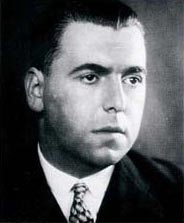
Erwin Schulhoff
1894-1942


1894-1942
Erwin Schulhoff (1894-1942) was a prolific and multi-faceted creative figure whose work embraced a full panoply of styles and influences. Like Kafka and Mahler, a German Jew in a Czech cultural milieu, the composer took full advantage of his “outsider looking in” status to forge a compelling musical personality. One of the earliest and most successful exponents of art music drawing on jazz, Schulhoff refracts multiple approaches of his time, from Dada to Expressionism, and from a distanced self-mockery to the stolid seriousness of Socialist Realism.
Life
I. Early training through WWI
Erwin Schulhoff, Czech composer and pianist of German descent, was born in Prague on June 8, 1894. Erwin’s father, Gustav, was a wool and cotton merchant who became very wealthy during World War I, only to lose his fortune to German inflation in the 1920s. During World War II, Gustav, who was Jewish, was deported to the Theresienstadt concentration camp, where he died in 1942. There were some musicians in Erwin’s family tree, most notably his great-uncle Julius Schulhoff, a piano virtuoso and composer, who taught in Dresden and Berlin, as well as his mother’s father, Heinrich Wolff, a violinist who was the concertmaster of a Frankfurt theater orchestra.
Schulhoff displayed musical talent at a very early age, picking out tunes at the piano by the age of three. Dvořák, who had little fondness for (or interest in) child prodigies, was convinced by Schulhoff’s mother to examine the young Erwin in 1901. After testing Schulhoff’s ability to recognize pitches and harmonies, Dvořák rewarded Schulhoff with two pieces of chocolate, and recommended him for private piano study with a professor at the Prague Conservatory. Schulhoff studied at the Prague Conservatory until 1906, continuing his study of piano in Vienna to 1908, and piano, theory and composition (with Max Reger) in Leipzig until 1910. His final student period was from 1911-14, in Cologne, where he studied piano (with Carl Friedberg), composition and conducting.
In addition to his formal studies, Schulhoff was especially impressed by the music of Richard Strauss and Claude Debussy. Schulhoff attended the Prague premiere of Strauss’ Salome in 1906, and many of his compositions of the next five years show some traces of Strauss’ influence. Schulhoff was liberated, both from Strauss’ influence and from a rigorous adherence to traditional compositional strictures, by his encounters with Debussy’s music in 1912. His immediate reaction was to include quartal harmonies, parallel chords and whole-tone scales in his works of early 1913, and to seek out Debussy for composition lessons. Debussy accepted Schulhoff as a student, but their collaboration was brief and unhappy, for Debussy insisted on enforcing exactly those rules that he had moved beyond in his own compositions.
The most important turning point in Schulhoff’s youth, though, was not a musical event but, rather, the First World War. Schulhoff was conscripted into the Austrian Army when war broke out and, although initially stationed in Prague, he saw action in Hungary in 1916 (where he suffered a shrapnel wound to his hand and nervous shock) and on the Russian front in 1917, as well as on other fronts through the end of the war. Schulhoff emerged from the war disillusioned and angry. Politically, he had become a committed Socialist, and musically he sought an escape from the post-Romantic language of his pre-war works.
II. Expressionism and Dada in Dresden and Berlin
After the War, Schulhoff was torn between two cities and two aesthetic attitudes. At the beginning of 1919, he moved to Dresden, where he lived with his sister, Viola, who was studying painting. The Schulhoff siblings moved in a lively circle of artists, musicians and dancers, including the painter Otto Dix, and Erwin became increasingly interested in the visual arts and in left-wing politics. Musically, he became oriented towards the freely atonal music of the Second Viennese School. Schulhoff had heard the Prague premiere of Arnold Schoenberg’s Pierrot lunaire in 1913, but became more involved with Schoenberg’s circle after the war. He struck up a friendly correspondence with Alban Berg, performed Berg’s Piano Sonata in Dresden and in Prague, and also wrote to Schoenberg and to Anton Webern. In 1919, Schulhoff began a series of concerts, presumably in imitation of the Vienna Society for Private Musical Performances, intended to promote “music of the future,” presenting works by himself, Schoenberg, Berg, and Webern as well as other modernists, including Aleksandr Scriabin and Josef Hauer. At the same time, though, Schulhoff had met George Grosz (through Dix), and became attracted to the Berlin Dada movement. Schulhoff helped to organize the first Dada event in Dresden. After marrying Alice Libochowitz in August 1921, Schulhoff moved to Berlin in early 1922, where he attempted to create musical counterparts to the scandalous provocations of Grosz (now a neighbor) and the Berlin Dadaists.
III. Prague and Jazz
Schulhoff was introduced to American ragtime, dance music and jazz by Grosz, who collected phonograph records of American music. Dance music figures in some of Schulhoff’s Dada-inspired compositions, but by the early 1920’s, jazz had become an independent source of inspiration and appeared (in various guises) in many of his works from the 1920’s. In addition to an intensified interest in jazz, Schulhoff abandoned the atonal Expressionism of the Schoenberg circle in favor of music influenced more by French neo-classicism and by Slavonic folk music. This shift in musical orientation roughly coincided with another personal transition, the 1923 return of the Schulhoffs to Prague. The next decade was a time of qualified success for Schulhoff. One the one hand, his compositions were published by Universal Edition and widely performed, and he was very active as a concert pianist. On the other, he was never financially secure, didn’t land the kind of academic position that could have made his situation more comfortable, and his opera Plameny was a failure.
Part of Schulhoff’s tenuous professional existence during this time can be attributed to his ambiguous position with respect to the Czech and German musical communities in Prague. Since the end of the War, musical life in Prague had been split between Czechs and Germans, as the Germans moved out of the Prague Conservatory and the National Theater and into parallel institutions. The German-speaking musical community also had its own music journal. Raised a German speaker, Schulhoff’s obvious place was with the German camp, and indeed, he succeeded Max Brod as the music critic of the Prager Abendblatt in 1924, and he wrote almost all of his essays in German, for Der Auftakt, Musikblätter des Anbruch, and Pult und Taktstock. Schulhoff, however, consciously saw himself as an intermediary between the German and Czech communities, albeit one who was not welcomed by either side. Schulhoff worked closely with important Czech musicians, including Václav Talich and the Zika Quartet, Czech writers, including Karel Benež and Vítĕzslav Nezval, and his only opera has a Czech libretto. Despite Schulhoff’s hopes of a position at the Akademie für Musik und Darstellende Kunst (the German equivalent of the Prague Conservatory), he was never offered work there, and the one minor teaching post that he was offered was teaching harmony and score reading at the Prague Conservatory. Schulhoff’s financial situation was further complicated by the need to provide for his son Peter, born in 1922, and the disappearance of his father’s wealth.
Despite these difficulties, Schulhoff became a well-established figure internationally as both a pianist and a composer. His concert appearances included successful engagements in Paris and London in 1927 and a tour of Germany and the Netherlands in 1930, featuring an appearance with the Concertgebouw Orchestra in Amsterdam as one of the soloists in his own Double Concerto. Schulhoff’s compositions also made regular appearances at the annual festivals of the International Society for Contemporary Music. The Zika Quartet performed the Five Pieces for String Quartet at the 1924 Festival in Salzburg, and premiered the First String Quartet at the 1925 Venice Festival. At the 1925 Prague ISCM concerts, Schulhoff not only performed his own First Piano Sonata and an early (1913) Sonata for Violin and Piano, but also played quarter-tone piano works by Alois Hába. Schulhoff’s compositions were also performed at the summer festivals of contemporary chamber music in Donaueschingen in 1924 and 1925. Schulhoff also became involved with the mechanical transmission and reproduction of sound during this time. He made his first phonograph records for Polydor in 1928, choosing to record selections from his jazz-influenced piano works. Schulhoff also worked with radio. His concerts were broadcast in Prague and London, and he was regularly heard over Prague Radio from 1930 to 1935 as half of a piano-duo that performed semi-improvised versions of popular music and jazz. In addition to his radio performances, Schulhoff wrote a piece specifically for the radio the 1930 Concerto for String Quartet and Wind Orchestra.
IV. Socialist Realism
The last decade of Schulhoff’s life was marked by declines in his professional and personal fortunes. His contract with Universal Edition, begun in 1924, was dissolved in 1931. In the first five years of the contract, Universal Edition published more new works by Schulhoff than by any other composer, but Schulhoff was too prolific for Universal’s tastes, and the composer was demanding and difficult to negotiate with. Also, Schulhoff’s belief in a synthesis of jazz and classical traditions as a way forward for modern music was no longer fashionable by the 1930s. Schulhoff had to look in many directions for income, arranging Czech classical works and writing dance music under pseudonyms, working for the radio and (more happily) appearing from 1933 to 1935 as the pianist in the orchestra of the Liberated Theater, a left-wing cabaret that produced the revues of Jiří Voskovec and Jan Werich, featuring songs by Jaroslav Ježek. Schulhoff’s family life was also deteriorating. Relations with his parents, long strained, worsened, and his mother died in 1938. Schulhoff’s wife became ill at the same time that he was involved with a student, and a difficult divorce ensued. Schulhoff remarried shortly after his mother’s death.
The greatest change in Schulhoff’s life, though, was a commitment to Marxism and Soviet Communism. Long an outspoken socialist, Schulhoff turned even farther to the left in the 1930s. In 1931, he joined the Czech “Left Front” and participated in a workers’ theater group. Schulhoff traveled to the Soviet Union in 1933 as a delegate to a workers’ theater competition, also concertizing in Moscow and Leningrad. After returning from Moscow, Schulhoff began to espouse the Soviet doctrine of Socialist Realism. The immediate musical fruit of Schulhoff’s political convictions was a setting of portions of the Communist Manifesto, in the form of a cantata for soloists, choruses and wind ensemble, composed in 1932. In addition to other explicitly communist vocal works, Schulhoff increasingly focused his compositional efforts on the symphony, producing pieces intended to be accessible, and to convey politically meaningful programs.
Schulhoff’s life in the Czech Republic quickly became endangered with the German occupation of the Czech lands in 1938 and 1939. Schulhoff, as a communist of Jewish heritage, was doubly at risk, and he began the process of emigrating to Great Britain, France or the United States. After the occupation, however, it appeared that Schulhoff’s only hope was to escape to the Soviet Union. Schulhoff applied for Soviet citizenship for himself, his wife and his son, receiving it in April 1941. Schulhoff picked up his visa to emigrate on June 13, 1941, but, with the Nazi invasion of the Soviet Union on June 22, leaving the country became impossible, and Schulhoff was arrested the next day. Unlike other well-known Czech cultural figures, like the composers Pavel Haas, Gideon Klein, Viktor Ullmann and Hans Krása (and like Schulhoff’s father), Schulhoff was arrested for being a Soviet citizen, rather than for being a Jew, and he was not taken to the notorious Theresienstadt camp. Initially held in the Prague YMCA, Schulhoff was deported to a concentration camp in Wülzburg, Bavaria, where he died of tuberculosis in August 1942.
Works
There is a range of interests, influences and preoccupations that helped to shape Schulhoff’s music. First were the compositional giants of the time: Strauss, Stravinsky, Schoenberg, Debussy and Ravel; and echoes of these composers can be heard in many places in his scores, along with references to the “locals,” Janáček, Novák and Dvořák. Notable, of course, was the composer’s use of various idioms associated with jazz. We should note that this “Euro-jazz” style of Weill, Krenek and others is always a kind of pseudo jazz since it banishes the improvisatory element (though Schulhoff was said to be a brilliant improviser himself). Attitudinally, the composer was much affected by movements such as Dada and Surrealism, lending much of his work a kind of parodic sharpness. Late in his life, with his full embrace of Communism, there is the pull of a kind of “heroic” socialist realism, when the edginess of the younger works is replaced with a kind of classicizing seriousness. However, it is a final element in the compositional mix that adds genuine power to the aesthetic project. Schulhoff, as a Czech Jew moving between cultures in Prague does a brilliant job of drawing on the astonishing musical diversity of the Hapsburg Empire to provide rhythmic vigor, varied sonorities and modalities of all sorts. Movements are marked “Alla Czeca,” “All’Slovacca,” “Zingaresca,” and Schulhoff clearly delights in providing his listeners with musical snapshots of the Empire, a combination of shorter-winded latter-day Mahler and an edgy Lehar.
Schulhoff’s catalogue also presents a fascinating menagerie of pieces which include such curiosities as a work for contrabassoon called “The Bass Nightingale,” as well as a composition for a female solo speaker which is nothing more than a series of provocative and gradually heightening moans. There are big band numbers, Czech patter songs, a “Hot Sonata” for Alto Sax and piano and a setting of the Communist Manifesto.
Indeed, it is the very fecundity and fluidity of Schulhoff’s music that sometimes lends ammunition to his detractors, who find some of the music derivative and lacking in profundity. But this is misleading. Schulhoff makes serious contributions in almost every genre. His jazz miniatures, pieces like “Susi” and “Syncopated Pete,” rank with the work of Ježek and Martinů, and demonstrate that Czech jazz-inflected art music was significant and wide-ranging. His references to local musics, such as the all’Slovacca movement from String Quartet No. 1, are convincing and not at all derivative. Indeed, though they may strike the listener first as either Janáčekian or Bartókian they are neither, but rather offer an alternative reading of music from similar sources.
Piano pieces, such as those marked “Brutal,” have a vitality and an edge that is forceful and effective, and the symphonies are varied and original, though the heroic seriousness of his socialist realist works takes some getting used to. Perhaps, though, it is in the chamber works where the composer is most relaxed, most innovative and most profound.
Stage
Die Mitschuldigen (ob, after J.W. von Goethe), 1918–20, unfinished
Ogelala (ballet mysterium) 1922–4
Die Mondsüchtige (La somnambule) (dance grotesque), 1925
Le bourgeois gentilhomme (incid music, Molière), 1926
Plameny [Flames] (op. 2, Beneš), 1927–9
Orchestral and vocal-orchestral
Symphonies
Landschaften (5 poems, after J.T. Kuhlemann), op.26, Mez, orch, 1918–19
Menschheit (5 poems, after T. Däubler), op.28, A, orch, 1919
Symphony no.1, 1924–5
Symphony no.2, 1932
Symphony no.3, 1935
Symphony no.4, 1936–7
Symphony no.5, 1938
Symphony no.6 ‘Symfonie svobody’ [Sym. of Freedom], 1940–41
Symphony no.7 ‘Eroica’, 1941 [piano sketch]; no.8, 1942, unfinished
Other orchestral
3 kusy [3 pieces], op.6, str, 1910
4 Lieder (H. Steiger: Die Garbe), op.2, string orchestra 1911
Lustige Ouvertüre, op.8, 1913
Piano Concerto, op.11, 1913–14
Serenade, op.18, 1914
32 Variationen über ein achssakliges eigenes Thema, op.33, 1919
Suite, op.37, chamber orch, 1921
Piano Concerto. [no.2], piano and chamber orchestra, 1923
Double Concerto, flute, piano, strings and 2 horns, 1927
Slavnostní predehra [Festival Prelude], 1929
Concerto for string quartet and winds, 1930
H.M.S. Royal Oak (jazz oratorio, O. Rombach), speaker, jazz singer (T), mixed chorus, jazz orch, 1930
Das Manifest (cantata with best by Karl Marx), 4vv, double mixed chorus, children’s chorus, wind orch, 1932
Other instrumental
Chamber
Melodie, violin and piano, 1903
Variationen, op.7, violin, cello and piano, 1910
Suite, op.1, violin and piano, 1911
Sonata, op.7 [sic], violin and piano, 1913
Divertimento, op.14, string quartet 1914
Sonata, op.17, cello and piano, 1914
String Quartet in, G, op.25, 1918
Sextet, 2 violins, 2 violas, 2 cellos, 1920–24
5 Stücke, string quartet, 1923
String Quartet no.1, 1924
Concertino, flute, viola and double bass, 1925
Duo, violin and cello 1925
String Quartet no.2, 1925
Divertissement, oboe, clarinet and bassoon, 1927
Sonata, flute and piano 1927
Sonata, violin and piano, 1927
Hot-Sonate, alto saxophone and piano 1930
Piano Works
Sonata, op.5, 1912
5 Vortragsstücke, op.3, 1912
4 Bilder, op.6 [sic], 1913
9 kleine Reigen, op.13, 1913
Variationen über ein eigenes Thema, op.10, 1913; 5 Impressionen, op.12, 1914
10 Variationen über ‘Ah, vous dirai-je, Maman’ und
Fuge, op.16, 1914
3 Präludien und 3 Fugen, op.19, 1915
5 Grotesken, op.21, 1917
5 Burlesken, op.23, 1918
Sonata, op.22, 1918
3 Walzer, op.24, 1918
5 Arabesken, op.29, 1919
5 Humoresken, op.27, 1919
10 Klavierstücke, op.30, 1919 [with lithographs by O. Griebel entitled Zehn Themen, 1920]
5 Pittoresken, op.31, 1919
Ironies, 6 pieces, op.34, pf duet, 1920
Musik für Klavier in 4 Teilen, op.35, 1920
11 Inventionen, 1921
Partita, 1922
Rag-music, op.41 1922
Sonata no.1, 1924
Suite no.2, 1924
Ostinato, 1925; 5 études de jazz, 1926
Sonata no.2, 1926
Suite no.3, pf LH, 1926
Esquisses de jazz, 1927
Sonata no.3, 1927
Hot-music, 10 Studies in Syncopation, 1928
Suite dansante en jazz, 1931 popular compositions for jazz pf duet
Other solo
BassnachtiGáll, 3 recital pieces, dbn, 1922
Sonate, vn, 1927
Other vocal
Single Voice with Ensemble:
3 Stimmungsbilder (H. Steiger), op.12, S, violin and piano, 1913
Die Wolkenpumpe (H. Arp), op.40, Bar, 4 wind insts, perc, 192
Ukolébavka [Lullaby] (J. Hořejší), Mez, flute, viola and cello, 1936
Zebrak [The Beggar] (melodrama, after J. Hora), narrator, flute, viola and cello, 1936
Voice and Piano:
Zigeunerlieder (A. Heyduk), op.12, S, pf, 1910–11
5 Lieder (C. Fleischler, O.J. Bierbaum, M. Dauthendey, H. Hesse, E.A. Herrmann), op.13, 1911
3 Lieder (Fleischler, D. Falckenberg, F. Alder), op.14, S, pf, 1911
3 Lieder (Das Lied vom Kinde), op.18 [sic], S, pf, 1911
Lieder (Steiger: Die Garbe), op.9, Bar, pf, 1913
3 písneĕ (O. Wilde), op.15, A, pf, 1915
5 Lieder (C. Morgenstern), op.20, Bar, pf, 1915, unfinished
5 Gesänge (Expressionen), op.32, 1v, pf, 1919
‘1917’ (P. Bezruc), song cycle, Bar, pf, 1933
Národní písneĕ a tance z Tesínska [Folksongs and Dances from the Tesínsko Region], mezzo and piano, 1936
Other solo: Sonata erotica, 1919; Sym. germanica, 1v, inst acc., 1919
‘Zum Einschlafen gibt ’s genügend Musiken’: Düsseldorf 1994
Bek, J. ‘“Alban Berg nennt sich mein neuer Freund”: Erwin Schulhoff als “musikalischer Futurist” in Dresden’, ÖMz, xlvii (1993), 469–76
Bek. J. ‘“Meine Zähne klappern im Shimmytakt”: der Komponist Erwin Schulhoff’, Fonoforum, no.6 (1994), 34–8
Bek, J. ‘Der Dresdner Aufenthalt Erwin Schulhoffs’, BMw, xxiv (1982), 112–22
Bek, J. ‘Ervín Schulhoff a avantgarda’ [Schulhoff and the avant-garde], Ĉeská hudba svĕtu, svĕt české hudbĕ (Prague, 1974), 247–68
Bek, J. ‘Erwin Schulhoff’, Musik in Theresienstadt (Berlin, 1991), 44–59
Bek, J. ‘Schulhoffovy balety’ [Schulhoff’s ballets], Taneční listy, xxx (1992), nos.7–8, p.10; no.9, p.14
Bek, J. ‘Schulhoffs Wolkenpumpe: Dada in Musik’, Der jüdische Beitrag zur Musikgeschichte Böhmens und Mährens: Regensburg 1992, 92–8.
Bek, J. ‘Schulhoffův projekt revoluční hudby’ [Schulhoff’s project to revolutionize music], HRo, xxx (1977), 504–8
Bek, J. Erwin Schulhoff: Leben und Werk (Hamburg, 1994)
Bösch, K. and I. Vojtĕch, ed.: ‘Der Briefwechsel zwischen Erwin Schulhoff und Alban Berg’, Schweizer Jahrbuch für Musikwissenschaft, nos.13–14 (1993–4), 27–78
Doubravová, J.: ‘Z rané tvorby Ervína Schulhoffa’ [From the early works of Schulhoff], HRo, xxix (1976), 281–5
Erwin Schulhoff: Cologne 1992
Forbáth, I: Ervín Schulhoff (Prague, 1946)
Gregor, V.: ‘Skladatelská tvorba Ervína Schulhoffa v dobĕ jeho ostravského působení (1935–8)’ [The compositional work of Schulhoff during the period of his activity in Ostrava], Slezský sborník, lx (1962), 397–403
Lüdke, M.: ‘Lebenssaft und Lebensnerv: Jazz im Werk Erwin Schulhoffs – zwischen Provokation und Protest’, Musik und Bildung, xxviii (1996), 37–41
Ludvová, J.: ‘Ervín Schulhoff, pianista’, HV, x (1973), 225–32 [with Ger. summary]
Musil, V. ‘Ervín Schulhoff a jeho Komunistický manifest’ [Schulhoff and his communist manifesto], HRo, xxx (1977), 512–17
Očadlík, M.: ‘Erwin Schulhoff zápasí s ideami’ [Schulhoff wrestles with ideas], Klíč, ii (1931–2), 113–17
Pukl, O: Konstanty, dominanty a varianty Schulhoffova skladebného stylu [Constants, dominants and variants in Schulhoff’s compositional style] (Prague, 1986)
Šimáková, N.: ‘Ervín Schulhoff a jeho symfonie’ [Schulhoff and his symphonies], ibid, 237–46
Stará, V. ed.: Ervín Schulhoff (Prague, 1958)
Streller, F.: ‘Erwin Schulhoffs Beziehung zu Berlin’, Studien zur Berliner Musikgeschichte: vom 18. Jahrhundert bis zur Gegenwart (Berlin, 1989), 313–20
Vojtéch, I., ed.: ‘Arnold Schoenberg, Anton Webern, Alban Berg: unbekannte Briefe an Erwin Schulhoff’, Miscellanea musicologica, xviii (Prague, 1965), 31–83
Widmaier, T. ‘Colonel Schulhoff, Musikdada: Unsinn als Ausdruck von Lebendigkeit’, NZM, Jg.155, no.3 (1994), 15–21
Widmaier, T.: ‘Dadaist mit Wolkenpumpe: zur Wiederentdeckung von Erwin Schulhoff’, NZM, Jg.152, no.11 (1991), 5–11