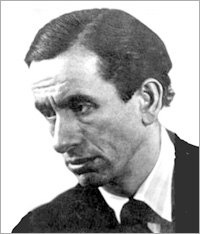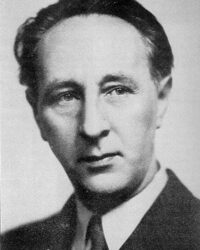
Bohuslav Martinu
1890–1959
Despite the fact he spent his last two decades in exile, Bohuslav Martinů (1890–1959) was among the most prolific composers of the twentieth century. Born in a church tower above the Czech–Moravian Highlands, he established himself in both Prague and Paris before the Nazi invasion of France forced him to flee to the United States. He became a star in the U.S. during the 1940s, but returned to Europe permanently in 1956. His folk—cantata The Opening of the Wells (1955) became enormously popular in Czechoslovakia, dealing with themes of purity, rebirth, and the pain of exile.
Life
Bohuslav Martinů was a Czech composer of Austro–Hungarian, Czechoslovak, and then American citizenship. His father’s dual occupation of fire watchman and shoemaker accounts for his childhood living atop the tower at St. Jacob’s Church in the Eastern Bohemian town of Polička. Later in life, Martinů explained the objectivity of his music from this early experience, seeing people and places only from afar. He left Polička for Prague in 1906 to study violin at the Prague Conservatory. A hopeless student, he was expelled and lived a Bohemian existence in the Czech capital, devoting his time to reading and composition. He deputized with the Czech Philharmonic before playing three seasons (1920—23) as a full member under Václav Talich.
Feeling restrained by Prague’s musical life, Martinů left for Paris in 1923 and resided there until France’s capitulation to Nazi Germany in 1940. His success in America and the uncertain situation of the Third Czechoslovak Republic (1945–48) led him to remain in New York after the end of the war. A crippling accident in 1946 and the communist coup in 1948 further discouraged him from traveling to Czechoslovakia, where, according to Soviet socialist–realist pretexts, he was quickly condemned as a formalist and emigrant traitor.
In 1952, Martinů became a naturalized U.S. citizen, prohibiting him from visiting the countries of the Soviet Bloc. His one—year engagement at the American Academy in Rome formed the pretext for him to resettle in Europe in 1956. The Paul Sacher Estate in Switzerland became his final residence; he died in nearby Liestal of stomach cancer in 1959. Work on his opera The Greek Passion, which resulted in two different versions (1957, 1959), formed the thread of his creative activity throughout his final peripatetic years.
Aesthetic Background and Early Works
Although Martinů’s stylistic development parallels the trajectory of many early twentieth–century modernists, his rationale for breaking with the Romantic tradition was grounded in the debates about Czech national music. Gaining considerable influence over Czech music criticism in the early twentieth century was the neo–romantic, socialist music critic Zdenĕk Nejedlý and his school. The Nejedlý School championed Smetana as the single point of departure (to the exclusion of Dvořák) and upheld a system of values reflecting the Wagner–Mahler trajectory.
Martinů actually contributed to this vein of national music with his patriotic cantata Czech Rhapsody (1918); composed in the jubilant atmosphere of national independence, it bears the clear influence of Smetana’s Libuše and the pathos of Mahler’s symphonies. Otherwise, his development from the 1910s onwards shows his systematic appropriation of French modernisms, beginning with Debussy and Roussel. After taking residence in Paris to study under Roussel, he was surprised by the extent of Stravinsky’s influence and a general flux in stylistic orientation due to frenetic experimentation. He became the leading Czech music correspondent in Paris, relating his discoveries about the Parisian music scene to the Czech cultural press. In his essays from this time, he frequently commented on the “outdated” and “Romantic” musical values he felt still persisted in Prague’s musical life. Among the earliest results from his Parisian years was his “orchestral–rondo” Half–time (1924), a work clearly inspired by Stravinsky’s Russian ballets. Although he defended the work from being a Stravinskian plagiarism, his polemical essays imply his desire to provoke the Czech critics with the sounds of the Parisian milieu. Half–time was premiered in Prague in December 1924 by the Czech Philharmonic under Václav Talich, who would remain Martinů’s most powerful ally at home until the fall of the First Czechoslovak Republic in 1938.
The duality of devoting his attention to cosmopolitan developments and his position at home continued throughout his life. Notable from the later 1920s is a string of Dadaist–inspired stage works that incorporate the sounds of the Parisian cabaret. His works for the Czech Theater during the 1930s culminated in his surrealist opera Julietta, or the Key to Dreams (1937), premiered under Talich at the Prague National Theater in March 1938. Dissonant neo–classicism pervades his instrumental works from the 1930s; here the eighteenth–century concerto grosso served as his guiding principle. His Double Concerto for Two String Orchestras, Piano, and Timpani (1938) forms the climax of this trajectory, a work reflecting the ominous atmosphere as Nazi forces tightened their grip on Czechoslovakia.
The summer of 1938 was his last visit to Czechoslovakia; it was due largely to the fascist and communist regimes that took control at home that he spent the remainder of his life abroad. For his patriotic cantata The Field Mass (1939), written for the Czechoslovak Army Band in France, he was black–listed by the Gestapo, who broke into Martinů’s apartment one day after he fled Paris for Southern France with his French wife Charlotte. Following six months of uncertainty, he obtained the necessary paperwork for transit via Spain and Portugal to New York, where he would work for the next thirteen concert seasons.
Years of Exile
Martinů never ranked in the top echelon of Parisian—based composers, but patronage by top musical personalities in the U.S. such as Serge Koussevitsky brought him to the forefront of the American musical world. Embraced by the major East Coast orchestras were his Symphonies Nos. 1–5, composed each year during the summers from 1942–46. His numerous new chamber works were published and received regular performances at this time. A continuously ametrical style, guided by phrasing rather than meter, forms a new characteristic in his music, an influence of sixteenth– and seventeenth–century polyphonic genres; portions of his Symphony No. 1 (1942) and The Madrigal Sonata for flute, piano, and violin (1942) can be cited as examples. Another new element is a cadential progression borrowed from his opera Julietta, which he continued to employ in numerous works until his death: the progression, often called the “Julietta Chords,” is a kind of plagal cadence from a dominant 13th chord on the subdominant to the tonic, which he often repeats immediately thereafter a whole–tone lower.
By the 1950s, he developed a more rhapsodic style in a neo–impressionistic idiom; fine examples of such works featuring an expanded orchestral palette and greater focus on instrumental texture include Fantaisies Symphoniques “Symphony No. 6” (1953), Piano Concerto No. 4 “Incantation” (1956), and Estampes (1958). His renown on the East Coast brought him to many leading music institutions as a pedagogue; by the end of his American period, he had taught at Tanglewood, Mannes, Princeton, and Curtis. A near–fatal fall from an unprotected terrace in the summer of 1946 while on staff at the Berkshire Music Festival resulted in partial deafness in one ear for the rest of his life.
His defense of French modernism in the Czech press during the inter—war years brought him into direct conflict with the Nejedlý School, but little could he have known that he was sowing the seeds for his later disenfranchisement in communist Czechoslovakia. From 1945 through the early years of communist dictatorship, Nejedlý held key positions in the cultural ministries, leaving the administration of national musical life to a third generation of Nejedlý disciples. By this time, the Nejedlý School also took their cues from the latest Soviet decrees. Martinů’s music was virtually banned during the earliest years of communist totality, and he was in official disfavor throughout the communist era. Projecting nostalgic sentiment for homeland, his seemingly innocuous folk cantata The Opening of the Wells (1955) was published in Czechoslovakia in 1955 and performed in schools throughout the country; it led to Martinů’s posthumous revival and widespread acceptance in the Czech musical community.
In 1979, Martinů’s remains were transferred with great ceremony from the Sacher Estate to Czechoslovakia for reburial in Polička. Before her death in 1978, Charlotte Martinů bequeathed the rights to her husband’s music to the Czech Music Fund. Following the 1989 Velvet Revolution, the Martinů Foundation was extracted from the Czech Music Fund; through its academic branch, the Martinů Institute, it has worked vigorously on the composer’s behalf since this time.
Although his works remain popular among performers and audiences internationally, Martinů has been slow to gain acceptance in the academic world outside of the Czech Republic. His position at the end of his life as a homeless artist without disciples in the sense of Schoenberg or Stravinsky partially accounts for this, notwithstanding the difficulties scholars faced while conducting work on the composer throughout the communist years. Provoking confusion and misunderstanding was Martinů’s emotionless exterior and reticence in public situations; he has been recently diagnosed with having suffered from a form of Asperger Syndrome. His stylistic development, embracing quotation to an increasingly refined degree, will continue to challenge scholars into the future. And the full nature of his aesthetics, growing increasingly available through translation and study, might yield invaluable insights on his contributions to music history as a whole.
By Thomas D. Svatos
Works List
Operas
Voják a tanečnice (Soldier and Dancer), comic opera in three acts (composed 1927 at Polička)
Larmes de couteau (Tears of the Knife), opera in one act (1928 Paris)
Les Trois Souhaits our Les vicissitudes de la vie (Three Wishes or Inconstancy of the Life), film–opera in 3 acts with prelude and postlude (1929 Paris).
Der Wohltätigkeitstag (Day of Kindness), opera in three acts (1931 Paris)
Hry o Marii (The Miracles of Mary) (1934 Paris)
Hlas lesa (The Voice of the Forest), radio–opera in 1 act (1935 Paris)
Veselohra na mostĕ (Comedy on the Bridge), radio–opera in 1 act (1935 Paris)
Divadlo za branou (Theatre Behind the Gate), opera–ballet in 3 acts (1936 Paris)
Julietta (Snář) (Julietta (The key to Dreams)), lyric opera in 3 acts (1937 Paris)
Dvakrát Alexandr (Alexandre Bis, Alexander Twice), opera buffa in 1 act (1937 Paris)
What Men Live By, opera–pastorale in 1 act (1952 New York)
The Marriage, Comic Opera in 2 Acts (1952 New York)
Plainte contre inconnu (Accusation Against the Unknown), Opera in 3 Acts (1953 Nice)
Mirandolina, comic opera in 3 acts (1953 Nice)
Ariane, lyric opera in 1 act (1958 Schönenberg–Pratteln)
The Greek Passion, Opera in 4 Acts (1957, 2nd version 1959)
Ballets
Noc (Night), ballet in 1 act (1914 Polička)
Tance se závoji (Dances with a Veils), meloplastic dance scenes (1914 Polička)
Stín (The Shadow), ballet in 1 act (1916 Polička)
Koleda (Christmas Carol), ballet in 4 acts with singing, dancing and recitation (1917 Polička)
Istar, ballet in 3 acts (1921 Polička, Prague)
Kdo je na svĕtĕ nejmocnĕjší? (Who is the Most Powerful in the World?), ballet comedy in 1 act (1922 Prague)
Vzpoura (The Revolt), ballet sketch in 1 act (1925 Paris, Prague)
Motýl, který dupal (The Butterfly that Stamped), ballet in 1 act (1926 Paris)
Le Raid merveilleux (The Amazing Flight), a mechanical ballet (1927 Paris)
La Revue de Cuisine (The Kitchen Revue), jazz–ballet in 1 act (1927 Paris)
On Tourne, ballet in 1 act (1927 Polička)
Check to the King, jazz–ballet in 2 act (1930 Paris)
špalíček (The Chap–Book), ballet with singing in 3 acts (1932 Paris)
Le jugement de Paris (The judgement of Paris), ballet in 1 act (1935 Paris)
The Strangler, ballet for three dancers (1948 New York)
Orchestral Symphonies
Symphony No. 1 (1942)
Symphony No. 2 (1943 Darien, Conn.)
Symphony No. 3 (1944 Ridgefield, Conn.)
Symphony No. 4 (1945 New York)
Symphony No. 5 (1946 New York)
Symphony No. 6 Fantaisies symphoniques (1953 New York, Paris)
Others
Half–time, rondo for large orchestra (1924 Polička)
Rhapsody (Allegro Symphonique), for large orchestra – H. 171 (1928 Paris)
Sinfonia Concertante for Two Orchestras (1932 Paris)
Concerto Grosso, for chamber orchestra (1937 Paris)
Double Concerto for Two String Orchestras, Piano, and Timpani (1938 Vieux Moulin, Schönenberg)
Sinfonietta Giocosa for piano and chamber orchestra – H. 282 – 1940 – Aix–en–Provence
Memorial to Lidice (1943 New York)
Thunderbolt P–47, scherzo for orchestra (1945 Cape Cod)
Toccata e Due Canzoni (1946 New York)
Sinfonietta La Jolla for piano and chamber orchestra in A major – H. 328 – 1950 – New York
The Frescoes of Piero della Francesca (1955 Nice)
The Parables – H. 367 (1958 Rome, Schönenberg)
Estampes (1958 Schönenberg)
Concertos Piano
Concertino for Piano and Orchestra – H. 269 – 1938 – Paris
Piano Concerto No. 1 in D – H. 149 – 1925 – Polička
Piano Concerto No. 2 – H. 237 – 1934 – Paris (Malakoff)
Piano Concerto No. 3 – H. 316 – 1948 – New York
Piano Concerto No. 4 “Incantations“ – H. 358 – 1956 – New York
Piano Concerto No. 5 “Fantasia concertante“ in B major H. 366 – 1958 – Schönenberg/Pratteln
Divertimento (Concertino) in G for left–hand piano and small orchestra – H. 173 – 1926, 1928 – Paris
Violin
“Concerto da Camera“ for violin and string orchestra with piano and percussion H. 285 – 1941 – Edgartown, Mass.
Violin Concerto No. 1 – H. 226 – 1933 – Paris
Violin Concerto No. 2 – H. 293 – 1943 – New York
Czech Rhapsody for violin and orchestra (see H. 307) – H. 307 A – 1945 – Cape Cod, South Orleans, Mass. (USA)
Suite Concertante for Violin and Orchestra in A major – 276 (2 versions) – 1st version: year unknown – Paris, 2nd version: 1944 – New York
Cello
Cello Concerto No. 1 (1930 Polička, 1939 Paris, 1955 Nice)
Cello Concerto No. 2 (1945 New York)
Others
Harpsichord Concerto, for harpsichord and small orchestra (1935 Paris)
Oboe Concerto (1955 Nice)
Rhapsody Concerto, for viola and orchestra (1952 New York)
Multiple Instruments
Concerto for String Quartet and Orchestra (1931 Paris)
Concertino for Piano Trio (Violin, Cello and Piano) and String Orchestra (1933 Paris)
Concerto for Flute, Violin and Orchestra (1936 Paris)
Sinfonia Concertante for Violin, Cello, Oboe, Bassoon, Orchestra and Piano (1949 New York)
Concerto for Violin, Piano, and Orchestra (1953 New York)
Concerto for Two Pianos and Orchestra (1943 New York)
Concerto for Two Violins and Orchestra in D (1950 New York)
Vocal
Polní mše (Field Mass), cantata for baritone, male chorus and orchestra (1939 Paris)
Gilgameš (The Epic of Gilgamesh), cantata for soli, mixed chorus and orchestra (1955 Nice)
Otvírání studánek (The Opening of the Springs), cantata for soli, female chorus and instrumental accompaniment (1955 Nice)
Legenda z dýmu bramborové nati (Legend of the Smoke from Potato Fires), cantata for soli, mixed chorus and instrumental accompaniment (1956 Rome)
Romance z pampelišek (The Romance of the Dandelions), cantata for mixed chorus a cappella and soprano solo (1957 Rome)
Chamber Duos
Duo No. 1 (Preludium – Rondo) for Violin and Cello
Duo No. 2 for Violin and Cello
Five Madrigal Stanzas for violin and piano H297 (1943)
Three Madrigals for Violin and Viola (1947 New York)
Trios
String Trio
String Trio No. 1, H. 136 (1923 Paris)
String Trio No. 2, H. 238 (1934 Paris)
Piano Trio
Piano Trio No. 1, H. 193 (1930 Paris)
Piano Trio No. 2 in D minor, H. 327 (1950 New York)
Piano Trio No. 3 in C major, H. 332 (1951 New York)
Bergerettes, five pieces for piano trio, H. 275 (1939 Paris)
Two Violins and Piano
Sonatina for Two Violins and Piano, H. 198 (1930 Paris)
Sonata for Two Violins and Piano, H. 213 (1932 Paris)
Flute, Violin and Keyboard
Sonata for Flute, Violin and Piano, H. 254 (1937 Paris)
Promenades for Flute, Violin and Harpsichord, H. 274 (1939 Paris)
Madrigal–Sonata for Flute, Violin and Piano, H. 291 (1942 New York )
Other Trios
Serenade No. 2, for two violins and viola, H. 216 (1932 Paris)
Trio for Flute, Violin and Bassoon, H. 265 (1937 Nice)
Four Madrigals, for oboe, clarinet and bassoon, H. 266 (1938 Nice)
Trio for Flute, Cello and Piano, H. 300 (1944 Ridgefield, Conn.)
Quartets
String Quartets
String Quartet No. 1 (1918 Polička)
String Quartet No. 2 (1925 Paris)
String Quartet No. 3 (1929 Paris)
String Quartet No. 4 (1937 Paris)
String Quartet No. 5 (1938 Paris)
String Quartet No. 6 (1946 New York)
String Quartet No. 7 Concerto da camera (1947 New York)
Three Riders, H. 1 (1902 Polička)
String Quartet, H. 60 (1912 Polička)
Two Nocturnes, H. 63 (1912 Polička)
Andante, H. 64 (1912 Polička)
String Quartet in E–flat minor, H. 103 (1917 Polička)
Oboe Quartet (oboe, violin, cello, and piano) 13‘
Mazurka–Nocturne (oboe, 2 violins, cello) 7‘
Piano Quartet
Quintets
Serenade (violin, viola, cello, & 2 clarinets)
String Quintet (2 violins, 2 violas, and cello) 18‘
Piano Quintet No. 1, H. 229 (1933 Paris) 19‘
Piano Quintet No. 2, H. 298 (1944 New York)
Piano Quintet, H. 35 (1911 Polička)
Sextets
Musique de Chambre No. 1 (violin, viola, cello, clarinet, harpe, and piano) 18‘
Septets
Fantasia (for theremin –also played with Ondes Martenot– with oboe, string quartet and piano)
Nonets
Nonet No. 1, for string trio, wind quintet, and piano (1925 Paris)
Nonet No. 2, for string trio, double bass, and wind quintet (1959 Schönenberg)
Stowe pastorals, nonet for five recorders, clarinet, two violins and violoncello, H. 335 (1951 New York)
Instrumental
Violin and Piano
Violin Sonata in C major (1919)
Violin Sonata in D minor (1926)
Violin Sonata No. 1, H. 182
Violin Sonata No. 2, H. 208
Violin Sonata No. 3, H. 303
Czech Rhapsody for Violin and Piano, H. 307
Cello and Piano
Cello Sonata No. 1, H. 277 (1939 Paris)
Cello Sonata No. 2, H. 286 (1941 Jamaica, Long Island)
Cello Sonata No. 3, H. 340 (1952 Vieux–Moulin)
Ariette, H. 188B (1930 Paris)
Nocturnes, H. 189 (1931 Paris)
Pastorals, H. 190 (1931 Paris)
Miniature Suite, H. 192 (1931 Paris)
Seven Arabesques, H. 201 (1931 Paris)
Variations on a Theme of Rossini, H. 290 (1942 New York)
Variations on a Slovak Folk Song, H. 378 (1959 Schönenberg–Pratteln)
Other Instrumental Works
Viola Sonata (1955), H. 355
Flute Sonata (1945), H. 306
Scherzo for Flute and Piano
Clarinet Sonatina, H. 356
Trumpet Sonatina, H. 357
Harpsichord Sonata
Deux Pieces pour Clavecin (harpsichord) (1935 Paris)
Piano
Sonata for Piano, H. 350 (1954 – Nice, France)
Loutky (Puppettes) (3 books, numbered by Martinů in reverse chronological order) [1]
Loutky I, H. 137 (1924 – Polička, Czechoslovakia/Paris, France)
Loutky II, H. 116 (1918 – Polička, Czechoslovakia)
Loutky III, H. 92 (1914 – Polička, Czechoslovakia)
Etudes and Polkas, H. 308 (1945 – South Orleans, Cape Cod, MA, USA) [3 books]
Dumka (unnumbered), H. 4 (1909 – Polička, Czechoslovakia)
Dumka No. 1, H. 249 (1936 – Paris, France)
Dumka No. 2, H. 250 (1936 – Paris, France)
Dumka No. 3, H. 285bis (1941 – Jamaica, NY, USA)
Bibliography
Beckerman, Michael. Martinů’s Mysterious Accident: Essays in Honor of Michael Henderson. Pendragon Press, 2008.
Březina, Aleš; Nekvasil, Jiří. Martinů and America. Documentary film. Prague: Czech Television, 2000.
Crump, Michael. Martinů and the Symphony. Toccata Press, forthcoming.
Halbreich, Harry. Bohuslav Martinů – Werkverzeichnis und Biografie. Zweite, revidierte Ausgabe. Mainz: Schott Music, 2007.
Large, Brian. Martinů. London: Gerald Duckworth & Co Ltd, 1975.
Martinů, Bohuslav. Domov, hudba a svĕt [Homeland, Music, and the World]. Ed. Miloš Šafránek. Prague: Státní hudební vydavatelství, 1966.
_______. Martinů’s Letters Home: Five Decades of Correspondence with Family and Friends. Ed. Iša Popelka. Toccata Press, forthcoming.
Mihule, Jaroslav. Martinů: osud skladatele [Martinů: The Fate of a Composer]. Prague: Nakladatelství Karolinum, 2002.
Mucha, Jiří. Podivné lásky [Strange Loves] . Prague: Mladá Fronta, 1988.
Renton, Barbara. “Martinů in the United States: Views of Critics and Students.” Bohuslav Martinů Anno 1981: Papers from an International Musicological Conference. Ed. Jitka Brabcová. Prague: Česká hudební společnost, 1990, 268–276.
Rentsch, Ivana. Anklänge an die Avantgarde. Bohuslav Martinůs Opern der Zwischenkriegszeit. Stuttgart: Franz Steiner Verlag, 2007.
Rybka, F. James. A Composer’s Mind — Bohuslav Martinů and his American Friends, forthcoming.
Rybka, F. James; Ozonoff, Sally. “Martinů’s ‘Impressive Quiet.’” The Journal of the Dvořák Society for Czech and Slovak Music. 23 (2003—4): 31—49.
Smaczny, Jan. “Martinů.” The New Grove Dictionary of Music and Musicians. Second Edition. Ed. John Tyrrell. London: Maxmillan Publisher Limited, 2001.
Svatos, Thomas D. “A Clash over Julietta: The Martinů/Nejedlý Political Conflict and Twentieth—Century Czech Critical Culture.” ex tempore (2010).
_______. Martinů on Music and Culture: a View from his Parisian Criticism and 1940s Notes. Ph.D Dissertation. UC, Santa Barbara, 2001.
_______. “Reasserting the Centrality of Musical Craft: Martinů and his American Diaries.” The Musical Times 2 (2009): 55—70.
_______. “Sovietizing Czechoslovak Music: The ‘Hatchet—Man’ Miroslav Barvík and his Speech The Composers Go with the People.” Music and Politics. Winter (2010).
Šafránek, Miloš. Bohuslav Martinů: His Life and Works. Tr. Roberta Finlayson–Samsourová. London: Allan Wingate, 1962.
_______. Bohuslav Martinů: The Man and his Music. London: Dennis Dobson Limited, 1946.
_______. Divadlo Bohuslava Martinů [Bohuslav Martinů’s Theater]. Prague: Editio Supraphon, 1979.