The situation of composers who became former Polish citizens in September 1939 was defined by general policies and new jurisdictions introduced by the Nazi and Soviet authorities. Poland disappeared from the maps in 1939, divided into three parts: the General Government under German civil administration and military occupation, the Third Reich–incorporated territories and the USSR–annexed territories. The approaches to the inhabitants of these regions varied, yet their common feature was terror, directed first of all towards the intelligentsia. In the part of Poland that came under Soviet rule, arrests by the NKVD and deportations to Siberia were means of grasping control of the Polish population, but until June 1941, when these territories were seized by the Third Reich and incorporated into the General Government District of Galicia, musical institutions and schools still operated, even though their functioning was adapted to Soviet models and the most important positions were given to those who were willing to collaborate with the new regime.
To Nazi ideologists, from Hitler, Himmler and Goebbels on down, Polish culture, education and science were obvious impediments to the plan that aimed at the degradation and transformation of the Polnische Bevölkerung (Polish population) into a docile mass labor force. In a speech on 24 October 1940, Hitler explained that “all representatives of Polish intelligentsia should be extinguished” because “this is the law of life”. 1 In order to prove that the occupied country had no culture or national identity and to make it into an “intellectual desert” (in the words of General Governor Hans Frank), universities and high schools were closed for Polish students and professors; independent Polish newspapers and periodicals were banned and replaced by German propaganda newspapers in Polish; and musical and cultural institutions, such as orchestras, choirs, the radio and music associations were closed down. Classical music publishing and performances of Polish music (e.g., Chopin and Paderewski) were banned in the first year of the occupation, and monuments representing great figures in Polish culture were destroyed. In May 1940, for instance, the famous Chopin monument in Warsaw's Łazienki Park was knocked down and the park was reserved “for Germans only.”
Thus, in September and October 1939 composers – former Polish citizens who found themselves under the Nazi occupation – lost their sources of income as music critics, teachers at conservatories, conductors, artistic directors, music editors or simply as composers, by having their works performed. The careers of numerous talented composers of popular music also came to an abrupt end: they no longer received commissions from the Polish Radio, cabarets and theaters or for the previously flourishing recording and film industries (e.g., the famous “Syrena Record” company), because all of these organizations had been shut down.
In the Reich–incorporated territories the main goal of the Nazis was to Germanize the population or relocate it in the General Government. Composers from the most important music centers such as Poznań and Łódź, which now belonged to the Warthegau or other Reich provinces, were mainly forced to depart, but in some instances they were arrested or interned in camps. Wacław Gieburowski (1878–1943), a priest and composer and the conductor of a renowned Cathedral Choir in Poznań, was arrested by the Gestapo in 1939, then released, and died in Warsaw. Jerzy Młodziejowski (1909–1985), a composer, conductor, writer on music, photographer and alpinist, took part in the September Campaign and from 1940 to 1945 was a prisoner in Woldenburg (Dobiegniew) oflag, where he conducted a prisoners' orchestra and a men's choir and composed. Zygmunt Mycielski (1907–1987), a composer and music critic who had studied with Paul Dukas and Nadia Boulanger, and who was the descendant of a noble family, took part in the September campaign and fought in France in 1940. As a Polish soldier, he found himself in a stalag, and then was sent to forced labor on a German farm. He nevertheless composed Fiat voluntas Tua, offertoire pour deux violoncelles et piano ou orgue (1943), and Five symphonic sketches (1945).
Composers from Poznań (renamed Posen) for the most part headed towards Warsaw or Cracow or hid elsewhere. Tadeusz Zygfryd Kassern (Lvov 1904–New York 1957), who, until 1939, had worked as a lawyer in the general prosecutor's office in Poznań and as a music critic in Nowy Kurier (1929–33) and Dziennik Poznański (1934–38), while maintaining quite a successful composing career, was evacuated to Lvov in August 1939, which he left in 1940 for Cracow, where he found work at a Gebethner and Wolff bookstore. As he was wanted by the Gestapo because of his Jewish origins, he moved to Warsaw, where he hid under the name of Teodor Sroczyński. During the war he composed several works, including a Concertino for piano and orchestra (1940), a Concerto for string orchestra, piano sonatinas, a Children's Suite for two pianos, and songs. Stanisław Wiechowicz – a widely respected composition professor at Poznań conservatory, author mainly of choral music (he later composed a mournful Letter to Marc Chagall, 1961), moved at first to Warsaw, then to a remote locality, where he was hired officially as an office clerk on his friends' forest property. Extermination was the principal method used for composers who were seen by the Nazis as being linked to patriotic activities or Polish cultural institutions in the territories, which they wanted to become ethnically “cleansed”. The talented Silesian composer Jan Sztwiertnia (1911–1940), who perished in the Mauthausen–Gusen concentration camp in Austria, was an early victim of these persecutions.
After the Wannsee conference in January 1942, most Polish–Jewish composers were murdered in the genocide conceived as the “Final solution to the Jewish question”, where the category of “Jew” was defined acccording to the German Nuremberg Laws. Whole generations of Polish musicians of Jewish origin were killed by the Nazis, unless a member of a family was abroad or survived in hiding. An example is the history of the Kagan and Górzyński (Grünberg) families. Of the four Kagan brothers born in Nowogródek (now Navahrudak in Belarus) as sons of Mordechai and Sara (née Kantor), the eldest, Mieczysław (born in 1887; he changed his name to Kochanowski), a conductor and composer of dance music, was murdered in May 1943 in the Gestapo interrogation prison at Szucha Avenue in Warsaw, where the arrested were routinely cruelly tortured and often killed. The youngest brother, Alexander (born in 1906), survived the war as a soldier in the Polish Army in France and was interned in Switzerland. Jakub Kagan (1896–1941), a composer of dance music, pianist, conductor, and jazz musician, who took part in the 1920 Polish–Soviet war, was the author of several pre–war hits, such as Złota pantera (Gold Panther, 1929), to words by Andrzej Włast (1895–1942?); he was forced to move to the Warsaw ghetto in 1941, where he performed as a pianist at the Splendid Café and Melody Palace Theater, and where he was killed by the Nazis, probably in 1942. The fourth brother, Feliks (who had changed his name to Kochański) also perished during the war (see Tomasz Lerski, Syrena Record. Pierwsza polska wytwórnia fonograficzna 1904–1939, Editions ”Karin”, New York – Warsaw 2004: 661–662).
Among the three sons of a music teacher in Cracow, the eldest, Władysław Górzyński (orig. Adolf Grünberg, composer and conductor, born in 1887), went into hiding during the war and survived. His three sons and wife died during the Warsaw Uprising in 1944. His younger brother, Zdzisław Górzyński (1895–1977), an outstanding Polish conductor who had worked at the Warsaw Opera House, in Lvov and at other theatres, directed the Small Orchestra of Polish Radio from 1935 to 1939. During the war, he hid under the very Polish name of Jan Zbigniew Michalczyk, survived by giving music lessons and accompanied clandestine concerts. He was under the care of composers who belonged to the clandestine Music Council (especially composer Piotr Perkowski and his sister, Felicja Krysiewicz). The youngest brother, composer Tadeusz Górzyński (born in 1899), who studied violin in Cracow, conducting and composition in Vienna, and was for many years president of the Warsaw Association of Musicians, was arrested and sent to the Nazis' Majdanek concentration camp. He was forced to work on the construction of the camp, and he died of typhoid fever in 1942 (Lerski 2004: 642–3).
Some of the composers imprisoned in the Warsaw and Łódź ghettos tried to earn their living through any possible form of musical activity under these tragic circumstances; these included Marian Neuteich, Adam Furmański, David Bajgelman, David Laks, Marian Altenberg, Artur Gold and several others. They perished in the ghettos and death camps (Treblinka and Auschwitz, primarily). Władysław Szpilman, probably the only composer in the Warsaw ghetto who survived the war, was helped by fellow musicians, including the composer Piotr Perkowski and the singers Andrzej Bogucki and Zofia Godlewska. An eminent composer from Lvov, Józef Koffler, the first Polish twelve–tone composer, was killed with his wife and small son somewhere in the former Polish territory. Those who stayed (Jakub Mund, Emmanuel Schlechter and Zygmunt Schatz) died in the ghetto or the Janovska camp. Other Polish composers from Lvov died as a result of other German persecutions: Alfred Stadler (1889–1944) was executed as a hostage and Wiktor Hausman (1893–1943) was executed at Warsaw's Gęsia Street prison. Mieczysław Krzyński (1901–1987) was imprisoned in the camps of Auschwitz and Sachsenhausen but survived.
In contrast to the territories annexed to the Reich, musical activity for Poles was allowed in the General Government, although Hans Frank confined it to “some forms of primitive entertainment” in the cafés, under such conditions as registration and special renewable permission (the Erlaubniskarte), and only after the acceptance of a concert program by Nazi censors. In the NSDAP document, Die Frage der Behandlung der Bevölkerung der ehemaligen polnischen Gebiete nach rassenpolitischen Gesichtspunkten (The Question of Dealing with the Population of the Former Polish Territory from the Racial–Political Point of View), of November 1939, in the section entitled Treatment of Poles and Jews in the Remaining [part of] Poland [i.e., General Government], the following guidelines are presented: “Cafés and restaurants, although they were often the meeting points of nationalistic and intellectual circles in Poland, should not be closed, as control over them seems to be easier than over the private gatherings of conspirators, as would necessarily have happened and in which Polish history so abounds.”
This method was diligently applied. Cafés were closed if they broke the censorship rules (as was the case with the Café Zachęta, where a concert program featured Polish compositions), or because at a certain point it was useful for the policy of terror and intimidation exercised by the Nazi authorities. At one of the first cafés, the Arkadia, which opened in occupied Warsaw at the end of 1939 in what was left of the Warsaw Philharmonic building (most of it had been destroyed in bombing raids in September, with the musical scores and instrument collections), and which was a center of right–wing nationalistic underground activity, everybody present was arrested on 5 December 1940. Some of the café's visitors and employees were executed, others were sent to concentration camps. Composer and pianist Henryk Gadomski (1907–1941), although he had nothing to do with the clandestine activities there, was transported to Auschwitz on 6 January 1941, where he perished the same year. His compositions were destroyed during the war. 2 Composer Bronisław Onufry Kopczyński (1916–1943), known for his anti–Semitic views and actions before the war, and who was linked during the war to right–wing underground organizations, was arrested by the Gestapo in January 1943 and died at the Majdanek camp in April of that year. Some composers survived thanks to their profession: Szymon Laks, arrested in France and transported to Auschwitz because of his Jewish origins, and Adam Kopyciński, both conducted orchestras at Auschwitz.
It was also at a café – the Lira at Szpitalna Street 5, opened by Piotr Perkowski – that the above–mentioned clandestine Council of Musicians was founded as one of many underground institutions. Its goals were to counteract the effects of Nazi policies. Different subsections served various aims: the organization of clandestine musical life (concerts in private apartments were organized in order to avoid censorship and perform Polish music, especially Chopin); the organization of classical music concerts at cafés; the commissioning of special songs for the underground Home Army (such songs were eventually composed by Witold Lutosławski, Andrzej Panufnik and others); music education; and financial support and help for musicians in hiding.
Thus, several composers performed at the Warsaw cafés, as it was almost the only possibility of work for a musician – apart from private teaching and playing at funerals or in churches . 3 Musicians who played in institutions established by the Nazis in the fall of 1940, such as the Theater der Stadt Warschau (Theatre of the City of Warsaw, which occupied the Teatr Polski), and the Orchestra of the General Government in Cracow, were either collaborationists or had no other choice and were sanctioned by the clandestine Council of Musicians because they were endangered themselves or had to protect a husband or a wife of Jewish origin). This was the case of Walerian Bierdiajew, who conducted at the Theater der Stadt Warschau.
The most ambitious venue was the café tellingly named “Home of Art” (“Dom Sztuki”) — in the absence of the Philharmonic, Opera and radio concert halls; it was organized by the composer Bolesław Woytowicz (1899–1980), who had been professor of piano at the Warsaw Conservatory before the war. This café's programs even featured newly composed chamber and solo works by Woytowicz himself and other jobless composers, such as Grażyna Bacewicz, Roman Palester (1907–1989), Lutosławski, Kisielewski and Kazimierz Wiłkomirski.
Some composers were imprisoned for a time at the Pawiak prison: Woytowicz was arrested on 22 May 1943 and released a month later; Palester was arrested in 1940 and held for about six weeks; Lech Miklaszewski (1910–1992), also arrested in 1940, was imprisoned there for six months; and Wacław Gajdziński was sent from the Pawiak prison on 24 May 1944 to Stutthof, where he died.
Witold Lutosławski performed mainly at cafés in a piano duo with Andrzej Panufnik, playing mostly arrangements of standard repertoire – first at the Aria café, sometimes accompanying soloists; then at U Aktorek (At the Actresses'); and, beginning in 1942, at Sztuka i Moda (Art and Fashion). The only surviving composition from that experience is Lutosławski's flamboyant Variations on Paganini (1941), for two pianos; other pieces were improvised, or else they perished in the Warsaw Uprising of 1944 and in the subsequent burning of the city by the Nazis. During a roundup, when all the visitors and staff were arrested and sent to the Pawiak prison, Panufnik and Lutosławski were released thanks to the intervention of the café's owner. During the war, Lutosławski also composed Two Studies for Piano (1940–41) and the Trio for oboe, clarinet and bassoon (1944).
In Cracow, which was much more tightly controlled, a café, Kawiarnia Plastyków (Café of Artists), was where Polish musicians could perform for Polish audiences, independent of the Nazis (except for the censorship, to be sure). As late as 14 April 1942, Jan Ekier gave a piano recital there, but two days later 198 artists and others were arrested and locked up in the Montelupi prison. On 24–25 April they were deported to Auschwitz (numbers 32489 – 32586 and 33091 – 33190). On 27 May 168 of these people were shot.
Composer Ludomir Marczak (1907–1943), linked to the underground Robotnicza Partia Polskich Socjalistów (Polish Socialist Workers Party), was arrested in November 1943, together with thirteen Jews whom he had hidden in a specially built shelter at Świętojerska Street. They were taken to the Pawiak prison and executed. Jadwiga Sałek–Daneko (pseudonym “Kasia”, 1911–1943), who actively took part in transferring people from the ghetto into hiding, was also arrested there and was then tortured and executed. They were posthumously awarded the medal “Righteous Among the Nations.”
In 1943, although the terror intensified, the Nazi Propaganda Office became more liberal towards music performances. This trend was even stronger in 1944, when, in the face of military defeats on all fronts, some of the Nazi authorities tried to gain some influence in Polish society by liberalizing cultural policies, and the Rada Naczelna Opiekuńcza – charitable council – was allowed to organize symphonic concerts in the conservatory building. Andrzej Panufnik's “Tragic” Overture (1942) was premiered there.
Some composers actively took part in the Warsaw Uprising as soldiers of the Home Army. Wawrzyniec Żuławski (1916–1957), a gifted writer, musicologist and critic, who had studied composition, philosophy and musicology in Warsaw until 1939 (and who was one of Poland's finest alpinists), was active in the underground and then fought in the Uprising under the pseudonym Jerzy Koryciński, in the “Odwet” Home Army battalion. During the war he composed a Partita for piano (1941), a Concertino for violin and string orchestra (1942), a Prelude and Fugue for string quartet (1942) and a Piano Quintet (1943).
Some composers were killed during the Uprising, either as soldiers or civilians. The most outstanding of them was Roman Padlewski (1915–1944), who was also a violinist, pianist, conductor and music critic; he was shot in the back by a German soldier on 14 August 1944 while attempting to disarm a Goliath tracked mine. He had been active in the underground Musicians Council and had composed several works: Songs to poems by Jerzy Liebert for soprano and orchestra (1942), a Violin Concerto (1944), an orchestral setting of J. S. Bach's Toccata and Fugue in D minor and D major (1943), as well as an uncompleted Third String Quartet (1944). Several of this composer's pre–war works perished, probably during the Uprising or afterwards, in Warsaw, which had been set on fire by Nazi squads. His Second String Quartet (1942) was preserved only thanks to the action of the Clandestine Musicians' Council, which chose the most valuable works composed during the war, microfilmed them and secretly sent them by plane to London, as it was rightly feared that they might not be preserved under the tragic wartime conditions.
Bronisław Wolfstahl (1883–1944), a conductor, pianist and composer who had studied in Vienna, Leipzig and Berlin and had conducted in Lvov, at the Vienna Volksoper, the Warsaw Opera House and the Warsaw Philharmonic, was murdered on 5 September 1944 in the Wola quarter, where, a month earlier (5–7 August), during the massacres of civilians by Nazi squads under the command of Heinz Reinefarth (1903–1979), approximately 59,400 people were killed.
After the Warsaw Uprising, some composers were sent to camps – among them, Andrzej Markowski (1924–1986), who fought in the Uprising and was then prisoner of the Murnau oflag, Edward Bury (1919–1995), Tomasz Kiesewetter (1911–1992), Stefania Allinówna (1895–1988) and – one of the youngest – Tadeusz Baird (1928–1981), who began to study composition during the war (with Bolesław Woytowicz and Kazimierz Sikorski) and was only sixteen when he was deported to Germany; there he had to work in the fields and constructing fortifications. After his attempt to escape failed, he was imprisoned by the Gestapo, went through concentration camp, misery, hunger, serious illness and long months of convalescence.
Not all of the Polish composers who fell victim to the Germans' ruthless extermination policies could be named here. The individual stories that have been described are only emblematic of the fate of Polish society as a whole, which was decimated and torn apart by the invaders. Only through grim determination and tremendous energy was Poland once again able to become a major center of musical activity after the most devastating war in its, and Europe's, history.
—————-
1. Quoted from: Adam Basak, Eksterminacja inteligencji jako metoda ludobójstwa. Polskie doświadczenia a praktyka kodyfikacyjna i orzecznictwo w sprawach zbrodni hitlerowskich [Extermination of intelligentsia as a method of genocide. Polish experiences versus jurisdiction concerning Nazi crimes], Acta Universitatis Wratislaviensis. Studia nad Faszyzmem i Zbrodniami Hitlerowskimi, Karol Jońca (ed.), Vol. 14, Wrocław 1991, p. 285. ↑
2. He graduated from conducting class at the Warsaw Conservatory in 1931 and then earned his living as a composer of incidental music for several Warsaw theaters. His compositions for symphony orchestra were performed at the Polish Radio and Warsaw Philharmonic (Tryptyk) and Warsaw Opera House (Ludowe Tańce). He was also the author of songs and of music for piano. O.B., Pamięci Henryka Gadomskiego [To the Memory of Henryk Gadomski], Ruch Muzyczny 1946, No. 20/21, p. 30. ↑
3. Read also Richard C. Lukas, The Forgotten Holocaust. The Poles under German Occupation 1939–1944, Hippocrene Books, New York 1986, p. 105: ”German authorities allowed Poles to attend only third–rate theatrical productions, often pornographic in nature. Since the Union of Polish Stage Artists forbade its members to perform in German–controlled theaters, this meant that actors and actresses frequently became singers or gave recitations at coffee houses where people drank ersatz coffee and ate minuscule pastries”. ↑
There is a small town about an hour's drive northwest of Prague, close to the convergence of the Labe (in German, Elbe) and Ohře (Eger) rivers; it was originally called Theresienstadt. Built by the Hapsburg Emperor Joseph II in 1780 and named for his mother, the Empress Maria Theresa, it was designed to protect Prague from a potential attack by Frederick the Great of Prussia. The complex consisted of a small fortress on one bank of the Ohře and a garrison town on the other. The town itself, called the Big Fortress, contained three large military barracks (Sudeten, Brandenburg and Magdeburg) and was partially walled; altogether it could easily accommodate about 6,000 people. By the beginning of the twentieth century Theresienstadt was obsolete as a military bastion, the Little Fortress serving only as a maximum security prison (Gavrilo Prinzip, whose assassination of the Austrian Archduke Francis Ferdinand provided the catalyst for World War I, was imprisoned there). When Czechoslovakia became a republic after World War I, the town's name was officially changed to the Czech equivalent, Terezín.
After the Nazi invasion of Western Europe in May 1940, Jews in the occupied countries, like those in Germany and in occupied Eastern Europe, immediately began to be persecuted. During 1941 the outside world became increasingly alarmed by the Nazis' wholesale arrests and transport of the occupied western countries' Jewish populations to unknown destinations of “resettlement” in the East. To counter this all too correct impression, the Nazis decided to create a propaganda façade: a town in a picturesque area where Jews could be observed living “normal” lives within their own close-knit community – a community that just happened to include the intellectual and artistic cream of European Jewry. Terezín was chosen for this because it could accommodate a large number of people and because it was ideally situated to become a secondary transit camp for those being shipped to extermination in the east. In 1941 the Nazis changed the town's name back to Theresienstadt, evacuated its inhabitants and, in late November, began transporting Czech Jews there.
The first transport arrived on 24 November and consisted of Aufbaukommando, young men assigned to complete preparations for housing a large number of people, including the completion of the wall around the town. Among these were the prominent choral conductor and pianist Raphael Schaechter and the pioneering theatrical director Karel Švenk. Informal evenings of music making began in the barracks virtually immediately, with the inmates singing folksongs together, an activity that may have been organized by Schaechter (Karas, 13). Other transports, filled with children and elderly people, arrived on 30 November and 2 December, and a second transport of Aufbaukommando (some of whom managed to bring instruments) arrived on 4 December. The first documented concert occurred shortly thereafter, perhaps as early as 6 December, in the Sudeten barracks. (The program, dated 6 December 1941, was typed at some point after the concert; at least one survivor, Kurt Maier, believed that the actual date was a week or so later. See Karas, 13.) Thereafter, evening musical activities steadily increased as more and more of Czechoslovakia's finest musicians arrived in the steady stream of transports. On 28 December the Nazis officially recognized these previously secret concerts as Kameradschaftsabende (evenings of fellowship). After all, what could be more normal in a “normal” town than to have evening concerts?
Schechter was thus able to begin a thorough organization of choral and other musical activities, and early in 1942 he produced a cabaret show with Karel Švenk called The Lost Food Card. The highpoint was the show's finale, a new composition by Švenk entitled “Terezín March”. It quickly became known throughout the ghetto and would appear in all subsequent shows produced by Švenk in Theresienstadt. The tune was easy to remember and the text uplifting:
Everything goes, if one wants,
United we'll hold our hands.
Despite the cruel times
We have humor in our hearts.
Every day we go on
Moving back and forth,
And can write letters in only thirty words.
Hey! Tomorrow life starts over,
And with it the time is approaching,
When we'll fold our knapsacks
And return home again.
Everything goes, if one wants,
United we'll hold our hands
And on the ruins of the Ghetto we shall laugh.
(Uncredited translation in Karas, 14-15)
This song, which not only spoke directly to the inmates' predicament but also insisted on a hopeful future, matched in style, tone and content earlier songs written in Nazi concentration camps: “Die Moorsoldaten” (written in Börgermoor by Rudi Goguel, Johann Esser and Wolfgang Langhoff, 1933), “Buchenwald Lied” (written in Buchenwald by Hermann Leopoldi and Fritz Loehner-Beda, 1938) and “Dachau Lied” (written in Dachau by Herbert Zipper and Jura Soyfer, 1938). “Die Moorsoldaten” circulated outside the camps in Germany during the 1930s, and some inmates (including Leopoldi and Zipper) were released from camps and expelled from Germany during that period, so it is possible that Švenk could have known one or more of these songs.
With the continued influx of musicians and the establishment, later in 1942, of the Freizeitgestaltung (Administration of Free Time Activities), choral activities blossomed. Schaechter added a women's chorus to the original male chorus organized in the Sudeten barracks. These groups could be put together to form a mixed chorus, but in that configuration occasionally had to be rehearsed outdoors because the approved rehearsal space, in the Sudeten barracks basement, was too small to accommodate everyone and other facilities were not always available (Krasa, interview of 8 February 2003). Further, at this time there was no piano in the ghetto, so Schaechter had to conduct rehearsals using a pitch-pipe. Throughout 1942 circumstances for music-making gradually improved, first with the securing of a reed organ and accordion (both only partly functional) and then thanks to the secret procurement of a piano, which was found outside the town and smuggled into the ghetto at night. It was missing legs and a couple of strings but was useable.
Encouraged by Schaechter, other choral ensembles were developed according to need: Rudolph Freudenfeld continued the children's chorus he had begun at the Prague Jewish orphanage; Karel Berman started a girls' chorus; Karel Vrba conducted a boys' choir; the Viennese Siegmund Subak formed a choir for liturgical and other specifically Jewish music. And, lastly, there was Karl Fischer's German oratorio chorus, which managed to present highly successful performances of Haydn's Die Schöpfung (The Creation) and Mendelssohn-Bartholdy's Elijah. Henry Oertelt, a member of this choir, wrote afterwards that he was not only struck by the fact that a work by the “racially” Jewish Mendelssohn could be performed but also by the attendance of numerous Nazi officers (Strimple, 110). In Theresienstadt, Nazi officials allowed the inmates to perform whatever they wanted, including secular and liturgical works by Jewish composers (Mahler, Schoenberg, Bruno Walter and others) and other “degenerate” music as well, including jazz. Most interesting, as exemplified by Die Schöpfung, the Theresienstadt inmates were also allowed to play German music, an activity expressly forbidden to the Jüdische Kulturbund in Germany during the 1930s. In all, Joža Karas identified at least eight choirs, in addition to Schaechter's choruses, Švenk's cabaret ensembles and ad hoc choruses in the various children's barracks, and commented that: “little is known about the activities of [these] groups, whose existence is documented through extant posters. Some of them sang mainly for their own enjoyment and for the most immediate neighborhood.” (Karas, 25)
There was an urgent need for repertoire. In some cases inmates, brought music with them or found it in the Theresienstadt town library. Raphael Schaechter apparently reconstructed Smetana's The Bartered Bride from memory; Karel Berman taught his girls classic works of the Czech treble choir repertoire from single copies (Berman, interview of 9 November 1989). Pre-existing rounds in Hebrew, Czech and German (many of them patriotic or Zionist in nature) were taught by rote to the children in their barracks. As early as December 1941, Schaechter had been joined in Theresienstadt by the brilliant young pianist and budding composer Gideon Klein (1919-1945), who assisted first by making arrangements of folksongs for various choral configurations and later, in 1943, by composing three of the most original, worthwhile and difficult choral works produced in Theresienstadt: the two madrigals on texts by Friedrich Hölderlin and François Villon, and the male chorus Prvni Hřich (The First Sin), on a Moravian folk text [see below]. Schaechter also provided folksong arrangements, as did Bernard Pollak, Karel Berman, Karel Vrba, Zikmund Schul and, later, Viktor Ullmann. Because paper, especially manuscript paper, was scarce, only one copy — if any — of an arrangement could be made; sometimes the arrangement existed only in the head of its composer. The music was always taught by rote, which may account for the large number of canonic arrangements. (Lewin, interview of 17 May 1991; Kleinová, interview of 17 July 1990; Viktor Ullmann also commented on this in one of his concert reviews: see Bloch, 1998.) According to Eliška Kleinová, sister of Gideon Klein, well over two hundred new choral arrangements of folksongs were taught to the choirs (Kleinová, interview of 8 November 1989). Because these songs either were never written down or existed only in lost manuscript copies, we now have only one Hebrew folksong arrangement by Schul, fourteen Hebrew and Yiddish arrangements by Viktor Ullmann, seven arrangements (Czech, Slovak, Moravian and Russian) by Klein, as well as his Bachuri Leantisa (if it is, indeed, a folksong; see below), and a Slovak folksong arranged by Schaechter and Klein (reconstructed by the author with the assistance of survivors Dasha Lewin and Francis Maier). Also surviving, and similar to these folksong arrangements, is a new canonic setting of a Czech folksong text, Komaři se zenili (The Gnat's Wedding), which is almost certainly by Klein (reconstructed by the author with the assistance of Francis Maier), and a unison song, probably by Klein and Schaechter, sung secretly only in one of the girls' barracks (Lewin, interview of 10 May 1991). One understands immediately, on reading the text, why this song was never sung publicly:
Even though a power dominates in the world,
Fists raised without rights, in a world of lies,
We will remain loyal and maintain honor
Because the truth will prevail.
We are wounded but we will not betray
The faith which remains in our hearts.
A day will come! A day will come!
The truth will prevail!
The world's development continues
In spite of reactionary criticism;
He who lies builds his own destruction,
But we salute the day when the truth will prevail!
The truth will prevail!
(translated by Monika Miller and Nick Strimple)
The text of a similar song, sung by youths in the Brandenburg barracks in 1943, appropriately celebrates Purim:
But once the day will arrive
When we walk out of the ghetto,
And life will smile at us.
In defiance of the Hamans
We will break the bars.
Forward our hope leads us.
(unknown translation; quoted in Karas, 90)
A few choral works that were not written for children or for secret political purposes also survive. Because of the exceptionally high quality of the musicians in Theresienstadt, composers could often write as their muse dictated, and this artistic freedom resulted in works that are not only of very high artistic quality but in some cases also quite difficult. Among them are May Song by František Domažlicky, Cantata Judaica by Zikmund Schul, Al S'fod (Do Not Lament) by Pavel Haas, and works by Viktor Ullmann and Gideon Klein; all of these were written for male choir.
May Song is a slight but attractive piece written in the pleasant, neo-romantic style that also informs Domažlicky's post-war works. Only the final chorus of Schul's Cantata Judaica (1942) survives. This setting of a text that spoke directly to the inmates' predicament (“sound the great Shofar for our freedom, and say Amen”) was inspired by the shofar's sound and is noteworthy for its accomplished contrapuntal writing.
Before the war, Pavel Haas had been the best known of all the composers who later found themselves in Theresienstadt. When the foreboding future of Czech Jewry became clear to him, he divorced his wife in order to save her and their daughter, Olga, from the concentration camps. During the 1990s a number of American newspapers carried stories about the Theresienstadt musicians and claimed that Mrs. Haasová and Olga had died in a concentration camp, but the truth is that Haas's ploy worked. His wife's family had emigrated from Russia when she was a child, shortly after the Bolshevik Revolution, and because her hometown's city hall and all its contents — including family records — had been destroyed in the fighting, new identity papers were issued to her family prior to emigration — papers that did not identify them as Jews. In spite of constant harassment by the Gestapo, she and Olga survived. She died in Brno in April 1982, and Olga and her family still live there (Haasová interview, 10 January 1992). Haas, who could not have known that his efforts to save his wife and daughter would ultimately succeed, was despondent for some time after he had entered the ghetto. Through the encouraging efforts of Gideon Klein he eventually began to compose again. His first Theresienstadt work was a setting for male voices of a poem written in Palestine in 1939 by David Shimoni:
Do not lament, do not cry
At a time like this,
Don't lower your head,
Work, work!
Plower, plow, sower, sow,
At a bad moment
Two-fold toil.
Two-fold create, plant and hoe
Remove stones and fence in.
Level and pave.
Pave the path to light and liberty:
In the path of affliction
Goes deliverance.
And the blood screams
For the people's soul:
Awake and labor,
Redeem and be redeemed.
(Uncredited translation in Bloch, 1998)
Much has been made of Haas's choice of text and of the inscription on the manuscript's title page, written in Hebrew made to look like musical notation: “In remembrance of the first, and at the same time, last anniversary of the Terezín exile.” Perhaps more interesting here is Haas's quoting of part of an old Hussite hymn, the St. Wenceslaus Chorale, which he had also used in works written prior to his incarceration in the ghetto. Haas was neither religious nor culturally Jewish, so his utilization of this material represents the determined effort of a Czech patriot. The work is tonal but rather difficult; a satisfactory performance requires an accomplished choir.
Viktor Ullmann's folksong arrangements occupy a somewhat different position from those made in the ghetto: all apparently survived, and they represent Ullmann's only choral writing. There are pieces for every choral ensemble configuration; some treble arrangements even distinguish between those for women and those for children. We know from the key relationships and the Hebrew/Yiddish transliterations the exact Zionist source that Ullmann consulted to find the original songs (Makkabi-Liederbuch, Berlin: Jüdischer Verlag, 1930); the two for mixed choir – Eliahu hanavi (Elijah the Prophet) and Anu olim artza (We are going up to the Land) – although challenging, are well within the reach of most choirs, including those that cannot attempt the madrigals of Klein. Finally, the musical intelligentsia are interested in Ullmann because he was a student of Arnold Schoenberg. All of these arrangements are charming, and the mixed choruses in particular produce a powerful effect in performance.
In addition to his folksong arrangements, Gideon Klein composed several other small choral works in Theresienstadt. Of these, three are the works of a master and one is a beautiful enigma. The enigma is the Hebrew-language Bachuri Leantisa (My boy, where are you going? My sweetheart, it's all over.) This setting for three-part treble choir was thought to be a folksong arrangement because it was first performed in a concert otherwise consisting of fourteen folksong arrangements. But, at this writing, the source remains unknown. Further, Klein's sister certainly thought of it as original: she included it in the first version of the Complete Edition of his work, along with the charming solo song, Wiegenlied (known to be an arrangement), but excluded his other surviving arrangements on the grounds that they “do not represent Gideon's work; they're only arrangements of folksongs” (Kleinová, interview of 20 November 1994). Confusion is furthered by the absence of a complete text. Only two phrases of text exist in the manuscript (see above), although the notation of eighth notes (some flagged and some connected with beams) clearly indicates that additional text, apparently known to the composer, existed. In any case, the piece is hauntingly beautiful and well within the grasp of most children's or women's ensembles. The editors of the Complete Edition inserted the text later in the piece when the opening music returns, leaving the rest to be sung on a neutral vowel or “lai”. Repetition of the opening text is a logical procedure, but the fact is that we know neither the complete text nor the composer's intentions.
Klein's madrigals on texts by Hölderlin and Villon are frighteningly difficult and remarkably satisfying. The severely modern musical language — much more in line with Klein's Piano Sonata and Songs, Op. 1, than with Bachuri – suggests that the pieces were probably intended to be sung like early Italian madrigals, with only one singer per part. Although numerous accomplished chamber choirs could perform them today, their delicacy is best preserved when they are performed by only five musicians (SSATB). The texts are poignant reminders that Klein had a very realistic view of his predicament in the ghetto:
The agreeable things of this world were mine to enjoy,
How long gone are the hours of my youth!
April, May and July are distant,
I'm nothing any more, yet listlessly I live on.
(Friedrich Holderlin. Unacknowledged translation in Bloch, 1993)
Death, I plead against your harshness
Which stole away my mistress,
And yet you'll not be satisfied
Until you also have me languish.
Since then I've had no strength, no vigor.
But what harm did she to you when alive?
Death, I plead against your harshness
Which stole away my mistress.
Though we were two, we had one heart;
If it is dead, I too must pass away —
Yes, or live lifelessly
Like an image, in the heart.
(François Villon. Unacknowledged translation in Bloch, 1993)
Klein set a Czech translation, by Otakar Fischer, of Villon's original French. But the Hölderlin setting contains both the original German and a Czech translation by E. A. Saudek. Karas states flatly that both madrigals are in Czech (Karas, 201). David Bloch acknowledges the presence of the German in Klein's manuscript, but thinks it was added later. In this author's recollection of the manuscript, the Czech is in a different color ink and located below the German, which would indicate that Klein first set the original text. However, the piece sings very well in both languages and, in any case, it seems apparent that Klein was willing to have it performed in either language.
The last of these pieces, Prvni Hřich (The First Sin), for male voices, sets a Moravian folk version of the biblical story of Adam, Eve, the serpent and the Tree of the Knowledge of Good and Evil. In no other choral work is Klein's genius more apparent: There is just enough folk influence in the initial musical material to acknowledge the text's popular origins; the chromatic lines are controlled with a sure hand; the sudden flash of A Major at the work's climax is brilliant; and the relatively quick dénouement clearly establishes Adam and Eve's recognition that they made a grave mistake. Of all Theresienstadt's surviving choral works, this is clearly the finest.
No article on choral music in Theresienstadt can fail to mention the famous performances of Verdi's Requiem in 1943 and 1944. These performances, like all the large choral performances in Theresienstadt, had to be given with piano. After the first performance, possibly in early September 1943 (see Karas, 140), Raphael Schaechter had to re-form the chorus completely because most of his singers had been taken to Auschwitz, and after the second performance the choir was again decimated. Most of the third group managed to stay together long enough to give fifteen performances, including one for the Red Cross dignitaries whose useless visit occurred in the summer of 1944, just prior to the large and relentless transports that took virtually all the remaining musicians to Auschwitz. Even though Schaechter's decision to present a Roman Catholic funeral mass was severely criticized at the time, everyone familiar with the incident now recognizes that it gave the performers the opportunity to declare — sometimes in their captors' faces — that a judgment day was coming. It is a further testament to the courageous will of the Theresienstadt inmates, neatly summed up by Viktor Ullmann, who wrote in his famous essay, Goethe and the Ghetto, that in Theresienstadt “our efforts in regard to Art were commensurate with our will to live.”
Select Bibliography
Bloch, David. 1993. Gideon Klein: Piano Sonata, Fantasia and Fugue, String Trio, Choral Works.
CD sleeve notes. Port Washington, New York: Koch International.
——-. 1998. Al S'fod: Do Not Lament. Hebrew and Jewish Instrumental and Vocal Works.
CD sleeve notes. Port Washington, New York: Koch International.
Jacobson, Joshua. 1995. Music in the Holocaust. The Choral Journal (December).
Karas, Joža. 1985. Music in Terezín, 1941-1945. Stuyvesant, New York: Pendragon Press.
Karahasan, Dževad. 1998. Der Platoniker Viktor Ullmann. Viktor Ullmann. Vienna: Edition Selene (Arbos)
Kuna, Milan. 1973. Arts in Terezín 1941-1945. Terezín: Memorial Terezín.
Lagus, Karel, and others. 1965. Terezín. Prague: Council of Jewish Communities in the Czech Lands.
Mandl, Herbert Thomas. 1998. Erinnerungen an Viktor Ullmann. Viktor Ullmann.
Vienna: Edition Selene (Arbos)
Oertelt, Henry A. 2000. An Unbroken Chain: My Journey Through the Nazi Holocaust.
Minneapolis: Lerner.
Peduzzi, Lubomír. 1993. Pavel Haas: život a dílo skladatele. Brno: Tisk.
Petřik, Otakar and Jarmila Skochová. 1984. Mladež v Terezíně 1941-1945: Literární Odkaz.
Praha: Vydalo Státní židovskě Muzeum v Praze.
Slavický, Milan. 1996. Gideon Klein: A Fragment of Life and Work. Translated by Dagmar Steinová. Prague: Helvetica-Tempora.
Strimple, Nick. 2002. Choral Music in the Twentieth Century. Portland, Oregon: Amadeus Press.
Ullmann, Viktor. 1998. Goethe und Ghetto. Viktor Ullmann. Vienna: Edition Selene (Arbos).
It is a kind of truism that the past comes to us through some combination of testimony (oral or written), images, written documents, and artifacts. Of course, the previous things are just words, and exactly what an artifact is, and what an image is, or whether on some level we could consider all such things as “documents” of the past is not precisely clear. However, it is in this broad sense that I wish to ask: what kind of historical document is a musical score, and how might one go about extracting information from it – and what kind of information might that be?
We are familiar with documents that say such things as: “The King of So and So paid three bottles of fine wine and three geese to the composer Monsieur X.” Once we go through the tiresome, but necessary, process of verifying the document’s provenance, we may conclude that someone wrote this statement on such and such a day, and unless we can think of a compelling reason why the document might contain mistaken information or be deliberately misleading or forged, we imagine that indeed, it is as it appears. Then we can check it against any other information that can be similarly verified and see whether any kind of coherent picture emerges, albeit of limited practices within a certain time and place. In the end, though, there is a great deal of guesswork involved in connecting these historical “points in space”, and in this cosmic game of follow-the-dots some will see rectangles as they connect four points in historical space, while others will insist that they have produced the Mona Lisa.
At the outset I should say that I favor the rectangle, and admit freely that for the most part we really haven’t the faintest idea of what happened in the past, whether it was five minutes ago, a century ago, or a millennium ago. The four, or ten, or one hundred “points” we have in historical space are four or ten or one hundred out of billions. Even if we come to believe this, it is only when we raise the stakes and endeavor to render a real piece of the past present that we begin to understand that the actual, lived past is farther away than Mars; even the future is easier to imagine.
For this reason, I’d like to use an urban metaphor suggesting how we might approach the past. In New York many people commute regularly on the subway, and many have learned how to sleep while on board. But one must be somehow vigilant lest one miss one’s stop. So a recognizable pattern of subway sleep has emerged. The passenger appears to be sleeping, but keeps jerking awake every few minutes, or even every few seconds, only to nod off again and again. So too, when we think we have the past within our sights, we need to “jerk” our imaginations, again and again, reminding ourselves that reassembling it is not so simple.
2. Terezín-Late Summer and Fall, 1944
Nevertheless, I’d like to take you back to the year 1944, and to a very strange place called Terezín, located in what was then northern Czechoslovakia. In 1944 it was officially known as Ghetto Theresienstadt and had been functioning as a concentration camp for almost three years. In 1943 it had become a significant propaganda tool used by the Nazis, who beautified it both to fool the Red Cross into thinking that all was well with the Jews and to serve as the basis for a particularly horrifying propaganda film for the same purpose, (available on YouTube; search “Theresienstadt propaganda”). At some point, toward the end of September 1944 (between the 23rd and the 28th), massive transports were announced and carried out. Over the period of a month, beginning on September 28, 1944, more than 18,000 people, many of them long-time prisoners, were sent to “the East” – Auschwitz – and most of them were immediately murdered.
Let us narrow down our questions about the past to just a few, in this case, and see whether we can find out what the camp was like at the time of these transports, when people found out about them; whether they knew what was waiting for them at the end of the line and how they might have responded to that knowledge. Even if we look at all the available evidence, it is perilously difficult to find an answer. It is likely that some people in Terezín knew what was waiting for them in “the East.” But we do not know exactly which ones, nor do we know how they processed the information, what it meant to them. We know, for example, that at least at first, the vast majority of people actually refused to believe that there could be such things as conveyor belt death factories. And who can blame them?
I recently had the opportunity of interviewing two women who were there at that time. Both of them are brilliant, honest and highly alert. One of them said to me: “Nobody knew anything. We lived from day to day.” The other said, “Everyone knew. It was impossible not to know.” That is history.
The goal of this essay is to see what happens when we try to use the manuscript of a musical composition as a document that might contribute to the process of trying to answer our questions. Is it a document like other documents, or is music forever bound to be a special case? When we look at this manuscript, are we mostly hoping for “affective” evidence, whatever that might be, or are there other categories of evidence available to us, depending on how we look?
3. Gideon Klein’s Trio and Heinlein’s “Fair Witness”
My chosen piece is Gideon Klein’s Trio for Strings, which, so far as I know, is the last major work composed in Terezín. According to notations on the manuscript, it was written precisely during the days in which the transports were announced and carried out. Note: “according to notations on the manuscript.” This is not the same as saying that “the piece was created in those days.” In calling attention to the difference between the two formulations I am reminded of Robert Heinlein’s Stranger in a Strange Land and in particular the author’s invented profession of “Fair Witness”. This is someone trained to observe the world without making what, for the rest of us, would be normal assumptions. Asked, for example, “What color is that house?” the Fair Witness answers: “It’s white on this side.” So when I say that Gideon Klein’s Trio for Strings was written during those days, I am merely stating that the dates on the manuscript coincide with this period. It is possible either that the dates are mistaken or purposely misleading, or that they represent only the writing down of something that had long been germinating in the composer’s imagination. Not everything, but almost everything, is possible.
As a historical document, the Trio poses many of the same questions as any other shred of the past: Is it genuine? What do we know about its creation? What kind of information does it contain? What can we say for sure about it? (The answer to this last question is always: far less than we think). Then we have a host of questions pertaining particularly to musical scores: Can we use language to describe what we might call the blueprint of the score and its realization in performance? Should that which the document contains be seen in relation to the real world, or is there another kind of relationship to pursue? If we sense such things as “point of view” or “emotional quality” in the document, is that to be considered a representation of the composer’s point of view or his “view of reality,” or should we assume, say, that “artists wear masks” and draw no conclusions about personal expression? When we find moments that appear to be highly expressive in some way, how much is evidence of authentic personal engagement and how much merely shows a technical understanding of how to create certain effects — or are the two forever intertwined?
These questions can keep us up at night, so we will narrow the field a bit more. The second movement of the Trio has a completion date of September 21st marked on the score — at least a week before the transports began and before they were announced. And yet the mood of the movement is unremittingly tragic. Is it possible that the musical content tells us something we cannot otherwise know: that everyone in Terezín, or at least Klein, knew exactly what was happening?
In other words, let’s imagine that we have two things. One is a piece of paper that we can, in our thought experiment, agree is in Klein’s hand, dated September 21, 1944, and that says: “I, Gideon Klein, know that I am to be sent to Auschwitz within a few weeks, and I know exactly what is waiting for me there. I am frightened.” And the other is the score of the second movement. What might each of them tell us?
We normally assume that the note is telling us some facts which, in connection with other things known, allow us to say “what happened.” But since “what happened” has value and meaning only insofar as it ties in with some aspect of human consciousness (those vexing trees falling the in middle of paradoxical forests…), it cannot be of value to us, really, unless we understand what we might call its tone. That is, unless we can determine whether it is ironic or desperate, uttered with vigor or despair, horror or resignation. One could go so far as to claim that, in and of themselves, any so-called “facts” gleaned from this fictitious document are dangerous, because they immediately allow us (encourage us?) to become involved in the process of erecting a false reality that we will all too quickly come to think of as in some way “objective”.
The second movement of the Trio, on the other hand, gives us information of other, different kinds. In effect, we have the opposite problem: if we need affect to interpret the written statement, it might seem that we need some kind of “statement” to interpret any “document-like” aspects of the movement. So, we must ask, do any conventional facts – “statements” – emerge from the score of the second movement?
4. Information from the Document. 1: Some Words
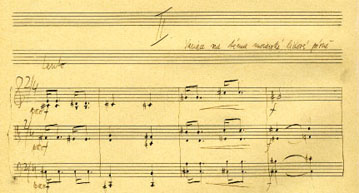
The answer in this regard is yes, and we may begin by dividing our information into material that uses letters and numbers, and thus corresponds to our normal sense of factual information, and other kinds that come to us via musical notation. The former kind of information is most illuminating at the beginning and the end of Klein’s second movement, as well as at one point near the middle of it. At the beginning of the movement the Roman numeral II is followed by the words (in Czech) “Variations on the Theme of a Moravian Folk Song”; the end of the movement is dated “September 21, 1944,”; but a passage in the middle calls attention to itself by its conspicuous chain of expressive markings: Con gran espressione, quasi improvisato senza rigore and, further, forte and con sordino (muted). In addition to these indications, all kinds of other information may be pertinent to our particular inquiry: internal expression markings, on the one hand, and, on the other, passages that refer to other works.
Before we consider these different kinds of material, let us return for a moment to the Trio and its likely dates of composition. We have three dates at the end of the movements: September 5, September 21, and October 7. If we allow roughly two weeks for each movement (sixteen days for the second movement, fourteen for the third), it follows that Klein probably started work on the Trio sometime late in August, although of course, he could have started the work at any time before the date on the manuscript – even years earlier. At any rate, there is no evidence for the Trio’s existence before September 5. I have not been able to find any indication that anyone knew anything about major transports at that time, though they may have been suspected. The second movement was written just as the High Holy Days began, finished three days after Rosh Hashanah and a week before Yom Kippur. Since we know that the first major transport went out on Yom Kippur, September 28, it is probable that the final movement was written just as the emptying of the camp, finished a few weeks later, was beginning. Klein himself was put on a transport leaving Terezín on October 16.
There is one additional anomaly to consider. The dates seem to indicate that the second and third movements were written in roughly equal amounts of time. This would make sense but for the fact that the second movement is twice as long as the outer movements combined and is far more intricate in structure. I do not mention this to propose a solution, but rather to roil the field of understanding so that we realize how challenging this endeavor really is.
Other scenarios must also be considered. The manuscript that survived is clearly the end of a process, not the beginning. Any sketches or other preliminary sources for the piece are missing. It is likely that the dates given show when each movement’s final draft was completed, rather than the date of the fair (final) copy of the manuscript. Which might mean that the final copy could have been made just before Klein’s transport (he may have understood that he was about to be sent off and needed to complete the score quickly) and, further, that “small” changes could have been incorporated into the final copy without changing the original dates. Thus a passage could have been added in response to events and inserted into the final copy.
5. Information from the Document. 2: What the Tower Tells Us
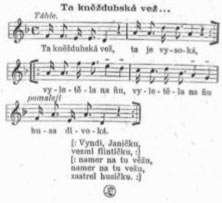
Despite the difficulty in verifying various kinds of evidence, it is easy to connect Klein’s designation of the “Theme and Variations on a Moravian Folksong” with a melody known as “Tá kneždubská vĕž” (The Kneždub Tower). There is no doubt that this is the tune used; it is preserved in several folksong collections from as early as the beginning of the nineteenth century and it is also found on recordings.
Example 1. Opening 2nd Movement “Variations on a Moravian Folk Song”
Example 2. Jan Kunc, Slovacke Jednohlasne pisne, 1918
The Knezdub tower is high,
A wild goose flew up to it
Go Janicek, get the rifle
Aim it at the tower
He shot the goose
That level of certainty, however, stops precisely where we would crave additional information. Thus we do not know why Klein chose this particular song – whether for its tune, its personal value to him, to comment broadly on his situation by referring to its text, some combination of the above, or something else altogether. In fact, like all such songs, this one has multiple textual variants, and we have no clue as to which text Klein might have known, if indeed the text is at all significant in this case.
It is worth noting, however, that all extant versions begin with the following words, with only minor variations:
The Kneždub Tower is high
A wild goose flew up to it (or around it)
So if we are going to suggest that the text of the song is an important part of the document, we are on fairly solid ground if we stick to the first verse. And we might conclude that such images as high towers and the image of the wild goose, a common symbol of freedom in Moravian folklore, resonate somehow either with Klein’s personal condition or with his desire to make a broader statement about the collective.
Things become more interesting in subsequent verses, with their different variants. Some are fairly obscure:
It wasn’t a goose it was a gosling
Stay well and farewell you beautiful girls.
Others are directly pertinent:
Johnny bring it, bring the rifle, aim at the tower!
He shot at the goose.
He shot the goose and shot it again.
Farewell lad, you have betrayed your beloved
A hundred times farewell
It is extremely tempting to argue or assume that Klein was “certainly” aware of these more specific references to violence and betrayal, and it would help to explain why he chose the song, yet this kind of data falls into the category of the unknowable. Nevertheless,the song offers suggestive images of a tower, wild geese, and a heartfelt farewell, and these we cannot ignore in trying to imagine what Klein might have wanted to communicate.
6. Information from the Document. 3: Numbers and Expressive Markings
If the words at the beginning of the inner movement lead to a particular Moravian song that supplies musical and textual parameters, the symbolic notation at its conclusion provides another combination of straightforward information and vexing questions. As we have noted, the composition is listed as having been completed on September 21, 1944. If this is true, then again, the movement was certainly begun and almost as certainly finished well before the transports began and even before they were announced. Thus the movement could not be a response to the almost certainly traumatic, specific event that followed its composition by a week or so. Of course, in historical investigation nothing is that straightforward. Since, as we have noted, it is likely that the piece had an earlier version, in the form of either sketches or an early manuscript source, or both, the dates at the ends of movements might simply indicate when a first version was complete, for reasons of both convenience and security; a date for other added materials, which could have been a response to more recent events, may have been omitted. A more dramatic hypothesis is that the threat of transports could have prodded Klein to complete something that had been sketched and planned for a long time.
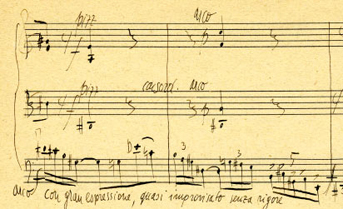
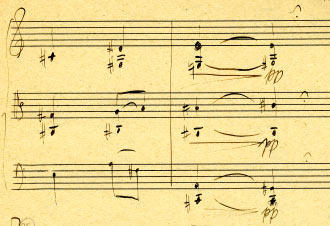
While that which precedes the opening of the movement, and follows its closing, provides parameters concerning the source material and date of composition, the elaborate expressive instructions in the middle of the movement are conspicuous enough to allow us to conjecture that this passage is to be construed as “special,” at least to the performers charged with conveying the composition to us. But what this means, and in what way it might be special, is as tricky an issue as can be imagined . The moment is a kind of cello speech/song interruption punctuated by sospirando sighs in the violin and viola. It begins with a two-octave plunge “to the depths” and then rebounds, only to make a much shorter chromatic descent a few measures later.
Example 3: Con gran expressione, cello “interruption”
Does this moment in the composition tell us anything that helps us to answer our questions about Terezín and its transports? Can we argue that the urgency of the interruption and the agony of the descent are a kind of personal interjection, a shift from a more objective style to something like “direct speech,” as if the composer were grabbing you by the collar, shaking you and saying, “No, really, it was this way!”? Is the chromatic descent intended as a traditional emblem of lament? Again, does such a moment constitute “evidence” of anything, and, more specifically, does it help in any way to clarify the question we raised at the beginning? In short: Did Klein know where he was going, and what did he make of that knowledge?
7. Things Hidden and Revealed
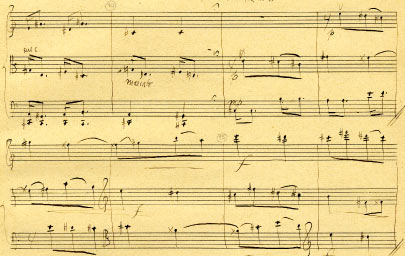
We will come back to this issue. But first, we should ask whether other aspects of the score suggest that a hidden message is concealed within. In addition to the clear reference to a specific folksong, indicated by the movement’s title, there are several possible allusions to other compositions, and the most tempting one is at the end of the first variation. Instead of a more conventional procedure, in which the variations gradually distance themselves from the theme, the first variation almost immediately loses the folksong in favor of a three-part canon.
Example 4
The song concludes with a downward trajectory, but the end of the first variation rises.
Example 5: Conclusion, Variation 1
Taken together, and considering possible sources, we are drawn immediately to the first song of Mahler’s Kindertotenlieder.
Example 6. Kindertotenlieder, Gustav Mahler, ending of Song #1
Now, we have no information other than what is in the score. There is no proof that this connection is real, especially since Mahler was not particularly popular in Czech circles at that time, and if it is real, no evidence that it is meant to be anything more than affective. However, considering the conditions in Terezín at the time, and given that many artists there had a stake in getting out “real” information about the camp, it is worth noting that the fragment could be a specific reference to Mahler’s song, thus also a statement by Klein to the effect that “this place is not what it seems: there are dead children here.”
Caution must rule, however. We must be extremely wary of giving preference to the stories we would most like to tell. In this case, the idea of secret messages, especially those bravely composed in the line of fire, is quite attractive. So when we identify what we think we would like to find, we must work against it, keeping in mind that there are things we do not know and in all likelihood will never know.
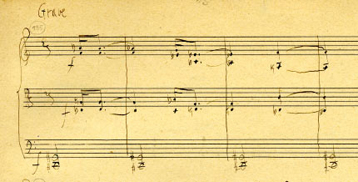
Another constellation of material at the end of the movement also arouses curiosity. The penultimate variation is actually two variations in one, the first in triplets, the second in sixteenth notes, as if Klein were somehow referring back to baroque variation technique. More compellingly, the piece seems to gather itself into a powerful unison passage, ascending in a crescendo until it comes rolling down in a ritardando that leads to the final variation. This segment, marked Grave, has a dirge-like character, and the dotted rhythms of the theme now suggest a funeral march. This passage recalls Suk’s Asrael Symphony, and specifically the moment when the Angel of Death appears.
Putting it all together—the song text, the allusions to other works, the expressive codes–we may decide that the variations movement is filled with images of death. The “expressive” passage we have noted in the center of the movement, an example of what we might call “direct musical speech,” may be a reference to the Verdi Requiem, which Klein had accompanied for the better part of a year. Yet we need to remind ourselves that when this movement was completed, on September 21, no transports had been announced in the camp, and, according to documents, none took place there between May 18 (when 2,500 people were sent to Auschwitz) and September 28. Does this mean that nothing in the second movement refers to these transports? Let us resist reaching this conclusion until we have taken a brief look at the Trio’s final movement.
Again, if we take the dates at face value, we conclude that the third movement was probably started after September 21. Although the date of composition coincides exactly with the transports, there is little on the surface of this final movement to suggest that Klein is somehow commenting on the horrific events around him. This is even more notable if we accept the final date of October 7 for the last movement’s completion. In this case, during the last nine days of the Trio’s composition, five transports carried roughly 8,500 people to Auschwitz. The camp must have been a scene of horror, and no one could have imagined that they would escape the train ride to the East. If it seems odd that the symbols and expressive depth of the variations movement was composed before the transports began, it is even more peculiar to find passages marked burlesco in the final movement.
Many explanations are possible. No one, composer or otherwise, needed the threat and reality of transports to understand that Terezín was a world of death, and Klein’s compositions reflect that reality. We should keep in mind the fact that in July of 1944 most of Terezín’s finest artists and draughtsmen had been imprisoned, tortured and murdered, because their secret cache of real, rather than sanitized, images had been discovered. Many inmates must have suspected that after the Red Cross visit and the propaganda film, the camp would be liquidated. But this does not allow us to draw any conclusions about what Klein knew, when he knew it and what bearing, if any, it had on his composition.
8. Secrets First to Last
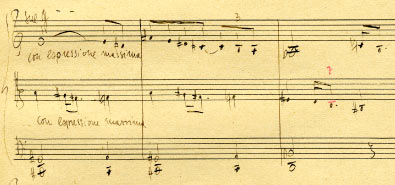
Two passage in the trio seem anomalous. The first one begins at Bar 67 of the first movement, which, according to the manuscript, was completed well before there was any knowledge of the forthcoming transports. Here, the piece’s incessant forward motion seems to stop cold.
Example 7: 1st Movement, Bars 67-9
The theme is distorted in the viola, and the cello plays an open fifth. Although there is no dynamic indication, the passage is marked with the unusual words con espressione massima (with maximum expression), and the violin is instructed to play on the G string. What is happening in these measures, with their sudden chromatic turn, and what does it tell us about Terezín, Klein and the transports?
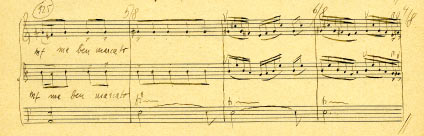
The other anomalous passage is located in the final movement, which, again according to the manuscript, was written when the transports were already underway. At Bar 124 there are descending scales in the upper strings, an echo of a passage that first occurs at Bar 44. But unlike the earlier passage, which leads to two quarter notes and a cessation of forward motion, this scale leads to a kind of motoric moment, with a blending of meters. Until now the piece has been in 4/8, with an occasional 5/8 measure to extend a phrase. At this point, though, a completely new idea appears, and we have the only 6/8 measure in the movement.
Example 8: 3rd movement, mm 125-8
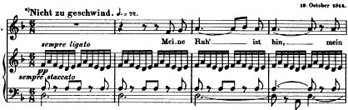
If we look closely at this passage, we recognize a reference to one of Schubert’s most famous songs, “Gretchen am Spinnrade,” and its opening lines, “Meine uh ist hin, mein Herz ist schwer.”
Example 9: Franz Schubert, Gretchen am Spinnrade, opening
These two passages suggest another possible reading of the piece that not only fits in with events but may even say something about the composer’s response to them.
Let’s deal first with the apparently less problematic finale. Its simple surface seems to conceal a series of musical quotations. The Schubert quote is the clearest, but there also appear to be references to Ravel’s Tombeau de Couperin, Suk’s Towards a New Life and perhaps even the devilish dance from L’Histoire du Soldat. While the designation burlesco at Bar 52 forecasts comedy or lightness, the indications marcatissimo and feroce suggest something altogether different. These allusions, taken with the calendar of events in Terezín, offer some evidence that the composer knew what was happening and took note of it.
What of the first movement though? As usual, there is no definitive answer, but the anomaly of the expressive instructions and the character of an interruption may be explained by similarities between the bass line at Bars 68 and 69 (See Ex. 7) and the closing variation of the second movement, with its open fifth on the same pitches.
Example 10: 2nd Movement, beginning final variation
Although it is possible that for purely aesthetic or musical reasons Klein wished to anticipate his final variations within the context of the opening movement, it is considerably more likely that this passage was inserted into the first movement after the second movement was completed.
9. One of Many Readings
Here is a scenario for the Trio that contributes a good deal of information to what is sometimes called “the historical record.” Klein begins to compose the Trio, a relatively lighthearted work, in mid- to late August. It is possible that nothing happens to change the affect or intent of the movement throughout the composition of the first draft, and it in no way is meant as a reflection of events in Terezín. The second movement’s overall concept feels like something that has been germinating for a long time. Everything, from the first variation canon to the careful use of the theme to the length of the movement (longer by far than the outer movements combined), leads to the assumption that this is the work’s core. But it is possible that, insofar as those aspects of the work that touch the “real world” are concerned, the second movement is more a general comment on being a prisoner in Terezín than a response to current events. It is almost certain, on the other hand, that the last movement was written while events related to the transports were taking place. Finishing his work under these conditions, Klein makes his final changes; he goes back to the first movement and inserts an anticipation of the funeral march, which concludes the following movement. He may even have inserted other passages or changed details in the second movement as a response to what was happening. We do not know. And as if acknowledging that he will be unable to take many possessions with him on his journey, he instead packs a musical suitcase filled with various kinds of information and leaves it behind for us to peruse.
10. What Kind of Historical Document is a Musical Score
In the end, two types of conclusions are possible. One could take the strong view that virtually no raw factual data that sheds light on events in Terezín can be extracted from the Trio’s score, and that, compared to a transport record or a diary entry, the score adds nothing substantial to our understanding of events and conditions. But we could just as well argue that no other extant document delineates what was happening in Terezín as clearly, powerfully and variously as does this score, especially considering the kinds of problems it poses for those who seek to reconstruct the past. Because like the work itself, the “full historical record“ of Terezín consists of what is known, what could be known and is not known, and what cannot be known at all. Like Terezín itself, the manuscript of the Trio is a landscape open to endless interpretations, but it is also a a work that could have been wrought in no other time or place.
Dutch painting is world famous. Every year, thousands of tourists flock to the Netherlands to admire paintings by Rembrandt, Vermeer, Frans Hals, Van Gogh and Mondriaan.
How different is the fame of Dutch music! Holland was always susceptible to the powerful cultural influences of its larger neighbors, France and Germany. This was certainly true in the 19th century when Holland was under the sway of German musical traditions, but the situation began to change toward the beginning of the 20th century, when French music became more influential. Although this was partly a result of the strength of a new school of French composers, the political and cultural climate in the Netherlands was also changing. Directly prior to the Second World War, affinity with French music even became a political statement, a declaration of opposition to the rising Nazi regime. During the war, that regime dictated new rules for the arts and for cultural life. Affiliation with French music was not sufficient cause for suppression of music by Dutch composers. There was no ‘Entartete Kunst’ as such. Music was forbidden simply because a composer either had a Jewish background or refused to comply with Nazi rules. Such composers had to give up their social positions, and their music was banned from all public performances. Most Jewish composers were deported, their personal belongings plundered. Many of them lost their lives. Their personal archives as well as their musical heritage were eradicated.
After the Second World War, a radically new musical aesthetic began to dominate Dutch musical life. This was partly because a large group of composers, many of them Jewish, had perished. The younger generation quickly filled the vacuum, claiming modernism as the watchword of the day. Next to this new avant-garde music, the music of the pre-war generation seemed hopelessly outdated. Most of the Dutch music from the first half of the century was neglected and looked down upon. Those compositions that had survived the war did not survive the scrutiny of post-war musical taste.
Yet the sieve of time is an effective mechanism in music. If good music disappears as a result of changing aesthetics and styles, it will sooner or later reappear thanks to its intrinsic quality. Only now, at the beginning of the twenty-first century, is this music taking its rightful place in the stream of music history. In 1996, flutist Eleonore Pameijer and pianist Frans van Ruth established the Leo Smit Foundation, named after the Dutch composer Leo Smit (1900-1943). Their purpose was to offer a platform for this forgotten music, because they believed in the high quality of the pre-war generation of Dutch composers. In recent years, painstaking research by committed individuals – facilitated by the Leo Smit Foundation – has brought back the music of suppressed composers in the Netherlands. Jurjen Vis aptly named his biography of Leo Smit Silhouettes: he reconstructed the composer’s life from the bits and pieces of information that had survived the war. Other composers’ lives were reconstructed with the help of city archives, information from the Red Cross and newspaper clippings.
The Leo Smit Foundation started an annual series of ‘Uilenburger Concerts’ in the restored Uilenburger Synagogue in Amsterdam. More than one hundred concerts have taken place since the mid-1990s. Rediscovered compositions are programmed alongside well-known music from the same period as well as contemporary music. Since many concerts are broadcast on national radio, surviving relatives, friends and pupils were reminded of these forgotten composers and began searching for manuscripts that were thought to be lost. Even today, treasures are still being rediscovered in archives, attics and sheds. In 2009, with the support of a grant from the Dutch government, an inventory was made of the works and lives of more than twenty suppressed composers. This article presents an overview of the findings of the last two decades.
The romantic music of Andries de Rosa (1869-1943) and Samuel Schuijer (1873-1942) was firmly rooted in the 19th century. De Rosa had to resort to his old trade of diamond cutter to support his family in times of crisis, and Schuijer formed his own orchestra to play light music in difficult years. Schuijer’s compositions met with some success: He won several international prizes and his Preludium for orchestra was premiered in Stuttgart. Because of their Jewish background, both men and their families were deported and killed in concentration camps. Several works of Samuel Schuijer were recently found by children on the street near a garbage can. The works of Andries de Rosa are archived in the Jewish Historical Museum in Amsterdam. Works of both composers were premiered at the 100th Uilenburger Concert in January 2009.
Among composers of the older generation, Jan van Gilse (1881-1944) composed in a style that followed the line of Brahms and Mahler, which is not surprising, given that he studied and worked in Germany for many years during the first decades of the twentieth century. It was not his music that caused trouble: his persistent and active resistance against Nazi occupation meant the end of his career. His music was banned and he was forced to go into hiding. After his two sons were killed in retribution for their resistance activities, Jan van Gilse fell ill at one of the addresses where he was being hidden–the house of his colleague composer Rudolf Escher. He was taken to hospital, died and was buried under a false name. Because Jan van Gilse played an immensely important role in founding the Dutch Composers Association (GeNeCo) and improving social circumstances for composers, his life is well documented. A biography – Jan van Gilse; Warrior and Idealist – has been published by Hans van Dijk. After the war, van Gilse’s music was considered old-fashioned because the German-oriented romantic style was no longer appreciated. Only recently, conductor David Porcelijn rediscovered this music’s high qualities and has started to record van Gilse’s symphonic works for the German label CPO.
Sem Dresden (1881-1957) also played an important role in musical life in the Netherlands in the early years of the twentieth century. Dresden studied composition with Hans Pfitzner at the Stern Conservatory in Berlin. Drawn to the new developments in French music, he was considered a modernist in his time. As a composition teacher in both Amsterdam and The Hague, he encouraged many young composers. Together with his colleague Willem Pijper, he established the Dutch chapter of the International Society of Contemporary Music (ISCM). Because of his Jewish background, he was forced to withdraw from his position as director of the conservatory in The Hague. He was cut off from public life but continued to compose. One of the works he wrote then is Chorus symphonicus. Based on Psalm texts referring to the hardships of daily life, the work can be considered a form of ‘passive resistance’. Dresden survived the war, resumed his position in The Hague and retired in 1949. Like Jan van Gilse, Dresden served on many boards and committees. Although well-remembered as a person, his compositions have largely been forgotten.
Rosy Wertheim (1888-1949) was one of Dresden’s pupils. She was born into a wealthy Amsterdam Jewish banking family. After having received a piano diploma from the Dutch Musicians' Society, she studied harmony and counterpoint with Bernard Zweers and Sem Dresden at the Amsterdam Music Lyceum. In the 1920s, she taught solfège and piano there. She was also conductor of a number of children’s and women’s choirs. In 1929 she left for Paris, where she took lessons in composition from Louis Aubert. Her home became a haven for Dutch artists and composers and a veritable salon for such leading French composers as Milhaud, Honegger, Messiaen, Jolivet, Ibert, and Elsa Barraine. Like many of her Dutch contemporaries, Wertheim was strongly influenced by French music and greatly admired the Impressionist works of Debussy and Ravel as well as the music of Stravinsky. She wrote a cello sonata, a string quartet, a piano concerto and many vocal works. Later, she travelled to Vienna and to the USA but returned home as tensions grew in Europe. At this point, it is not clear what happened. Her obituary describes her as an incredible source of comfort and support to others during the war years. Many who knew her were especially grateful for the covert concerts she gave in the basement of her home, where she frequently presented works by Jewish composers whose music had been outlawed. She survived the war but lost most of her family. After the war, she fell ill and never resumed composing. Despite a sizeable oeuvre of high quality, Rosy Wertheim was largely forgotten and even now is not included in anthologies of twentieth-century Dutch music. Her music manuscripts are stored in the archives of the Netherlands Music Institute in The Hague, but they remain unpublished. A CD with an overview of her most important chamber music is presently (2010) being recorded for the Dutch label FutureClassics. Most of Wertheim’s works are not dated, and very little written documentation of her life remains, which makes it difficult to construct a biography.
Martin Spanjaard (1892-1942) was best known as a conductor. He conducted the world’s most famous orchestras, including the Vienna and Berlin philharmonics and the Amsterdam Concertgebouw Orchestra. In 1997, his grandson discovered several of Spanjaard’s compositions in some boxes of personal belongings that had survived the war. Spanjaard studied piano with Willem Andriessen and composition with Cornelis Dopper before he moved to Berlin in 1915 to continue his musical education. In Berlin he wrote songs on texts of Li Tai Po as well as a Scherzo for orchestra. In later years, his career as conductor was so successful that he had no time for composing. In 1942, Martin Spanjaard and his wife Elly Okladek, a Hungarian harpist, both Jewish, were deported and killed in Auschwitz.
Bob Hanf (1894-1944) was endowed with many talents: he wrote novels and plays, painted, played the violin and composed. His mother, Laura Romberg, was an excellent pianist. She gave Bob his first music lessons. His parents sent him to Delft University to pursue a technical career, but Hanf preferred a career in music and studied the violin with Louis Zimmerman and composition with Cornelis Dopper. His compositions, which include songs on texts by Rilke, Kafka and Goethe, are closer to the German-Austrian tradition than to the French school. While studying chemistry in Delft, Hanf gave lectures on modern art and organized several expositions dedicated to such important painters as Vassily Kandinsky. Around 1920, he produced a number of drawings in a German Expressionistic style similar to that of Max Beckman – a style later referred to by the Nazis as degenerate. As a composer, Hanf produced a small but elegant oeuvre consisting of songs and chamber music. Owing to his Jewish background, Hanf had to go into hiding, where he continued his writings under a false name. He was arrested in April 1944 and deported to Auschwitz, where he was killed in September of the same year. The Bob Hanf Foundation has published a biography with reproductions of his paintings and a CD with some of his chamber music, but his compositions remain unpublished.
The eradication of the memory of Daniël Belinfante (1893-1945) seemed complete until the Italian pianist Francesco Lotoro contacted the Dutch pianist Marcel Worms, who is associated with the Leo Smit Foundation. In the early years of the twenty-first century, research by Worms and the musicologist Wim de Vries uncovered the outlines of Belinfante’s musical career as pianist, composer and director of a music school in Amsterdam, where members of the Concertgebouw Orchestra taught both classical music and jazz. Belinfante married his pupil Martha Dekker (1900-1989), who developed a method for teaching singing and declamation to children and composed many songs. Belinfante was an interesting composer who experimented with polytonality and polyrhythm- and who left a considerable oeuvre. In 1940, he was forced by the occupying forces to close his music school. He was active in the Resistance, helping others to hide, and was arrested for these activities; he died in a fire in the hospital of the Fürstengrube camp in January 1945. Martha survived the war, continued the music school but did not compose again. In his wife's archives there is no record of any of Belinfante’s music having been performed after the war. In 1955, she donated his manuscripts to the Netherlands Music Institute.
Franz (Ferenc) Weisz (1893-1944) was born in Budapest, where he studied piano and composition. He remained in the Netherlands after a concert tour around 1920, married and obtained Dutch nationality in 1932. He taught piano, composed for this instrument and performed in many concerts. In 1943, Weisz’s Jewish background caused him to be taken first to Westerbork, then to Theresienstadt and finally to Auschwitz, where he died in 1944. Niek Verkruisen, a pupil of Weisz, possessed five compositions for piano solo that had been published by Roszavolgyi & Co in 1929. One of these virtuoso pieces, a Chopinesque suite, was performed at the hundredth Uilenburger Concert in January 2009. Since then, more of Weisz’s compositions have surfaced.
Ignace Lilien (1897-1964) was born in the Polish city of Lemberg (Lwów; now Lviv in the Ukraine). At the age of seventeen, he toured Europe on a bicycle in order to visit museums. While in the Netherlands, the First World War broke out, and Lilien decided to stay in Holland. He studied chemical engineering at Delft University but also piano with Theodor Pollak, harmony with H. Ehrlich and instrumentation with Josef Suk. Although Lilien earned his living as a chemical engineer, he was a versatile composer and pianist. During the 1930s, he lived in the Bohemian city of Reichenberg (Liberec), where he composed the ‘Modern Times Sonata’ for violin and piano. In 1939, Lilien returned to the Netherlands. As a non-native, he was not registered as a Jew, thus he survived the German occupation thanks to forged documents. Between 1939 and 1943 he composed a great number of songs on Dutch texts. In his song cycle Maria Lecina’ Lilien demonstrates his love of Spanish rhythms and passionate singing. The Ballade van Westerbork is a sober, realistic setting of his own poems, which depict the deportation of Jewish children from Westerbork to the concentration camps of Eastern Europe. After the war, Lilien went to South America as a concert pianist. His music was performed regularly, and George Bernard Shaw wrote the libretto for Lilien’s opera, Great Catherine (premiered in Wiesbaden in 1932).
Most of the Jewish composers mentioned in this article wrote concert music. Simon Gokkes (1897-1943), however, wrote many works for use in the synagogue. He studied piano with Sem Dresden at the Amsterdam Conservatory, became a well-known conductor and worked for the Netherlands Opera. Some of his songs were performed at the Salle Pleyel in Paris. Gokkes and his family were deported and their belongings plundered, which is why most of his compositions were lost. What little has survived is of high quality and of a surprisingly modern character. In 1943 Simon Gokkes, his wife Rebecca Winnik and their two children were killed at Auschwitz. Only recently, interest in his concert music has revived. His work Kinah (1928), for solo voices, wind quintet and piano, has been published by the Netherlands Music Institute.
Henriëtte Bosmans (1895-1952), a well-known concert pianist, studied composition with Cornelis Dopper. In order to develop her style from a romantic idiom into a more modern one, she decided to take lessons from the composer Willem Pijper. She wrote an impressive number of pieces, including symphonic and chamber works. After 1942 she was no longer allowed to perform in public because she was half Jewish; instead, she performed at illegal concerts in private homes. She resumed her career after the war, and the many songs that she composed for her muse, the French singer Noémie Perugia, are considered among the finest music composed in the Netherlands. Despite the high quality of her work, Bosmans has yet to receive the international attention that she deserves. In 2002, a biography of Bosmans by musiclogist Helen Metzelaar was published.
Johanna Bordewijk-Roepman (1892-1971) began composing relatively late in life. In 1936-37, she took lessons with composer-conductor Eduard Flipse, and her first orchestral works were performed in 1940. Because she refused to become a member of the Kultuur Kamer as required by the Nazis, her works could not be performed or published. In March 1945, she and her family barely escaped death during the bombing of The Hague. After the war she became a member of the ‘Ereraad voor de Muziek’, an institution that judged musicians who had collaborated. She felt that this cast a shadow over her career, although her works were performed regularly until the 1950s.
As the most gifted pupil of Sem Dresden, Leo Smit (1900-43) was at the forefront of a new generation of Dutch composers. He came from a musical Portuguese Jewish family, and in 1924 he became the first student at the Amsterdam Conservatory to receive a composition diploma cum laude. Like many other Dutch composers, he was attracted to new French music and left Holland for Paris, where he remained for the following nine years. There, he threw himself into the musical life of both the concert hall and the café. He had no need to seek out the limelight, because his parent’s support made him financially independent and gave him time to compose. Some of his compositions were published and performed, but his thoughts were still directed towards Holland, which he often visited. His ballet “Shemselnihar” and his Harp Concertino, written for the harpist Rosa Spier, were premiered at the Concertgebouw in 1929 and 1934, respectively. In Paris Smit developed his own style, which was initially very French in orientation but later became more intellectual and austere. In his thirties he wrote a great many pieces: Sextuor (1932), Symphony in C (1936), Piano Concerto (1937) and Viola Concerto (1940). His name was well established in Holland, and his music was often heard on the radio. When the war broke out, Leo Smit did not to go into hiding. Together with his wife, he was transported to Sobibor via Westerbork, where they were killed on April 30, 1943. The Flute Sonata (1943) – the last composition he completed – has both a lyrical side reminiscent of Ravel and a motoric, rhythmical side that is more Stravinskian. The touching second movement was written shortly before Smit was deported and contains the last notes that he composed. Smit gave most of his compositions to his pupil Frits Zuiderweg for safekeeping; after the war, Zuiderweg returned them to Smit’s sister, Nora, but despite her efforts she could not rekindle interest in his music. Only in the early 1990s, when pianist Frans van Ruth and flutist Eleonore Pameijer discovered the beauty of Smit’s Flute Sonata, the quality of his oeuvre was recognized. Van Ruth and Pameijer founded the Leo Smit Foundation, which resulted in the recording and publication of his complete works and more than a hundred concerts focusing on suppressed composers.
Julius Hijman (1901-1967), pianist, composer and musicologist, studied piano with Dirk Schäfer and composition with Sem Dresden and played an important role in promoting contemporary music in the Netherlands. During a stay in Vienna, he became acquainted with the music of Schoenberg, Berg and Webern, and in 1937 he published an article on the subject in the Dutch magazine Caecilia. He was one of the few Dutch-Jewish composers who managed to leave the Netherlands just before the war broke out. By immigrating to the USA, he managed to save his family, although this meant giving up his position in Dutch musical life. He taught at music academies in Houston, Kansas City, Philadelphia and New York, where he was an avid promoter of Dutch music. Although he regularly went back to his native country, his music, which consisted primarily of chamber and choral works, was hardly recognized in Holland.
Hans Lachman (1906-1990) was born in Berlin as Heinz Lachmann. As a Jew, he fled his native country in 1933 soon after Hitler came to power. Having been a member of Sid Kay’s Fellows – Berlin’s first jazz band – he later joined the Tuschinski film orchestra of Max Tak in Amsterdam as an arranger and trombonist. He wrote and arranged music for many films. He, his wife and young son, survived the war hidden in a forest by a Roman Catholic priest in the south of the Netherlands; the priest was betrayed and executed. After the war, Lachman turned to classical music. One of his first compositions was a Requiem for the priest, performed and recorded for Dutch radio. Lachman formed his own ensemble with musicians from the Concertgebouw Orchestra, and his music was regularly performed and broadcast on national radio. He left an extended repertoire in every genre.
Bertus van Lier (1906-1962) studied cello with Max Orobio da Castro, composition with Willem Pijper and conducting with Hermann Scherchen. He taught at several conservatories and wrote about music for various newspapers. He was a well-known conductor who performed at Benjamin Britten’s Aldeburgh Festival, among other venues. He wrote orchestral, chamber and vocal works, and his best-known compositions were Het Hooglied (The Song of Songs, 1949) and A Tfile fun a Ghettojid (Prayer of a Ghetto Jew, 1951), on a text by Kwiattkowska . During the war, he worked for a bank in order not to have to join the Kultuur Kamer. Because he was half Jewish, he eventually had to go into hiding and barely escaped arrest. After the war, Van Lier, like Johanna Bordewijk-Roepman, became a member of the 'Ereraad'. His membership on this board, which required him to condemn collaborationist colleagues, created such negative reactions that he gave up most of his musical career and moved north, where he became a lecturer at the University of Groningen.
Lex van Delden (born Alexander Zwaap, 1919-1988) started composing at the age of eleven and remained self-taught as a composer. Despite his artistic promise and interests, he enrolled at the University of Amsterdam in 1938 to study medicine. In 1940, however, the Germans invaded the Netherlands and, as a Jew, he was forced to interrupt his studies. Irrevocably, as it turned out: his hopes of becoming a neurosurgeon were dashed during World War II, because while he was in hiding an exploding carbide lamp left him virtually blind in his left eye. He joined the underground students' resistance movement, and after the war he was commended for his bravery. In 1953 the name he had assumed since the Liberation in 1945 (Lex van Delden – derived from the name he used in the resistance) was legally approved. During the postwar period Van Delden made his way in Dutch cultural life. From 1947 to 1982 he was music editor of the daily , newspaper Het Parool – originally an underground publication. Throughout the 1950s and ’60s he was one of the most widely-performed Dutch composers of his generation. He created a large body of works written in an accessible, moderately modern style, firmly rooted in the classical tradition. Most of his postwar works were published and are still part of the repertoire.
Marius Flothuis (1914-2001), an Amsterdam-born composer, musicologist, critic and writer, He studied piano, music theory and musicology and received his doctorate in 1969 with a thesis about Mozart's arrangements of his own compositions. In 1937, Flothuis became the assistant artistic director of the Concertgebouw Orchestra. In 1942, he was forced out of this position because he refused to collaborate with the German occupying forces; his refusal to collaborate stemmed from his many friendships with members of the Jewish community, among other reasons. He was captured and imprisoned in Camp Vught because of his activities in the resistance, helping Jews. While incarcerated, he composed both the Aubade and the Sonata da Camera for flute. After the war, he rejoined the Concertgebouw Orchestra and became its artistic director. As a composer he was initially influenced by his friend and colleague Bertus van Lier but later developed his own style. He considered the words of conductor Bernard Haitink, after a performance of one of Flothuis's compositions, to be the highest compliment he ever received: “Not one note of this entire piece is superfluous.” To the end of his life, Flothuis played an important role in Dutch musical life.
Nico Richter (1915-1945) was born into a secular Jewish family in Amsterdam. He received violin lessons from an early age, and his compositional talent emerged at around the age of thirteen. At fifteen he was studying violin with Sepha Tromp, wife of the conductor Eduard van Beinum. Richter studied medicine in Amsterdam at the same time as Lex van Delden. Van Delden composed a work for the student orchestra MUSA led by Richter, and the two became close friends. Inspired by a concert performance of Willem Pijper, Richter started composing at a young age. He studied composition with Ernest Mulder in Amsterdam and conducting with Hermann Scherchen in Brussels, where he won a prize for his Concertino for cello and five instruments.
When the war broke out, he married Hetta Scheffer, continued his medical studies, took part in student anti-war protests and remained active as conductor of the MUSA orchestra. Although Jewish students were no longer allowed to apply to the University, he was allowed to finish his medical studies and completed them on November 18, 1941. Richter took part in the resistance but was betrayed in April 1942 and sent to prison, first in Amsterdam, then at Scheveningen, and from Camp Amersfoort in November to Camp Vught in January of 1943. On November 15, 1943, he was transported to Auschwitz. He was later transferred to Dachau and survived to return to the Netherlands in July 1945. He was so weakened, however, that he died on August 16, 1945, after having managed to complete his Serenade for flute, violin and viola while on his deathbed. His output, modest in size, was performed only sporadically until the Leo Smit Ensemble released a CD of his chamber music on the Tatlin label. The Two Pieces for flute and piano were originally written for violin and piano. Richter's music is close to the Second Viennese School. His compositions are often only vaguely tonal, and his succinct musical language reminds one of Webern.
Dick Kattenburg (1919-1944) was still a student when the war broke out. Little is known about Kattenburg and his musical activities, as there are few surviving documents. He must have had a solid musical education at an early age, because by the time he was seventeen he had received a diploma “Théorie et Violon” at the Collège Musical Belge in Brussels, where his teacher was Hugo Godron. In 1941, he passed his state examination in music at The Hague under the direction of Willem Pijper. During his short life, Dick Kattenburg wrote about thirty compositions: solo pieces, chamber music and works for orchestra. His compositions show the influence of French music, but they are often somewhat Romantic, too, with charming melodic lines and harmonies and sometimes even a jazzy feel. At the age of eighteen, he wrote a piece for piano four-hands and a tap dance. During the war, he received lessons in composition from Leo Smit while in hiding. It was only then that his Jewish background started to appear as an inspiration in his music. He started to write songs on Hebrew texts, calling them Palestinian, Mexican or Rumanian in the hope that this would increase the manuscripts' chances of surviving the war. Dick Kattenburg was arrested and transported to Auschwitz, where he was killed in the summer of 1944 at the age of 24. After Eleonore Pameijer performed what was thought to be his sole surviving composition, the Flute Sonata, Kattenburg's niece, Joyce Bergman-van Hessen, decided to go through the family effects that she had inherited; she found a considerable number of compositions and gave them to the conductor Ed Spanjaard. Most of these works turned out to be of high quality, often joyful and light-hearted, with many polytonal passages reminiscent of the music of Kattenburg's contemporary, Darius Milhaud. His chamber music was released on CD by FutureClassics in December 2009, and three of his works were recently published by MCN (Music Center of the Netherlands).
In conclusion: Extensive research has shown that the Second World War wiped out an important part of Dutch musical life. Seventy years later, our perception of our country’s musical history has changed, thanks in part to this research. Gaps in our collective memory are being filled in, although we can only guess what would have happened if talents like Leo Smit, Nico Richter, Simon Gokkes and Dick Kattenburg had had a chance to continue their careers after the war. Would their music have changed had they had a chance to hear it performed more often? How would they have influenced the following generation? What would the Dutch musical scene have been like had these composers survived? These questions will never be answered. The composers cannot be brought back, but we can dedicate ourselves to their music. Future plans include research into the lives and works of Fania Chapiro, Israel Olman, Robert de Roos, Andrée Bonhomme, Sedje Hémon, Paul Hermann and Leo Kok as well as others, perhaps, who not yet known to us. The Leo Smit Foundation remains dedicated to this task.
At Terezín, in what is now in the Czech Republic, opportunities for the performance of jazz and other forms of popular music – operettas, revues and cabaret music, for instance – emerged in the wake of the SS's decision to turn the concentration camp into a “model ghetto.” Throughout its existence, Terezín served a dual function within National Socialist policies – and specifically, those of Heinrich Himmler. Although it was originally conceived as a transit camp for Bohemian and Moravian Jews on their way to extermination camps in the General Government area, Terezín also fulfilled the propagandistic function of keeping up the appearance of Jewish autonomy and the “normality” of ghetto life. But this make-believe autonomy of the Jewish administration, presided over by the Jewish Council of Elders, was entirely subservient to the SS's dictatorship over Terezín and its prisoners.
Until the end of 1942 musical instruments were banned in Terezín, thus only vocal music was performed during that period. In the wake of the establishment of the nominal Jüdische Selbstverwaltung (Jewish self-government), musical instruments were smuggled in by incoming transports. Since every form of entertainment was strictly forbidden, any music performed had to be muted. The situation suddenly changed toward the end of 1942, when the Stadtverschönerung (town beautification) programs began to be carried out: “Terezín was destined to be a model ghetto, to be shown to a commission of the International Red Cross as proof that everything written in the enemy press about concentration camps, with gas chambers, forced labor and killing, was a lie.”1 Of major significance in the evolution of Terezín's cultural output was the so-called Freizeitgestaltung (Administration of Free Time Activities), founded in 1942 as an “autonomous” cultural department of the Jewish self-governing body, which promoted and enabled both private and public cultural life. In the course of the SS's endeavor to “normalize” the camp, musical instruments, previously banned, were now allowed and even encouraged, and this made possible the establishment of an orchestra and various bands.
A crucial figure in the evolution of Terezín's musical activities was Eric Vogel, a Czech amateur jazz trumpeter and arranger. Having lost his job as an engineer after the German occupation of Czechoslovakia in 1939, Vogel was forced to survive by relying on his skills as an arranger for jazz ensembles. He took a job with the Jewish community in Brno – under the direct supervision of the Gestapo – where he gave vocational retraining courses in which he lectured to classically trained musicians on the theory, history and other aspects of jazz. Vogel eventually formed a jazz band called the Kille Dillers, a name derived from Kehila, Brno's Jewish community. Vogel was sent to Terezín in March 1942, and on January 8, 1943, he requested permission to form a jazz ensemble. The personnel proposed by Vogel consisted of Dr. Brammer, piano; Dr. Kurt Bauer, percussion; Franta Goldschmidt, guitar; Fasal, bass; Langer, tenor sax and clarinet; Fr. Mautner, trombone; and himself playing trumpet.2 Permission was granted a few days later, and Vogel organized a jazz orchestra modeled on the American big bands of the swing era. It was called the The Ghetto Swingers.
Another jazz group active in Terezín was the Jazz-Quintet Weiss, which had been formed in Prague in 1940 by clarinetist Fritz Weiss, one of prewar Europe's most renowned jazz musicians. Although changes in personnel resulted from deportations of band members to death camps, the group achieved its highest caliber with Weiss, clarinet; Wolfi Lederer, piano; Paul Libensky, double bass; Coco Schumann, percussion (although he was a guitarist); and Franta Goldschmidt, guitar. Like many other musicians at Terezín, Weiss was a member of the camp's fifty-piece symphony orchestra, directed by the Danish conductor Peter Deutsch, and he participated in performances of Hans Krása's children's opera, Brundibár. Both the Ghetto Swingers and the Jazz-Quintet Weiss performed frequently at Terezín's “café”. Opened in December 1942 by the Freizeitgestaltung, this coffee house was not freely accessible: admission was limited to ticket-holders, who were allowed to stay there for two hours.
Another venue for jazz performances was a wooden pavilion built on Terezín's main square as part of the “town beautification” program that began in December 1943. The Ghetto Swingers had to perform at both venues for many hours every day.
In January 1944, the German pianist Martin Roman arrived in Terezín. Roman had worked with Louis Armstrong, Sidney Bechet, Coleman Hawkins and Django Reinhardt and had been a member of two of Germany's foremost jazz ensembles, the Weintraub Syncopators and the Marek Weber Band. Shortly after his arrival, Roman was asked by Ghetto Swingers' member Pavel Libensky, who also worked as a coordinator for the Freizeitgestaltung, to take over leadership of the orchestra. Under Roman, the Ghetto Swingers included three violins, three saxophones, four trumpets, guitar, accordion, bass and drums. Roman composed original compositions for the orchestra, conducted the band and occasionally played piano solos; Fritz Weiss also contributed his own compositions as well as arrangements. Occasionally, the tenor Fredy Haber and a trio of female vocalists singing in the style of the Andrews Sisters were added to the Ghetto Swingers.3
“Avant de mourir” (“Before Dying”), a tango by Georges Boulanger, was the group's most popular arrangement, but George Gershwin's “I Got Rhythm” was its theme song. The Ghetto Swingers' repertory comprised twenty to thirty pieces, drawn mostly from Tin Pan Alley songs by Irving Berlin, a collection of Benny Goodman's band's repertory and music by Count Basie and Duke Ellington. Among the pieces performed by the Swingers, whose members also played in the symphony orchestra, was a jazz arrangement of Krása's Brundibár. Another jazz ensemble active in Terezín was a trio that consisted of Fritz Weiss, Martin Roman and guitarist Coco Schumann.4
The Ghetto Swingers had to participate in the propagandistic, “Terezín, a Documentary Film of the Jewish Resettlement”, directed by the famous German actor, singer and director Kurt Gerron; he was ordered to create the film early in 1944, shortly after having been deported to Terezín,. Produced in connection with the visit of the International Red Cross Committee on June 22, 1944, the film gave the appearance of concentration camp life as recreational and spa-like at a time when German troops were making “heroic sacrifices” for their fatherland. Music played a prominent role in the film, which showed prisoners dancing to the tunes of the Ghetto Swingers – who were ordered to sound American. The Swingers appeared several times in the movie and provided portions of the soundtrack, among them a performance of the Yiddish song “Bei Mir Bist Du Schaynn.” In September 1944, after the movie was completed, all members of the Ghetto Swingers were deported to Auschwitz. Some, including Fritz Weiss, went directly from the train to the gas chambers. Of the original members of the Ghetto Swingers only Eric Vogel, Martin Roman, and Coco Schumann survived.
Cabaret was another of Terezín's thriving popular music genres. Under the aegis of the Freizeitgestaltung, artists such as Karel Svenk, Leo Strauss, Hans Hofer, Bobby John, Trude Popper and Egon Thorn contributed to the camp's cultural life by performing in an idiom that had been systematically suppressed in Germany since the Nazis' accession to power in 1933. Embraced by the Freizeitgestaltung's head Erich Weiner – for their allegedly “therapeutical” function – cabaret performances essentially played a dual role: some of the songs reflected the conditions of life in Terezín in satirical and ironic terms, whereas others “made serious attempts to alleviate the situation of the prisoners” by trying to “correct modes of behavior whereby the inmates hurt each other and themselves.” The performances often contained medleys of well-known Viennese waltzes such as the “Blue Danube” and “Viennese Blood” together with popular themes from operas such as Der Rosenkavalier and operettas such as Die Fledermaus. Most cabaret shows were in German, but some were in Czech.
Terezín's most popular cabaret was the Carousel, the outcome of an interdisciplinary collaboration among several artists under the direction of Kurt Gerron, who had been approached by SS Kommandant Karl Rahm and asked to take charge. Set designs were provided by František Zelenka, who had worked for Prague's Czech National Theatre, but most of the music was composed, arranged and performed by Martin Roman, with whom Gerron had worked during the Weimar Republic in the 1920s.5 The repertoire drew upon material written in the '20s, but performances also included songs written by Terezín prisoners – songs that described life under concentration camp conditions. Carousel's two main poets were Leo Strauss and Martin Greiffenhagen, but Frieda Rosenthal, Theodor Otto Beer, Hans Hofer and Walter Lindenbaum also provided lyrics. Admission to Carousel performances was limited to the camp's elite: capos, block wardens and the like. The Carousel performed over fifty times, most frequently during June and July 1944, the period during which the International Red Cross Delegations visit took place. All the artists who worked for Carousel were among the approximately twenty thousand Terezín prisoners who were deported to Auschwitz in September and October 1944. Gerron and Strauss were killed in the gas chambers of Auschwitz; Greiffenhagen died in Dachau in January 1945.
Selected Bibliography
Jelavich, Peter. “Cabaret in Concentration Camps,” in Theatre and War 1933-1945: Performance in Extremis, ed. Michael Balfour, New York: Berghahn Books, 2001, 137-163.
Karas, Joža. Music in Terezín 1941-1945, New York: Beaufort Books Publishers, 1985.
Kater, Michael H. Different Drummers: Jazz in the Culture of Nazi Germany, New York: Oxford University Press, 1992.
Migdal, Ulrike (ed.), Und die Musik spielt dazu: Chansons und Satiren aus dem KZ Theresienstadt, München: Piper, 1986.
Muth, Wolfgang. “Musik hinter Stacheldraht: Swing in Ghetto und KZ,” in Swing Heil: Jazz im Nationalsozialismus, ed. Bernd Polster, Berlin: Transit Buchverlag, 1989, 211-220.
Schumann, Coco: Der Ghetto-Swinger: Eine Jazzlegende erzählt, München: Deutscher Taschenbuch Verlag, 1998.
Vogel, Eric T. “Jazz in a Nazi Concentration Camp: Part 1,” Down Beat, 7 December 1961, 20-22.
—————-. “Jazz in a Nazi Concentration Camp: Part 2,” Down Beat, 21 December 1961, 16-17.
—————-. “Jazz in a Nazi Concentration Camp: Part 2,” Down Beat, 4 January 1961, 20-21.
Zwerin, Mike. Swing under the Nazis: Jazz as Metaphor for Freedom, New York: Cooper Square Press, 2000.
————
Eric T. Vogel, “Jazz in a Nazi Concentration Camp: Part 2,” Down Beat, 21 December 1961, 16. ↑
See Joža Karas, Music in Terezín 1941-1945, New York: Beaufort Books Publishers, 1985, 151. ↑
See Coco Schumann, Der Ghetto-Swinger: Eine Jazzlegende erzählt, München: Deutscher Taschenbuch Verlag, 1998, 67. ↑
Peter Jelavich, “Cabaret in Concentration Camps,” in Theatre and War 1933-1945: Performance in Extremis, ed. Michael Balfour, New York: Berghahn Books, 2001, 157. ↑
See Joža Karas, Music in Terezín 1941-1945, New York: Beaufort Books Publishers, 1985, 147. ↑
Even though musicology was a relatively young and fairly small academic discipline when Hitler seized power, Germany lost more than one hundred of its music researchers to exile; they included Jews and opponents of the regime. 1 The implementation of the Gesetz zur Wiederherstellung des Berufsbeamtentums (Law for the Reconstitution of the Civil Service) of April 7, 1933, dismissing non-Aryans from any position in the public sector, also put an end to many university careers. It may come as a surprise that, compared with the number of those who had to leave the country, few musicologists lost proper university positions. The reason for this is that the years preceding the ‘Third Reich’ were already severely marked by anti-Semitic discrimination. In the Weimar Republic, German-Jewish scholars had had great difficulty obtaining professorships. 2 Since academia at the time was predominantly conservative and anti-republican, often in conjunction with anti-Semitic ideology, Jews were rejected for their alleged liberal attitudes. Thus, the professional discrimination against Jewish scholars in the Weimar Republic should be considered more political than ethnic or religious.
When Jewish scholars were expelled from academia in the Third Reich, only two professorial posts became vacant: those of Curt Sachs and Erich von Hornbostel at the University of Berlin. Both men worked in the newly-established field of systematic musicology. It was no coincidence that Sachs and Hornbostel, of all scholars, had succeeded in securing professorships. Although it had been comparatively easy for Jews to excel professionally in mathematics or the sciences, the humanities were closely associated with German identity and culture. Subjects related to the fine arts were therefore defended by conservatives against Jewish influence, since Jews were regarded as not ‘really’ German. Comparative musicology, on the other hand, was marked by a scientific methodology and was therefore ideologically less suspect. 3
Many of those lucky enough to escape from the terrors of Nazi Germany sought refuge in the United States, but those who gained entry faced several professional hurdles upon arrival. Apart from the competition for university positions, with a multitude of fellow exiles, 4 the most obvious barrier to success was linguistic in nature. Whereas the sciences had a more international tradition and scientists could communicate in formulas, and whereas musicians spoke a virtually universal language through their art, refugee scholars in the humanities were expected to master the English language up to the subtlest detail. Moreover, they had to learn that, status-wise, professors did not enjoy as high a rank in America as in their German-speaking home countries, and that manners were more casual in American academia. Often their American colleagues laughed at them for their German stiffness. Last but not least, Jewish exiles in the US were often confronted with acts of discrimination similar in many ways to the ones they had just fled. 5
In spite of these difficulties in the process of acculturation, some of the German-speaking exiles ended up looking back on their academic careers in America as a blessing. In the Weimar Republic, the majority of them had been forced to earn a living as journalists, librarians, archivists or editors and had had to restrict musicological research to their spare time, whereas in the US some of them now had good university positions in prospect. This held true especially for émigré scholars who had succeeded in making names for themselves in the professional field in spite of anti-Semitic suppressions in Weimar Germany. Music historian and composer Hugo Leichtentritt (1874-1951) earned his living at the Berlin Klindworth-Scharwenka Conservatory as a teacher of composition, music history and aesthetics, giving private lessons in composition and writing music criticism on the side. With the National Socialists' seizure of power at the beginning of 1933, he could not continue teaching, because he was Jewish. However, he kept working as a correspondent for Britain's Musical Times until October 1933. In the section “Musical Notes from Abroad: Germany“, he reported critically on the changes in German cultural life, such as the Kulturbund Deutscher Juden (Culture League of German Jews) and the exile of prominent musicians and music teachers. Having attended a US high school for some time and having studied at Harvard University, Leichtentritt accepted an invitation from Harvard, where he worked as a lecturer in music from 1934 until his retirement in 1940. During his American exile, Leichtentritt exerted a strong influence on behalf of Béla Bartók's academic endeavors. Although the general conditions for his professional exile were comparatively good, Leichtentritt was disappointed by his compositions' lack of success as well as by the sceptical attitude toward his critical and musicological writings. 6
The Viennese musicologist Karl Geiringer (1899-1989) took his family to London upon the National Socialists' assumption of power in Austria in 1938. In England, he worked for the BBC, wrote articles for the Grove Dictionary and taught at the Royal Conservatory of Music. He then moved to the United States, where he was a visiting professor at Hamilton College, New York, in 1940-41 before becoming head of graduate studies in music at Boston University; he stayed there for 21 years. In 1962, he moved to California, where he developed the University of California at Santa Barbara's musicological studies. Several honors were conferred on Geiringer during his US years, including election, in 1959, as a Fellow of the American Academy of Arts and Sciences. 7 Among Geiringer's US students were H. C. Robbins Landon, who was to become the great Haydn scholar of his time, as well as Klaus G. Roy, who became the Cleveland Orchestra’s program annotator under George Szell.
The most prominent example of a scholar who had professional fortune on his side is Alfred Einstein (1880-1952). In Germany, Einstein, who would have preferred a university position, had been confined to working as a music critic, editor and publisher for thirty-five years before he finally became professor of music at Smith College in Northampton, Massachusetts, in 1939. With a small teaching load and a decent salary, he was finally able to dedicate the greater part of his time to research, a luxury he had long wished for. Consequently, he felt deeply indebted to his new country, and he stated that he had been ‘driven into paradise'. In his idiosyncratic black humor, he even called Adolf Hitler his ”greatest benefactor”. 8 The path to paradise was a long and strenuous one, however. Having left Hitler's Germany in 1933, Einstein and his family spent time in England, Italy and Switzerland under difficult financial conditions until they eventually were permitted into the US with the help of the family's prominent friend (but not close relative) Albert Einstein.
As for women, their opportunities in the academic field were impeded in the Weimar Republic and the Third Reich as well as in the US. Kathi Meyer-Baer (1892-1977), who had obtained her doctorate in 1916 as the first woman in musicology, was active as a librarian and music critic before the Nazis set up their dictatorship. Upon her immigration to America, she worked with the Schirmer publishing house and in the music section of the New York Public Library, and she continued to do research. It is not known, however, whether she did not want to pursue an academic career or whether she could not do so because she was discriminated against as a woman – at home as well as abroad. 9 Finally, to round out the list of German-speaking musical scholars whose immigration to the US influenced American musicology, one should add the names of Leo Schrade, Willi Apel, Manfred Bukofzer, Otto Johannes Gombosi, Edward Lowinsky and Paul Nettl.
Researchers dealing with the consequences of exile have coined the term ‘brain gain/brain drain phenomenon' to describe the intellectual impact on the respective societies. With regard to US musicology, Laura Fermi asserts that there was a profound brain-gain effect on the US: “European musicologists arriving in the thirties gave an enormous impetus to their discipline, greatly hastening the process of its growth and its acceptance in the academic world.” 10 But Pamela Potter does not fail to point out a negative side of the strong German influences on US musicology. She argues that American musicology adopted a too Germanocentric view of music history that can still be found today. She accuses her American colleagues of not having questioned the socio-historical context in which this approach had evolved and of not critically assessing its consequences. 11 Maybe, one can conjecture, American scholars in the post-war era would have turned faster and more whole-heartedly to Ives, Barber and Copland instead of mainly focusing on Bach, Mozart and Brahms, had they not predominantly been trained by German teachers. In addition, with regard to the German-speaking exiles' limited command of the English language (with rare exceptions such as in the case of the US-trained Leichtentritt), some US scholars have diagnosed a negative impact on the American language of musicology.
Given the large number of German-speaking musicologists who came to the United States upon their expulsion from Nazi Germany, was, after all, Europe's loss America's gain? As for Europe's loss, its scale could not be fully detected at the time. Since – as mentioned above – most German-speaking Jewish scholars had already been kept from university careers due to anti-Semitic discrimination in the Weimar Republic, their departure did not create serious gaps in the German university system. When, however, some German universities and publishing houses tried to win them back after the war, it was not uncommon for émigré scholars to refuse any type of cooperation. Alfred Einstein, for instance, would never go back to Germany, let alone publish or teach in his former country. With respect to America's gain, and notwithstanding the Germanocentric hegemony that resulted from the exiles' involvement, it is clear that US musicology blossomed considerably through the contribution of German-speaking exiles, who added new methods and perspectives to a discipline that was still evolving in the New World as well as in the Old. 12
Melina Gehring is the author of Alfred Einstein. Ein Musikwissenschaftler im Exil (Hamburg: von Bockel, 2007). She has published articles in the Neue Zeitschrift für Musik, Österreichische Musikzeitschrift, and in the online-encyclopedia LexM, as well as in the field of American Literary Studies.
—————-
1. Albrecht Schneider, „Musikwissenschaft in der Emigration. Zur Vertreibung von Gelehrten und zu den Auswirkungen auf das Fach“, in Musik im Exil. Folgen des Nazismus für die internationale Musikkultur, eds. Hanns-Werner Heister, Claudia Maurer Zenck, Peter Petersen (Frankfurt am Main: Fischer Taschenbuchverlag, 1993), 192. ↑
2. Pamela M. Potter, „Die Lage der jüdischen Musikwissenschaftler an den Universitäten der Weimarer Zeit”, in Musik in der Emigration 1933-1945: Verfolgung – Vertreibung – Rückwirkung, Symposium Essen, 10. bis 13. Juni 1992, ed. Horst Weber (Stuttgart, Weimar: Metzler 1994), 56-57; Pamela M. Potter, „Deutsche Musikwissenschaft im Nationalsozialismus aus amerikanischer Sicht”,Musikforschung / Faschismus / Nationalsozialismus, Referate der Tagung der Gesellschaft für Musikforschung Schloss Engers (8. bis 11. März 2000), eds. Isolde von Foerster et al. (Mainz: Are 2001), 96. ↑
3. Potter „Die Lage”, 66; Pamela M. Potter, “From Jewish Exile in Germany to German Scholar in America. Alfred Einstein’s Emigration”, in Driven into Paradise. The Musical Migration from Nazi Germany to the United States, eds. Reinhold Brinkmann, Christoph Wolff (Berkeley, Los Angeles, London: University of California Press 1999), 300. ↑
4. Anthony Heilbut, Exiled in Paradise. German Refugee Artists and Intellectuals in America, from the 1930s to the Present (New York: The Viking Press 1983), 79. ↑
5. Lewis A. Coser, Refugee Scholars in America: Their Impact and Their Experiences (New Haven: Yale University Press 1984), 2-7. ↑
6. Sophie Fetthauer, „Hugo Leichtentritt“, http://www.lexm.uni-hamburg.de/object/lexm_lexmperson_00000971; Rodney H. Mill, Michael von der Linn, “Leichtentritt, Hugo”, The New Grove Dictionary of Music and Musicians, Volume 14 (New York: Mcmillan 2001, 502-503. ↑
7. Cecil Hill, Paula Morgan, “Geiringer, Karl (Johannes)”, The New Grove Dictionary of Music and Musicians, Volume 9, 628-629. ↑
10. Laura Fermi, Illustrious Immigrants. The Intellectual Migration from Europe 1930-41 (Chicago und London: The University of Chicago Press 1968), 229. ↑
11. Pamela M. Potter, Die deutscheste der Künste. Musikwissenschaft und Gesellschaft von der Weimarer Republik bis zum Ende des Dritten Reichs (Stuttgart: Klett-Cotta 2000), translated by Wolfram Ette. American Original: Pamela M. Potter, Most German of the Arts: Musicology and Society from the Weimar Republic to the End of Hitler’s Reich (New Haven: Yale University Press, 1998), 320-321. ↑
12. Hans-Werner Heister, Claudia Maurer Zenck, Peter Petersen: „Vorwort“, in Musik im Exil, 20; Albrecht Schneider, „Musikwissenschaft in der Emigration. Zur Vertreibung von Gelehrten und zu den Auswirkungen auf das Fach“, in Musik im Exil, 207. ↑