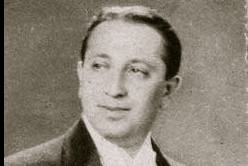
Like a time capsule, unopened for nearly three quarters of a century, the music of Walter Arlen lay hidden until 2008. Full of emotional issues from a period most of us know only from history, it inevitably leads us to ask: What is the ‘cut-off’ point, at which one can confidently say that Hitler’s direct influence has dissipated from our emotional, cultural and musical lives? How many generations are necessary to bridge the dual states of “refugee” to “all-American” with no emotional ties to a distant country with a language no longer spoken at home. Refugees arriving with young families were astonished to see how quickly their children assimilated. Lawrence Weschler, grandson of the composer Ernst Toch, and the son of Viennese parents, has written of his incomprehension of a grandfather who was neither interested in, nor enthusiastic about baseball. Indeed, for many refugees, it was often their Americanized children and grandchildren who kept them from returning to their former homelands.
On the other hand, Walter Arlen, who was born more or less around the time of Weschler’s parents, became an intriguing mixture of two cultures. Born in 1920, he was 18 when he left Austria for America in March of 1939. His dreams of studying music had been dashed, and he was fortunate to have escaped. Miraculously, his father had been released from Buchenwald days before a visa expired, and could leave for England with Walter’s mother and sister, where they arrived as penniless refugees. From Otto Erich Deutsch’s pronouncement that the five-year-old Walter had absolute pitch, to spending his teen-age years larking about with best friend Paul Hamburger, who would become the accompanist and teacher of a generation of British singers such as Dame Janet Baker, the young Arlen found himself working for a furrier in Chicago in 1939. To the wrecked plans of studying composition, there followed the humiliation of the family’s businesses and homes being appropriated by the Nazis, the suicides of his mother and other close relatives, the concentration camp deaths of friends and family and the separation throughout the war years from his immediate family, who remained at the mercy of London’s bombing raids. After Hitler’s defeat, the family was subjected to the full brunt of Austrian shabbiness in its treatment of Jews trying legally to regain what had been stolen from them: foot-dragging, stone-walling and the bureaucratic bully-boy re-possession of property damaged in the war which refugees living abroad had difficulty paying to have repaired. Destroyed not only were his youthful dreams, but also his memories of a happy childhood in Vienna and at the family’s summer villa near the Hungarian border. The country that had kicked them out showed no remorse, let alone interest, in having them return. Thus unimaginable pain was heaped on top of the humiliations already inflicted.
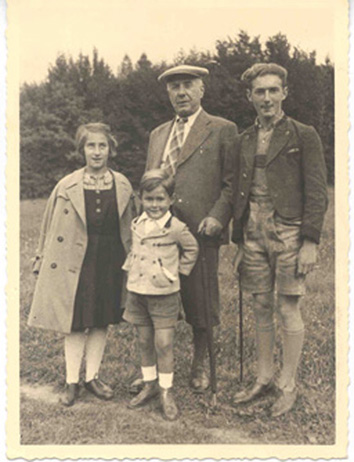
Photo 1: Walter Arlen hiking in the woods near Sauerbrunn, Austria, in 1935. From left, sister Edith Aptowitzer (changed later to Arlen); cousin Peter Silberstein; grandfather Leopold Dichter, founder of Warenhaus Dichter in Vienna; Walter (Aptowitzer) Arlen.
Through sheer talent, ambition and luck, Arlen was able to make the transition from furrier to musician. For four years he was the pupil and amanuensis of Roy Harris, one of the best known and most frequently performed American composers of the 1930s and 1940s. His musical calligraphy and fastidious inner-ear meant he was able to spot mistakes, correct and transcribe the Harris scores that now reside at the Library of Congress. From Harris he moved to Los Angeles for graduate studies in composition at UCLA and fell in with the remaining group of Austrian and German émigrés. He worked as a critic for The Los Angeles Times, founded, built up and chaired the music department at Loyola Marymount University and began a friendship with Howard Myers who became his devoted companion for the next fifty years. Arlen’s English, both written and spoken, was flawless and showed no trace of his Austrian origins. He and Myers travelled widely and were welcomed into the most important circles of American and international musical life; they were friendly with Igor Stravinsky, Darius Milhaud, Heitor Villa-Lobos, Carlos Chávez and Mario Castelnuovo-Tedesco.
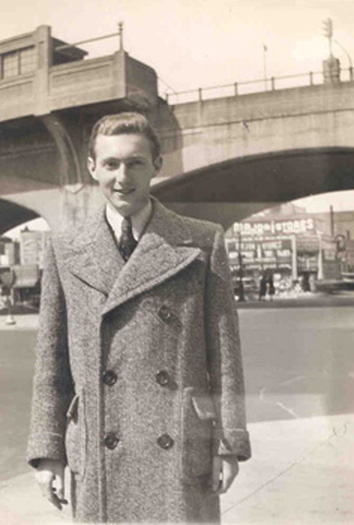
Photo 2: Walter Arlen on a Chicago street in 1940.
Yet beneath the appearance of recovery and cultural assimilation surged frustration and anger over the events of the past. Writing music, which he had done since his earliest years, became a form of therapy. In his “free time” after mornings working at the newspaper, afternoons teaching classes and evenings reviewing concerts, he added songs and piano pieces to the manuscripts he had kept before leaving Vienna. Most were put into desk drawers, but some received private performances by Arlen’s friend, singer Marni Nixon, thanks to encouragement from the likes of Milhaud and Chávez.
A series of chance meetings in 2005 led to a concert of Arlen’s works at Vienna’s Jewish Museum on March 12th 2008, the 70th anniversary of Austria’s annexation by Germany. In attendance were the country’s leading politicians along with various representatives of Exile-Music groups in Austria and Germany. Walter Arlen was interviewed between works and although performances were far from perfect, a strong enough impression was made so that his music was quickly taken up by both German and Austrian institutions. The Austrians brought him back for educational workshops, and the Germans mounted a festival with Arlen as the featured composer. A series of concerts was taken on tour and Arlen’s music started to be heard in numerous cities throughout Europe. Subsequent performances took place in Berlin, Milan, Los Angeles, San Diego and New York. In 2010 the Vienna-based Exile-Music Organization exil.arte paid to have baritone Christian Immler, soprano Rebecca Nelsen and the pianist Danny Driver record a selection of Arlen’s songs on two CDs to be released in 2011 by the Austrian label Gramola.
Walter Arlen is now ninety years old, nearly blind and he has not composed for more than a decade. Many of the songs chosen for recording had never been heard, even by the composer himself. Although he can no longer read a score, his keen ear and crystalline memory proved infallible in spotting wrong notes and incorrectly balanced harmonies. It confirmed the degree that each work had been meticulously crafted and remained indelibly etched onto his memory. The musical language is immediate; most of the songs are poignant and many are painfully intimate. They range from the mystical eroticism of the poetry of St. John of the Cross’ Five Songs of Love and Yearning, to the despair and nostalgia of displacement in the cycle of Czesław Miłosz’s texts, Poet in Exile. There are songs with texts by Robert Frost, Shakespeare, Rilke and Cavafi, among many others. One, the aptly named “Es geht wohl anders” (“Things turn out differently”) was written following Austria’s annexation by Nazi Germany when the composer was still in his teens; others were composed as late as the onset of his blindness in the 1990s.
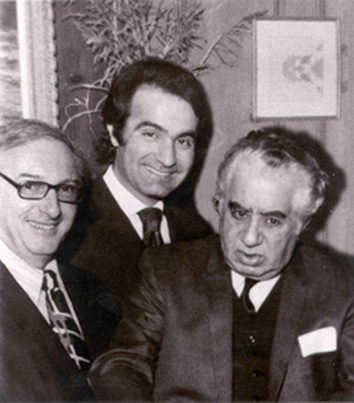
Photo 3: From left, Walter Arlen, conductor Varujan Kojian and composer Aram Kachaturian at a private home in Beverly Hills in 1974.
Inevitably, another question arises: “What actually constitutes an ‘exile” composer?” Arlen has lived in America since his late teens. His ties to Austria exist today only through his music as he has neither relatives nor possessions in the country of his youth. Yet his music is not that of an American composer — nor is it the work of an Austrian. It is a unique fusion of the two and offers a singular expressive cosmos that is, quite literally, neither here nor there but reaches all who listen to it.
Audio: ‘Island’ from Poet in Exile Text Czesław Miłosz; Baritone: Christian Immler; pianist: Danny Driver
ISLAND
—Czeslaw Milosz (co-translated by Robert Hass)
Think however you like about this island, its ocean whiteness, grottoes overgrown with vines, under violets, springs.
I’m frightened, for I can hardly remember myself there, in one of those mediterranean civilizations from which one must sail far, through the gloom and rustle of icebergs.
Here a finger points at fields in rows, pear trees, a bridle, the yoke of a water carrier, everything enclosed in crystal, and then I believe that, yes, I once lived there, instructed in those customs and manners.
I pull my coat around me listening to the incoming tide, I rock and lament my foolish ways, but even if I had been wise I would have failed to change my fate.
Lament my foolishness then and later and now, for which I would like so much to be forgiven.
The first half of the twentieth century was to see an explosion of creativity in all the arts, not least in classical music and opera. It was also an era of profound political and social upheaval, tumultuous transition, revolution and warfare. The art and music of the time reflect this and, like a cardiogram, tracked its movements. Out of the growing pains came new, formidable, innovative impulses. In the first third of the century, a vibrant, dynamic and liberal artistic culture nourished this even before the First World War.
But in 1933, with the Nazi accession to power in Berlin, the German-speaking world was to experience the greatest rupture of the over two-century-old cultural milieu. It interrupted, at best, destroyed and uprooted at worst, one of the supreme and enduring cultural traditions in Western Civilization: German Classical Music. The loss cut across all genres, and included opera.. This article focuses only on a fraction of the music that was silenced, operas of several German, Austrian and Czech composers. The long silence has been tragic, but the good news is that most of this music is published and readily available. Better news will come the day that much more of it will have been re-integrated into the repertory, where most of it was born and still belongs.
Of the two generations affected by the Nazi suppression, the older one was led by a pair of Vienna-trained composers, Alexander Zemlinsky (1871- 1942) and Franz Schreker (1878-1934). Both trained in the Brahmsian tradition and, fully versed in Wagner (together with the former’s student and brother-in-law Arnold Schoenberg), they would be the first to seek a new synthesis, born of the Brahms/Wagner polemic of their youths. In Vienna, and later in Berlin and Prague, they would teach and inspire a younger generation that would include Alban Berg (1885-1935), Erich Wolfgang Korngold (1897-1957), Viktor Ullmann (1898-1944), Ernst Krenek (1900-1991) and Berthold Goldschmidt (1903-1996). Berg needs no introduction. Korngold’s precocious genius produced extravagant post-Romantic music under the influence of Zemlinsky. Krenek would display an extraordinary virtuosity and command of different styles and genres, including jazz and operetta. His 1933 dodecaphonic political tract, Karl V, was offered as a humanist antidote to the political wave of the moment. It was banned and not played until the 1980’s. Ullmann’s three operas all bear a sharp and often witty extension of Schoenberg and Zemlinsky. Der Kaiser von Atlantis, written in the concentration camp at Terezin, is a brilliant mixture of social satire and inspirational humanism. Goldschmidt, with the Magnificent Cuckold and Beatrice Cenci, through a dissonant lyricism, made his political points more subtly.
Two young German composers developed far away from Viennese influence: Walter Braunfels (1882-1954), a strong advocate of neo-Romanticism, and Paul Hindemith (1895-1963), who, after his early years in the avant-garde, came to embrace neo-classicism. Like Krenek, his most significant political opera and masterpiece, Mathis der Maler, ran afoul of the Nazis.
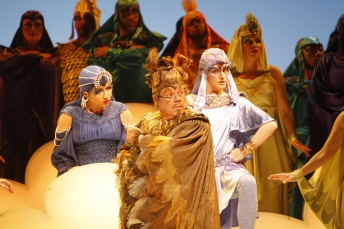
Figure 1: LA Opera’s Production of Die Vögel composed by Walter Braunfels. Front: Brandon Jovanovich (Good Hope) James Johnson (Loyal Friend) Back: Desiree Rancatore (Nightingale), Martin Gantner (The Hoopoe) Stacey Tappan (The Wren). Photo credit: Robert Millard/LA Opera
Czech by birth and German by culture, Erwin Schulhoff (1894-1942), outsider and maverick iconoclast, wrote a single opera, Flammen. Even today, this psychodrama would be considered “out of the box.” Also Czech, but French “by adoption,” Bohuslav Martinu (1890 -1959) wrote prolifically during a life of exile. Kurt Weill (1900-1950) moved from Berlin to Paris to New York, from early dodecaphonic music, to tonal social criticism to, finally, reinventing himself in the popular theater.
All of these men made significant contributions to the world of twentieth-century opera. Yet, with the exception of Berg, and to a lesser degree Schoenberg and Hindemith, they lost their rightful places in twentieth-century opera houses. Why and how that came about merits some comment.
After the end of the Second World War, our knowledge of the broad repertory of the generation that immediately preceded, and had lived and died in, the era of Nazi Germany was significantly limited. The lacunae were part of the legacy of the atrocities committed between 1933 and 1945. The Third Reich effectively silenced these two generations and, with them, important links in the chain of music history.
The first of these generations was transforming Late Romanticism into twentieth-century idioms. The younger, post-War generation moved from the extravagant emotionality of that world into an intense period of experimentation. Nothing was excluded as a starting point for a new art after 1920. High and low, beauty and ugliness, Dada and Marx, Freud and Picasso, jazz and neo-classicism—all were to be stirred in a broth of polemics. Hitler removed these artists from public view and, with them, a vibrant artistic document of the times.
Though some of this music is lost, an enormous amount of it has survived and is published and available. Insofar as it is physically preserved, one could argue that it has survived. But music “lives” only if it is performed and heard, and in this respect, it remains to be discovered by our music-loving public.
Since 1945, the classical music world has enjoyed enormous creativity. At the same time it has been impoverished by the disappearance of part of an entire musical era. On a moral level alone, this is unacceptable. In the Western world, our common patrimony of literature, music, architecture and dance is among our most prized possessions. We cannot allow a part of it to remain permanently excised by the actions of a repressive authoritarian regime.
The spirit of these “lost generations” needs to be heard in its entirety. The twentieth century is now behind us, and the community of classical musicians, musicologists and historians are re-writing its history. Seemingly authoritative judgments already have been proffered, without serious consideration of a great quantity of music. One of the moral mandates of the historian is to revisit any past era as new information is available. Whether it is Ancient China or Persia, Greece or Rome, nineteenth-century Europe or twentieth-century America, or revelations from last week’s newspaper, the historian must place the past in an informed context.
No detail is too small to be taken into consideration. French historian Fernand Braudel maintained it is not in the recounting of great battles, kings and warriors that the essence of history is to be found, but in the minutiae of everyday life. Without the complete picture, we have a distorted picture. Far from suggesting that these composers and musicians are “minutiae” (quite the contrary), I am advocating their resuscitation as genuinely significant creators. The fact that they were on the unfortunate side of history and destiny does not invalidate their work; conversely, neither should their status as victims give them rank for their fates rather than for their accomplishments.
Musical creativity of the first half of the twentieth century is far richer and pluralistic than we think. We, today, also live in a time when compositional styles are highly varied, inventive, open-minded, searching and fluid. The orthodoxies of post-war classical music are now history. The accepted authority of those orthodoxies impeded the revival of all that was not itself, sweeping away the musical ferment of this earlier, era, as well as those musicians who composed in competing and contradictory styles.
As monumental as the accomplishments of the disciples of dodecaphonic, electronic music and the post-war avant-garde were, they nevertheless did not have the authority to stake an exclusive claim on the twentieth century. In their way, these composers and critics perpetuated some of the very consequences of the policies of their Nazi nemesis, albeit with a commitment to the tenets of artistic prerogatives and legitimate rights to their own beliefs. No one doubts the fact that they were qualified to prefer their own music; but many who were less qualified were inspired to promote an overzealous condemnation of all in the past, that had a relationship to Late Romanticism, or trafficked in tonality, lyricism, cabaret and jazz. It was proclaimed, and accepted, that tonality was dead. From today’s perspective we know it clearly did not die, but migrated to the popular world, sometimes to the impoverishment of the world of “high art.”
The cliché “there are no lost masterpieces” reveals our own ignorance. Entire civilizations, along with their masterpieces, have been destroyed by war since the beginning of human history. It would be ludicrous to suggest that every piece of art from ancient Greece and Egypt, Pre-Columbian civilization and Dynastic China has been recovered. This cliché suggests that Art’s past is already complete. It implies that no unknown art or music can be good art. Furthermore, and more perfidious, it suggests that things are unknown because they are not good. It presumes that sound artistic judgment is the only factor in the gradual selection of that art which has value and is worth preserving. The history of the 1930’s and 40’s clearly contradicts that premise. Throughout history, the ravages of war, politics, and autocratic suppression of art have also “selected out” what we know and admire. Various forms of censorship have repeatedly affected artists and their works.
However, the suppression of certain composers and musicians during the Nazi era caused the greatest single rupture in what had been a continuous seamless transmittal of German classical music. The policies of the Third Reich destroyed the environment in which this music could flourish, murdering an entire generation of its greatest talents, uprooting a tradition with its creative polemics and dialectics, forcing those who survived to scatter to places where there was no comparable artistic milieu in which to live and create. This immense—ultimately self-destructive—act seriously damaged a most cherished tradition, killed its caretakers, and buried much of two “lost generations” and the spirit living within them.
In reviving this music, there are three aspects to take into consideration: moral, historical and artistic. Undoing injustice, when one can, is a moral mandate for all citizens of a civilized world. We cannot restore to these composers their lost lives. We can, however, do the one thing that would mean more to them than any other: play their music.
Figure 2: LA Opera’s Production of Die Vögel composed by Walter Braunfels. Desiree Rancatore (Nightingale), Martin Gantner (The Hoopoe), Stacey Tappan (The Wren)
Photo credit: Robert Millard/LA Opera
Historically, our perspectives on twentieth-century classical music are incomplete because an enormous quantity of works has remained unperformed, and the lives of its composers largely ignored. The twentieth century needs to be re-scrutinized after we acquaint ourselves with the voluminous music cast out during the Nazi suppression.
Neither moral nor historical considerations would be reason enough for revival were it not for the artistic quality of what was lost. That quality is manifest, and, I believe, demonstrable. But, for the quality of this music to be more clearly apparent, it must be played so that musicians and music lovers can experience its live performance. Its value cannot be judged by a single hearing or the occasional tokenistic performance. Judgments, if indeed they must be made, can only be so after those performing and listening to this body of work over the course of years have given the spirit of the era sufficient time to be fully digested.
A fully valid argument maintains that some of this music has gained and kept a place in the repertory after the bans of the 1930’s and the composers’ deaths and this is, arguably, a testament to its quality. The inverse argument—namely, that music that does not currently enjoy such status is due to a lack of quality—is, in my opinion, invalid. Such false arguments are, unfortunately, sometimes made on the basis of hearsay about, if not total ignorance of, the actual works themselves.
Zemlinsky and Schreker
Theodor Adorno described Zemlinsky as a “seismograph of his time.” This is a very apt observation. If one could listen to all of his music chronologically, one would feel his development step by step with that of the musical world around him. Some see this as a weakness, a lack of identity. Others see it as measure of his genius of adaptability and immense craftsmanship. To my ears, he has a voice and, above all, a character of his own, which reveals itself throughout to those who know his music in its breadth and entirety. With his sometimes stubborn determination to follow his own path, he alienated both the avant-garde (by his rejection of dodecaphonic techniques) and the conservatives (who found him too threatening). It is this lack of a convenient label that hurt his place in a century often characterized by reductionism, dependency on labeling, and discomfort with that which does not fall into tidy categories.
Zemlinsky’s early period, which is late-Romantic Viennese in character, produced music of great lyricism, grace and charm. Sarema (1893-5) Es war einmal (1897-99; conducted by Mahler) and Kleider machen Leute (1908-09) comprise the early period. Der Traumgörge (1904-06; commissioned by Mahler for Vienna, but cancelled during rehearsals when Mahler was forced to resign) is a transitional work that, despite a confusing story, contains a great deal of powerful music. It also reflects more of Mahler’s influence than the previous works.
The middle-period masterpieces (if I may) are both one-act operas based on Oscar Wilde. Zemlinsky, having conducted the Viennese premiere of Salome, had thoroughly digested and assimilated its compositional and orchestral techniques. This is reflected strongly in Eine florentinische Tragödie (1915-16). Like Salome, it is a word-for-word translation of the original Wilde, with a prelude of pre-curtain eroticism (Der Rosenkavalier) and polytonal shock at the finale. But by now, he has brought Mahler clearly into the mix and organized it all into an over-arching and subtle symphonic form. (Aside from some small details to be found ten years later in Wozzeck, the seminal idea of organizing an opera and its scenes on baroque and classical structures embodied in this work clearly was not lost on the young Berg, who attended one of the premieres the Tragödie and admired and knew the score intimately.)
Der Zwerg (1920-21) was premiered at the Cologne opera under the direction of Otto Klemperer. It is a free adaptation of Wilde, based on the short story, “A Birthday for the Infanta.” Its protagonist, a misshapen dwarf with a poetic and generous soul, is rejected in love by the unattainable and coldly mischievous young daughter of King Phillip II of Spain. It is a deeply personal and confessional work.
This opera had a long gestation. A decade earlier, Zemlinsky had commissioned his friend Franz Schreker to write him a “tragedy of an ugly man.” Schreker complied, and became so enthralled with his own story that he asked to withdraw from the commission and keep it for himself. That is what happened, and the result was one of Schreker’s great achievements, Die Gezeichneten. Zemlinsky, who was the first of the long line of geniuses to have been passionately involved with Alma Schindler, was, by her assessment, small in stature and ugly. She referred to him as a “gnome.” The unceremonious and abrupt end of their frustrating and tantalizing relationship in 1902 left the composer deeply scarred. Twenty years after, he was still exorcising its ghost.
Tastes, of course, are very personal, but I believe Der Zwerg stands not only at the summit of the composer’s power, alongside its contemporaneous Lyric Symphony, but is one of the great operas of the twentieth century. Having learned what he needed from Strauss and Mahler, Zemlinsky integrated the former’s theatrical genius with the latter’s paradoxical melding of the metaphysical and the personal, injecting his own brand of searing eroticism. The entire work is a tour de force.
Subsequent to his move to Berlin, where he collaborated with Klemperer, Zemlinsky conducted, among many works, the Berlin premiere of Kurt Weill’s Rise and Fall of the City of Mahagonny. Fascinated with the neue Sachlichkeit and his new surroundings, he produced a Brechtian work of his own, complete with alternating dialogue, Der Kreidekreis (1930-2). It was this work that was specifically banned and led directly to Zemlinsky’s flight from the Nazis, first from Berlin to Vienna in 1933, and a second time, from Vienna to the United States, in 1938. His final opera Der König Kandaules, which he did not live to complete, features dark, tortured harmonies, demonstrating that in his maturity, the man who had taught and influenced Berg had also learned from him, and the posthumous completion and orchestration of this work by Anthony Beaumont shows this clearly.
Franz Schreker was perhaps the most successful opera composer of his time. He was considered in some quarters to be the worthy successor to Wagner and Strauss. Though this assessment was clearly over-inflated, it shows the measure of the admiration and success he enjoyed for a period between 1912 (Der Ferne Klang) and his first significant set back (Irrelohe) in 1924. Die Gezeichneten (1913-15, premiered in1918) and Der Schatzgräber (1915-18, premiered 1920), exemplify and demonstrate the best of Schreker.
Among his debts to Wagner (and all of these composers had them) is reflected in his choice to write his own stories and libretti. Though not mythical in subject matter, they are far removed from contemporary life. But under the surface, they reflect the moving tectonic plates of fin de siècle Vienna: the gradual dissolution of the Empire, the world of Freud and the subconscious, Klimt and Schiele. If not exactly autobiographical, the protagonist is clearly the young striving artist. The subject is Art, and the search for, and value of, Beauty in a world of ugliness and despair.
His musical style, immediately lauded for its evocative use of orchestral timbres, is tonal in base with a strong admixture of poly- and atonality. The composer conducted the world premiere of Schoenberg’s Gurrelieder, and the coloristic possibilities of that immense orchestra were not lost on him. Schreker’s style is Romantic Expressionism, strongly seasoned with morbid eroticism and its whiff of decadence. By nature and early experience more in contact with greater Europe than some of his contemporaries in Vienna, Schreker submitted also to the influences of Impressionism. Schreker scholar Christopher Hailey sees him also as the missing link between Mahler and Puccini. The attraction to Italy, demonstrated in the scenarios of Die Gezeichneten and Der Ferne Klang, is reflected in tinges of Verismo opera.
Walter Braunfels and Die Vögel
Considering all that was going on around him, it is difficult to situate Braunfels amongst his contemporaries. His music inhabits a very different world, both geographically and aesthetically, nurtured far from Vienna’s charged, multi-cultural atmosphere., Deeply rooted in German Classicism and Romanticism, he conceals none of his admiration for the inherited past and sees himself as building on its fundamentals. By almost any standard, he was a conservative. Like Schreker, Krenek and Hindemith, he followed Wagner’s example in writing most of his own libretti. Almost diametrically opposed to Schreker’s highly coloristic, polytonal eclecticism, his music is tonal, polyphonic, lyrical and formal. Equally at odds with Zemlinsky and Schreker, his choices of subject matter show a penchant for Classical Antiquity, German Romantic literature and Christian mysticism. In Braunfels’ best-known opera, Die Vögel (The Birds) , his admiration for Bruckner and Mozart and Mendelssohn is reflected throughout. Some contemporary critics saw this work as a rejection of Wagner and Schreker, under the banner “forward to Mozart.” This seems partially mistaken to me, as this work owes debts to both Die Meistersinger and Parsifal. This view held that the music was stepping out of its role as the servant to drama: the music is the narrative.
Braunfels himself related that he simultaneously wrote text and music. Very telling is the composer’s decision not to “recount” Aristophanes, but to recast him for his own purposes and, in so doing, show us where his soul and sensibilities lay. The subject is Sehnsucht (yearning), the omnipresent dynamo of nineteenth-century German music. It is no longer only comedic social and political satire; it is a spiritual testament wrapped in fantasy. It is in this sense that a deeper relationship to the The Magic Flute becomes apparent.
Two young men, Good Hope and Loyal Friend, set out on an adventure to escape disappointment with human affairs in Athens, determined to find a new life amongst the birds. Like Tamino and Papageno, one will come home changed from a mystical experience, the other, chastened and resigned, if not exactly wiser. Mozart’s flute is magic, charms humans and animals alike. Braunfels’ Nightingale, with her plaintive song, strikes the deepest chord of Sehnsucht imaginable. The enchantment scene of the second act symbolically re-creates the trials, not of fire, water and silence, but of the mystical realm of Parsifal’s Karfreitagzauber. Good Hope, having fled rejection by the city girls, will discover cosmic yearning and transcendence through his erotic “encounter” with the Nightingale, as Parsifal will eventually find the grail through his confrontation with Kundry.
Figure 3: LA Opera’s Production of Die Vögel composed by Walter Braunfels. Desiree Rancatore (Nightingale).
Photo credit: Robert Millard/LA Opera
The juxtaposition of Loyal Friend’s buffo chatter to Good Hope’s spiritual transformation captures the Mozartian model with finesse. Loyal Friend pushes the narrative forward, much like dialogue in Singspiel and recitative in opera buffa. Good Hope dreams and reflects in Schumannesque reverie. All this, in the lunar, nocturnal forest described by another contemporary writer as “kunstheiliges Land;” holy land, made so by art, made so by the composer peering into the depths of his own soul and transforming this into the sound world.
This is the stuff of high Romanticism, clearly not what we associate with post-World War I Germany. Yet even Strauss did not disdain to return to the past, and there is no question that Die Vögel has also been influenced by Der Rosenkavalier and Ariadne auf Naxos. The purposeful use of musical anachronism to evoke the past is one of the key departure points for Strauss. In a very different context, and less as a “technique” than the expression of the state of his soul, Strauss will return to it at the end of his life with Capriccio, Metamorphosen and the Vier Letzte Lieder. The classical/Romantic juxtaposition of Ancient Greece and the Commedia dell’arte in the latter are direct role models for Braunfels, as exemplified by the Nightingale’s Zerbinetta-like prologue.
One of the great charms of Die Vögel is just this anachronistic (neo-Romantic) atmosphere. It is not so much a Straussian “use” of the musical means, but a concordance of the essence of Braunfels’ musical language with that aspect of the subject matter. It perfectly evokes a non-existent world, a garden of paradise imagined, only to be found beyond the limits of urban life and reality. Its choice of setting from Classical Antiquity lends itself well to a genus of “non sectarian spirituality.” Later, Braunfels will immerse himself in Catholicism and, large works will reflect this (the Te Deum, Verkündigung (1935), Die Heilige Johanna (1943) being the most significant of that genre.
It is not hard to imagine why the composer was marginalized after the war. On the aesthetic spectrum he was a life-long conservative, a category that was regarded with total disdain in the post-war milieu. Those who had opposed the progressive and avant-garde currents of the pre-war years were considered by definition, reactionary, and invited to join their confreres in the dustbin of history. The notion that only composers who were progressive, pioneering ground-breakers in their eras are worthy of our attention, had, and still has, great currency. The fact that, in a majority of cases, these “progressives” did happen to be the same persons, however, is more a corollary than a causal relationship.
Figure 4: LA Opera’s Production of Die Vögel composed by Walter Braunfels. Brandon Jovanovich (Good Hope), James Johnson (Loyal Friend), Martin Gantner (The Hoopoe).
Photo credit: Robert Millard/LA Opera
To scrutinize compositions from the past on the basis of their location on the progressive/conservative divide is to prefer categorization based on anterior knowledge to the immediacy of non-prejudicial listening. The earth has shifted below many of the questions that divided aesthetic viewpoints from the past. The importance of knowing who was part of the avant-garde and who was not, fades with time. It is the essence of the music, in my opinion, not its historical/musicological placement, that matters. Had Die Vögel been written in 1875, would we listen to it differently because, at that time, it would have been progressive? Should we continue to ignore a work such as this because we consider it old fashioned? In their way, Bach and Brahms were so considered in their own times, and it would be absurd to discard their music on that basis.
The premiere of Die Vögel in Munich in 1920, under the direction of Bruno Walter (who still lauded the work as late as 1950), was a huge public and critical success. The number of productions and performances in the following years was staggering. However, in the post-World War II years of his “rehabilitation,” Braunfel never regained a foothold. Die Vögel was not produced until 1971 in Karlsruhe and 1994 in Berlin. The beautiful Decca recording gave it new life after 1996.
Had some major recording company believed in it in the 1950’s or 60’s, this opera might have regained its past popularity in no time at all. A recording with, say, Dame Joan Sutherland, Fritz Wunderlich and George London, might have assured its future on the stage.
There is a striking irony within Braunfels’ history with the Nazis. He embodied everything that represented the best of the German Romantic legacy. Had the Nazis wished to see him as a model of all of their professed ideas about Germany and Art, he would have seemed an ideal choice. He was versed in Goethe and Antiquity, Bach, Beethoven and Brahms. He clearly emulated the Wagner of Parsifal and Die Meistersinger (the work most misappropriated and abused by Hitler) and shared certain esthetic viewpoints with Pfitzner (who also subsequently fell under Nazi opprobrium). He resisted almost all of the trends and movements the Nazis professed to despise. Their hatred of him resided not so much in the fact that he was a “Halbjude,” as they defined him, but because he had openly opposed and criticized them already in the 1920’s, refusing to write an anthem for their movement.
Braunfels, like the vast majority of assimilated German Jewish artists and writers of the time, viewed himself first and foremost as German and secondarily, if at all, as Jewish (he converted to Catholicism in 1917). His immediate dismissal in 1933 and subsequent disappearance from public life simultaneously reveal the utter depth of the Nazis’ intellectual ignorance of their own professed belief in “pure” German Art, as well as their vindictiveness in overlooking an obvious “cultural model.” There was no one more quintessentially “Deutsch” than Braunfels, who embodied the very best of inherited German art, and who honored the tradition (in the best sense of the word), of its great culture.
Originally published in Opera magazine, April 2009. Reprinted with permission.
More than a hundred Jewish musicians who were forced to flee Europe during the Nazi years found refuge in Argentina. Most of them came to the country with excellent musical education and having achieved significant, successful professional lives in Europe. Composers, performers, critics, musicologists, educators and stage directors (many of whom were were born in Germany or Austria) had to leave their homes and jobs on the European continent and chose to come to Buenos Aires as a place of exile.
The majority of these musicians arrived in Argentina with a solid background, having studied in great schools of music (Sternschen Konservatorium in Berlin, Staatlichen akademischen Hochschule für Musik in Berlin, Neuköllner Volksmusikschule in Berlin, Hochschule für Musik in Leipzig or the École Normale de Musique in Paris) and with important teachers: Ljerko Spiller sudied with Jacques Thibaud, Georges Enesco and Diran Alexanian; Roberto Kinsky with Zoltán Kodály; Dolly Schlichter with Arnold Schoenberg and pianist Eduard Steurmann; Victor Schlichter with Schoenberg; George Andreani with Sergei Trailin, a student of Rimsky Korsakov; and violinist Ana Sujovolsky with Carl Flesch; Lili Heinemann with Louis Bachner and Anna Wüllner-Hoffmann; Herman Geiger-Torel with Lothar Wallerstein. The diversity presented by this range of schooling–which runs the gamut from traditional European concert music to the avant-garde–is evidence of the rich and varied background these musicians brought to Argentina.
It is also noteworthy that some of these immigrants held significant positions in their countries of origin: Roberto Kinsky at the prestigious Dresden Opera; Ljerko Spiller was the concertmaster of the chamber orchestra conducted by Swiss pianist Alfred Cortot; Teodoro Fuchs was a conductor in Danzig and worked at the Stuttgart Opera. The violinist Ljerko Spiller had won the Wieniawski Prize, and the soprano Lily Heinemann had appeared at the Glyndebourne Festival. Dajos Béla, Efim Schachmeister, Victor Schlichter and Illia Lifchakoff had conducted successful jazz orchestras and had played in the ballrooms of various European cities: Hotel Excelsior and Hotel Adlon in Berlin, the London Palladium or the Monseigneur in Paris. They had recorded for the Odeon and other record companies of the time.
The conditions upon arrival in Buenos Aires, although different in each case, corresponded to the historical moment. In some cases, family members already in the country awaited the arrival of their relatives. In other cases, an association for immigrants was ready to lend support. Although most musicians had to begin looking for work when they arrived, a few of them came with contracts already in hand. Many remained in Argentina for the rest of their lives, although others opted to return to Europe after the war or left for the United States.
Among the group that stayed were musicians who dedicated themselves to composition, musicological research or music criticism; to the interpretation of European art music, tango, liturgical music or klezmer music; to the formation and/or direction of musicians' unions; to editing music magazines; to orchestral conducting; or to opera directing. Radio and film were also venues for these émigré musicians. Some held positions of leadership as orchestra conductors, violin soloists or film composers. This group of musicians included the composers Jean Gilbert, Teodoro Fuchs, George Andreani, Alexander Szenkar, Guillermo Graetzer, Victor Schlichter, Istvan Weishaus and Dajos Béla. The young Werner Wagner, Michael Gielen, Alejandro Pinto and Marcelo Koci all studied composition with teachers in Argentina.
Figure 1: Jean Gilbert
On May 4, 1939, Jean Gilbert (Max Winterfeld), a renowned composer of operettas (he had composed more than fifty of them in Berlin), arrived in Buenos Aires, where he was engaged to conduct the orchestra Radio El Mundo. The performances that took place three times a weekend provided a great impetus to the operetta genre in Argentina. Gilbert worked ceaselessly as a conductor and operetta composer for the national cinema, but only for a few years, because he died in December 1942. He provided music for the films Novios para las muchachas (by Antonio Momplet, 1941), El pijama de Adán (by Francisco Mugica, 1942), Su primer baile (by Ernesto Arancibia, 1942), En el viejo Buenos Aires (by Antonio Momplet, 1942) and La casta Susana (by Benito Perojo, 1944).
George Andreani (Joseph Kumok) arrived in Argentina in 1937 and immediately composed the music for the film Fuera de la ley, directed by Manuel Romero. Andreani had worked as a conductor and composer of thirty-eight film scores at the Barrandow Studios in Prague and the UFA Studios in Berlin and had composed the music for the award-winning film The Golem, by Julien Duvivier. In Argentina he maintained his links to the world of cinema, composing the music for more than seventy movies and working alongside such directors as Manuel Romero, Enrique Susini, Arturo García Buhr and Carlos Hugo Christensen; most of these films were made for the Lumiton Studios).
Victor Schlichter composed his first piece at the age of six and, at twelve, gave his first concert in Vienna. He studied violin at the Musikschule in Vienna, then in Paris with Lucien Capet, and composition (in Vienna) with Arnold Schoenberg. He also studied with Paul Elgers. He was born in Vienna on March 7, 1903, in the bosom of a bourgeois Viennese family. The German film industry was one of the most successful in the European market, and the UFA-film production company was one of Europe's largest. Under its auspices, Schlichter launched a career as a conductor and composer of film music and, simultaneously, as an operetta conductor. By early 1933, his career in Berlin was well established. That same year he founded a successful quartet, The Viennese Bohemians, which performed throughout Europe. But with the increasingly critical situation in Europe, Schlichter, like so many others in those dark years, began to think of leaving. Together with the other members of his quartet, Schlichter obtained a contract in Argentina, which allowed him to arrive in Buenos Aires and live there with no problems. Victor He embarked on the “Conte Biancamano” at Genoa on December 18, 1936, and reached Buenos Aires on December 31. There he fully developed his career as both conductor and composer. He was particularly successful in the areas of broadcasting and film, which were in their heyday in Argentina. He also composed incidental music for different kinds of radio programs and accompanied popular comic actors at the radio station. Between 1945 and 1977 he composed music for theaters where his sister Hedy Crilla worked as an actress or director; these included children's theater, classical theater and Yiddish theater (including a stage adaptation of Tevye the Milkman by Sholem Aleichem, The Princess and the Swineherd by Hans Christian Andersen, Spring Awakening by Frank Wedekind and Harold and Maude by Colin Higgins. Victor Schlichter died in Buenos Aires on December 8, 1986, leaving a body of work that also included carols, fox-trots, approximately thirty children's songs and the soundtracks for more than twenty-five Argentine films, on which he had worked with such directors as Luis Saslavsky, Luis César Amadori and Carlos Schlieper.
Figure 2: Dajos Béla
Dajos Béla was born in Kiev on December 19, 1897. He studied violin in Moscow with Michajl Press and in Berlin with Issay Barmas. His early engagements were in small clubs in the north of Berlin. In the early '20s he started his own jazz orchestra, whose repertoire included dance music along with music by Johann Strauss, Erik Meyer-Helmund and others. With the advent of “talkies,” Béla and his band participated in the films Tingel-Tangel (1930); Ein Lied, ein Kuss, Ein Mädel and Gitta entdeckt ihr Herz (1932, directed by Carl Froelich); Hasenklein kann nichts dafür (1932); and in the shorts Kabarett-Programm Nr. 1 (1931) and Kabarett-Programm Nr. 4 (1931). In March 1933, while giving a concert at the Hotel Excelsior in Berlin, he was brutally interrupted by Nazi assault troops. He retreated to his home, and he and his wife left Germany for Holland that same night. Two years later, Béla obtained a contract with Radio Splendid in Buenos Aires. He arrived, accompanied by some members of his orchestra, in March 1935. In Argentina he continued his brilliant career as a conductor and violinist linked to the radio. He also composed music for the movies Compañeros (directed by Gerardo Húttula, 1936), Turbión (directed by Antonio Momplet, 1938) and 24 horas en libertad (directed by Lucas Demare, 1939). Other compositions realized in Argentina: “Un beso de tus labios” (waltz), “Adoro el mar” (waltz), “Aquí estoy solo contigo” (“Du bist in Letzter zeits”; fox-trot), “Okey Mr. Pepe” (milonga), “Noches de Hungría, Gitano.”
Little information has been found to date about István Weishaus, conductor and violinist, born, it is believed, in 1904. Arriving in Buenos Aires around 1934, he conducted various radio orchestras, including Radio Excelsior, Radio Stentor and Radio El Mundo. In Argentina he composed waltzes and other pieces, including “Allá… en Viena” (waltz); “Bailando en el Broadway,” “Círculo romántico,” “Dulzura,” “Flores de Viena,” “Ondas del Plata” (waltz), “Pasión gitana,” “Pot pourri de valses,” “Princesa mora” (paso doble), “Suspiros,” “Brisas del Danubio” (waltz) and “Vida mía” (waltz).
The conductor and composer Teodoro Fuchs was born in Chemnitz, Saxony, Germany, in 1908. He studied conducting with Clemens Krauss, conducting and composition with Joseph Marx and Robert Heder. In1933 he fled Germany and settled in Istanbul, where he taught at that city's university. He arrived in Argentina on April 2, 1937, aboard the ship “Alcyone” out of Rotterdam. Shortly after his arrival, he was named conductor of the Symphony Orchestra of Córdoba. His compositions include Variaciones y fuga (1927), Sonata para violín (1937), Danza judía (1934), Suite judaica, “Impresiones argentinas” (1940), Sonata para dos violines y piano (1945), Sinfonía (1945), Oratorio profano, “Danza oriental” (1946), Ruhayat.
Although best known for his work as a conductor, Alexander Szenkar (Szenkar, Michael Alexander), born in Budapest, was also a composer of symphonies, suites, lieder, chamber music and theater music. He came from a family of musicians (his brother Eugen was also a noted conductor) and had a great career in Europe before going into exile in Argentina. He arrived in Buenos Aires in 1938 and conducted the orchestra of the Teatro Colón. He founded and directed the “Camerata Academica de Buenos Aires.” In 1959 and 1960 he conducted the Radio Symphony Orchestra of Uruguay in Montevideo. Compositions from his time in Argentina include “No la puedo olvidar,” “Adiós ilusión,” “Canción de cuna,” “Canción para el que llega,” “Cuatro canciones infantiles,” “Lied,” “Noches gitanas” and “Song.”
Figure 3: Guillermo Graetzer
Guillermo Graetzer was born in Vienna on September 5, 1914. From 1930 to '34 he studied at Berlin's Neuköllner Volkshochschule, where his teachers included Paul Hindemith (until his resignation), Harald Genzmer, Ernst Lothar von Knörr and Hans Böttcher, among others. He also took private composition lessons until 1935 with von Knorr and Böttcher. In 1935 he moved to Vienna because the situation in Berlin had become untenable. There, he studied composition with Paul Amadeus Pisk. Graetzer participated in various concerts shared with other composers of the modern school; many of their works were given their premieres. As the European situation became increasingly dangerous, the Graetzer family decided to immigrate to Argentina, and they arrived in Buenos Aires on January 2, 1939. In his new country, Graetzer connected with Juan Carlos Paz, who was involved in the avant-garde music scene. (Paul Pisk established the contact between them via a letter of recommendation.) During this initial stage, Graetzer was also linked to various musical events organized by Jewish – mainly Zionist – cultural associations, for which he set a considerable number of biblical texts as well as Hasidic, Yiddish and Hebrew poetry. In 1946, on the basis of the ideas he had encountered at the Volkshochschulen developed by Paul Hindemith, he founded the “Collegium Musicum” of Buenos Aires. There he organized music classes for children and training courses for teachers of music and dance. In addition to his role as artistic director, he also taught pedagogy and musicology and conducted choirs. He adapted the Orff Method for Latin America and published a significant number of anthologies and arrangements.
In his first compositional period, which dates from the Primer Cuaderno de Lieder (1935-37) to De la Sabiduría (1957), his music was influenced by neo-classical trends. Over time, Graetzer began to write polytonally, atonally, serially and by building textures of remarkable character, manifested through his own individual style of instrumentation. From the 1960s on, in his second period, he sought a break with the Old World and explored other paths, especially the Latin American sound world. American themes — notably pre-Columbian ones — captivated him. In 1962 he composed the Preámbulo al Popol Vuh de los Mayas, and then music with texts by Spanish and Latin American writers. In posthumous recognition of his achievements, the Argentine Society of Authors and Composers created the Guillermo Graetzer Composition Competition.
Conclusion
For most modern artists, travel has been common and necessary as a means for encountering new aesthetic ideas, opportunities for study with certain teachers or for improving economic conditions. Such networking established meaningful cultural ties throughout Europe and between Europe and the Americas. But in the lives of these musicians in particular, political conditions made the word “exile” an extension of the word “travel.” For many of these immigrants, one exile was followed by others. Thus, the original “other place” was no longer just Palestine but also Germany, Austria, Poland, Russia and other countries affected by Nazism and World War II. For many of these musicians, arrival in Argentina reflected their hopes for social, political, cultural and economic success. Having been expelled from their native countries, they searched–not without difficulty– for ways to continue their work in music. In the course of adapting and integrating, they learned a new language, often changed their names, and established ties to a new musical environment.
In conceiving of artistic practices as a network of collaboration among individuals, I acknowledge the contributions of sociologist Howard Beckerii and, following his model, interpret the activities of the Jewish musical community in Argentina as an “art world,” that is, a model of collective activity organized and later reified in the creation of, or participation in, diverse musical institutions, such as chamber ensembles, orchestras, educational institutions, and professional associations. Becker's idea is that all artistic activity is a social phenomenon; that is, an activity involving a group of individuals related to a particular area and a given historical context, one that evolves in a certain social direction, which manifests itself among the individuals involved in this enterprise. According to Becker, there are two types of solidarity among these individuals: one that is related to these individuals' origins, and one that is related to subsequently developed professional affinities.
All of these musicians faced exile, but – without ignoring or forgetting their painful past – they created and left behind an important legacy in all of Argentina's musical spheres.
This article is an extract from the Ph.D. thesis “Músicos judíos exiliados en la Argentina durante el nazismo (1933-1945). Estudio sbre su inserción profesional y el impacto de su presencia en la cultura nacional”, made in Universidad de Buenos Aires. (not yet published)
Posted October 7, 2010
This article is an extract from the Ph.D. thesis “Músicos judíos exiliados en la Argentina durante el nazismo (1933-1945). Estudio sbre su inserción profesional y el impacto de su presencia en la cultura nacional”, made in Universidad de Buenos Aires. (not yet published)
————
————
i. Wagner arrived at the age of ten and studied composition with Jacobo Fischer; Koc arrived at twenty and studied with Fischer, Graetzer and Juan Carlos Paz; Pinto arrived at the age of eight and studied with Graetzer; Gielen arrived at thirteen and studied with Erwin Leuchter. ↑
ii. Howard Becker, Art Worlds, Berkeley and Los Angeles: University of California Press, 1982. ↑
In 1927, Alexander Zemlinsky, the fifty-seven year old conductor of Prague's New German Theater, headed for Berlin, hoping for a fresh musical start. During the previous seventeen years he had given the Czech capital everything he had and had kept the city abreast of contemporary musical currents, but he had been longing all the while to be free of Prague's provincialism. Zemlinsky's preference was always to return to Vienna, the city of his birth, but Vienna seemed indifferent to what he had to offer, and offered him nothing in return. When Otto Klemperer invited the veteran conductor to join his staff at Berlin's newly formed Kroll Oper, Zemlinsky jumped at the chance. He would spend the next five years in the Prussian capital. Yet rather than providing true musical fulfillment and the recognition that was Zemlinsky's due, Berlin proved to be his undoing. His work as a conductor would be cut short when Klemperer's experimental theater was closed down after four years, and shortly thereafter Zemlinsky and his seventh opera, Der Kreidekreis, became early victims of Goebbels' yet-to-be defined—or refined—musical policies.
These misfortunes could not have been predicted. Indeed, upon his arrival in Berlin early in September 1927, Zemlinsky encountered a revitalized metropolis. The crippling post-war inflation that had left Berliners demoralized, hungry and unemployed as late as 1923 had been brought under control, and optimism and confidence had returned. The path was paved for Berlin's goldenen Zwanzigerjahrigen, the Golden Twenties. The city had supplanted Vienna as the musical capital of the German-speaking world and was now home to a number of Zemlinsky's friends and colleagues, among them the composers Arnold Schoenberg, Franz Schreker and Paul Hindemith and such world-class conductors as Bruno Walter, Erich Kleiber and Wilhelm Furtwängler. Berlin was likewise attracting many of Europe's premier architects, scientists, writers and artists and developing the progressive institutions with which they were associated.
By 1931, however, Berlin's promising political and cultural climate had disintegrated. The Kroll Oper, for example, under siege from the right -wing press almost from the start for fostering what it perceived as a Judeo-Negro epoch in Prussian art, was finally shut down, and by the summer of 1932 Germany once again found itself knee-deep in recession. With thousands of small businesses failing and six million people out of work, new parliamentary elections were held. Victory went to the National Socialists, now the most powerful party in Germany, claiming 230 seats in the Reichstag. Then, in January of the New Year, Adolf Hitler was appointed chancellor.
The closure of the Kroll brought to an end the last conducting post of any consequence that Zemlinsky would hold; this was in part a personal choice and in part a result of diminishing professional options as the National Socialists began to tighten the noose around non-Aryans. As a result, Zemlinsky turned increasingly to composition. In 1930 he had begun crafting a libretto based on a play, Der Kreidekreis (The Circle of Chalk), by Alfred Henschke (better known as Klabund); by midsummer of that year he was at work on the short score, and for two years he composed nothing else. In October of 1932, Zemlinsky finished what proved to be his last completed opera, and his publisher, Universal Edition, arranged for Der Kreidekreis to receive premiere performances the following year in various German cities, including Berlin, Frankfurt, Nuremberg and Cologne. Zemlinsky finally seemed poised for a breakthrough.
Based on a masterpiece of the thirteenth- and fourteenth-century Yuan dynasty established by Kublai Khan, Der Kreidekreis revolves around the pretty Haitang, whose family is caught in a web of extortion spun by the mandarin Ma. Unable to pay his taxes, Haitang's father hangs himself, and her brother, Chang-ling, becomes a revolutionary. Destitute, Haitang's mother sells her daughter into prostitution. Pao, a prince, falls in love with Haitang and bids for her, but he cannot match the sum Ma is willing to pay. At the start of the opera's second act, Ma's childless wife, Yu-Pei, learns that she is to be eliminated from Ma's will because Haitang has given birth to a son. Yu-Pei poisons Ma and points the finger of blame at Haitang, paying off “witnesses” to bolster her case, all the while maintaining that the child is hers. Haitang is sentenced to death, but she is granted a stay of execution when Pao, who has since attained the rank of emperor, suspends all death sentences as his first act of justice. Pao brings the two women together and, placing the child between them in the middle of a circle of chalk, declares that whoever can pull the baby from the circle is the rightful mother. As Yu-Pei begins to pull the child away, Haitang relinquishes her grip so as not to cause him harm. Her true compassion proves her innocence and maternal rights, and exposes Yu-Pei's guilt. Pao then confesses to having seduced Haitang as she slept during her first night in the mandarin's house. Haitang's dream is now reality: her child is elevated to the rank of prince and she to that of empress.
Despite the rags-to-riches story line of Der Kreidekreis and its fairy-tale ending, the opera is distinguished from all of Zemlinsky's earlier work through its reliance on a variety of powerful themes — good versus evil, rich versus poor, the brutality of the ruling class, rebellion, victimization, suicide and revolution. The story's focus on social order and morality, however stereotyped, places it squarely within the prevailing operatic zeitgeist, resulting in the timeliest of all Zemlinsky's operas. i The form and style of the opera also suggest Zemlinsky's attempt to keep pace with his contemporaries, particularly Kurt Weill and Berthold Brecht, whose Dreigroschenoper had burst onto the Berlin scene two years before Zemlinsky set to work on Der Kreidekreis. The latter opera's jazz associations, its combination of song, spoken dialogue and melodrama (spoken voice with orchestral accompaniment) and even its themes of social criticism all point to Brechtian dramaturgy and, arguably, to Berlin nightlife.
From the first scene, Zemlinsky is in territory far removed from any he had previously explored. Tong, the teahouse/brothel proprietor, speaks directly to the audience, accompanied by the soft swing of the saxophone. The atmosphere is seedy and mysterious, and, if not for the libretto's indication that the scene opens in a teahouse, it could just as easily play in a smoky Berlin cabaret. Musically, however, Der Kreidekreis displays strong connections to Zemlinsky's other works of the period. As in the Symphonische Gesänge and the Third Quartet, Zemlinsky here relies on tight motivic cells, static ostinato patterns and neue Sachlichkeit restraint, and he charts a harmonic course parallel to that of the Symphonic Songs, moving from D minor to D major — a symbol of the plot's transcendent movement from darkness to light.
Der Kreidekreis's Berlin premiere was to have been led by Otto Klemperer in April of 1933, but in mid-March, six weeks after Hitler's ascent to power, Zemlinsky got word that his opera was being placed on hold. The Reich had yet to establish its “official” policy regulating what could and could not be performed, but already its intent was clear where Jews and their music were concerned. Until January, the attacks had come via the Nazi press and through the disruption of concerts, but in February and March, members of the Sturmabteilung (SA) began invading opera houses and threatening conductors. Klemperer and the Staatsoper drew attention to themselves in February with an unorthodox interpretation of Wagner's Tannhäuser, which Goebbels considered a travesty and which was marred by cries of disgust from Nazis in attendance. Before another Klemperer concert, a caller threatened to disrupt the performance, which was then cancelled outright “for reasons of public safety”. ii In view of these events, Heinz Tietjen, General-Intendant of Berlin's opera houses, refused to allow Klemperer or the Staatsoper to take unnecessary risks and wrote to Klemperer, in March, that the decision to postpone Der Kreidekreis was “primarily preventive”. iii Universal Edition expected the other theaters around Germany to follow suit.
Zemlinsky's letters to Universal during this period reflect his frustration and anxiety. He was accustomed to production complications, but the current problems were new and sinister, and he did not know what to make of them. What, Zemlinsky wanted to know, was the exact nature of the situation? “Are the problems with the libretto — the music — myself ?” iv For the moment, nothing was certain, except that Zemlinsky's case was not unique. Already in 1932 Ernst Toch's opera Der Fächer had been shut down in mid-rehearsal when storm troopers wrested the baton from the conductor's hand. Berthold Goldschmidt's opera Der Gewaltige Hahnrei, on the other hand, went more quietly: scheduled for performance at Berlin's Städtische Oper in 1933, following its successful Mannheim debut, it was simply cancelled with no explanation. In Dresden, the music director Fritz Busch was manhandled in rehearsal and he subsequently resigned. Although he was not Jewish, Busch was openly and vehemently opposed to Hitler and the Nazi Party. The Jewish conductor Bruno Walter, physically barred from conducting in Leipzig, requested police protection for a concert with the Berlin Philharmonic, but rather than honor his request the authorities had him replaced. v For Zemlinsky, Universal still held out hopes that his opera would have its premiere in mid-November, but because the new regime did not expect to have its people and policies in place before the end of April, the Staatsoper could make no immediate decisions.
Toward the end of 1933 Zemlinsky finally received the long-awaited good news: Der Kreidekreis had been cleared to play in Germany. Opera houses scrambled to put things in order and in the first few months of 1934 the floodgates were thrown open. Productions were staged in Stettin (January 16), Coburg (January 21) and Nuremberg (January 25), as well as in Graz, Austria (February 9). On January 23, Berlin hosted the first of over twenty performances, and at the Cologne premiere a few days later the opera achieved overwhelming success. iv Productions in Bratislava and Prague followed toward the year's end. Throughout Germany, the reviews were, predictably, widely divergent. Many critics praised Zemlinsky's technique, his control and his colors. The Berlin critic H. H. Stuckenschmidt wrote, “one would have to be struck blind and deaf in order not to recognize the high level and high artistic worth of this (consciously restrained) music.” But mixed with the praise were other more scathing reviews, such as the vitriolic criticism of Fritz Brust of the Allgemeine Musikzeitung: “It is undoubtedly true that Der Kreidekreis does not gain depth by repeated listening.” viii Considering Germany's volatile sociopolitical climate, such polarized views were to be expected, and Zemlinsky and others would undoubtedly have discerned the anti-Semitic nature of the press that attacked his music because of his origins. Yet, in spite of the occasional harsh word, Zemlinsky, now 63 years old, seemed finally to be on the verge of realizing international acclaim.
But his optimism was short-lived. Stettin's chief of police, who had heard about the opera at second hand, canceled all further performances and the rest of Germany soon followed suit. Der Kreidekreis was branded entartete Musik — degenerate music, unfit for German society.
The ban on Der Kreidekreis thrust Zemlinsky into the epicenter of the Reich's ban, for reasons far beyond his Jewish origins. He was simultaneously composer, conductor, teacher, colleague and friend of many who were falling victim to the new decrees, and his association with other known “degenerates” – among them Schoenberg, Hindemith and Schreker – not to mention his association with the Kroll, was enough to have condemned his work. And while his latest opera may have played behind an Oriental scrim, its themes — prostitution, destitution, decadence and, above all, governmental oppression — were particularly abhorrent to the Nazis. At what was arguably the most heartbreaking moment of Zemlinsky's career, Der Kreidekreis was struck from the repertoire just when it appeared destined to triumph. Zemlinsky was never again presented with such an opportunity. In a life already plagued by more than its share of disappointments, this was surely among the hardest to endure.
References:
Hailey, Christopher. 1993. Franz Schreker, 1878-1934: A Cultural Biography. Cambridge : Cambridge University Press.
Heyworth, Peter. 1983. Otto Klemperer : His Life and Times, vol. 1 (1885-1933). Cambridge: Cambridge University Press.
Meyer, Michael. 1991. The Politics of Music in the Third Reich. New York: Peter Lang.
Posted September 8, 2010
————
i. Ernst Toch's Der Fächer, another Zeitoper with a Chinese subject, received its 1930 premiere in Königsberg. As the music historian Christopher Hailey has suggested, a similar social thread runs through other works of the time, including Hindemith's Mathis der Maler, Schreker's Der Schmied von Gent, Schoenberg's Moses und Aron, Krenek's Karl V and arguably the era's best known indictment of social corruption, Brecht and Weill's Dreigroschenoper. See Hailey (1993), 260. ↑
In the spring and summer of 1943, a theater piece with a stellar cast and an urgent message scooped the daily press to bring news of the genocide of European Jews to a scarcely believing American public. Subtitled “A memorial dedicated to the 2,000,000 Jewish dead of Europe,” We Will Never Die was the brainchild of the popular screenwriter Ben Hecht (1894–1964). Those unfamiliar with Hecht’s name will probably recognize the titles of some of the more than 150 films to which he contributed: Scarface, Twentieth Century, Gone With the Wind, Notorious, A Star Is Born. i An ex-newsman who had lived the fabulous-gaudy life that a Chicago newsman of the roaring teens and ’20s was supposed to have lived, Hecht had an insider’s grasp of the popular media and the confidence and enterprise to challenge its priorities openly.
Born in New York City and raised in Racine, Wisconsin, Hecht, by his early twenties, was a star reporter for the Chicago Daily News. He spent time as a correspondent in Weimar Germany and as a litterateur in Manhattan before coming, at age 30, to Hollywood, where his facility with words assured him steady work and a staggering income. Soon after the start of the Second World War, however, Hecht’s emerging sense of Jewish identity and his unblinking assessment of the Nazi racial agenda, along with a sense that his “easy” earnings from movie hackwork might somehow benefit mankind, combined to transform him into a high-level propagandist. His pet cause, the main beneficiary of his energy and polemical flair, was the Committee for a Jewish Army of Stateless and Palestinian Jews, whose leader, the militant Zionist activist Peter Bergson (1915-2001), would become a lifelong friend and mentor. ii
Figure 1: “For Sale To Humanity” (excerpt), New York Times, February 13, 1943. Hecht and Bergson placed this and similar ads in several U.S. newspapers. (David S. Wyman, America and the Holocaust, Vol. 2.) To see this image in bigger format, click here.
Birth of a Pageant
During the first months of 1943, although the United States had been at war for more than a year, Americans were skeptical—or else simply unaware—of the occasional, often well-buried news reports of the Holocaust that was already taking place. iii Among those with an entrée to mainstream media, Hecht alone seemed willing to articulate what others in the country could not or would not say: that the Germans meant to kill every Jew in Europe; that the Jews, a stateless people, could expect no special help from the Allies; and that the best hope for Jewish survival lay in Jewish self-defense.
In February 1943, Hecht’s article “The Extermination of the Jews”—a dramatic recounting of Nazi horrors from the victims’ point of view—appeared in The American Mercury. Abridged as “Remember Us,” it almost immediately reappeared in the popular Reader’s Digest. iv Hoping to capitalize on the publicity, Hecht convened a think tank at the Manhattan home of playwright George S. Kaufman. He related his account of this affair in his autobiography, A Child of the Century:
Thirty famous writers (and one composer) were assembled at George Kaufman’s house by my friend, his wife Beatrice. All had written hit plays or successful novels. Put their names together and you had the box-office flower of American culture. In addition to success, wit and influence, they had in common the fact that they were all Jews.
I had said to Bea that thirty New York dinner guests might save the surviving four million Jews in Europe. The first massacre scores had come in: dead Jews—two million; anti-German-butchery protests—none.
I looked eagerly at the thirty celebrities in Bea’s drawing room. Some were friends, some enemies. Some wrote like artists (almost), some like clodhoppers. Some were insufferably fatheaded, some psychotically shy. But such variation was unimportant. Bold, shy, Shakespeare or Boob McNutt—they had a great common virtue. They could command the press of the world.
What would happen if these brilliant Jews cried out with passion against the German butchers? […] I recited all the facts I knew about the Jewish killings. I said I felt certain that if we banded together and let loose our talents and our moral passion against the Germans we might halt the massacre. […]
There was no applause when I stopped talking. Not that I expected any. […] But the nature of the silence was revealed to me when a half-dozen of the guests stood up and without saying “Boo” walked out of the room.
“It looks like I struck out,” I said to my hostess as the silence kept up. […]
In the vestibule, Beatrice said to me, “I’m sorry it turned out like this. But I didn’t expect anything much different. You asked them to throw away the most valuable thing they own—the fact that they are Americans.”
How argue with Beatrice, a fine woman with as bright a mind and as soft a heart as anyone I knew? How convince any of her high-falutin guests that they had not behaved like Americans but like scared Jews? […] Two of the thirty guests came into the vestibule to say good night to me.
“I thought I’d tell you that if I can do anything definite in the way of Jewish propaganda, call on me,” said Moss Hart.
Kurt Weill, the lone composer present, looked at me with misty eyes. A radiance was in his strong face.
In Hecht’s 1930s farce, Twentieth Century, an egomaniacal theater producer (played in the film by John Barrymore) proposed turning the Passion of Christ into a Broadway spectacular. And now, a decade later, Hecht – who, according to one of his newspaper cronies, “could make a breakfast egg seem theatrical” – took on a project no less imposing. vi Soon after the debacle at the Kaufmans’, he resolved to take news of the mass killings straight to the American public. He would do so by means of a theatrical extravaganza: a pageant featuring stars of stage, screen, and radio, vast sets with striking scenery, an orchestra, a choir, and a cast (plus crew) of thousands. Incredibly, he delivered the goods within just over a month.
With Moss Hart directing, Billy Rose producing, and a score composed and compiled by Kurt Weill, We Will Never Die opened for a single performance at Madison Square Garden on March 9, 1943. Twenty thousand seats swiftly sold out, and the show had to be repeated that same night, again to a full house, with sound piped outside the hall to accommodate an overflow crowd of perhaps twenty thousand more.
Hecht read in these figures “a hunger” on the part of Americans to “hear something that was not being spoken very loud in our country.” viiWith New York governor Thomas Dewey having proclaimed March 9, 1943 a day set aside to “offer prayer to Almighty God for the Jews who have been brutally massacred,” the show went on the road. viii On April 12 it was staged at Constitution Hall in Washington, D.C. Eleanor Roosevelt attended, as did hundreds of politicians and diplomats from more than forty nations. Two days later, Mrs. Roosevelt’s impressions appeared in her widely syndicated newspaper column, “My Day.”
The music, singing, narration and actors all served to make it one of the most impressive and moving pageants I have ever seen. No one who heard each group come forward and give the story of what had happened to it at the hands of a ruthless German military will ever forget those haunting words: “Remember us.” ix
As with Hecht’s Reader’s Digest piece, this column by the First Lady spread the word to millions of heretofore uninformed Americans. During the following three months the pageant toured to packed venues in Philadelphia (where it featured Claude Rains and Edward Arnold), Boston (with Ralph Bellamy and Howard Da Silva), Chicago (with John Garfield and Burgess Meredith), and lastly, Los Angeles (with Edward G. Robinson and Edward Arnold). Total attendance topped 100,000, and the spectacle drew such widespread media coverage that Hecht would maintain that “the news and pictures of the pageant in the press” amounted to “the first American newspaper reports on the Jewish massacre in Europe.” x
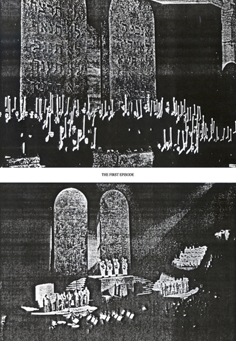
Figure 2. Scenes from the New York production. Ben Hecht, We Will Never Die (New York: Committee for a Jewish Army of Stateless and Palestinian Jews, 1943), facing p. 21. To see this image in a bigger format, click here.
The pageant’s presentation at the Hollywood Bowl, on July 21, 1943, drew 10,000 spectators, among them California governor Earl Warren and a host of Hollywood celebrities and members of Los Angeles’ elite. This performance, fortunately, has been preserved on a set of transcription discs made for radio broadcast in the Los Angeles area. (Never published, the discs were left by Ben Hecht’s estate to the Newberry Library, Chicago. xi) Since most of the music manuscript to We Will Never Die has vanished, this recording may be as close as listeners today can come to experiencing this landmark stage production. xii
Audio 1: “Good evening, ladies and gentlemen”
Kurt Weill’s Contribution
The pageant is a theatrical form in which music, while essential, is subordinate to a story-line meant to advance a political or cultural agenda and to rouse an audience to action. xiii Certainly the refugee Kurt Weill (1900–1950), a veteran of culture wars in Berlin and Paris, understood music’s power as a bearer of propaganda and how it might underscore Hecht’s narrative. He also knew that he had little time for crafting an original score, and in fact much of his work for We Will Never Die was cobbled together from preexisting compositions. Hecht streamlined Weill’s task by scripting in cues for specific works of music (including Hatikvah, Kol Nidre and various national anthems); and Weill himself made effective use of familiar Jewish, popular and patriotic motifs. From his original work, Weill drew most freely on his score for Max Reinhardt’s epic The Eternal Road, the pro-Zionist, anti-Nazi Broadway production that had first brought him to the U.S. in 1935. xiv
Weill, one of the best-known émigré composers active in New York in the 1940s, had arrived on the scene with a radical-leftist reputation. Yet Weill scholar David Farneth believes that this reputation was largely a result of the composer’s artistic association in Germany with the bona fide revolutionary poet and dramatist Bertolt Brecht: Weill’s “willingness to work on We Will Never Die,” Farneth notes, “was probably motivated more by the plight of the Jews in Europe (to whom he had an intimate connection) than by a conviction to join Hecht in supporting Peter Bergson and the Committee for a Jewish Army.” xv (Ben Hecht, however, had little doubt where the composer’s sympathies lay; in his autobiography, Weill’s photo is captioned “Irgun Comrade.” xvi)
Certainly Weill had supported efforts, pre–Pearl Harbor, to urge U.S. entry into the war. In 1941 he contributed the score to Fun to Be Free, a pageant by Ben Hecht and Charles MacArthur, which was also staged at Madison Square Garden. The next year, at the request of the Office of War Information, he wrote and – with his wife, Lotte Lenya – recorded a set of anti-Nazi propaganda songs for shortwave transmission to Germany. Further patriotic efforts included incidental music for the radio program Your Navy (1942); folksong settings for the melodrama Mine Eyes Have Seen the Glory (1942); and, again for the Office of War Information, the score to Jean Renoir and Garson Kanin’s propaganda film, Salute to France (1944). xvii Even after the German defeat, Weill continued to support Hecht and Bergson’s radical program for Jewish survival by teaming up with them again for A Flag Is Born, a propagandistic theater piece (featuring a young Marlon Brando) that opened on Broadway in 1946. He then toured the USA with the express aim of raising funds to break the British blockade of Palestine and of helping the illegal transport of Jewish Displaced Persons to Palestine. xviii
Franz Waxman’s Contribution
Early in 1943, as Hecht pounded out his urgent copy, Jews inside the Warsaw Ghetto were plotting an armed rebellion against their German captors. The uprising began in earnest in April 1943, while We Will Never Die was on tour, and by the time the pageant reached its final destination in Hollywood that summer the revolt had already been brutally suppressed. xix But Hecht meanwhile seized on the news and managed to interpolate a new section containing some of his most impassioned dramaturgy and inspiring some of the pageant’s best music. It should be noted, though, that the music for this section, entitled “The Battle of Warsaw” and featuring the choral song “Battle Hymn of the Ghetto” was not composed by Kurt Weill. Rather, it represents an original contribution to the pageant by its Hollywood Bowl conductor, the gifted film composer Franz Waxman (1906–1967).
A rising composer and cinema orchestrator in his native Germany, Waxman had come to the United States with the first wave of artistic émigrés soon after the Nazi advent to power. How he and the famed Broadway and Hollywood songwriter Frank Loesser became involved in We Will Never Die is a story yet to be documented. Both men, however, received prominent credit in the Hollywood Bowl program, and Waxman’s efforts in particular deserve wider recognition. His newly-added music—almost a stand-alone set piece—takes as its leitmotif “Deutschland über Alles,” the Nazi anthem heard menacingly in many a film score of the day. The episode climaxes, amid a clamor of martial sound effects, with “The Hymn of the Ghetto;” somewhat incongruously, its melody was yet another transfiguration of the malevolent Teutonic theme.
Lyric Sheet for “The Battle Hymn of the Ghetto”
Audio 2: “Battle Hymn”
The End of the Pageant
The Los Angeles performance – the pageant’s sixth – would also be its last. Just as Manhattan’s Jewish intellectuals had rebuffed Hecht during the production’s planning phase, so intramural conflict put a premature end to We Will Never Die. Hecht, seeking to publicize the pageant, had sought endorsements from Jewish organizations across the ideological spectrum, and to that end he had convened thirty-two “Jewish presidents, vice-presidents and secretaries” one afternoon at New York’s Algonquin Hotel. He recalled in his autobiography:
I told my guests much the same things I had said to the thirty literary celebrities. Their eyes brightened and they straightened eagerly in their seats. I then read excerpts from the pageant, and Kurt Weill played the accompanying music on a piano. […]
No words I had ever written had ever been received with such love as beamed on me now. […]
I told my guests then that the pageant they had heard was going to be put on in Madison Square Garden, New York, and, thereafter, in a dozen other cities. We needed no money from any organizations present. […] All we wished of them was their approval. […] All we asked concretely of each organization present was as its name on our letterhead and the privilege of saying that all the Jewish organizations of New York were presenting the pageant. […]
I announced I would call the roll and asked that each official answer yes or no to the question.
The first two names I called answered in unhappy voices, “I pass.” The third called was the secretary of the American Jewish Congress.
“I wish to know,” he spoke up, “whether you are asking for my personal cooperation or the cooperation of my organization.”
“I want the yes from your organization,” I said.
The representative of the American Jewish Congress stood up, pointed a finger and cried out, “As an organization, we refuse to work with Morris Goldfarb! Never will the American Jewish Congress join up with anything in which the Arbeterring is involved!”
A man, possibly Morris Goldfarb, was on his feet yelling back, “And we will never work with the American Jewish Congress in a thousand years.”
Hecht reports that he left the room “sickened” at “the spectacle of Jews comically belaboring each other in the worst hour of their history.” xxii
During the period in question, factional passions within and among American Jewish groups may have been as much a matter of habit as ideology—a difficult habit (as Hecht observed) to break in a hurry. Yet Hecht also indicated that the leaders of these American Jewish organizations equivocated for much the same reason as the one he had previously spelled out in his tale of the Broadway notables. That is, many of them felt that publicly advocating for a so-called Jewish issue, especially in time of war, would compromise their status as “neutral Americans.” Hecht places much of the blame for fostering the mind-set that closed down his show on Rabbi Stephen S. Wise, the influential leader of the American Jewish Congress. Wise had openly condemned We Will Never Die, and other groups followed suit, anxious to disassociate themselves from Bergson’s band of radicals, fearful, however irrationally, of provoking “pogroms in the U.S.A.” xxiii
Legacy
As Bergson and Hecht had anticipated, We Will Never Die captured the attention of the public and the press, and in the process unleashed a torrent of controversy. Was the show, then, a success? The question can be answered both unequivocally no, and conditionally yes. No, in that it clearly failed in its objective to establish an independent Jewish army to battle the Nazis and liberate Jews from their European deathtrap. Yet a positive outcome can also be argued from the fact that the Bergson Group’s propaganda campaign tangibly affected U.S. policy toward rescuing Jews. The Holocaust historian (and Bergson biographer) Rafael Medoff has persuasively linked the production and promotion of We Will Never Die with President Roosevelt’s decision, six months after the pageant’s final performance, to create the War Refugee Board, specifically to “forestall the plan of the Nazis to exterminate all the Jews and other persecuted minorities in Europe.” xxiv According to Medoff’s findings, reported in a study of the Hecht-Weill show prepared for the U.S. Holocaust Memorial Museum,
The War Refugee Board’s activities, which included financing the rescue work of Raoul Wallenberg, played a crucial role in saving the lives of more than 200,000 people during the final 15 months of the war. We Will Never Die helped set in motion the events that led to the saving of those lives. xxv
Posted August 10, 2010
————
Grateful acknowledgement is due to the Ben Hecht authority and publisher Florice Whyte Kovan, whose extensive research for an unrealized U.S. Holocaust Memorial Museum web-based exhibition about We Will Never Die has contributed to the writing of this article.
ii. Hecht on his facility and prosperity as a screenwriter: “For many years Hollywood held this double lure for me, tremendous sums of money for work that required no more effort than a game of pinochle.” A Child of the Century, p. 467. Peter Bergson (real name, Hillel Kook), a U.S. emissary for the Irgun, befriended Hecht in April 1941 and soon convinced him to serve as a spokesman for his organization (A Child of the Century, p. 515 ff). On Bergson and his activities, see Holocaust Encyclopedia on-line: http://www1.ushmm.org/wlc/article.php?lang=en&ModuleId=10007041; and Rafael Medoff, Militant Zionism in America: The Rise and Impact of the Jabotinsky Movement in the United States, 1926–1948 (Tuscaloosa: University of Alabama Press, 2002). ↑
iii. See for example, Laurel Leff, Buried by the Times: the Holocaust and America’s Most Important Newspaper (Boston: Cambridge University Press, 2005). ↑
iv. American Mercury 56 (February, 1943), pp. 194–99; Reader’s Digest, February 1943, pp. 107-110. Hecht’s primary informant was Yiddish journalist Chaim Greenberg (A Child of the Century, pp. 549–50; and Stephen J. Whitfield, “The Politics of Pageantry,” pp. 235–36). On March 12, 1943, Alabama Congressman George Grant read the Reader’s Digest piece into the Congressional Record. ↑
vi. The quote is from the political columnist Max Lerner; cited in Rafael Medoff, “ ‘We Will Never Die’: Shattering the Silence Surrounding The Holocaust,” Holocaust Encyclopedia on-line: http://www.ushmm.org/wlc/en/index.php?ModuleId=10007036. ↑
vii. Ben Hecht, foreword to We Will Never Die (New York: Committee for a Jewish Army of Stateless and Palestinian Jews, 1943), p. 5. ↑
viii. For Dewey’s proclamation, see Isaac Kowaski, ed. Anthology of Jewish Resistance, vol. 3 p. 602. ↑
xi. Ben Hecht Papers, Midwest Manuscript Collection, The Newberry Library, Chicago. Another set of discs is held by Syracuse University (Franz Waxman Papers). ↑
xii. Weill did not prepare the score for publication; some fragments survive at the Weill/Lenya Archive, Yale University Music Library, New Haven, Conn. ↑
xiii Whitfield characterizes pageants as “hybrids of art and propaganda which often evoke the past in order to affect public opinion and to stimulate communal cohesion.” (“The Politics of Pageantry,” p. 221) ↑
xiv. On Weill’s self-borrowings, see David Drew, Kurt Weill: A Handbook (Berkeley: University of California Press, 1987), pp. 330–333. ↑
xix. Hecht’s “Madison Square Garden” script makes no reference to the Warsaw uprising (see We Will Never Die, typescript, Billy Rose Theatre Collection, New York Public Library). The published text gives an erroneous date (March 17, 1943) for the uprising’s commencement. See “Warsaw Ghetto Uprising,” Holocaust Encyclopedia on-line: http://www.ushmm.org/wlc/en/article.php?ModuleId=10005188. ↑
xx. In his analysis of We Will Never Die, Drew notes that “[o]ne or two musical devices in the Ghetto sequence are surprisingly ‘advanced’ by Weill’s standards in the 1940s, and raise the question of a possible contribution by Waxmann [sic].” (Kurt Weill: A Handbook, p. 333). ↑
xxi. For Waxman’s biography and discography, see Waxman Papers, Special Collections Research Center, Syracuse University Library, http://libwww.syr.edu/digital/guides/w/waxman_f.htm; and Waxman’s official website, http://www.franzwaxman.com. It is hoped that additional research will reveal the origins and extent of Waxman’s involvement with the pageant. ↑
xxii. A Child of the Century, pp.554–56. “Arbeterring” (Yiddish, Arbeter-ring, “Workmen’s Circle), Jewish labor organization founded in New York City in 1900. ↑
xxiii “Neutral Americans,” see A Child of the Century, p. 517; “Pogroms in the USA,” see A Child of the Century, p. 565. The remark (by American Jewish Committee president Joseph M. Proskauer) was in response to Hecht’s poem “Ballad of the Doomed Jews of Europe.” See Rafael Medoff, “Christmas Without Jews” in David S. Wyman Institute of Holocaust Studies (December 2003); http://www.jewishaz.com/jewishnews/031226/christmas.shtml. On Rabbi Wise and We Will Never Die, see also Walter Roth, “Peter Bergson, the Irgun, and Chicago,” in Chicago Jewish History, Fall 2001, http://www.chicagojewishhistory.org/pdf/2001/CJH.3.2001.pdf. For documentation on Wise’s anti-pageant activities see David S. Wyman, America and the Holocaust, Volume 2 “The Struggle for Rescue Action” (New York: Garland, 1990), pp. 206-210 and ff. ↑
xxv. Medoff, “ ‘We Will Never Die’: Shattering the Silence Surrounding The Holocaust” (see fn. 6, above). See also Robert Skloot, “’We Will Never Die’: The Success and Failure of a Holocaust Pageant,” Theatre Journal, Vol. 37, No. 2 (May, 1985), pp. 167-180 (http://jstor.org/stable/3207063); and David S. Wyman and Rafael Medoff, A Race Against Death: Peter Bergson, America, and the Holocaust (New York: New Press, 2002). ↑
Equal in fascination to the concept of creation is that of resurrection. The possibility that death might be reversed or transformed can serve as an irresistible trigger to imagination. Certainly the idea has generated some of the most powerful moments in religion and the arts, from the myth of the phoenix and belief in Jesus's resurrection to the story of Dickens's Dr. Manette, recalled to life during the French Revolution. The same fascination with recalling to life no doubt explains the satisfaction of excavation—recovering artifacts and voices that previous generations had consigned to oblivion.
Many voices disappear gradually, as a result of natural processes of time, neglect and changing sensibilities; with or without disjunctions of social upheaval and war, production of the new will remorselessly silt over the old. But voices from the past can resonate anew, and when they do they can shake up our understanding of what was already familiar. Large chunks of music history, as it stands today, consist of composers and styles that had been silted over before being recovered, often decades or centuries later. A recent conference on the campus of the University of California, Los Angeles (UCLA), was devoted to just such a project of recovery. Here, however, attention focused not on music that had disappeared “naturally” but on composers who had been made to disappear—voices from the first half of the twentieth century silenced as a result of the National-Socialist dictatorship's cultural policy in Germany from 1933 to 1945. Of course lacunae exist in the history of every era, and every age is more diverse and multivoiced at ground level than in teleological hindsight. But never before was an entire body of cultural production so calculatingly expunged as during the Nazi era. And what disappeared in those twelve years comprises a surprisingly varied corpus of music.
The conference, which took place on 7 and 8 April 2010, was jointly sponsored by the OREL Foundation and the UCLA Center for Jewish Studies; Kenneth Reinhard of UCLA and Robert Elias of the OREL Foundation organized the event. Titled “Recovered Voices: Staging Suppressed Opera of the Early 20th Century,” the conference grew out of the concurrent production of Franz Schreker's Die Gezeichneten at the Los Angeles Opera (LAO), whose music director, James Conlon, is also the OREL Foundation's inspiration and artistic advisor. This production was the first American performance of Die Gezeichneten; indeed, this was the first time any Schreker opera has been staged in North America. (For more information on the production, see http://www.losangelesopera.com/production/0910/stigmatized/index.aspx )
Ancillary to the conference were two evening events: a concert and a keynote address. The concert, in UCLA's Schoenberg Hall, presented chamber music of Erwin Schulhoff (1894–1942), the multifaceted, prolific and at one time internationally known Czech composer who stayed too long in Prague and was arrested and deported to the Wülzburg internment camp in Bavaria, where he died. Engaged performances by Jeffrey Kahane, Daniel Hope and members of the Los Angeles Chamber Orchestra were aural evidence of how exciting it can be to hear music by an idiosyncratic composer whose voice matches and complements more familiar voices. The following evening's keynote address by Maestro James Conlon showed him to be a man with a mission. He spoke with the kind of passionate belief that persuades, even though in this audience he could take for granted a common purpose and shared convictions. So he concentrated not so much on the whys and wherefores of recovering works suppressed during the Nazi era as on where recovery efforts stand, and on what needs most pressingly to be done. The points of view of this distinguished conductor and practicing musician provided a satisfying final cadence to the two-day meeting.
***
Common threads and cross-connections laced through the two days of talks. Questions of staging recurred in different contexts, as did the significance of the fairy tale for post-Wagnerian opera, the Nazis' censoring use of the label “degenerate” and the phenomenon of premonition in pre-Holocaust stage works. Several presenters used a wide-angle lens for examining musico-political conditions during the Nazi era. Others focused on aspects of a single work or a single composer, but these talks, too, contributed to the discussion of broader issues. Collectively, the talks shed light on the complexities of prewar and wartime Germany; the experiences of German and Austrian exiles in England and the United States; American—specifically Jewish American—response to the news of genocide in Europe; and, perhaps most fascinating, the stylistic heterogeneity of musical modernism as represented by the handful of composers discussed. Eventually, many of the conference talks are to be revised for publication or posted on the OREL Web site. I shall therefore comment on only some of the themes and information presented. (For more information on the presenters than I include here, please go to http://orelfoundation.org/index.php/conference/presenters/.)
Cultural politics in Germany in the prewar Nazi years was the topic of a talk by Albrecht Dümling, chair of musica reanimata, who presented the complicated back story of the Degenerate Music exhibit held in Düsseldorf as part of the Reich Music Days of 1938. This exhibition, the brainchild of an untrained musician named Hans Severus Ziegler, targeted jazz, atonality and the putative Jewish domination of German music. The project highlighted the problem that the Nazis faced in trying to establish ideologically and racially based criteria for “cleansing” German art of impure and “degenerate” influences. For how could race be objectively detected in art? A composer could conceivably be defined as Jewish on the basis of ancestry, but what could be thought to make music Jewish? There was, even among anti-Semitic Nazis, no agreement on this issue. At one point during the 1930s, a man named Nobbe proposed a simple formula: the triad and tonality are German, and atonality is Jewish. Others—among them Herbert Gerigk, infamously associated with the 1940 Lexikon der Juden in der Musik, mit einem Titelverzeichnis jüdischer Werke (Dictionary of Jews in music, with a list of Jewish works)—countered that atonality, in the right hands, could be an effective musical device. Most politicians chose to steer clear of the debate and, like Goebbels in his “Ten Principles of German Music Creativity” delivered at the opening of the Degenerate Music exhibit, restricted themselves to vague statements about the incompatibility of German Germanness and un-German Jewishness. Unlike the previous year's Degenerate Art exhibit on which it was based, the Degenerate Music exhibit was a failure and had to close early. Foreign coverage, on the other hand, was apparently favorable; Dümling quoted from British and American reviews that did not even mention the racist overtones, accepting the idea of government control of art, as of so much else in Nazi Germany, at face value.
The radio host and writer Martin Goldsmith presented a corollary to Dümling's talk with his overview of the Reichsverband der jüdischen Kulturbünde (National association of Jewish cultural leagues). This network of independent performing arts ensembles in Germany, run solely by and for Jews, was sanctioned and even encouraged by the Nazi government between 1933 and 1941. Originally named Kulturbund deutscher Juden (Cultural league of German Jews), the league began in Berlin in response to the Law for the Reestablishment of the Civil Service (Gesetz zur Wiederherstellung des Berufsbeamtentums) of 7 April 1933, which had led to the dismissal of thousands of non-Aryans working in schools, universities and all government and cultural institutions. The idea of recruiting unemployed Jewish musicians and performers for putting on plays and concerts originated with Kurt Baumann and Kurt Singer, both formerly with the Städtische Oper in Berlin, who succeeded in persuading Hans Hinkel, head of the Prussian Theater Commission, to support the idea. From the Nazis' point of view, a Jewish arts organization for Jews was splendid propaganda; from the point of view of out-of-work performers and culture-hungry citizens, the Kulturbund offered employment and solace. And it was an immediate success. Soon after opening in Berlin in September 1933, the organization had close to 20,000 members, and smaller leagues soon sprang up in other cities around Germany, including Hamburg, Munich and Frankfurt. The national association of Kulturbünde flourished for eight years, though under constant and increasingly repressive surveillance. Goldsmith brought this by now fairly well documented story alive by telling it through the prism of the experiences of his parents, Günther and Rosemarie Goldschmidt, one a flutist, the other a violist, who met in 1936 when they both got jobs playing in the Frankfurt Kulturbund orchestra. The complete story of their experiences in Germany and emigration in 1941 to the United States is told in Goldsmith's book, The Inextinguishable Symphony: A True Story of Music and Love in Nazi Germany (2000).
In his talk “Opera in Mussolini's Italy,” the writer and music historian Harvey Sachs, who also teaches at the Curtis Institute of Music, shifted the conference's attention to conditions in fascist Italy. Cultural upheaval in Italy during the fascist years was not, as in Germany, the result of the government's censoring undesirable artistic or ideological philosophies or, indeed, of pursuing anti-Semitic policies: Italy did not have that many Jews to begin with, and when Mussolini made anti-Semitism a plank in fascist philosophy in 1938 it was only in to strengthen his alliance with Hitler. The danger originated, rather, in Mussolini's expanding government control over cultural institutions. Opera was already in a precarious situation by the time the fascists took over in 1922, as the once popular art form was steadily losing ground to the cinema and becoming, as elsewhere in the Western world, an elite genre requiring subsidization. (Concurrent with this development is what Sachs called “the petrifaction” of the repertoire, when interest in new works transformed into a passion for new interpretations of familiar works.) Sachs used the history of La Scala to show how the price for receiving subsidies from the fascist regime was to submit to whatever the government demanded, from hiring to operational matters. Opera house administrators became, by definition, political toadies. Unfortunately, the traditions then put in place have had long-term effects to which Italian opera houses of today still bear witness.
A description of contemporaneous conditions in England were the welcome byproduct of a talk by Michael Haas (read by Gerold Gruber) devoted to an overview of the Austrian composer Hans Gál and his 1924 opera Die heilige Ente. Gál had established a successful career in Germany when he became director of the prestigious Mainz Music Academy in 1929. With the Nazi takeover in 1933, Vienna became for him, as for many other persecuted German-speaking Jews, his first refuge. When he had to flee yet again, after Germany's 1938 annexation of Austria, he must have considered himself fortunate to have been allowed into England. However, details of Gál's earliest experiences as an exile must darken the long-held image of that country as a comfortable safe haven. His family was broken up almost immediately. His younger son was deported, his elder son committed suicide, and Gál himself in 1940 underwent months of imprisonment in two camps; in addition to German-speaking and Jewish refugees from the Continent, these camps (the British government, like that of the United States a couple of years later, preferred to call them internment, not concentration, camps) held British citizens of German descent, German businessmen and suspected fifth-columnists and Nazis—anyone with the remotest connection to Germany. After his release for medical reasons Gal had to try to support himself and his family despite the official ban on employing refugee musicians outside the confines of refugee organizations. The parallels with Germany are striking. Haas, who produced Decca's groundbreaking “Entartete Musik” recording series and is presently music curator of the Jewish Museum of Vienna, had much of interest to say about Die heilige Ente (1924), which had been a repertoire favorite with German and Austrian opera-goers for years; astonishingly, its rehabilitation still awaits. Haas also briefly outlined the problems of those who, like Gál, composed in musical styles that in the postwar years were regarded as regressive and possibly even tainted by resemblances to music and compositional languages propagated by the Nazis.
Conditions in the United States during the Nazi era were fascinatingly illuminated in a talk by Bret Werb, the music collection curator for the U.S. Holocaust Memorial Museum in Washington, DC. The subject of Werb's talk, “We Will Never Die (1943): A Pageant to Save the Jews of Europe,” was the staging not of a work but of a message. The instigator of the enormous touring propaganda event, the screenwriter Ben Hecht, intended it to be a political wake-up call for Americans who might not yet be aware of the need to save the Jews of Europe; ultimately he hoped to secure support for an autonomous Jewish army. Yet Hecht encountered great difficulties in raising funding and other forms of support; Werb quoted Hecht's descriptions of rebuff from prominent Jewish Americans who were afraid that affiliating themselves with the project would undermine their status as “true” Americans. As collaborators for We Will Never Die, which was subtitled “a memorial pageant dedicated to the two million Jewish dead of Europe,” Hecht succeeded in recruiting the Zionist activist Peter Bergson, the producer Billy Rose, the director Moss Hart, the exiled composer Kurt Weill, and a host of celebrity actors and performers. The first performance, at Madison Square Garden on 9 March 1943, was sold out, as were most of the additional performances; Eleanor Roosevelt attended the one in Washington, DC. Rafael Medoff, Peter Bergson's biographer, links the production of We Will Never Die directly to President Roosevelt's creation of the War Refugee Board in January 1944. Werb was able to show a number of photographs and a rare broadcast recording of the final performance of the pageant, at the Hollywood Bowl, conducted by Franz Waxman.
Not surprisingly, Franz Schreker (1878–1934) got a good deal of attention in the course of the conference: in passing references throughout; in a concluding panel discussion with Ian Judge, the stage director of LAO's new production, and Michael Hackett of UCLA's School of Theater, Film, and Television; and above all in two talks by scholars known for their Schreker studies, Peter Franklin of the University of Oxford and Christopher Hailey, director of the Franz Schreker Foundation. Schreker, who has become one of the more familiar “recovered voices,” was among the first wave of victims targeted by Hitler's opening salvo of racial housecleaning, the infamous Law for the Reestablishment of the Civil Service of 7 April 1933; the stresses of that first year of Nazi rule led directly to the composer's early death. Yet he had been one of the few opera composers of the 1920s whose works had become repertoire staples; it is often said, but bears repeating, that for several years during the Weimar Republic the number of Schreker performances rivaled those of Richard Strauss.
Hailey's talk, “‘Ecco le plebi’: Schreker, His People, and the Ambivalence of Modernity,” included a brief overview of Schreker's early life and influences, particularly his itinerant childhood and lack of formal education, which set him apart from many of his class and chosen profession. But he compensated for this with extensive reading. Among his formative aesthetic influences were E.T.A. Hoffmann, Strindberg, Maeterlinck and Hauptmann. He was also unusually open to non-German musical influences, particularly Verdi, from whose use of choruses and staging devices he learned much. Schreker's libretti, which he wrote himself, are a mix of realism and symbolism; some of them are disturbingly personal, even self-confessional, and they articulate his ambivalences toward the prevailing dogmas of high art and modernism. Schreker infused his secondary characters, in particular, with his own self-reflexive detachment, thus creating a perspective on stage that can be said to be informed by the “view from below.” He often structured his choruses, too, as if they were intended to comment on the artifice of the theatrical enterprise. All of these disparate elements are consciously subsumed in and reflected through the heterogeneity of musical styles that make up Schreker's musical language. Die Gezeichneten, Hailey said, represents the work in which Schreker came closest to creating a true Gesamtkunstwerk, a phantasmagoric world encompassing all the senses. And yet here, too, he made use of distancing effects and, in taking opera to unprecedented heights of sensuous intoxication, simultaneously exposed the form's vulnerability.
Peter Franklin, in his “Lost in Spaces: Recovering Schreker's Spectacular Voices,” continued the exploration of Schreker's intentions, taking as his starting point the relationship between scenic and discursive space. The theatrical effects and sensuous seductiveness that are integral to the experience of a Schreker opera, particularly the early ones that first established his reputation, are the very aspects that so offended many of his contemporaries and still today have the power to disturb. Franklin found it useful to adapt theories and points of view from the film theorist Laura Mulvey's work on the gendered camera lens (the lens of the camera, that of the characters on screen, and that of the spectators) and from the musicologist Rose Theresa's work on spectacle, narrative and enunciative modes of address in late nineteenth-century opera. According to Mulvey, a film director can position the camera lens on a scene or character so as to constrain the viewer to respond in certain ways. In the gendering of spectacle as other, static and feminine, and narrative as same, active and masculine, it follows that the camera lens, when it is directed on a quiescent, non-active character on screen, can establish an immediate rapport between that character and the spectator, even to the point of merging—or implicating—spectator with spectacle. Franklin made a persuasive case for Schreker's achieving just this effect in his operas, drawing on examples from Der ferne Klang, Der Schatzgräber, Die Gezeichneten, and Der Schmied von Ghent. Interestingly, Schreker himself tackled the dichotomy of opera as spectacle and “pure” music as narrative in his penultimate opera, Christophorus.
Questions of staging and intent also figured in the talk titled “Schlusschoral: History and Meaning in Ullmann and Weill” by Ryan Minor, of the State University of New York (SUNY) at Stony Brook, who compared the dramatic role and meaning of the closing chorale in Weill's and Brecht's Threepenny Opera, written at the height of the Weimar culture in 1928, with the chorale that concludes Viktor Ullmann's and Petr Kien's Der Kaiser von Atlantis, written in Terezín in 1944. Addressing the ways in which the composer-librettist collaborators of both pieces worked with and against the fourth wall, that perceptual boundary between any fictional work and its audience, Minor argued that the Brecht libretto shows a fundamental discrepancy between the earnestness of the chorale text and the ironic distance in the rest of the libretto. Weill's setting reflects that discrepancy somewhat differently, but he too, in Minor's reading, interprets the chorale earnestly and without the critical distance that characterizes the musical style up to that point in the work. The closing chorale of Kaiser von Atlantis resembles the one in Threepenny Opera in a number of aspects, but here, strikingly, the chorale text welcomes death—another instance of premonition, for both Ullmann and Kien were murdered at Auschwitz shortly after they completed the work. As in the Brecht text, Kien's breaks the fourth wall by marking itself as a theatrical performance. Ullmann, however, set the text with the chorale melody from “Ein' feste Burg ist unser Gott,” which, so Ryan concluded, can be variously interpreted as a moment of Brechtian estrangement and declaration of adherence to Weimar theatrical precepts, an act of defiance reclaiming the German (non-Nazi) heritage symbolized by Bach, or possibly as a reminder, for comfort, that the fourth wall did still exist and the chorale text was not yet true on the spectators' side of the stage.
In “Opera after the Bauhaus: Wolpe's Zeus und Elida and the Ethics of Montage,” Brigid Cohen of the University of North Carolina at Chapel Hill tackled the conundrum of Stefan Wolpe (1902–1972), who is one of those iconoclastic figures almost impossible to categorize. His stylistic experimentation and resulting creative heterogeneity were always inextricable from both his multiple affiliations with Dada, agitprop, the Bauhaus and other avant-garde movements, and his lifelong exploration of social visions of human plurality and collectivity. These issues continued to engage and sustain him in his long exile, first in Palestine and then, after 1938, in the United States. Cohen drew on aural examples from the short operetta Zeus und Elida of 1928, where Wolpe uses montage structurally on aesthetic, narrative and musical levels. The work would probably be impossible to perform as conceived, and after hearing the excerpts one could understand why for most of his life Wolpe was the paradigmatic outsider. He was largely ignored by the contemporary musical establishment until the last decade of his life, when his works finally began to be championed by such ensembles as Continuum and the Group for Contemporary Music. Yet Cohen made a strong argument for considering the incongruities of Wolpe's stylistic experimentation as perhaps a truer reflection of the complex interconnected texture of modernism than any tidily ordered collection of schools and isms.
Three talks–by David Levin, Adrian Daub, and Sigrid Weigel–dealt with Alexander Zemlinsky (1871–1942), particularly his operas Der Zwerg and Der Traumgörge. David Levin, who teaches at the University of Chicago (for the Committee on Theater and Performance Studies, the Committee on Cinema & Media Studies, and the Department of Germanic Studies), explored Zemlinsky's operatic world in a talk titled “‘Das Schönste ist scheusslich'”: Alexander von Zemlinsky's Der Zwerg,” based on Wilde's “The Birthday of the Infanta.” The quote in the title of the talk is drawn from the moment in the opera when the Chamberlain introduces the Infanta's final present, the dwarf, with the words “the loveliest [present] is awful.” This opera was Zemlinsky's contribution to the “opera of the ugly man,” also represented by Schreker's Die Gezeichneten. Zemlinsky's identification with the figure of the ugly man, and with victims generally, is a strong autobiographical component in the work but not, said Levin, the whole story. He took interesting approaches to that larger story, beginning with an exploration of Wagner's articulation of Jewish voices on stage as something both dreadful and comical, and thus representative of what is deformed, disorderly or monstrous. This might explain the discipline that Wagner's concept of Gesamtkunstwerk imposed on the disorderly form of opera and the violent unmasking and expulsion of outsider characters in Wagner's dramas. Levin's second line of approach started with Lacan's theory about the traumatic moment of self-recognition, which can be equated with the moment when the dwarf sees himself in a mirror for the first time and recognizes himself as ugly. Unlike Wagner, Zemlinsky treats this moment with empathy. One of the questions Levin left his audience with was whether such empathy, which has no power to effect change for the better, is not perhaps itself embedded in trauma.
Adrian Daub of Stanford University also discussed the meaning and musical treatments of the outsider figure. In a talk titled “Total Work of Art, ‘Degenerate’ Artists and Ugly Detail: The Birthdays of the Infanta of Wilde, Schreker and Zemlinsky,” Daub began by pointing out that a suspicion of degeneracy had connected itself to opera long before Nazi cultural policy-setters got into the game, and that post-Wagnerian composers themselves grappled self-consciously with the concept and its association with elements outside the norm. Both Schreker's and Zemlinsky's settings of the same Wilde fairy tale concentrated on the story of the dwarf, the outsider, and in both works the dwarf is isolated from the malicious external world by his ugliness and self-delusion. Yet he is ugly in appearance only; unlike Wagner's Mime, whom the composer cruelly exposes as ugly in appearance and voice, Schreker's dwarf character dances, and Zemlinsky's sings, just like all the other characters on stage. Daub argues, among other points, that in these scores the ugly has been liberated from the cruel, rejecting, unifying world of the Gesamtkunstwerk.
Sigrid Weigel, director of the Zentrum für Literatur- und Kulturforschung in Berlin, sounded similar tones in her “Zemlinsky's Der Traumgörge: A Post-Wagnerian Pentecost Play, or: On the Emergence of a Pogrom from the Midst of a Christian Community.” Zemlinsky's avowed inspiration for the opera Der Traumgörge was Heinrich Heine's figure of Poor Peter, a young enthusiast and dreamer who is excluded from society. According to Weigel, the opera is a combination of fairy tale, social commentary and Pentecostal revival. She referred to the passage in Act 1 in which a character tells Görge the dreamer that his books should all be burned; this is reminiscent, Weigel pointed out, of the oft-cited and premonitory passage from another Heine work, “Where books are burned, in the end people will be burned, too.” In Act 2 the latent violence becomes explicit when the Christian village attacks the outcast Gertraud and torches her house. Although it is unlikely that Zemlinsky in 1906 would have consciously associated any of these fictional moments with the position and possible fate of Jews in Germany, they certainly carry prophetic force now.
The subject of premonition was tackled head on in the talk given by Michael Beckerman, of New York University, on “Haas's Charlatan and Other Forecasts of Disaster.” Correspondences between plot and subsequent historical events can, we learned, be found in such pre-Holocaust works as, among others, Kafka's The Penal Colony, Berg's Wozzeck, Janáček's House of the Dead and Hans Krása's Brundibár—this last-named work, in particular, seems explicitly to evoke the concentration camp experience, though it was originally composed in 1938. The tragicomic Charlatan by Pavel Haas (1899–1944), a kaleidoscopic mix of fairy tale, drama and balladic tableaux composed in 1934–1937, depicts the wandering life of a quack doctor named Pustrpalk. The shifting persona of this character over the course of the work makes it unclear whether he was meant to represent Jews or Nazis—or perhaps both. Premonitory events include botched medical experiments and operations, a crowd singing joyfully while a man is burned alive and a village that vanishes as a result of war. Musical examples that Beckerman played to illustrate these moments supported his thesis that Haas, though he could not have known how prophetic his opera's story would be, must have wanted the work to be heard on multiple levels. (Beckerman also slipped in an excerpt that could have been mistaken for a passage from the Haas work but was actually Martinů's Memorial to Lidice, written after the war to commemorate the Nazi destruction of that town; the aural resemblance was striking.) And yet, as Beckerman noted, it is not entirely clear what meaning Haas intended the opera to convey—how, for example, to interpret the fact that Pustrpalk sings “in the voice of Papageno.” The recovery of a work such as Charlatan would require wrestling with just such interpretive philosophical and political as well as straightforwardly artistic questions.
***
The Nazi era lasted only twelve years. But it is easier to destroy than to rebuild, as Maestro Conlon said in his keynote address, and even today, after decades of work recovering some of the voices suppressed by the Nazis, general awareness of the range and diversity of music produced in the first half of the twentieth century is woefully incomplete. One of the realizations that repeatedly resonated during the two conference days is that so much of the cultural destruction the Nazis deliberately perpetrated continued in the eras that followed. This was often the result of ignorance, intellectual indolence or lack of curiosity, but, especially in the immediate postwar period, some people with ideological or personal axes to grind took advantage of the opportunities to do so. Their deeds, too, need to be reversed.
Those who have specialized in the area of musical, cultural, and political recovery come from a variety of backgrounds. Many have German roots or were born of parents who lived through the Nazi time; many, indeed, are German; exile studies began in Germany in the 1960s, at least a decade before they were taken up on this side of the Atlantic. I am glad that Albrecht Dümling mentioned the German music historian Fred K. Prieberg, who died on 28 March 2010, just days before the conference opened; Prieberg's pioneering Musik im NS-Staat (1982), the first attempt to address, objectively, the politics of music history in Germany in the years 1933–1945, remains a canonic reference work.
For German nationals, Wiedergutmachung is a shorthand term that encapsulates a nexus of complex motivations, including family or national guilt. But work on behalf of suppressed composers need not be just an act of political reversal or memorialization, and many of those who work on suppressed music have no personal connection to the time, the perpetrators or the victims. For them, the impetus may well have been a wow moment when they were bowled over by hearing an unfamiliar work. It was good to be reminded, during this conference, that the project of recovering suppressed voices will be re-energized every time one of those voices is recalled to life and again resounds in performance.