Eric Zeisl

Eric Zeisl

1905-1959

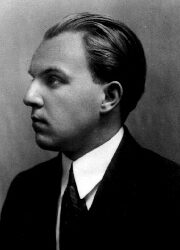
Eric Zeisl (1905-1959) was a composer whose career unfolded along a well-trodden path of exile.  In the early 1930’s he was a promising young Viennese composer just starting to make his career.  When Austria was annexed by the Nazis in 1938, he was forced to leave.  Emigrating through Paris and New York, he eventually settled in Southern California, living in Hollywood where he worked in the film business, did some teaching and was part of a vibrant and distinguished émigré community before he died of a heart attack in his early 50’s.  Zeisl’s music is deeply traditional; drawing on a broad range of powerful expressive devices, and from the late 1930’s his output is marked by a frequent turn towards what has been described as something like a “Hebraic” mode.

Early Life

Eric Zeisl was born into an assimilated Jewish upper middle-class family.  His family ran a café on Praterstern.  Eric and his brothers were involved in musical pursuits, particularly singing, from their earliest years.  There are stories about his passionate desire to improvise at the piano, and his early reverence for such composers as Beethoven, Schubert, Wolf, Wagner and Bruckner.

His ambition to study music seriously was opposed by his parents, so young Eric apparently sold his stamp collection to pay for lessons.  After a year or so of study at the Vienna Academy of Music and Performing Arts, he continued to study privately with Richard Stöhr, a popular composition teacher at the Academy of Music and author of several important textbooks.  Unlike Schoenberg, his exact contemporary, Stöhr was a dedicated traditionalist who believed that the musical language of the late nineteenth century was still viable.  Stöhr considered Zeisl to be his most talented composition student.

Zeisl also studied with Joseph Marx and Hugo Kauder in the early 1930’s and began to be recognized for the expressive power of such works as the Piano Trio Suite, Op.8, and his early songs, including several powerful ones based on the poetry of Nietzsche.  According to his biographers, Kauder was an innovative theorist and teacher who had been much influenced by Gustav Mahler in his thinking, something that he passed on to Zeisl.  In both his songs and his instrumental works, Zeisl was taken with Kauder’s approach.  One of the works where this is evident is the First String Quartet, in particular the final movement, a theme and variations based on a Slovak melody.  This work, premiered in 1934, made a great impression.  Zeisl’s biographer, Karin Wagner makes the important point that during these years avant-garde music was already being banned by the Nazis, and Zeisl’s more traditional language was tolerated in the early years of Nazi power.  She also points out that, despite various claims, Zeisl was never offered the Austrian State Prize for his Requiem Concertante, but rather received a small stipend to help with copying.  Around this time Zeisl also made some lifelong friends, associating with the painter Lisel Salzer and the writer Hilde Spiel.  At this time Zeisl was both productive and popular, composing works in almost every genre, but this was soon to end.

Change and Exile

With Hitler’s annexation of Austria in 1938 Zeisl’s fortunes took a predictable turn.  Though he at first moved to Baden in the hopes of riding out the bad times, it soon became clear that the Zeisls would not be able to stay in Austria.  Leaving his parents behind, Zeisl and several of his brothers left the country, and Eric and his wife, Gertrude, to Paris.

France in the late 1930’s was the home and pass-through zone of exiles from all over Europe, coming and going at a prodigious rate, from Walter Benjamin to Sigmund Freud, and from Pablo Picasso to Elias Canetti.  Hundreds of musicians from Germany, Austria, Poland, Czechoslovakia and Hungary also took up residence there for more or less time as their needs and, more importantly, their opportunities dictated.

It was during his time in Paris that Zeisl made the acquaintance of the work of the Austrian writer Joseph Roth (1894-1939).  In 1939, his novel Job was presented in a staged version featuring such talents as Hugo Haas, Josef Meinrad and Leon Askin.  Zeisl wrote several pieces for this production, including Menuhim’s Song and a Cossack Dance.  This story of a search for Jewish identity through tragedy and exile, and its contemporary Job, Mendel Singer, captured Zeisl’s imagination, and became part of his musical and dramatic thought for the rest of his life.  Although he never finished a planned opera on Job, there are two acts extant, and Roth’s story is credited with pushing Zeisl in the direction of something like a “Jewish” compositional idiom.

To America

With the political situation worsening in Europe, the Zeisls left for the United States in 1939, at first settling in New York.  Initially, Zeisl was both lucky and successful.  Ernö Rapee, a Hungarian conductor, included Zeisl’s Little Symphony in his weekly national radio broadcast, and it was a fantastic success.  Other works of the composer were played, and it looked as if he might be able to build a career for himself in New York.  The next year the family moved to a large house in Mamaroneck near the Long Island Sound, and the composer was able to work in pleasant and tranquil circumstances.  He was productive as never before and, compared to many other émigrés, doing quite well.

Like many composers both before and after, Zeisl seems to have regarded Hollywood as a place where he could make a comfortable living and, at the very least, match his current output.  And like many other composers, he was to find that the movie business could be a trap for all but the most successful, and that California itself could veer wildly from a land of dreams to a land of dreams dashed.  His name for the town, “Schein-Heiligenstadt” is both a pun on “Holly=Holy” town, but also included the German word for hypocrisy.

Zeisl began to work for MGM in the early 1940’s and wrote music for the Fitzpatrick Travel Talks with titles like “On the Road to Monterey” “Morning in Minnesota,” and “Glimpses of Scotland.”  Although he ended up writing music for several films, including Bataan (1943), Song of Russia (1943), The Postman Always Rings Twice (1946) and even Abbott and Costello Meet the Invisible Man (1951), he was never to receive the main composer credit in a film.  Despite his disappointments with the film industry— and again, in this he was not alone— he was able to forge ahead in his own creative world with such significant works as the Requiem Ebraico in memory of his parents, who had died in the camps, and all those who perished.  Once again, he used something of the “Jewish” color he had begun to consciously employ in Job.  Many other works during this period, including the ballets Naboth’s Vineyard (1953) and Jacob and Rachel (1954) were composed at this time.  These, and many other works with Jewish themes, were performed at concerts devoted to Jewish music.  These concerts and his success led to his employment at the Brandeis Camp Institute in Simi Valley from 1948-50 and resulted in a major work, the “Brandeis Sonata” for Violin and Piano (1949-50).

His last completed work was the so-called “Arrowhead” Trio, written in 1956, but he spent the summers of 1957 and 1958 trying to complete the opera Job, a task he did not accomplish.

West Coast Exiles

According to the recollections of Gertrude Zeisl, painstakingly recorded by Malcolm Cole over twelve hours and transcribed, the Zeisl home was a meeting place of the great European exile community of the West Coast.  Alma Mahler Werfel, Korngold, Stravinsky, Mario Castelnuovo-Tedesco, Alexander Tansman and many, many others spent time together, and while he only met Schoenberg once, their children, Barbara and Ronald, met, uniting these families.

From the late 1940’s Zeisl made his living teaching at several schools including the Southern California School of Music and Arts and the Los Angeles City College, where he gave evening classes.  He died of a heart attack in 1959 after teaching a class at City College.

Music Early Years

Eric Zeisl had a particular kind of talent involving an unabashed directness, a penchant for rich textures, “expressive” harmonies that sometimes recall the Baroque use of chords, and seemingly a preference for shorter over longer forms.  His first works, indeed through the early 1930’s, are primarily songs and suites.  We may remember that the suite originally referred to a collection of dance pieces, and in the 19th century came also to suggest a group of excerpts.  Either definition is far from the world of the symphony, with its implications of emotional and logical sweep.  Like his songs, Zeisl’s suites, including the Op. 2 Suite for Violin and Piano, the “Heinzelmännchen” Suite for Piano and the Op. 8 Suite for Piano Violin and Cello, are collections of musical pictures, linked by key more than attempts to establish themselves in the tradition of Sonatas and Trios. (Dvořák once famously remarked that Tchaikovsky’s symphonies were actually more like suites).

So there is no suggestion that these works are in any way poorly organized or lacking in ambition.  The Op. 8 Trio Suite is a bold and powerful piece, revealing a sureness of tone that recalls early Brahms even as it reaches for the harmonic world of Mahler.  From the enormous depth of the Adagio to the faux-Oriental waltz of the Scherzo, to the beautifully crafted variations of the last movement (based on a theme recalling both Hansel and Gretel the Brahms Haydn Variations), this is the work of a composer who seems to have few doubts about his musical speech.  The last movement in particular, using a variation form that serves the composer well in many other works, shows an effortless fluidity that is simultaneously new, dramatic and ravishing.

When the composer does get to a traditional genre, as he does in 1930-33 with his first String Quartet, it too combines elements of traditional quartet structure with a kind of looseness more common to the suite style.  Particularly effective is a Theme and Variations on a Slovak folksong, revealing everything from the most delicate colors to wild bravura passages; the composer later successfully arranged this for orchestra.

Once again, when Zeisl does start working with a large orchestra it is to write a work using one of his beloved variation genres, the Passacaglia.  In this work Zeisl boldly chooses a bass theme that is at least twice as long as is typical for the genre.  Because the first half of the theme is somewhat simple and predictable, while the second veers wildly through several keys, the work has simultaneously a straightforward regal bearing and a risky edge.

Zeisl’s almost 100 songs reveal a talented reader of poems and a subtle setter of texts. His “Komm süsser Tod” combines the rhythms of Schubert’s “Death and the Maiden” with the harmonic intensity of Dvořák’s Biblical Songs to create a memorable farewell.  This may be noteworthy since it was both the last song written by Zeisl and a probably a commentary on the loss of his homeland.

Job and After

Writing about her father, Zeisl’s daughter Barbara recalls something the composer said when he was asked about whether his music had changed in the United States.  “I was a finished product of the old world; I could not change that even if I wanted to.”  Whether this is true or not is difficult to say, and still more difficult to prove. However, we have remarked on certain changes that took place in his outlook, and his music, when he began to work on Job.

Most audible in places like “Menuhim’s Song,” with its augmented intervals and “Hava nagila” skips, and its attempts to conjure ancient modes, this Hebraic style becomes part of Zeisl’s musical vocabulary, to be used whenever plot or his inner need calls for it.  While this does become one feature of his style, it would also be wrong to overemphasize it, since it is well integrated into the rest of his vocabularies.  We might note at this point that one characteristic of any so-called Viennese style is its concatenation of musical dialects.  Whether in Mozart’s Magic Flute, Beethoven’s Ninth or Mahler’s Symphony #1, we encounter an amazingly wide palette of styles, featuring quite abrupt juxtapositions.  Zeisl’s discovery and assimilation of any “Jewish” style would simply place him on a par with the very masters he revered.

Vestiges of this musical idiolect can be heard in one of his most important and popular works, the Requiem Ebraico, a setting of Psalm 97 in three versions, including a final one for SATB chorus, soloists and orchestra.  This deeply moving tribute to those who perished in the war pushes the vocabulary even further with what seems sometimes to cultivate a Jewishly inflected “innigkeit” to augment that Viennese innerness he felt was his birthright.

Such a thing can also be heard in his final work, the “Arrowhead” Trio.  While the outer movements move with alla Barocca fluidity, the inner core is something different altogether.  Here, the “Jewish” opening interval is seamlessly integrated into the rest of the texture, and the result, with the flute, violin and harp, sounds something like Debussy, “only a little bit Jewish.”  For whatever reason the composer chose to write in this manner, the result is, like his best work, some uncanny combination of the completely conventional with enough depth and subtlety to strike the listener as convincing and deeply moving.

Indeed, it is perhaps in his brilliantly rendered slow movements that Zeisl is his most powerful and original.  While the outer movements of the Second String Quartet, for example, are forceful (in the case of the opening movement) and charming (the Finale), it is in the best Viennese tradition that the slow center carries the expressive weight of the work.  Although there are no easily audible studied Semitisms, the movement has the feel of his penchant for a Jewishly inflected innerness, combining the ancient and the modern and the traditionally lyrical with the pulse of cantillation.  And when the opening gives way to a series of prayer-like sequences, the effect is mesmerizing.

 Postlude

In his recent book, Outliers, Malcolm Gladwell encourages us to question the meaning of success, and the means by which one achieves it.  At the very beginning of the book he notes that if you look at the rosters of the most successful Canadian hockey teams, a hugely disproportionate number of players were born in January, February and March.  That is because the cutoff for these elite leagues is January 1, and thus, at a very young age, when differences of months genuinely matter, players born in January will usually shine when opposing players up to a full year younger.  Those players will get more attention, superior training, and in general will do far better than their teammates who have the “misfortune” to be born in, say, October, November and December.

While nothing can truly explain the past, this phenomenon might allow for some understanding of why things were so hard for Eric Zeisl.  Born in 1905, he was virtually the youngest of his cohort of exiles and had neither the accomplishments of Krenek (b.1900) or Weinberger (b.1896) who had established themselves as international stars with “Jonny” and “Schwanda,” nor the connections of Korngold (b.1897) or Martinů (b.1890) to help him along.

Often, when we look at measures of success and failure, we consider issues of talent to be paramount, or imagine that it all is a matter of luck.  Yet it might be that neither is the case; perhaps much of Zeisl’s fate was determined, quite simply, by the year in which he was born.

By Michael Beckerman

Bibliography

Cole, Malcolm and Barclay, Barbara. Armseelchen. The Life and Music of Eric Zeisl. Westport/London, 1984.

Cole, Malcolm. “Eric Zeisl, the Rediscovery of an Émigré Composer.” The Musical Quarterly, 1978/64, p.237-44.

Cole, Malcolm. “Eric Zeisl’s Hiob: The Story of an Unsung Opera.” Opera Quarterly, 1992/2, p.52-75.

Wagner, Karin and Michael Haas, eds. Endstation Schein-Heiligenstadt: Eric Zeisls Flucht nach Hollywood/ Vienna California: Eric Zeisl’s Musical Exile in Hollywood. Judisches Museum Wien, 2006.

Wagner, Karin. Fremd bin ich ausgezogen, Eric Zeisl-Biographie. Wien, 2005.

Zeisl, Gertrude. Oral History. Transcribed from taped interviews.

Zeisl-Schoenberg, Barbara. The Reception of Austrian Composer in Los Angeles.
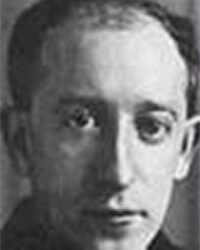
Jaromir Weinberger

Jaromir Weinberger

1896-1967

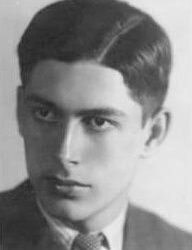
Jaromír Weinberger (1896-1967) was the composer of one of the most successful operas between the wars, the comedy Švanda Dudák (Schwanda the Bagpiper).  While unable to duplicate that level of success in his subsequent works, Weinberger was a prolific, productive and highly effective composer for several decades.  The disruption of emigration and his inability to retrieve his royalties made his life in the United States somewhat difficult, but he continued to compose in a variety of styles on a broad array of subjects, including such works as the Lincoln Symphony.

Life

Weinberger was born in Prague in January of 1896.  He was a prodigy of near-Mozartian proportions, starting piano at the age of five and composing by his tenth year.  He studied in Prague with such significant figures as Jaroslav Křička, Václav Talich and Rudolf Karel.  Eventually he ended up in the master class of Vítĕzslav Novák, a Dvořák pupil and one of the country’s leading creative figures.  He continued studying with Karel Hoffmeister and eventually traveled to Leipzig to take lessons with Max Reger, whose rigorous approach to composition, especially counterpoint, is a factor in many of Weinberger’s works.

In September of 1922, almost inexplicably, Weinberger moved to the United States where he took up a position as an instructor at Cornell University.  While he at first found many wonderful things in the USA, and made much of his cultural affinity to such writers as Whitman, Twain, Longfellow and Bret Harte–also signaling his intention to write an American symphony on the order of Dvořák’s “New World”—his first American sojourn was brief and his words bitter upon his return (Americans were too stiff and mechanical, too motivated by profit, etc.).

When he returned to Czechoslovakia he was appointed director of the National Theater in Bratislava, and later received appointments in Eger in Hungary, and Prague.  In 1926 Weinberger completed Švanda Dudák (Schwanda the Bagpiper) which became one of the most popular operatic works between the wars, with thousands of performances in hundreds of theaters including the Metropolitan Opera in New York.  Although none of his subsequent European works captured audiences as Švanda had, such pieces as the Passacaglia for Orchestra and Organ, Six Bohemian Dances for Violin and Piano, the opera The Outcasts of Poker Flat and a grand oratorio Christmas reveal a versatile composer, making use of the widest variety of materials and approaches.

Several observers, including Hans Heinsheimer at Universal Edition and Renato Mordo, manager of the German theater in Prague noted Weinberger’s pessimism and regarded his long discussions about world events to be utterly pessimistic.  Whatever one thinks of such things, the 1930’s were a time when even the most pessimistic and catastrophic visions fell well short of the mark.  With the rise of Nazism, Weinberger’s works were gradually denied performances, and the composer eventually fled his homeland for France and England.  He arrived in New York in 1939, a place where he was well known, for the success of Švanda at the Metropolitan Opera in 1931 had been considerable.

Shortly after his arrival he was interviewed by Howard Taubman who wrote an article for The New York Times titled “Weinberger Seeks Time to Compose.”  The composer’s tone alternates understandably between some level of near despair, with some discussion of how few royalties from Švanda were being sent to him, but also focused on a possibly bright future, which would include such works as a grand Lincoln Symphony.  Throughout, though, Weinberger expresses the exile’s worry about where his income will be coming from, where he will live, who he is.

He did land on his feet, at least at first.  The initial years of his American period were immensely productive featuring such varied works as Ten Characteristic Solos for Drum and Piano (1939), Mississippi Rhapsody (1940), Prelude to the Festival for symphonic band (1941), Prelude and Fugue on a Southern Folk Tune (1940), the Lincoln Symphony (1941) Czech Rhapsody (1941) and several religious compositions, including Ecclesiastes (1946) and Six Religious Preludes (1946).

The late 1930’s and 1940’s were spent mostly in the picturesque village of Fleishmanns in the Catskills, but after about a decade Weinberger moved to St. Petersburg, Florida.  The composer had a history of mental disorder, and was almost certainly bi-polar.  During the 1950’s and ‘60’s he gradually sank into a deep depression and committed suicide in 1967 in mourning, according to his biographer, for a culture that which no longer existed.

Works

The sources of Weinberger’s musical languages are many and varied.  His studies in Prague and Leipzig stressed formal control and contrapuntal mastery; his teachers, Křička, Novák and Reger were concerned with a certain professional polish and control, but they were also somewhat playful, and that combination can be found in Weinberger’s works.  These were aspects of his output that alternately received critical acclaim (when they were regarded as somehow genuine) and also set the composer up for a good deal of criticism (when they were thought to be either too automatic or insufficiently profound).  It is fair to say that, with the exception of Švanda, Weinberger frustrated his critics even as he pleased them.

Several of his Czech compositions enjoyed great local renown until the war.  Among these, the most conspicuous was his Christmas oratorio, which combined various stories about the holiday with the long, rich tradition of Czech “koledy,” or Christmas carols.  While the composer continued to write works that used Czech sources, from the very beginning he had a broad outlook, perhaps gleaned from Vítĕzslav Novák who also wrote in virtually every available genre.  Weinberger’s catalogue includes manifestly American works, such as the Lincoln Symphony and the Prelude and Fugue on a Southern Folk Tune, both of which try to combine old world musical sophistication with local elements, echoing Dvořák’s work decades earlier.  In his later years Weinberger more and more explored musical worlds related to religious mysticism, cultivating a more objective and nuanced style.

Without a doubt though, it was his latter-day export of “Czechness” to the rest of Europe that was Weinberger’s greatest contribution and his greatest success.  But this was not an entirely simple matter.  As in Bohuslav Martinů’s opera The Plays of Mary and Kodály’s Háry János (composed within a year of Švanda), Weinberger’s nationality comes to the fore precisely because it is set up by an array of “cosmopolitan” musical languages that stand for the very forces that threaten the simple goodness of the homeland.  Thus when Švanda (or Mary or Háry) sings at home, and presents himself to the world, he does so in intonations reminiscent of Smetana and Dvořák.  Indeed, his words “I am Švanda the Bagpiper” ape the opening of Smetana’s Má vlast.  When, however, he forgets his beloved and moves to the city, we hear “modern” music of a different stripe.  Like Martinů and Kodály (and Mozart, Dvořák, Schubert and Lehar), Weinberger’s dazzling mastery of many modern styles simultaneously infuses his music with depth and dimension and marks him as a kind of Hapsburg composer whose true style is a “style of styles.”

It is somewhat ironic that there is such a degree of nationalist absurdity in the reception of Weinberger’s works.  While the Czechs tended to find Švanda not quite Czech enough, or too routinely Czech, the rest of Europe clearly felt that Weinberger’s origins gave him an authentic Czech composing license, and it was rather his other works which sometimes failed in their estimation for being insufficiently Švanda-esque. The utter confusion in such matters is neatly encapsulated in a fragment from The New York Times, anticipating Švanda’s premiere at the Metropolitan Opera in 1931:

“The opera has been heard on almost one hundred stages abroad, although some of the presentations had to be postponed in parts of Germany as a matter of reprisal due to the feeling engendered by certain Czech Nationalists who had protested in their country against the singing of the choral section of Beethoven’s Ninth Symphony in German.  The presentation here will probably be in German.”

What’s this?  Švanda postponed because Czech patriots needed their Schiller in Czech?  And in the end the opera is presented at the Met in German anyway?  This kind of tension has simultaneously helped and hindered works like Švanda and composers such as Weinberger and untold others from this region.

Conclusion

It is customary with composers such as Weinberger to marvel somewhat at the fact that they had only one hit, and to suggest that they somehow fell short of their potential.  But the reality is that any composer with an enduring hit like Švanda is the great exception.  While Weinberger could never duplicate that opera’s success, which came about due to a complex interaction of politics, personal style and audience reception, he remained a productive and thoughtful composer until his final tortured years.  Forced to emigrate, losing his sources of income, we should marvel not that he did not live up to Švanda, but that he continued to compose at all.

By Michael Beckerman

Works List

Stage

Kocourov (1923–4,

S vanda dudák [Schwanda, the Bagpiper] 1926

Milovany hlas [Die geliebte Stimme] 1930

Lidé z Pokerflatu [The Outcasts of Poker Flat] 1932

Jarní Boure [Frühlingsstürme/Spring Storm] (operetta,)1933

Na ruzích ustláno [In a Bed of Roses] (operetta,)1933

Apropó co delá Andula? [By the Way, What is Andula Doing?] (operetta) 1934

Císarř pán na tresních [The Emperor and Lord of the

Cherries] (operetta) 1936

Valdstejn [Wallenstein] (op, 6 scenes,)1937

Saratoga (ballet), 1941


Orchestral

Lustspiel, overture., 1913

Scherzo giocoso, 1920

Puppenspiel Ouverture (1924)

Christmas, 1929

Liebesplauder, Neckerei, small orch, 1929

Ouverture zu einem ritterlichen Spiel (1931)

Passacaglia, orch, org, 1931

Chant hébraïque [Neima Ivrit] (1936)

Concertp., brass, timp, orch (1939)

Under the Spreading Chestnut Tree (1939, rev. 1941)

The Bird’s Opera (1940)

Concerto for Saxophone and Orchestra, 1940

Homage to the Pioneers, band, 1940

Legend of Sleepy Hollow (1940)

Mississippi Rhapsody, band, 1940

Prelude and Fugue on a Southern Folktune, 1940 [based on Dixie]

Song of the High Seas (1940)

Czech Rhapsody (1941)

Lincoln Symphony (1941);

Prelude to the Festival, band, 1941

Afternoon in the Village, band, 1951

Préludes réligieux et profanes, 1954

Aus Tirol, folkdance and fugue, 1959;

Waltz Overture, 1960


Vocal

Hatikvah, voice and piano, 1919

e Songs (Czech), voice and piano, 1924

Psalm cl (solo cant.), high voice, org (1940)

The Way to Emmaus (solo cant.), high voice, org, 1940

Ecclesiastes [Kohelet], Soprano, baritone, mixed choir, org, bells (1946)

Of Divine Work, anthem, mixed chorus, 1946 [from Bible: Ecclesiastes]

Ave, rhapsody, chorus, orchestra, 1962

5 Songs from Des Knaben Wunderhorn, S, pf, 1962 (manuscript)


Chamber

Colloque sentimental, violin and piano, 1920

Une cantilène jalouse, violin and piano 1920

Banjos, violin and piano 1924

Cowboy’s Christmas, violin and piano1924

To Nelly Gray, violin and piano, 1924

[6] Czech Songs and Dances violin and piano, 1929

10 Characteristic Solos, snare drum and piano 1939–41

Sonatina, bassoon and piano 1940

Sonatina, clarinet and piano 1940

Sonatina, flute and piano,  1940

Sonatina, oboe and piano, 1940

String Quartet (manuscript)


Keyboard

Sonata, piano (1915)

Spinet Sonata, piano 1915 (1925)

Etude on a Polish Chorale, piano 1924

Gravures, 5 preludes and fugues, piano 1924

Bible Poems, organ (1939)

Sonata, org an(1941)

6 Religious Preludes, organ (1946)

Dedications, 5 preludes, org an(1954)

Meditations, 3 preludes, organ 1956

Bibliography

O.  Erhardt: ‘Schwanda and the Czech Folk Opera’, Sackbut, xi (1930), 23–6 [Eng. trans. W. Monk]

H. Lindlar, ed.: ‘Jaromír Weinberger’, Tschechische Komponisten (Bonn, 1954), 37–41

D.Z. Kushner: ‘Jaromír Weinberger (1896–1967): From Bohemia to America’, American Music, vi/3 (1988), 293–313

D.Z. Kushner: ‘Jaromír Weinberger’, International Dictionary of Opera, ed. C.S. LaRue and L. Shrimpton (Detroit, 1993)

E. Entwistle, ed.: ‘The Turkey Takes Wing: Weinberger’s Schwanda and the Aesthetic of Folk Opera’, OQ, xii/2 (1995–6), 35–46

Ernst Krenek

Ernst Krenek

1900-1991

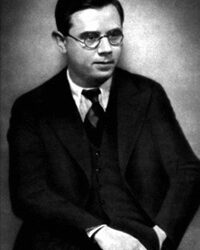
Ernst Krenek (1900-1991) was one of the most prolific musical figures of his time.  Born with the century in 1900, he lived until 1991 and was active as a composer for more than seven decades.  During that time he played a part in many of the century’s significant artistic movements, from atonality to neoclassicism and from jazz-influenced writing to total serialism, with turns to Schubertian lyricism and avant-garde electronic music at various points.  In addition to his astonishing productivity as a composer (his work list includes 242 compositions), he was also a prolific writer and critic as well as an avid educator.  Virtually the only figure of his time to have had both superstar popular success (with his opera Jonny spielt auf) and credibility as a major modernist, the experience of exile was particularly difficult for Krenek, who continued to be productive until the very end of his life without ever recovering his earlier stature.

Early Career

Krenek was born in Vienna in 1900 and, like his compatriot Korngold, was a prodigy, beginning his composing career at the age of six (though his Op.1 dates from his seventeenth year).  A decade later he began his studies with Franz Schreker at the Vienna Music Academy.  Though Krenek would eventually break with Schreker as his music became more atonal, the composer played a major role in his early thinking about music.  His first works are written in a late Romantic style, and already Krenek displays an almost Mozartian reach, writing pieces for keyboard, chamber ensemble, orchestra and operatic forces (in his career he wrote twenty-two operas).

In 1920 Krenek moved to Berlin to continue his studies with Schreker, and there he met such influential musicians as Busoni, Hermann Scherchen and Artur Schnabel.  Though he had begun his career writing in a late Romantic idiom, by the early 1920’s he adopted an uncompromising atonal style.  In 1922 he completed his Second Symphony, Op.12, a major work of epic proportions that reveals the young composer at his most original.  Two massive outer movements, each more than twenty-five minutes in length and characterized by slow introductions, where ideas and concepts slowly emerge out of a kind of primordial ooze, surround a motoric Allegro half that length, consisting of a series of contrapuntal expositions.  While it has been noted that there is much Mahler in this composition (to make the comparison more tempting, Krenek had married the composer’s daughter Anna just before he began composing the symphony), the work also stands apart from the spirit of Mahler and moves in what are, arguably, even riskier directions.  Around this time Krenek also completed his first dramatic work, the scenic cantata Die Zwingburg based on a work by Demuth and a libretto by Werfel, a classic expressionist work of alienation and social commentary.

A Major Success

Between 1923 and 1925 Krenek spent time in Switzerland, where he met such figures as Friedrich Gubler (an editor of the Frankfurter Zeitung) and the poet Rainer Maria Rilke.  He also met Theodor Adorno at this time, and their lively polemics on the subject of new directions in music is one of the most exciting intellectual exchanges of its time.  During this period he also visited Paris, where he became acquainted with Stravinsky’s neoclassical style, particularly Pulcinella, and with the music of Les Six.  Returning from France, he befriended Berg, Webern and Schoenberg.

Out of this ferment and virtual explosion of styles came the only work that Krenek could count as an unequivocal public success: the opera Jonny spielt auf (Johnny Plays On).  Combining the eclecticism of the times with a nod at a kind of “Euro jazz” as cultivated by Stravinsky and Milhaud in La Boeuf sur le toit, the piece was an instant hit and gave rise to hoards of imitations.  Set in nightclubs, glaciers and trains, and referencing almost all the available styles of the time in some guise or other, the opera tells the story of the lovers Max and Anita and their travels through the demimonde, and especially their connection with the black violinist Jonny, who steals an Amati violin.  The symbolic aspects of the tale, especially the contrast between the self-absorbed Central European intellectual and the “free man” Jonny caught the imagination of audiences throughout Europe.  The opera was performed in dozens of different opera houses, and made its way to New York as early as 1929.

Years of Turmoil

Ironically, it was the very success of Jonny, in particular its use of “jazziness,” that made things difficult for Krenek later on.  As the Nazis continued their inexorable rise to power, certain vernacular styles became convenient targets for the Nazis, and it was inevitable that Jonny would end up being considered what some started calling “degenerate music.”

Of course, despite the runaway success of the work, it was hardly typical of Krenek.  More characteristic, one could argue, was his other major operatic work of the period, Karl V, commissioned by the Vienna State Opera and completed in 1933.  The work deals with the life and ideals of the Holy Roman Emperor Charles V, who ruled Austria in the 16th century (1500-1558).  As he did research for the project, Krenek became convinced that the emperor embodied a kind of Christian humanism that could oppose the barbarity of current political movements. For this special project, the composer used a musical approach that was to color his works for the remainder of his career: the twelve-tone system.  Though he took a different attitude towards dodecaphonic music than Schoenberg, he believed greatly in its rigor, its uncompromising standards and its possibilities for further development.  The opera was due to be performed in 1934, but was cancelled and not performed until almost fifty years later as a major gesture of reconciliation.

Exile

Krenek remained productive throughout the 1930’s, devoting a great deal of time to writing essays and lecturing.  It was in 1937 that he first visited the United States.  He made a second trip to the US the following year and was intending to return to Austria when the Anschluss of 1938 made that impossible.  Krenek ended up staying in the United States and accepting a position in the Department of Music at Vassar College.  Despite the fact that he had been a rising superstar in European musical circles, in the United States he was just another exile, and despite good connections, he struggled to find a position that would allow him both the freedom to compose and an environment where he could put his pedagogical theories into practice.  Some of the conflicts that were to dog his career appeared early on in Vassar, where the assumption was that he would contribute to teaching music as a liberal art.  Krenek felt strongly that even as such, it was important for students to understand the rigor of composition, particularly twelve-tone composition, even if they never became composers, and in his high-minded but probably inflexible style, he alienated the rest of the music faculty and was forced to leave.

Lamentations

Despite these conflicts, he was characteristically prolific.  His continued efforts to freshly exploit the twelve-tone system and comment, through the lens of Christian humanism, on ongoing events led to the composition of Lamentatio Jeremiae Prophetae in 1942.  Based on the biblical writings of the Prophet Jeremiah, the Lamentations is an astonishing work for a cappella voices.  It explores intersections of various historical musical tendencies, and invokes a special musical spirit through the linkage of twelve-tone and modal tendencies.  In this work, contemporary style and basic principles of Netherlandish counterpoint mesh with an expressive power that is sustained for more than an hour.

Moving West Then Further West

In 1942 Krenek received an offer to become a professor and head of the Department of Music at Hamline University in St. Paul, Minnesota.  Despite the small size and budget of the institution, this proved a productive time for the composer.  Not only were the teaching conditions at the college congenial, but the conductor of the Minneapolis Symphony Orchestra, Dimitri Mitropoulos, took a keen interest in Krenek’s compositions and performed several of his works with the orchestra including the Second Symphony (which got a frosty reception) and the Piano Concerto No. 3 (which was a hit).  Krenek also helped to found a local chapter of the International Society for Contemporary Music that played a major role in local musical life and offered many significant premieres.  Despite these activities, Krenek never really reconciled himself to the region (He once remarked: “I wonder what desperation drove people to settle in this latitude”) and rather suddenly departed for the West Coast in 1947, leaving a good deal of bad feeling behind.  Aside from a visiting stint here and there, Krenek was to spend the rest of his life in California, in Los Angeles and Palm Springs.  During this period he continued to compose conduct, teach and write.

Late Wine

Krenek’s California years cannot be characterized by a single style or approach; indeed, the period contains over 100 compositions, including experimental works such as From Three Make Seven (1961) and Fibonacci Mobile (1964), takes in electronic works inspired by his visit to Cologne in 1955, and includes such autobiographical pieces such as The Dissembler (1978) and Spätlese (1972).  The latter in particular is a fine example of emotionally intense but technically more relaxed later style.  Beautifully written for the voice, and profoundly expressive, the six poems reflect on the joys and bitterness of life, and on coming to terms with oneself.

Starting in the 1960’s, and continuing for the remainder of his life, Krenek was honored in many ways, most appropriately, as far as the composer was concerned, through a production of Karl V in Vienna in 1983.  Many festivals of his work were mounted, especially in California.  His last work, a Suite for Mandolin and Guitar was written in 1989.  The composer died in 1991.

By Michael Beckerman

Bibliography

Bowles, G.H. Ernst Krenek: a Bio-Bibliography (New York, 1989)

Erickson, R. “Krenek’s Later Music”, Music Review, ix (1948), 29–44 Grandi, W. Il sistema tonale ed il sontrappunto dodecafonia di Ernst Krenek (Rome, 1954)

H.K. Metzger and R. Riehn, eds.: Ernst Krenek, Musik-Konzepte, xxxiv/xxxx (1984)

Hogan, C.: “Threni: Stravinsky’s “Debt” to Krenek”, Tempo, cxli (1982), 22–9

Hughes, J.: “Ernst Krenek Festival Concerts”, Musical Quarterly, lxi (1975), 464–70

Knessl, L. Ernst Krenek, Österreichische Komponisten des XX. Jahrhunderts, xii (Vienna, 1967)

Knoch, H. Orpheus und Eurydike (Regensburg, 1977)

Maurer- Zenck, C. “The Ship Loaded with Faith and Hope: Krenek’s Karl V and the Viennese Politics of the Thirties”, Musical Quarterly, lxxi (Munich, 1985), 116–34

Maurer-Zenck, C. Ernst Krenek, ein Komponist im Exil (Vienna, 1980)

Newsletter of the Ernst Krenek Archive (La Jolla, CA, 1990–)

Rogge, W. Ernst Kreneks Opern (Wolfenbüttel, 1970)

Rubey, N. Musikhandschriften in der Wiener Stadt- und Landesbibliothek: Ernst-Krenek-Archiv (Vienna, 1996)

Scook, S.C. Opera for a New Republic: the Zeitopern of Krenek, Weill and Hindemith (Ann Arbor, 1988)

Staehle- Laburda, M. Ernst Krenek and the 12-Tone Technique (diss., U. of California, San Diego, 1989)

Stewart, J.L: Ernst Krenek (Berkeley, 1991)

There is a complete Krenek bibliography available on the Krenek Institute Website (http://www.krenek.com as well as additional commentary and a complete wordlist.)

Gideon Klein

Gideon Klein

1919-1945

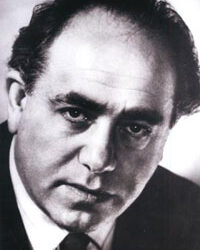
Gideon Klein (1919-1945) was a pianist, composer, writer and educator. In his short life he combined a dizzying array of skills, experiences, musical styles and activity. He arranged Hebrew folk melodies, wrote quarter-tone compositions, served as repetiteur for the infamous production of the Verdi Requiem in Terezín, and was a formidable presence in the musical life of that place.

Michael Flach, who was in Terezín with Klein, created a poetic impression of his presence in this excerpt from “A Concert in the Old School Loft (played by Gideon Klein)”

“And yesterday that man cut all the veins

He opened all the organ pipes

He bribed all birds to make them sing

To make them sing

Even though the verger’s hard fingers harshly sleep on top
of us”

Life

Klein was born in the Moravian town of Přerov in 1919, the youngest of four children. His parents were Czech-speaking Jews and he grew up in a traditional atmosphere. His gifts showed early, and at age 11 he began piano lessons with Růžena Kurzová in Prague; by the time he was twenty he had moved permanently to the city. He began composing in 1934, and continued studying piano with Vilém Kurz. He completed his Master Class in 1939 and continued studying musicology at Charles University and composition with Alois Hába.

These studies took place in difficult and uncertain conditions — by November of 1939 the Czech universities were closed by the Nazis, and Klein was forced to leave the Conservatory by 1940. An attempt to study in London in response to an invitation to study at the Royal Academy of Music was aborted. For the next year Klein tried to continue his activities using the pseudonym Karel Vránek, playing concerts in private homes, and continuing to work as a composer. His own apartment became the site of something very much like a salon, a meeting place for musicians and writers. On December 4th 1941 he was sent to Terezín where he remained for almost three years.

Klein’s time in Terezín is a record of remarkable activity under adverse circumstances. He became an avid educator, on musical and other subjects, and devoted himself to the teaching of the camp’s orphans. He remained active as a performer, serving as pianist for several opera productions and playing in solo recitals such works as Beethoven’s Op.110, Janáček’s Sonata, and Busoni’s transcription of Bach’s Toccata and Fugue in C Major and performing such chamber compositions as the Schubert Trio in Bb, Op.99, and piano quartets by Brahms and Dvořák. He also displayed conspicuous artistic growth as a composer, completing several choral works, a formidable Piano Sonata, a Fantasy and Fugue for String Quartet, and his final work, a Trio for strings, completed a week or so before he was transported to Auschwitz.

Like so many others, his final days, spent at the Fürstengrube concentration camp, are impossible to document. One of the last sightings of Klein is described in Milan Slavický’s excellent biography of the composer. According to a prisoner named Hans Schimmeling, all new arrivals at Fürstengrube were subject to a doctor’s examination. They were forced to wait naked in a room together, guarded by an SS officer. There happened to be a piano in the room, and the SS man asked if anyone played the piano. “The eyewitness was not a musician and did not recognize the piece, yet to this day he remembers Klein’s playing and is convinced that had Klein played something to the guard’s liking (a waltz, a ditty or something of that kind), he could have alleviated his fate and perhaps even saved his life.”

Klein’s legacy was preserved by several musicians, and carried forward primarily by his sister, the remarkable Eliška Kleinová who took great pains to make his music available and encourage a range of performers to take an interest in it. In her goals, and hopefully in her successes she embodies many of the same intentions of the Orel Foundation.

Although there was a flurry of interest in Klein’s music immediately after the war, his legacy and that of his fellow Terezín prisoners did not fare so well under the Communists. Complex conflicts and geo-political alliances created an atmosphere of de facto anti-Semitism in Czechoslovakia under normalization, ranging from the Slánský trials to the more benign but similarly toxic undermining of both religious and cultural forms.


Works

In his short and eventful life Gideon Klein completed approximately twenty-five original works and ten or so arrangements of songs, mostly in Terezín. Milan Slavický divides the composer’s oeuvre into three periods. From 1929-38 we have the development of a self-taught composer, and works ranging from first attempts to more assured utterances. From 1939-41 Klein became more professional since he was attending Alois Hába’s composition class at the Prague Conservatory. It was at this time he experimented with quarter-tone music. The third and most significant period took place while the composer was in Terezín and combined a far-reaching modernity with the quite natural desire to speak to a large audience about the circumstances in which he found himself. It is this latter music that has been most performed.

Until 1990 it was assumed that most of Klein’s youthful compositions had disappeared during the war years. In the words of Milan Slavický “one of Gideon Klein’s friends found a suitcase that had remained unopened since the war—and in this suitcase were almost all Klein’s compositions from the period preceding Terezín. Gideon Klein gave this suitcase to his friend shortly before joining the transport for Terezín…In this respect the newly discovered works reveal Gideon Klein as an experimenting composer of lofty ambitions, in harmony with the most advanced endeavors, thus substantially modifying his image.”

Klein’s compositions are distinguished by a clarity of form, an ongoing interest in contemporary movements such as jazz, neoclassicism, serialism and microtonalism and an abiding interest in contrapuntal design and variation technique. He was also profoundly influenced by his career as a performer, and his exploration of Busoni’s Bach arrangements created a warm synthesis of Bachian intellectual goals and a kind of hyper-expressivity.

By Michael Beckerman

Works List

1. Suite lyrique September-November
1929

2. Small Suite April
1933

3. Composition for a Human Voice, Op.2 August
1934

4. Three Fancies, op.3a August
1934

5. The Stranger, op.3b August
1934

6. Four Small Fancies, op.4 before
January 1935

7. Four Movements, op.5 January-February
1935

8. Blood of Childhood February
1935

9. Four Small Pieces October
1935

10. Four Movements for String Quartet July
1936-September 1938

11. Poplar Tree July
1938

12. Duo for Violin and Viola in the December
1939-February 1940

¼ tone system

13. Divertimento (for 8 wind instruments) June
1939-April 1940

14. Viola Prelude April
1940

15. Three Songs op.1 May-June
1940

16. String Quartet op.2 August
1940-August 1941

17. Duo for Violin and Cello November
1941

18. Madrigal (Villon) June
1942

19. Original Sin December
1942

20. Fantasy and Fugue December
1942-February 1943

21. Piano Sonata June-October
1943

22. Madrigal (Holderlin) December
1943

23. String Trio September-October
1944

Bibliography

Beckerman, Michael. Gideon Klein’s Last Concert.

Beckerman, Michael. “Postcard from Prague, Trio from
Terezín,” in Music and Politics.

Karas, Joža. Music in Terezín 1941-1945. Stuyvesant, New York: Pendragon Press, 1985.

Klein, Hans-Gunter. Gideon Klein-Materialen. Verdrangte Musik 6, 1995.

Peduzzi, Lubomir. Musik im Ghetto
Theresienstadt
. Brno: Barrister and
Principal. 2005

Slavický, Milan. Gideon
Klein: A Fragment of Life and Work. Prague: Helvetica- Tempora
Publishers, 1996.

Discography

Link to comprehensive Klein discography:

http://claudet.club.fr/Terezín/MyKlein.html#1–23

Jaroslav Jezek

Jaroslav Jezek

Karl Amadeus Hartmann, composer and organizer of Munich’s postwar contemporary music series Musica Viva, has received much attention in association with notions of inner emigration. Emerging in the postwar correspondence between Thomas Mann and Frank Thiess, the term “inner emigration” refers to those artists that remained in Third Reich Germany but did not publish or participate in party events, whether for political or aesthetic reasons. As inner emigration scholar Michael Philipp suggests in his social history of the phenomenon, the concept remains highly elusive. Distinctions between collaboration and so-called “aesthetic resistance” are often permeated by a politically charged postwar ideology that occludes the complexity involved in each artist’s case. The following article chronicles Hartmann’s life and output and will also survey the literature that presents Hartmann as the inner emigration composer par excellence.

Early Life

Karl Amadeus Hartmann was born in Munich in 1905 as the youngest of four sons within an artistically inclined lower-middle-class family. His father Friedrich Richard (1866-1925) was a professional painter, and his mother Getrud (né Schwamm, 1874-1935) expressed a keen interest in literature and music. His brother Adolf (1900-1971) also became an accomplished painter and his artistic connections, especially at the Munich Juryfreien exhibitions, were critical in shaping the young Karl Amadeus.

Karl Amadeus showed musical talent from an early age and, despite dropping out of school, Hartmann later enrolled in Munich’s Akademie der Tonkunst and studied composition with the Reger disciple Joseph Haas. During the troubled, yet artistically dynamic years of the Weimar Republic, Hartmann remained largely an inconspicuous trombonist for the Munich opera. Yet, he also became involved with the prestigious Juryfreien exhibitions beginning in 1928, for which he served as an organizer, composer and conductor. It was during these years that Hartmann’s leftist political and aesthetic convictions were formed. [The talented and multifaceted conductor Hermann Scherchen became an outstanding influence on Hartmann’s subsequent career as a composer and artistic director.]

In these early years Hartmann wrote mainly in the avant-garde idiom of the great composers of the time (Hindemith, Stravinsky, Milhaud, Orff and Krenek). Despite later studying with Anton Webern, Hartmann distanced himself from the Second Viennese School. Instead, as demonstrated in the Jazz-Toccata und Fuge (1928) and the Tanzsuite (1931), Hartmann adopted jazz sonorities and rhythms, and his dense layering of percussive, polymetrical textures made the post-1933 reception of his music in Germany problematic. Furthermore, these early works frequently incorporated explicit messages of communism and did not shy from images of violent revolution. Thus, Hartmann composed two a-cappella chorales to Communist texts by Johannes Becher and Karl Marx and also a series of highly parodic Kurzopern entitled Wachsfigurenkabinett. Yet, as the latter operatic sketches attest, satire and radicalism were fashionable and could be manipulated to explore a number of coloristic musical effects.

Inner Emigration Years

After Hitler’s 1933 seizure of power, the Bavarian Radio cancelled its intended premiere of Hartmann’s Burleske Musik, fearing the scandal that avant-garde idiom would create, and although he was too insignificant to be directly attacked by National Socialist sympathizers, he was nonetheless forced into a marginalized position. Not in the financial position to emigrate to Switzerland (like many of his colleagues), Hartmann was compelled to remain in Third Reich Germany, supported by his wife’s family. As Michael Kater points out, although Hartmann ignored all Reichsmusikkammer letters requesting participation in official duties and for proof of his “Aryan identity,” he was by default an RMK member. During this time, whether for political, social or artistic reasons, Hartmann neither published nor solicited performances of his works within Nazi Germany.

Instead, Hartmann directed his creative energies abroad, toward international festivals and competitions. Between the years 1933 and 1945, Hartmann appeared at several international contemporary music festivals with a declaration of independence from Third Reich Germany. This included performances of his orchestral work Miserae and of his First String Quartet at the annual IGNM festivals in Prague and London in 1935 and 1938 respectively. Both premieres were positively received abroad, lending the impression that contemporary music continued in Germany However, the Prague premiere resulted in a confrontation with National Socialist authorities and, as Kater argues, the fact that Hartmann was able to participate three years later in London suggests that Hartmann did have administrative connections. Other international recognition included the Emil Hertzka Stiftung for the choral work Anno ’48 Friede, the 1936 Le Carillon prize, performances of his Symphonie L’oeuvre and the Concerto funèbre at the 1939 International Exhibitions in Belgium and Switzerland, and also broadcasts via the Belgian Radio in Brussels.

Works of this time period, usually referred to as “inner emigration works,” often incorporate both explicit and indirect references to music that was either forbidden or discredited by the Nazi party. Thus, in his dissertation on Hartmann’s opera Simplicius Simplicissimus, Rüdiger Behschnitt refers to the viola melody in the overture’s Adagio section as being Jewish in origin. Moreover, as exemplified by the second movement of Symphonie L’oeuvre (which is based on an anti-war Chinese song by Confucius), the use of extra-musical sources and often autobiographically related texts serve to comment on surrounding political and social realities. This is complemented by dedications and inscriptions that were unambiguously subversive, like the dedication of Sinfoniae Drammaticae “China fights” to the Russian author Sergej Tretjakov and the Chinese independence-fighter Den Shi-Hua.  Further, as Hartmann scholar Andreas Jaschinski articulates, the use of extended slow symphonic movements serve as elaborate lamentations; and, to contrast this, Hartmann adopts quick, ostinato-driven movements that build up into chaotic climaxes, in turn satirically undermining their own monumentality.

Significantly, many of these inner emigration compositions were later reworked into postwar publications. Yet, in conformity with postwar ideological demands and emerging Cold War politics, these re-workings frequently neutralized initial political messages of socialist revolution. For example, the “China fights” dedication was replaced with an inscription to the Munich music critic Antonio Mingotti. Similarly, Hartmann denied the symphony’s programmatic content and its revolutionary character, instead asserting that the composition was merely a simple musical exercise on an eight-measure Chinese melody.

Hence, unlike many opportunistic composers during the immediate postwar period who selectively reinterpreted their works as exhibiting hidden messages of aesthetic resistance, Hartmann deemphasized and (as in the case of Sinfoniae Drammaticae) even erased those features that might be associated with political subversion and communist activity. This resulted in what some have considered to be a more subdued form of socialism, one that propounded an ethos of tolerance, love for humanity and “commitment” against all tyranny.  Here, Hartmann’s revised tone may be contextualized vis-à-vis his subsequent employment by the American military occupation, an environment that precluded communist sympathies and revolutionary activities.

Writing Between the Lines: A Paradigm of Aesthetic Resistance

Before proceeding to outline Hartmann’s postwar symphonic output and his efforts as organizer for the Musica Viva series, several paragraphs about the notion of “aesthetic resistance” are in order.

Although Hans-Werner Heister alludes to Hartmann’s brief involvement in an underground anti-fascist network, Hartmann scholarship for the most part constructs arguments of inner emigration and resistance in terms of a paradigm of aesthetic communication, one of “writing between the lines”. Also referred to as “verdeckte Schreibweise” (literally “hidden writing”), this mode of interpretation presents music as a language that is to be decoded, assuming that the listener is properly attuned within a “horizon of expectation” (“Erwartungshorizont”). In the case of Hartmann’s music, this is an audience that is capable of deciphering and that most likely shares the composer’s political and social messages. Needless to say, this is a paradigm that assumes the ultimate transparency of the composer’s intention (irrespective of whether such a clear intention existed) and that reduces music to a means of sending and receiving encoded messages.

In Heister’s seminal work (“Inner Emigration, Hidden Writing, Compositional Resistance: Karl Amadeus Hartmann’s Output after 1933”) – the same essay that transplants Dolf Sternberger’s concept of “verdeckte Schreibweise” from literary criticism into musicological research – Heister argues that the musical quote (“Musikzitat”) is this paradigm’s central mechanism. Here, musical quotation is broadly described as a manner of signaling a message to an appropriately critical audience, while simultaneously deceiving the unsuspecting and “system-conforming” listener. (Note the implicit moral judgment.) Several different types of “musical” allusion are enumerated, varying from direct and indirect musical quotation to extra-musical appropriation of literary topoi and ideological content. In turn, these are exemplified in Hartmann’s opera Simplicius Simplissimus, a work composed in 1934 to a picaresque novel by the seventeenth-century German author Grimmelshausen (1621-1676).

The first type of quotation is characterized as an “inversion of negation,” or the adoption of music that was forbidden within Nazi Germany. Here, Heister turns to the émigré Paul Walter Jakob, who formulates “forbidden music” in terms of its being “Marxist” (e.g. Weill and Eisler), “Jewish” (i.e. according to biographical details and not musical criteria), or “culture bolshevist” avant-garde music. Although critical of Jakob’s “overly-selective” categorization, this tripartite model pervades Heister’s analysis of the Simplicius opera. Thus, the Jewish melody “Elijahu ha-navi” appears in the opera’s second tableau, lending a prophetic tone to the hermit’s death. However, unlike the String Quartet (1933), where the same Jewish melody appears in a more conspicuous form, the Simplicius opera extrapolates only segments, instead integrating the musical reference into its surrounding content. A similar indirect musical allusion occurs in the opera’s finale (directly before the “Peasants’ War Song”), where a march-like piano piece by Prokofiev serves as a fighting song for the politically awakened Simplicius. Furthermore, Heister argues that the transition from recitando speech-song to metered and rhymed prosody (within the same number) points to a technique frequently employed by Soviet composers. Thus, Hartmann is characterized as having used all three types of forbidden music, thereby “inverting” Third Reich Germany’s marginalization and persecution of Jewish and Marxist composers. Yet, the question remains if today’s listener, let alone Hartmann’s intended audience, was capable of perceiving such indirect references. If not, the theory that music functions in terms of transparent signals is misleading and fails to account for the listener’s actual experience.

The second type of musical quote outlined by Heister is referred to as the “reclamation of history.” In the early stages of Hartmann’s inner emigration, “satire and parodic elements pervade the compositional vocabulary.” This is exemplified in Hartmann’s negative depictions of soldiers and authority figures (e.g. the Governor), these being character types that were frequently championed by the Nazi party. Yet, as Heister contends, Hartmann’s position is subtler than simple parody. Rather, Hartmann aspires “to reclaim Germany’s cultural and historical past from National Socialist misappropriation.” In keeping with this, Hartmann makes explicit use of the Volkslied  “Wir sind Geyers Schwarzer Haufen,” a song that was often used in Nazi Germany but had a longer standing history as a revolutionary song, commemorating the fight against tyranny during the Peasants’ War (1524-25). As Heister maintains, Hartmann is able to reclaim history and de-ossify ideological reification by abandoning the song’s usual conservative chorale treatment, instead “integrating the song into a modern musical language.” This is complemented by the fact that certain ambivalent passages in the song are left out in favor of an unequivocal statement of revolutionary sentiment.

Hartmann’s reclamation of history extends beyond explicit musical quotation. As Heister articulates, Hartmann adopts a historical subject that was common in stage works and historical novels of this time period. The Peasants’ War and the Thirty Years War (1618-48), which are anachronistically combined in Hartmann’s opera, also appeared in sanctified National Socialist operas; however, Hartmann uses the historical subject to depict the destruction and absurdities of war and to criticize the National Socialist trope of heroism. In a similar manner Hartmann reclaims the orchestration technique of speech-choir, what Victor Klemperer has described as the “language of the Third Reich.” Despite being a common technique of amateur and professional choirs at party events, Hartmann instead utilizes speech-choir in the manner of politically engaged Weimar Republic art, its use as a dramaturgical device of Marxist epic theater.

In conclusion, Heister’s treatment of the Simplicius opera as a series of covert political messages is insightful, and the treatment of specific moments in the musical score and libretto as decodable signals enables a “thick description” in terms of the deeper-lying political and cultural contexts. However, the readers of Heister’s well-thought-out essay are left with a feeling of doubt whether Hartmann indeed intended such explicit messages (as his post-factum autobiographical Kleine Schriften similarly argue) and whether the music-as-language model functions effectively, given that today’s listenership no longer understands these references.

Postwar Years

In the years following Germany’s 1945 surrender, Hartmann was employed by American military occupation forces to promote cultural reeducation and to combat Bavarian regionalism. Although a native of Bavaria, Hartmann was deemed sufficiently free of Nazi and local party sympathies to mediate in subsequent political decisions.  Given America’s outstanding support and patronage, Hartmann was able to found and lead the concert series Musica Viva until his death in 1963. Here, Hartmann’s creative programming and his juxtaposition of past and present musical works presented a forum for active dialogue and critical confrontation with the past. Moreover, through his active commissioning of visual artworks for the Musica Viva program booklets, and through innovative stage productions, Hartmann effectively placed contemporary music within a larger artistic and cultural community. Thus, in some sense Hartmann’s Musica Viva was an anti-thesis to the contemporary festivals in Darmstadt and Donaueschingen, which stressed a “Zero Hour” ideology of musical autonomy and a clean break with the past.

During the postwar period many of Hartmann’s existing compositions were performed for the first time, albeit often in a revised form. Revisions were made of the Simplicius opera, which was first staged in 1949 and then again in its revised form in 1957. Inner emigration works like the Symphonie für Streicher und Sopransolo (1938), the Concertino für Trompete und Bläserkammerorchester (1933), and the Symphonie “L’ouevre” (1938/9) were revised and included in the Fourth Symphony (1947), Fifth Symphony (1950), and Sixth Symphony (1951-3) respectively. Other works, like the Kantate für Altstimme und Orchester (1936) saw multiple revisions – first as Lamento, then as Symphonisches Fragment, and finally as the First Symphony (1947/8). At times, as with the Fifth Symphony, the revision entailed as little as the addition of several instruments; however, compositions like the Sixth Symphony were completely reworked.
Works like the Sinfonia tragica, the Symphonische Hymen, Klagegesang, Friede Anno ’48 – composed in 1940, 1943, 1944, and 1936 respectively – had to wait until well after Hartmann’s death for their premieres (1989, 1975, 1990, and 1968 respectively.)

Typically, the Sixth Symphony is seen as a turning point in Hartmann’s symphonic oeuvre, which in turn culminates in the Seventh and Eighth symphonies. In these works Hartmann turns increasingly to music history, experimenting with past notations, musical structures, rhythms, timbres and polyphonic textures.

During his final years Hartmann exhibited a renewed interest in operatic and dramatic works. This resulted in the Gesangsszene für Bariton und Orchester, based on the prologue to Jean Giraudoux’s drama Sodome et Gomorrhe. Heinz von Cramer also speaks of operatic sketches for Lope de Vega’s Fuente Ovejuna, and fragments for projects on Giraudoux’s Ondine and Shakespeare’s Macbeth exist in the Munich City Library. As exemplified in the scene based on Sodom and Gomorrah, Hartmann became increasingly concerned with nuclear holocaust, technological abuses and environmental pollution. Mention should also be made of Hartmann’s contribution to the Jüdische Chronik, a series of musical compositions that were commissioned in the early 1960s to commemorate the Jewish victims of the Holocaust. Complementing works contributed by Blacher, Henze, Dessau, and Wagner-Régeny, Hartmann’s movement (“Ghetto”) served as a threnody to the last moments of the Warsaw Ghetto.

By Alexander Rothe

Works List

Stage

Wachsfigurenkabinett (5 chamber operas, libretto E. Bormann, 1929-30, premiere Munich 1989); Simplicius Simplicissimus (chamber opera, 3 scenes, libretto H. Scherchen, W. Petzet, K.A. Hartmann, after H.J.C. Grimmelshausen: Der abenteuerliche Simplicissimus, 1934-5, revised 1956 – radio broadcast Munich 1948, staged Cologne 1949, revised version staged Mannheim 1957); Undine (unfinished, 1955); Macbeth (unfinished, 1959)

Orchestral

Symphonic: Symphony No. 1 “Versuch eines Requiems” (W. Whitman, 1935-6, revised 1954-5, p. 1955); Symphony “L’oeuvre” (1937-8); Sinfonia tragica (1940-3); Symphony No. 2 “Adagio” (1945-6, p. 1950); Symphony No. 4 (1946-7, p. 1948); Symphony No. 3 (1948-9, p. 1950); Symphony No. 5 “Hommage à Stravinsky” (Symphonie concertante, 1950, p. 1951); Symphony No. 6 (1951-3, p. 1953); Symphony No. 7 (1957-8, p. 1959); Symphony No. 8 (1960-2, p. 1963)

Concerto: Chamber Concerto (clarinet, string quartet, and string orchestra, 1930-5, p. 1969); Concerto for Trumpet and Winds (1932, p. 1933); Konzertante Musik (cello and orchestra, 1932-3); Symphonie divertissement (bassoon, trombone, double bass, and chamber orchestra, 1932-4); Concerto funebre (violin and strings, 1939, revised 1959, p. 1940); Concerto for Two Trumpets, Winds, and Double Basses (1948-9); Concerto for Piano, Winds, and Percussion (1953, p. 1953); Concerto for Piano and Viola, accompanied by Winds and Percussion (1955, p. 1956)

Other: Miserae (symphonic poem, 1934, p. 1935); Overture to “Simplicius Simplicissimus” (1934-5); Sinfonia tragica (1940-3, p. 1989); Symphonische Hymen (1942, p. 1975); Symphonische Ouvertüre (1942, p. 1947); Klagegesang (1944-5, p. 1990); Symponische Suite “Vita nova” (1948); Fugue-Scherzo (1956-7, completed by W. Hiller, 1992)


Vocal

Cantata (a cappella chorus, texts from J.R. Becher, K. Marx, 1929); Profane Messe (a cappella chorus, M. See, 1929-30); Friede Anno ’48 (soprano, mixed choir, and piano, A. Gryphius, 1936-7, p. 1968); Lamento (revision of Friede Anno ’48, soprano and piano, Gryphius, 1955, p. 1955); Ghetto (3rd movement from Jüdische Chronik, text J. Gerlach, 1960-1, p. 1966); Gesangsszene (baritone and orchestra, J. Giraudoux Sodome et Gomorrhe, 1963, p. 1964)


Chamber

Ensemble: Burleske Musik (winds, piano, and percussion, 1931, p. 1931); Kleines Konzert (string quartet and percussion, 1931-2, p. 1932); Tanzsuite (wind quintet, 1931, p. 1931); Toccata variata (10 winds, piano, and percussion, 1931); String Quartet No. 1 “Carillon” (1933-5, p. 1936); String Quartet No. 2 (1945-6, p. 1949)

Solo: Sonata No. 1, violin (1927, p. 1987); Sonata No. 2, violin (1927, p. 1987); Two Suites, violin solo (1927, p. 1984/6); Jazz Toccata und Fuge (1928); Kleine Suite No. 1, piano (1929-30, p. 1989); Kleine Suite No. 2, piano (1929-30, p. 1989); Sonatina, piano (1931); Sonata, piano (1932, p. 1990); Sonata “den 27. April 1945”, piano (1945, revised 1947, p. 1982)


Literary Works

Kleine Schriften (published by Ernst Thomas, 1965)

Bibliography

Rüdiger Behschnitt, “Die Zeiten sein so wunderlich…”. Karl Amadeus Hartmanns Oper ‘Simplicius Simplicissimus’ (Hamburg: Bockel Verlag, 1998).

Hanns-Werner Heister, “Innere Emigration, verdeckte Schreibweise, kompositorischer Widerstand: Aus Karl Amadeus Hartmanns Schaffen nach 1933,” in Die dunkle Last. Musik und Nationalsozialismus, ed. Brunhild Sonntag (Köln, Bela 1999).

Hanns-Werner Heister, “Karl Amadeus Hartmanns innere Emigration vor und nach 1945. Die symphonische Ouvertüre China kämpft,” in Aspekte der Künstlerischen Inneren Emigration 1933 bis 1945, ed. Claus-Dieter Krohn (Munich: Edition Text + Kritik, 1994).

Andreas Jaschinski, Karl Amadeus Hartmann: Symphonische Tradition und ihre Auflösung (Munich and Salzburg: Musikverlag Emil Katzbichler, 1982).

Michael Kater, Composers of the Nazi Erar: Eight Portraits (New York: Oxford University Press, 2000).

Michael Kater, The Twisted Muse: Musicians and Their Music in the Third Reich (New York: Oxford University Press, 1997).

Andrew McCredie, Karl Amadeus Hartmann: Sein Leben und Werk, Taschenbücher zur Musikwissenschaft 74 (Wilhelmshaven: F. Noetzel, Heinrichshofen-Bücher, 2004).

Andrew McCredie, “The Comparative Case Histories of Karl Amadeus Hartmann, Clemens von Frankenstein and Paul von Klenau as Variant Examples of Inner Emigration: Problems and Issues for German Music Historiography of the Period 1918-1945,” in Music, Ideas, and Society: Essays in Honour of Ivan Supicic (Croatia: Hrvatsko Muzikolosko Drustvo, 1993).

Michael Philipp, “Distanz und Anpassung – Sozialgeschichtliche Aspekte der IE,” in Aspekte der Künstlerischen Inneren Emigration 1933 bis 1945, ed. Claus-Dieter Krohn (Munich: Edition Text + Kritik, 1994).

Alexander Rothe, “Rethinking Postwar History: Munich’s Musica Viva During the Karl Amadeus Hartmann Years (1945-1963),” Musical Quarterly (forthcoming).

Habakuk Traber, “Exil und Innere Emigration. Über Vladimir Vogel und Karl Amadeus Hartmann,” in Verdrängte Musik: Berliner Komponisten im Exil, ed. Habakuk Traber und Emil Weingarten (Berlin 1987).