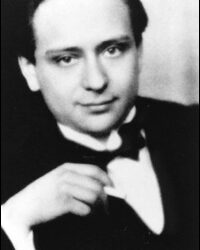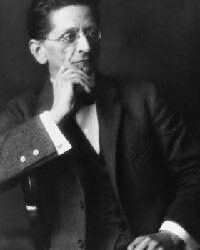
Alexander Zemlinsky

Alexander Zemlinsky

October 14, 1871 – March 15, 1942

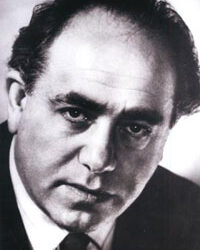
Alexander Zemlinsky (October 14, 1871 – March 15, 1942) was one of the most powerful musical voices of his time.  A remarkably influential musician, he had connections with both the more traditional and the Second Viennese School.  Although his work was nearly forgotten after the war, he has recently been recognized as one of the 20th century’s significant compositional voices.

Life

Alexander Zemlinsky, composer and conductor, was born in Vienna to a Slovakian Catholic father and mother of mixed Sephardic Jewish–Muslim descent. He played piano and organ from a young age and was admitted to the Vienna Conservatory in 1884 to study piano and composition under Anton Door, Franz Krenn, and the brothers Robert and Johann Nepomuk Fuchs. Zemlinsky’s first chamber compositions were performed in 1893 at the Wiener Tonkünstlerverein, where he appeared as guest pianist and conductor.

Brahms was reportedly impressed with his Clarinet Trio (1896) and recommended it to Simrock as Zemlinsky’s first publication. At this time Zemlinsky was conducting Vienna’s Polyhymnia orchestra, at which time he met composer (then cellist), Arnold Schoenberg. An informal teacher–pupil relationship developed between the composers: Schoenberg composed his D Major Quartet under Zemlinsky’s supervision and dedicated his Op. 1 Lieder to him as “teacher and friend.” The two became close friends and eventually brothers–in–law when Schoenberg married Zemlinsky’s sister, Mathilde. In 1896 Zemlinsky won the Luitpold Prize in Munich for his opera Sarema with a vocal score by Schoenberg.  Zemlinsky’s reputation as a composer was further established with the premiere of his second opera, Es war einmal… , conducted by Gustav Mahler at the Vienna Hofoper in 1900. Shortly thereafter, Zemlinsky became romantically involved with Mahler’s pupil Alma Schindler. Pressure from friends and family, however, influenced Schindler to reject Zemlinsky in favor of Mahler himself. Zemlinsky married Ida Guttmann in 1907; following her death in 1929, Zemlinsky married Louise Sachsel, a former student twenty–nine years his junior.

Until 1903 Zemlinsky had been Kapellmeister at both operetta houses, Carltheater and Theater an der Wien. Although Zemlinsky also taught regularly at the Schwarzwald school, he was forced to seek further employment with the early death of his father. In 1904 Zemlinsky and Schoenberg founded the Vereinigung Schaffender Tonkünstler, with support from Mahler, to promote contemporary music in Vienna. At this time Zemlinsky was appointed first Kapellmeister at the Volksoper, before departing briefly to join Mahler at the more prestigious Hofoper.  However, when Mahler resigned, his contract was not extended, and Zemlinsky returned to the Volksoper.

Zemlinsky received acclaim in 1910 with the premiere of his own Kleider machen Leute, subsequently accepting the musical directorship of the Neues Deutsches Theater in Prague. It was under his direction that the Prague theater gained admiration as one of the most esteemed opera houses in Europe. His assistants included Kleiber (1911–12), Webern (1917–18) and Szell (1919–20), and Viktor Ullmann served as chorus master (1921–7). In addition to conducting, Zemlinsky’s finest works were composed during this time, including the Maeterlinck songs, the Second Quartet, the Lyrische Symphonie, Eine florentinische Tragoedie and Der Zwerg.

Zemlinsky had successfully secured the future of the Prague theater, renamed the Deutsches Landestheater with the founding of the Czech Republic in 1918. He was appointed rector of the Deutsche Akademie für Musik und Bildende Kunst, where he associated with Schoenberg’s pupils Anton Webern, Heinrich Jalowetz, Karl Horowitz and composer Hans Krása. In 1923 he became a guest conductor for the Czech Philharmonic Orchestra, launching the orchestra’s affinity for Mahler as well as conducting notable premieres of Czech music, including works of Bedřich Smetana, Leoš Janáček and Josef Suk. In 1924 Zemlinsky conducted the world premiere of Schoenberg’s Erwartung at the Prague ISCM Festival, though relations with his brother–in–law had begun to deteriorate for personal and professional reasons (apparently a disagreement that stemmed from contradictory views on the technique of 12–note composition).

Although Zemlinsky was an important musical figure in Prague from 1911 to 1927, he nonetheless made several unsuccessful attempts to either return to Vienna or continue his work in Germany. In 1923 Max von Schillings offered him the post of Generalmusikdirector at the Staatsoper in Berlin. Zemlinsky refused the position, but reluctantly accepted an offer at the Kroll Oper with the promotion of a new Kapellmeister, Hans Wilhelm Steinberg, in Prague. He remained in Berlin until the closing of the theater in 1931, subsequently teaching at the Musikhochschule and guest conducting throughout Europe. Although Zemlinsky received praise for conducting the Berlin production of Kurt Weill’s The Rise and Fall of the City of Mahagonny that year, and later for setting Klabund’s (pseudonym of Alfred Henschke) Kreidekreis in 1932, he soon returned to Vienna with new focus on his own compositions. After completing the score for Der König Kandaules in 1936, Zemlinsky was required to abandon its orchestration because of the Anschluss in March 1938. He fled first to Prague and afterwards to New York City with his wife and daughter. Once in New York City, Zemlinsky hoped to perform Kandaules at the Metropolitan Opera, but the libretto was considered inadequate.  He was forced to forsake these larger works and direct attention to smaller compositions for financial reasons. In 1939 Zemlinsky attempted a final opera, Circe, but it remained incomplete after the composer suffered a series of strokes. Memorable moments of his final years include a brief reconciliation with Schoenberg and a national NBC broadcast of his Sinfonietta in 1940 under the direction of conductor Dimitri Mitropoulos.

Music

Zemlinsky’s compositions are recognized for bridging the gap between late Romanticism and twentieth–century modernist styles. Following the path of teachers Robert and J.N. Fuchs, and also Brahms and Wagner, Zemlinsky notably developed shifting tonal centers within a formal technique of variation and word–painting in the style of Viennese expressionism. The influence of Brahms is apparent in Zemlinsky’s early works, while later works draw from Mahler and the extended harmonies of Wagner. Zemlinsky eventually explored symbolism, but unlike his colleague Schoenberg, avoided extreme dissonance, twelve–tone technique and atonal music in general. Although these compositions reflect an affinity with Berg, who sought rational solutions to structural problems, Zemlinsky embraced asymmetry and did not seek such solutions.

Zemlinksy’s earlier works, Sarema and Es war einmal, reveal a characteristic Brahmsian form, dramatic pacing and nervous intensity also observed later in his First Quartet and Clarinet Trio. He departs suddenly from these Romantic characteristics in Die Seejungfrau, a work composed during his tumultuous affair with Alma Schindler, who appears indirectly as the princess and outcast in the subsequent Der Traumgörge, often considered one of Zemlinsky’s finest works.

Zemlinsky explored various combinations of music and drama in the style of Wagner with his Oscar Wilde operas. While early symphonies revealed his attempts to radically alter variation technique within traditional sonata form, Zemlinsky developed a new style of irregular rhythms and astringent harmonies in these operas, which are also apparent in his Third Quartet. After nearly five idle years, Zemlinsky returned to compose a dark Fourth Quartet (on the death of Berg) and several unique works that merged his various styles and techniques. These later works, such as the Symphonische Gesänge, Sinfonietta and the Third and Fourth string quartets tended towards sparseness, incorporating elements of Neue Sachlichkeit, Neo–Classicism and jazz. Although Zemlinsky was consistently drawn to larger–scale compositions, his lieder, especially the early Maeterlinck songs, are thought to best exhibit his creative skill and intuition

Zemlinsky was admired not only for his compositions, but also for his conducting.  Kurt Weill and Stravinsky, among others, praised him for his notable interpretations of Mozart and for his advocacy of Mahler, Schoenberg and contemporary music in general. Zemlinsky’s work vanished from concert and opera programs until the late 1960’s, when his music was revived in the wake of widespread Mahler zeal. The Fourth Quartet and Psalm XIII, neither of which had been published or performed during his lifetime, were rediscovered and celebrated posthumously. In 1907 Der Traumgörge was scheduled for a performance by Mahler, but was cancelled by Felix Weingartner, and postponed until its world premiere in 1980.

By Anoosua Mukherjee

Works List

Stage

— Sarema (op, 2, Adolph von Zemlinszky, after R. von Gottschall: Die Rose vom Kaukasus), 1893–5; Munich, Hof, 10 Oct 1897

— Es war einmal … (op, prelude, 3, M. Singer, after H. Drachmann), 1897–9; Vienna, Hof, 22 Jan 1900

— Der Triumph der Zeit (ballet, 3, H. von Hofmannsthal), 1901, inc.; act 2 separated as Ein Tanzpoem, 1901–4; Zürich, 19 Jan 1992

— Ein Lichtstrahl (mime drama with pf, 1, O. Geller), 1901

— Der Traumgörge (op, 3, L. Feld), 1904–6; Nuremberg, 11 Oct 1980

— Kleider machen Leute (comic op, prelude, 3, L. Feld, after G. Keller), 1907–9; Vienna, Volksoper, 2 Dec 1910; rev. 1922 (prelude, 2), Prague, Deutsches Landestheater, 20 April 1922

— Cymbeline (incidental music, W. Shakespeare), 1913–15

— Eine florentinische Tragödie (op, 1, O. Wilde, trans. M. Meyerfeld), 1915–16; Stuttgart, Hof, 30 Jan 1917, op. 16

— Der Zwerg (op, 1, G.C. Klaren, after Wilde: The Birthday of the Infanta), 1920–21; Cologne, Neues, 28 May 1922, op. 17

— Der Kreidekreis (op, 3, after Klabund), 1930–32; Zürich, Stadt, 14 Oct 1933

— Der König Kandaules (op, 3, A. Gide, trans. F. Blei), 1935–8, orchestration completed A. Beaumont, 1993; Hamburg, Staatsoper, 6 Oct 1996


Choral

— Minnelied (H. Heine), TTBB, 2 fl, 2 hn, hp, c1895

— Frühlingsglaube (L. Uhland), SATB, str, 1896

— Geheimnis (unidentified), SATB, str, 1896

— Hochzeitsgesang (Jewish liturgy), cantor (T), SATB, org, 1896

— Frühlingsbegräbnis (P. Heyse), S, Bar, SATB, orch, 1896, rev. c1903

— Psalm lxxxiii, S, A, T, B, SATB, orch, 1900

— Psalm xxiii, SATB, orch, 1910, op. 14

— Aurikelchen (R. Dehmel), SSAA, c1920

— Psalm xiii, SATB, orch, 1935, op. 24


Orchestral

— Symphony [no.1], e, c1891, fragment

— Symphony [no.2], d, 1892–3

— Lustspielouvertüre, 1894–5

— Suite, c1895

— Symphony [no.3], B[], 1897

— Drei Ballettstücke, from Der Triumph der Zeit, 1901

— Die Seejungfrau, symph. fantasy after H.C. Andersen, 1902–3

— Lyrische Symphonie (R. Tagore), drafts and sketches, orch, 1922–3, op. 18

— Sinfonietta, 1934, op. 23


Chamber and solo instrumental

— Trio (Allegro), a, pf trio, 1888

— Romanze, D[], vn, pf, 1889

— Terzet, A, 2 vn, va, 1892

— String Quartet, e, c1893

— String Quintet, d, 2 vn, 2 va, vc, 1894–6, mvts 2–3 lost

— Suite, A, vn, pf, 1895

— Trio, d, cl/vn, vc, pf, 1896, op. 3

— String Quartet no.1, A, 1896, op. 4

— String Quartet no.2, 1913–15, op. 15

— String Quartet no.3, 1924, op. 19

— Zwei Sätze, str qt, 1927

— String Quartet no.4 (Suite), 1936, op. 25

— Hunting Piece, 2 hn, pf, 1939

— Humoreske, wind qnt, 1939


Piano

— Sonata [no.1], G, 1887

— Scherzo, 1889

— 4 Nocturnes, E, b, G, E, 1888–1889

— Sonata [no.2], c, 1890

— Vier Miniaturen, c1891

— Drei Stücke, 1891

— Zwei Stücke, 1891

— Drei leichte Stücke, 1891

— Zwei Stücke, 4 hands, 1891

— Ländliche Tänze, 1892, op. 1

— Vier Balladen, c1893

— Albumblatt, 1895

— Skizze, 1896

— Fantasien über Gedichte von Richard Dehmel, 1898, op. 9

— Menuett, pf, 1901

— [5] Stücke, 4 hands, 1903


Songs: for 1v, pf unless otherwise stated

— O lasst mich nicht im dunklen Grab (L. Uhland), 1889

— Manchmal schiesst am blauen Bogen (K. Groth), 1889

— [7] Songs (H. Heine, J.F. von Eichendorff and others), 1889–90

— Des Mädchens Klage (V. Zusner), c1891

— Das Rosenband (F. Klopstock), 1892

— Lerchengesang (C. Candidus), 1892

— Abendstern (J. Mayrhofer), 1892

— Der Morgenstern (Zusner), 1892

— Frühlingslied (Heine), 1892

— Wandl’ ich im Wald des Abends (Heine), ?1892

— Die Trauerende (H. von Rustige), ?1893

— Orientalisches Sonett (H. Grasberger), 1895

— Herbsten (P. Wertheimer), 1896

— Waldgespräch (von Eichendorff), drafts and sketches, 2 hn, hp, str, 1896

— Nun schwillt der See so bang (Wertheimer), 1896

— Süsse, süsse Sommernacht (A. Lynx), 1896

— Der Tag wird kühl (P. Heyse), 1897

— Lieder (Heyse, T. Storm, J.W. von Goethe and others), 2 vols., 1895–6, op. 2

— Gesänge (Heyse, D. von Liliencron and others), 2 vols., 1896–7, op. 5

— Walzer–Gesänge nach toskanischen Volksliedern (Gregorovius), 1898, op. 6

— Irmelin Rose und andere Gesänge (C. Morgenstern, Dehmel, J.P. Jacobsen, Wertheimer), 1898–9, op. 7

— Turmwächterlied und andere Gesänge (Jacobsen, Liliencron), 1899, op. 8

— Ehetanzlied und andere Gesänge (O. Bierbaum, Morgenstern and others), 1900–01, op. 10

— [2] Songs (von Eichendorff, anon.), male v, orch, 1900–01

— In der Sonnesgasse (A. Holz), 1901

— Herr Bombardil (R.A. Schröder), 1901

— Maiblumen blühten überall (Dehmel), S, 2 vn, 2 va, 2 vc, c1903

— Es war ein alter König (Heine), 1903

— Mädel, kommst du mit zum Tanz? (Feld), c1904

— über eine Wiege (Liliencron), 1904

— Schlummerlied (R. Beer–Hofmann), 1905

— Zwei Balladen (V. Klemperer, H. Amann), 1907

— Fünf Lieder (Dehmel), 1907

— Der chinesische Hund, 1v, tambourine, 1908

— [6] Gesänge (M. Maeterlinck), Mez/Bar, pf, 1910–13, orch, 1913, 1922, op. 13

— Noch spür ich ihren Atem (Hofmannsthal), 1916

— Hörtest du denn nicht hinein (Hofmannsthal), 1916

— Die Beiden (Hofmannsthal), 1916

— Harmonie des Abends (C. Baudelaire, trans. A. Englert), 1916

— Symphonische Gesänge (L. Hughes, C. Cullen and others, trans. H. Kesser and others), Mez/Bar, orch, 1929, op. 20

— Und einmal gehst du (Eigner), 1933

— Sechs Lieder (Morgenstern, Goethe and others), 1934, op. 22

— Das bucklichte Männlein (Des Knaben Wunderhorn), 1934

— Ahnung Beatricens (F. Werfel), 1935

— Zwölf Lieder (S. George, Kalidasa, Goethe and others), 1937, op. 27

— Three Songs (I. Stein–Firner, trans. A. Matullath), 1939

Bibliography

Adorno, T.W. “Zemlinsky.” Quasi una fantasia: musikalische Schriften II (Frankfurt, 1963; Eng. trans., 1992) 155–80.

Biba, O. Alexander Zemlinsky: bin ich kein Wiener? (Vienna, 1992) [exhibition catalogue]

Beaumont, A. ed. “Alexander Zemlinsky: Der Triumph der Zeit – Drei Ballettstücke – Ein Tanzpoem, eine Dokumentation.“ Über Musiktheater, eine Festschrift, ed. S. Harpner and B. Gotzes (Munich, 1992) 13–31.

Beaumont, A. and S. Rode–Breymann, eds. Alma Mahler–Werfel: Tagebuch–Suiten 1898–1902 (Frankfurt, 1997; Eng. trans., 1988)

Clayton, A. “Brahms und Zemlinsky,” Brahms Congress: Vienna 1983, 81–93.

Heuberger, R. Im Foyer: gesammelte Essays über das Opernrepertoire der Gegenwart (Leipzig, 1901)

Hoffmann R.S. “Alexander von Zemlinsky.“ Der Merker, 2 (1910–11) 193–7. Der Auftakt, vol. 1 nos. 14–15 (1920–21) 197–240 [Zemlinsky issue]

Kolleritsch, O. ed. Alexander Zemlinsky: Tradition in Umkreis der Wiener Schule, Studien zur Wertungsforschung, 7 (Graz, 1976)

Krones, H. ed. Alexander Zemlinsky: ästhetik, Stil und Umfeld, Wiener Schriften zur Stilkunde und Aufführungspraxis, 1 (Vienna, Cologne and Weimar, 1995)

Loll, W. Zwischen Tradition und Avantgarde: die Kammermusik Alexander Zemlinskys, Kieler Schriften zur Musikwissenschaft, 34 (Kassel, 1990) öMz. vol. 4, no. 4 (1992)

Moskovitz, M. “Alexander Zemlinsky: A Lyric Symphony” Boydell Press, 2010.  [To see a review of this book, please navigate to:  http://www.operanews.com/Opera_News_Magazine/2011/5/Departments/Alexander_Zemlinsky__A_Lyric_Symphony.html  ]

Oncley, L.A. “The Works of Alexander Zemlinsky: a Chronological List,“ Notes. vol. 34, no. 2 (1977) 291–302.

Sommer, U. Alexander Zemlinsky: Der König Kandaules, Musik–Konzepte, 92–94 (Munich, 1996)

Specht R. “Die Jungwiener Tondichter.“ Die Musik, vol. 4, no. 7 (1909–10) 3–16, 9–12.

Stefan, P. “Zemlinsky.” Musikblätter des Anbruch, 7 (1932) 126–7.

Stephan, R. Alexander Zemlinsky: ein unbekannter Meister der Wiener Schule (Kiel, 1978)

Weber, H. Alexander Zemlinsky, österreichische Komponisten des XX. Jahrhunderts 23 (Vienna, 1977)

Weber, H. ed. Briefwechsel mit Arnold Schönberg, Anton Webern, Alban Berg und Franz Schreker (Darmstadt, 1995)

Weber, H. “Zemlinsky in Wien 1871–1911.“ AMw, 27 (1971) 77–96.

Zemlinsky, A. “Brahms und die neuere Generation: persönliche Erinnerungen,“ Musikblätter des Anbruch, vol. 4 (1922) 69–70. repr. in Brahms and His World, ed. W.M. Frisch (Princeton, NJ, 1990) 205–10

______ “Lyrische Symphonie,“ Pult und Taktstock, 1 (1924) 10–11.

______ “Einige Worte über das Studium von Schönbergs Erwartung.“ Pult und Taktstock, 4 (1927) 44–5.

______ “Jugenderinnerungen,“ Arnold Schönberg zum 60. Geburtstag (Vienna, 1934) 33–5.

Files

For a timetable of Alexander Zemlinsky’s life by Janet Wasserman,
click here
.

Eric Zeisl

Eric Zeisl

1905-1959

Eric Zeisl (1905-1959) was a composer whose career unfolded along a well-trodden path of exile.  In the early 1930’s he was a promising young Viennese composer just starting to make his career.  When Austria was annexed by the Nazis in 1938, he was forced to leave.  Emigrating through Paris and New York, he eventually settled in Southern California, living in Hollywood where he worked in the film business, did some teaching and was part of a vibrant and distinguished émigré community before he died of a heart attack in his early 50’s.  Zeisl’s music is deeply traditional; drawing on a broad range of powerful expressive devices, and from the late 1930’s his output is marked by a frequent turn towards what has been described as something like a “Hebraic” mode.

Early Life

Eric Zeisl was born into an assimilated Jewish upper middle-class family.  His family ran a café on Praterstern.  Eric and his brothers were involved in musical pursuits, particularly singing, from their earliest years.  There are stories about his passionate desire to improvise at the piano, and his early reverence for such composers as Beethoven, Schubert, Wolf, Wagner and Bruckner.

His ambition to study music seriously was opposed by his parents, so young Eric apparently sold his stamp collection to pay for lessons.  After a year or so of study at the Vienna Academy of Music and Performing Arts, he continued to study privately with Richard Stöhr, a popular composition teacher at the Academy of Music and author of several important textbooks.  Unlike Schoenberg, his exact contemporary, Stöhr was a dedicated traditionalist who believed that the musical language of the late nineteenth century was still viable.  Stöhr considered Zeisl to be his most talented composition student.

Zeisl also studied with Joseph Marx and Hugo Kauder in the early 1930’s and began to be recognized for the expressive power of such works as the Piano Trio Suite, Op.8, and his early songs, including several powerful ones based on the poetry of Nietzsche.  According to his biographers, Kauder was an innovative theorist and teacher who had been much influenced by Gustav Mahler in his thinking, something that he passed on to Zeisl.  In both his songs and his instrumental works, Zeisl was taken with Kauder’s approach.  One of the works where this is evident is the First String Quartet, in particular the final movement, a theme and variations based on a Slovak melody.  This work, premiered in 1934, made a great impression.  Zeisl’s biographer, Karin Wagner makes the important point that during these years avant-garde music was already being banned by the Nazis, and Zeisl’s more traditional language was tolerated in the early years of Nazi power.  She also points out that, despite various claims, Zeisl was never offered the Austrian State Prize for his Requiem Concertante, but rather received a small stipend to help with copying.  Around this time Zeisl also made some lifelong friends, associating with the painter Lisel Salzer and the writer Hilde Spiel.  At this time Zeisl was both productive and popular, composing works in almost every genre, but this was soon to end.

Change and Exile

With Hitler’s annexation of Austria in 1938 Zeisl’s fortunes took a predictable turn.  Though he at first moved to Baden in the hopes of riding out the bad times, it soon became clear that the Zeisls would not be able to stay in Austria.  Leaving his parents behind, Zeisl and several of his brothers left the country, and Eric and his wife, Gertrude, to Paris.

France in the late 1930’s was the home and pass-through zone of exiles from all over Europe, coming and going at a prodigious rate, from Walter Benjamin to Sigmund Freud, and from Pablo Picasso to Elias Canetti.  Hundreds of musicians from Germany, Austria, Poland, Czechoslovakia and Hungary also took up residence there for more or less time as their needs and, more importantly, their opportunities dictated.

It was during his time in Paris that Zeisl made the acquaintance of the work of the Austrian writer Joseph Roth (1894-1939).  In 1939, his novel Job was presented in a staged version featuring such talents as Hugo Haas, Josef Meinrad and Leon Askin.  Zeisl wrote several pieces for this production, including Menuhim’s Song and a Cossack Dance.  This story of a search for Jewish identity through tragedy and exile, and its contemporary Job, Mendel Singer, captured Zeisl’s imagination, and became part of his musical and dramatic thought for the rest of his life.  Although he never finished a planned opera on Job, there are two acts extant, and Roth’s story is credited with pushing Zeisl in the direction of something like a “Jewish” compositional idiom.

To America

With the political situation worsening in Europe, the Zeisls left for the United States in 1939, at first settling in New York.  Initially, Zeisl was both lucky and successful.  Ernö Rapee, a Hungarian conductor, included Zeisl’s Little Symphony in his weekly national radio broadcast, and it was a fantastic success.  Other works of the composer were played, and it looked as if he might be able to build a career for himself in New York.  The next year the family moved to a large house in Mamaroneck near the Long Island Sound, and the composer was able to work in pleasant and tranquil circumstances.  He was productive as never before and, compared to many other émigrés, doing quite well.

Like many composers both before and after, Zeisl seems to have regarded Hollywood as a place where he could make a comfortable living and, at the very least, match his current output.  And like many other composers, he was to find that the movie business could be a trap for all but the most successful, and that California itself could veer wildly from a land of dreams to a land of dreams dashed.  His name for the town, “Schein-Heiligenstadt” is both a pun on “Holly=Holy” town, but also included the German word for hypocrisy.

Zeisl began to work for MGM in the early 1940’s and wrote music for the Fitzpatrick Travel Talks with titles like “On the Road to Monterey” “Morning in Minnesota,” and “Glimpses of Scotland.”  Although he ended up writing music for several films, including Bataan (1943), Song of Russia (1943), The Postman Always Rings Twice (1946) and even Abbott and Costello Meet the Invisible Man (1951), he was never to receive the main composer credit in a film.  Despite his disappointments with the film industry— and again, in this he was not alone— he was able to forge ahead in his own creative world with such significant works as the Requiem Ebraico in memory of his parents, who had died in the camps, and all those who perished.  Once again, he used something of the “Jewish” color he had begun to consciously employ in Job.  Many other works during this period, including the ballets Naboth’s Vineyard (1953) and Jacob and Rachel (1954) were composed at this time.  These, and many other works with Jewish themes, were performed at concerts devoted to Jewish music.  These concerts and his success led to his employment at the Brandeis Camp Institute in Simi Valley from 1948-50 and resulted in a major work, the “Brandeis Sonata” for Violin and Piano (1949-50).

His last completed work was the so-called “Arrowhead” Trio, written in 1956, but he spent the summers of 1957 and 1958 trying to complete the opera Job, a task he did not accomplish.

West Coast Exiles

According to the recollections of Gertrude Zeisl, painstakingly recorded by Malcolm Cole over twelve hours and transcribed, the Zeisl home was a meeting place of the great European exile community of the West Coast.  Alma Mahler Werfel, Korngold, Stravinsky, Mario Castelnuovo-Tedesco, Alexander Tansman and many, many others spent time together, and while he only met Schoenberg once, their children, Barbara and Ronald, met, uniting these families.

From the late 1940’s Zeisl made his living teaching at several schools including the Southern California School of Music and Arts and the Los Angeles City College, where he gave evening classes.  He died of a heart attack in 1959 after teaching a class at City College.

Music Early Years

Eric Zeisl had a particular kind of talent involving an unabashed directness, a penchant for rich textures, “expressive” harmonies that sometimes recall the Baroque use of chords, and seemingly a preference for shorter over longer forms.  His first works, indeed through the early 1930’s, are primarily songs and suites.  We may remember that the suite originally referred to a collection of dance pieces, and in the 19th century came also to suggest a group of excerpts.  Either definition is far from the world of the symphony, with its implications of emotional and logical sweep.  Like his songs, Zeisl’s suites, including the Op. 2 Suite for Violin and Piano, the “Heinzelmännchen” Suite for Piano and the Op. 8 Suite for Piano Violin and Cello, are collections of musical pictures, linked by key more than attempts to establish themselves in the tradition of Sonatas and Trios. (Dvořák once famously remarked that Tchaikovsky’s symphonies were actually more like suites).

So there is no suggestion that these works are in any way poorly organized or lacking in ambition.  The Op. 8 Trio Suite is a bold and powerful piece, revealing a sureness of tone that recalls early Brahms even as it reaches for the harmonic world of Mahler.  From the enormous depth of the Adagio to the faux-Oriental waltz of the Scherzo, to the beautifully crafted variations of the last movement (based on a theme recalling both Hansel and Gretel the Brahms Haydn Variations), this is the work of a composer who seems to have few doubts about his musical speech.  The last movement in particular, using a variation form that serves the composer well in many other works, shows an effortless fluidity that is simultaneously new, dramatic and ravishing.

When the composer does get to a traditional genre, as he does in 1930-33 with his first String Quartet, it too combines elements of traditional quartet structure with a kind of looseness more common to the suite style.  Particularly effective is a Theme and Variations on a Slovak folksong, revealing everything from the most delicate colors to wild bravura passages; the composer later successfully arranged this for orchestra.

Once again, when Zeisl does start working with a large orchestra it is to write a work using one of his beloved variation genres, the Passacaglia.  In this work Zeisl boldly chooses a bass theme that is at least twice as long as is typical for the genre.  Because the first half of the theme is somewhat simple and predictable, while the second veers wildly through several keys, the work has simultaneously a straightforward regal bearing and a risky edge.

Zeisl’s almost 100 songs reveal a talented reader of poems and a subtle setter of texts. His “Komm süsser Tod” combines the rhythms of Schubert’s “Death and the Maiden” with the harmonic intensity of Dvořák’s Biblical Songs to create a memorable farewell.  This may be noteworthy since it was both the last song written by Zeisl and a probably a commentary on the loss of his homeland.

Job and After

Writing about her father, Zeisl’s daughter Barbara recalls something the composer said when he was asked about whether his music had changed in the United States.  “I was a finished product of the old world; I could not change that even if I wanted to.”  Whether this is true or not is difficult to say, and still more difficult to prove. However, we have remarked on certain changes that took place in his outlook, and his music, when he began to work on Job.

Most audible in places like “Menuhim’s Song,” with its augmented intervals and “Hava nagila” skips, and its attempts to conjure ancient modes, this Hebraic style becomes part of Zeisl’s musical vocabulary, to be used whenever plot or his inner need calls for it.  While this does become one feature of his style, it would also be wrong to overemphasize it, since it is well integrated into the rest of his vocabularies.  We might note at this point that one characteristic of any so-called Viennese style is its concatenation of musical dialects.  Whether in Mozart’s Magic Flute, Beethoven’s Ninth or Mahler’s Symphony #1, we encounter an amazingly wide palette of styles, featuring quite abrupt juxtapositions.  Zeisl’s discovery and assimilation of any “Jewish” style would simply place him on a par with the very masters he revered.

Vestiges of this musical idiolect can be heard in one of his most important and popular works, the Requiem Ebraico, a setting of Psalm 97 in three versions, including a final one for SATB chorus, soloists and orchestra.  This deeply moving tribute to those who perished in the war pushes the vocabulary even further with what seems sometimes to cultivate a Jewishly inflected “innigkeit” to augment that Viennese innerness he felt was his birthright.

Such a thing can also be heard in his final work, the “Arrowhead” Trio.  While the outer movements move with alla Barocca fluidity, the inner core is something different altogether.  Here, the “Jewish” opening interval is seamlessly integrated into the rest of the texture, and the result, with the flute, violin and harp, sounds something like Debussy, “only a little bit Jewish.”  For whatever reason the composer chose to write in this manner, the result is, like his best work, some uncanny combination of the completely conventional with enough depth and subtlety to strike the listener as convincing and deeply moving.

Indeed, it is perhaps in his brilliantly rendered slow movements that Zeisl is his most powerful and original.  While the outer movements of the Second String Quartet, for example, are forceful (in the case of the opening movement) and charming (the Finale), it is in the best Viennese tradition that the slow center carries the expressive weight of the work.  Although there are no easily audible studied Semitisms, the movement has the feel of his penchant for a Jewishly inflected innerness, combining the ancient and the modern and the traditionally lyrical with the pulse of cantillation.  And when the opening gives way to a series of prayer-like sequences, the effect is mesmerizing.

 Postlude

In his recent book, Outliers, Malcolm Gladwell encourages us to question the meaning of success, and the means by which one achieves it.  At the very beginning of the book he notes that if you look at the rosters of the most successful Canadian hockey teams, a hugely disproportionate number of players were born in January, February and March.  That is because the cutoff for these elite leagues is January 1, and thus, at a very young age, when differences of months genuinely matter, players born in January will usually shine when opposing players up to a full year younger.  Those players will get more attention, superior training, and in general will do far better than their teammates who have the “misfortune” to be born in, say, October, November and December.

While nothing can truly explain the past, this phenomenon might allow for some understanding of why things were so hard for Eric Zeisl.  Born in 1905, he was virtually the youngest of his cohort of exiles and had neither the accomplishments of Krenek (b.1900) or Weinberger (b.1896) who had established themselves as international stars with “Jonny” and “Schwanda,” nor the connections of Korngold (b.1897) or Martinů (b.1890) to help him along.

Often, when we look at measures of success and failure, we consider issues of talent to be paramount, or imagine that it all is a matter of luck.  Yet it might be that neither is the case; perhaps much of Zeisl’s fate was determined, quite simply, by the year in which he was born.

By Michael Beckerman

Bibliography

Cole, Malcolm and Barclay, Barbara. Armseelchen. The Life and Music of Eric Zeisl. Westport/London, 1984.

Cole, Malcolm. “Eric Zeisl, the Rediscovery of an Émigré Composer.” The Musical Quarterly, 1978/64, p.237-44.

Cole, Malcolm. “Eric Zeisl’s Hiob: The Story of an Unsung Opera.” Opera Quarterly, 1992/2, p.52-75.

Wagner, Karin and Michael Haas, eds. Endstation Schein-Heiligenstadt: Eric Zeisls Flucht nach Hollywood/ Vienna California: Eric Zeisl’s Musical Exile in Hollywood. Judisches Museum Wien, 2006.

Wagner, Karin. Fremd bin ich ausgezogen, Eric Zeisl-Biographie. Wien, 2005.

Zeisl, Gertrude. Oral History. Transcribed from taped interviews.

Zeisl-Schoenberg, Barbara. The Reception of Austrian Composer in Los Angeles.

Jaromir Weinberger

Jaromir Weinberger

1896-1967

Jaromír Weinberger (1896-1967) was the composer of one of the most successful operas between the wars, the comedy Švanda Dudák (Schwanda the Bagpiper).  While unable to duplicate that level of success in his subsequent works, Weinberger was a prolific, productive and highly effective composer for several decades.  The disruption of emigration and his inability to retrieve his royalties made his life in the United States somewhat difficult, but he continued to compose in a variety of styles on a broad array of subjects, including such works as the Lincoln Symphony.

Life

Weinberger was born in Prague in January of 1896.  He was a prodigy of near-Mozartian proportions, starting piano at the age of five and composing by his tenth year.  He studied in Prague with such significant figures as Jaroslav Křička, Václav Talich and Rudolf Karel.  Eventually he ended up in the master class of Vítĕzslav Novák, a Dvořák pupil and one of the country’s leading creative figures.  He continued studying with Karel Hoffmeister and eventually traveled to Leipzig to take lessons with Max Reger, whose rigorous approach to composition, especially counterpoint, is a factor in many of Weinberger’s works.

In September of 1922, almost inexplicably, Weinberger moved to the United States where he took up a position as an instructor at Cornell University.  While he at first found many wonderful things in the USA, and made much of his cultural affinity to such writers as Whitman, Twain, Longfellow and Bret Harte–also signaling his intention to write an American symphony on the order of Dvořák’s “New World”—his first American sojourn was brief and his words bitter upon his return (Americans were too stiff and mechanical, too motivated by profit, etc.).

When he returned to Czechoslovakia he was appointed director of the National Theater in Bratislava, and later received appointments in Eger in Hungary, and Prague.  In 1926 Weinberger completed Švanda Dudák (Schwanda the Bagpiper) which became one of the most popular operatic works between the wars, with thousands of performances in hundreds of theaters including the Metropolitan Opera in New York.  Although none of his subsequent European works captured audiences as Švanda had, such pieces as the Passacaglia for Orchestra and Organ, Six Bohemian Dances for Violin and Piano, the opera The Outcasts of Poker Flat and a grand oratorio Christmas reveal a versatile composer, making use of the widest variety of materials and approaches.

Several observers, including Hans Heinsheimer at Universal Edition and Renato Mordo, manager of the German theater in Prague noted Weinberger’s pessimism and regarded his long discussions about world events to be utterly pessimistic.  Whatever one thinks of such things, the 1930’s were a time when even the most pessimistic and catastrophic visions fell well short of the mark.  With the rise of Nazism, Weinberger’s works were gradually denied performances, and the composer eventually fled his homeland for France and England.  He arrived in New York in 1939, a place where he was well known, for the success of Švanda at the Metropolitan Opera in 1931 had been considerable.

Shortly after his arrival he was interviewed by Howard Taubman who wrote an article for The New York Times titled “Weinberger Seeks Time to Compose.”  The composer’s tone alternates understandably between some level of near despair, with some discussion of how few royalties from Švanda were being sent to him, but also focused on a possibly bright future, which would include such works as a grand Lincoln Symphony.  Throughout, though, Weinberger expresses the exile’s worry about where his income will be coming from, where he will live, who he is.

He did land on his feet, at least at first.  The initial years of his American period were immensely productive featuring such varied works as Ten Characteristic Solos for Drum and Piano (1939), Mississippi Rhapsody (1940), Prelude to the Festival for symphonic band (1941), Prelude and Fugue on a Southern Folk Tune (1940), the Lincoln Symphony (1941) Czech Rhapsody (1941) and several religious compositions, including Ecclesiastes (1946) and Six Religious Preludes (1946).

The late 1930’s and 1940’s were spent mostly in the picturesque village of Fleishmanns in the Catskills, but after about a decade Weinberger moved to St. Petersburg, Florida.  The composer had a history of mental disorder, and was almost certainly bi-polar.  During the 1950’s and ‘60’s he gradually sank into a deep depression and committed suicide in 1967 in mourning, according to his biographer, for a culture that which no longer existed.

Works

The sources of Weinberger’s musical languages are many and varied.  His studies in Prague and Leipzig stressed formal control and contrapuntal mastery; his teachers, Křička, Novák and Reger were concerned with a certain professional polish and control, but they were also somewhat playful, and that combination can be found in Weinberger’s works.  These were aspects of his output that alternately received critical acclaim (when they were regarded as somehow genuine) and also set the composer up for a good deal of criticism (when they were thought to be either too automatic or insufficiently profound).  It is fair to say that, with the exception of Švanda, Weinberger frustrated his critics even as he pleased them.

Several of his Czech compositions enjoyed great local renown until the war.  Among these, the most conspicuous was his Christmas oratorio, which combined various stories about the holiday with the long, rich tradition of Czech “koledy,” or Christmas carols.  While the composer continued to write works that used Czech sources, from the very beginning he had a broad outlook, perhaps gleaned from Vítĕzslav Novák who also wrote in virtually every available genre.  Weinberger’s catalogue includes manifestly American works, such as the Lincoln Symphony and the Prelude and Fugue on a Southern Folk Tune, both of which try to combine old world musical sophistication with local elements, echoing Dvořák’s work decades earlier.  In his later years Weinberger more and more explored musical worlds related to religious mysticism, cultivating a more objective and nuanced style.

Without a doubt though, it was his latter-day export of “Czechness” to the rest of Europe that was Weinberger’s greatest contribution and his greatest success.  But this was not an entirely simple matter.  As in Bohuslav Martinů’s opera The Plays of Mary and Kodály’s Háry János (composed within a year of Švanda), Weinberger’s nationality comes to the fore precisely because it is set up by an array of “cosmopolitan” musical languages that stand for the very forces that threaten the simple goodness of the homeland.  Thus when Švanda (or Mary or Háry) sings at home, and presents himself to the world, he does so in intonations reminiscent of Smetana and Dvořák.  Indeed, his words “I am Švanda the Bagpiper” ape the opening of Smetana’s Má vlast.  When, however, he forgets his beloved and moves to the city, we hear “modern” music of a different stripe.  Like Martinů and Kodály (and Mozart, Dvořák, Schubert and Lehar), Weinberger’s dazzling mastery of many modern styles simultaneously infuses his music with depth and dimension and marks him as a kind of Hapsburg composer whose true style is a “style of styles.”

It is somewhat ironic that there is such a degree of nationalist absurdity in the reception of Weinberger’s works.  While the Czechs tended to find Švanda not quite Czech enough, or too routinely Czech, the rest of Europe clearly felt that Weinberger’s origins gave him an authentic Czech composing license, and it was rather his other works which sometimes failed in their estimation for being insufficiently Švanda-esque. The utter confusion in such matters is neatly encapsulated in a fragment from The New York Times, anticipating Švanda’s premiere at the Metropolitan Opera in 1931:

“The opera has been heard on almost one hundred stages abroad, although some of the presentations had to be postponed in parts of Germany as a matter of reprisal due to the feeling engendered by certain Czech Nationalists who had protested in their country against the singing of the choral section of Beethoven’s Ninth Symphony in German.  The presentation here will probably be in German.”

What’s this?  Švanda postponed because Czech patriots needed their Schiller in Czech?  And in the end the opera is presented at the Met in German anyway?  This kind of tension has simultaneously helped and hindered works like Švanda and composers such as Weinberger and untold others from this region.

Conclusion

It is customary with composers such as Weinberger to marvel somewhat at the fact that they had only one hit, and to suggest that they somehow fell short of their potential.  But the reality is that any composer with an enduring hit like Švanda is the great exception.  While Weinberger could never duplicate that opera’s success, which came about due to a complex interaction of politics, personal style and audience reception, he remained a productive and thoughtful composer until his final tortured years.  Forced to emigrate, losing his sources of income, we should marvel not that he did not live up to Švanda, but that he continued to compose at all.

By Michael Beckerman

Works List

Stage

Kocourov (1923–4,

S vanda dudák [Schwanda, the Bagpiper] 1926

Milovany hlas [Die geliebte Stimme] 1930

Lidé z Pokerflatu [The Outcasts of Poker Flat] 1932

Jarní Boure [Frühlingsstürme/Spring Storm] (operetta,)1933

Na ruzích ustláno [In a Bed of Roses] (operetta,)1933

Apropó co delá Andula? [By the Way, What is Andula Doing?] (operetta) 1934

Císarř pán na tresních [The Emperor and Lord of the

Cherries] (operetta) 1936

Valdstejn [Wallenstein] (op, 6 scenes,)1937

Saratoga (ballet), 1941


Orchestral

Lustspiel, overture., 1913

Scherzo giocoso, 1920

Puppenspiel Ouverture (1924)

Christmas, 1929

Liebesplauder, Neckerei, small orch, 1929

Ouverture zu einem ritterlichen Spiel (1931)

Passacaglia, orch, org, 1931

Chant hébraïque [Neima Ivrit] (1936)

Concertp., brass, timp, orch (1939)

Under the Spreading Chestnut Tree (1939, rev. 1941)

The Bird’s Opera (1940)

Concerto for Saxophone and Orchestra, 1940

Homage to the Pioneers, band, 1940

Legend of Sleepy Hollow (1940)

Mississippi Rhapsody, band, 1940

Prelude and Fugue on a Southern Folktune, 1940 [based on Dixie]

Song of the High Seas (1940)

Czech Rhapsody (1941)

Lincoln Symphony (1941);

Prelude to the Festival, band, 1941

Afternoon in the Village, band, 1951

Préludes réligieux et profanes, 1954

Aus Tirol, folkdance and fugue, 1959;

Waltz Overture, 1960


Vocal

Hatikvah, voice and piano, 1919

e Songs (Czech), voice and piano, 1924

Psalm cl (solo cant.), high voice, org (1940)

The Way to Emmaus (solo cant.), high voice, org, 1940

Ecclesiastes [Kohelet], Soprano, baritone, mixed choir, org, bells (1946)

Of Divine Work, anthem, mixed chorus, 1946 [from Bible: Ecclesiastes]

Ave, rhapsody, chorus, orchestra, 1962

5 Songs from Des Knaben Wunderhorn, S, pf, 1962 (manuscript)


Chamber

Colloque sentimental, violin and piano, 1920

Une cantilène jalouse, violin and piano 1920

Banjos, violin and piano 1924

Cowboy’s Christmas, violin and piano1924

To Nelly Gray, violin and piano, 1924

[6] Czech Songs and Dances violin and piano, 1929

10 Characteristic Solos, snare drum and piano 1939–41

Sonatina, bassoon and piano 1940

Sonatina, clarinet and piano 1940

Sonatina, flute and piano,  1940

Sonatina, oboe and piano, 1940

String Quartet (manuscript)


Keyboard

Sonata, piano (1915)

Spinet Sonata, piano 1915 (1925)

Etude on a Polish Chorale, piano 1924

Gravures, 5 preludes and fugues, piano 1924

Bible Poems, organ (1939)

Sonata, org an(1941)

6 Religious Preludes, organ (1946)

Dedications, 5 preludes, org an(1954)

Meditations, 3 preludes, organ 1956

Bibliography

O.  Erhardt: ‘Schwanda and the Czech Folk Opera’, Sackbut, xi (1930), 23–6 [Eng. trans. W. Monk]

H. Lindlar, ed.: ‘Jaromír Weinberger’, Tschechische Komponisten (Bonn, 1954), 37–41

D.Z. Kushner: ‘Jaromír Weinberger (1896–1967): From Bohemia to America’, American Music, vi/3 (1988), 293–313

D.Z. Kushner: ‘Jaromír Weinberger’, International Dictionary of Opera, ed. C.S. LaRue and L. Shrimpton (Detroit, 1993)

E. Entwistle, ed.: ‘The Turkey Takes Wing: Weinberger’s Schwanda and the Aesthetic of Folk Opera’, OQ, xii/2 (1995–6), 35–46

Mieczyslaw Weinberg

Mieczyslaw Weinberg

Mieczysław Weinberg’s flight from Nazi-occupied Europe was rather different from the customary exile to the West – to England or the United States. His move to the Soviet Union meant a second period of threat and discrimination under Stalin. But unlike many of his émigré colleagues in the West, Weinberg did enjoy considerable success as one of his adopted country’s most fêted and frequently performed composers, especially during the 1960s and 1970s when Emil Gilels, Mstislav Rostropovich. Kiril Kondrashin, the Borodin Quartet and Leonid Kogan all recorded and performed his works. Weinberg’s massive ouevre, which includes over 150 opus numbers, found favour on the opera stage, on movie soundtracks and in chamber and orchestral programs. However his music was known only in the USSR, its spread stifled by the Iron Curtain and the restrictions imposed by the cold war. His career foundered completely when the USSR fragmented, and it is only over the last five to ten years that Weinberg has found a growing number of enthusiasts outside Russia. Following a pioneering series of releases on the Olympia label (unfortunately no longer available) there have been a slew of new recordings, including issues by the Danel Quartet (on CPO) and the Polish National Symphony Orchestra (on Chandos). Peermusic have reissued a number of his works and Weinberg’s significance is now being reassessed, to a point where several critics argue that the century’s greatest Russian music was composed by a triumvirate that consisted of Prokofiev, Shostakovich and Weinberg.

Some confusion has attended Mieczysław Weinberg’s surname. In Poland he was Wajnberg, in the Soviet Union, Moisey Samuilovich Vaynberg — “Matek” to those who knew him well. A few traditionalists still cling to the other Cyrillic-derived version: “Vainberg”.  But there have been a number of other variations, including Wajnberg, Vaynberg or Vijnberg. The music-historian Per Skans has written of the composer’s preference for the standard Westernised version, “Weinberg”, and this spelling is now becoming the norm.

Weinberg was born in Warsaw on December 8, 1919. His father Shmuel had left the Moldavian town of Kishinyov (Chişinău) ten years earlier following a series of anti-Semitic attacks that had killed both his father and grandfather. In Warsaw he worked as a violinist and conductor in Yiddish theatre and it was he who provided Mieczysław with his initial practical experience, and exposed him to the traditional and liturgical Jewish music that was to inform his work for the rest of his life.

Eight years at the Warsaw Conservatory, then directed by Karol Szymanowski, provided Weinberg with a thorough traditional grounding. Under the tuition of Józef Turczyński he became an exceptional pianist, and it was generally assumed that once he had graduated, Weinberg would become a touring virtuoso in the tradition of Polish legends like Leopold Godowsky, Ignaz Friedman and Ignaz Paderewski. War changed these expectations, and his departure (on foot) from Warsaw in 1939, shortly before Hitler’s Panzers swept through Poland, marked the beginning of a series of well-timed re-locations. By 1940 he was in the White Russian capital of Minsk, 300 miles east of Warsaw (Belarus) studying composition with Vassily Zolotaryov, a protégé of Rimsky-Korsakov and Mily Balakirev. The day after his final examinations in June 1941 the Wehrmacht rolled into Russia and Weinberg was again forced to flee. He found work as a coach at the Tashkent opera house, 2000 miles away in eastern Uzbekistan. Many intellectuals and artists had been evacuated here, among them the illustrious actor and theatre director Solomon Mikhoels, a Latvian Jew whose daughter, Natalia Vovsi, Weinberg would soon marry. At Mikhoel’s behest Shostakovich examined the score of Weinberg’s First Symphony. Immensely impressed, he organized for Weinberg to come to Moscow. Here Weinberg re-established his friendship with Nikolay Myaskovsky, Professor of Composition at the Moscow Conservatory whom he had first met in 1940.

After 1917, the emerging Soviet Union had offered Jews living conditions superior to anything they had ever previously enjoyed. But this dispensation was short-lived and a renewal of repression in the 1930s saw the banning of Jewish newspapers and periodicals, and the closure of Jewish theatres and educational institutions. During the Second World War — still known in Russia as “The Great Patriotic War” – the reins of anti-Semitism were relaxed again, this time by Joseph Stalin, who wanted to encourage Jewish support for the war within the Soviet Union as well as to access funds from American Jewry. It was during this period of relative tolerance that Weinberg found refuge in Moscow. Official permission to reside in the city, a rarity during the war, was granted thanks to Shostakovich’s influence. He arrived in the capital in 1943 and remained there until his death in 1996. A lifelong friend, Shostakovich’s enthusiasm for Weinberg’s abilities grew and he came to describe him as “one of the most outstanding composers of today”.

In turn, Weinberg revered Shostakovich, for his generosity and humanity, as well as his gifts as a musician. Although he was already an accomplished composer by the time he arrived in Moscow — his Piano Quintet completed in 1943 is one of the most extraordinary in the repertoire – Weinberg claimed that Shostakovich had introduced him to “a new continent” in music, and despite the 12 year age difference and Shostakovich’s burgeoning reputation, the nature of their relationship was collegial rather than that of master and student. They lived in the same Moscow apartment block; saw each other regularly, and played through one another’s compositions, often in arrangements for two pianos. Weinberg performed the four-hand piano-reductions of Shostakovich’s Tenth Symphony (with Shostakovich), and his Twelfth (with Boris Tchaikovsky, another Shostakovich student) when the works were auditioned by the Composers’ Union, and Weinberg and Shostakovich also played the Babi Yar Symphony in this arrangement. There are also many mutual musical “borrowings”: the two-note motif that appears in Shostakovich’s Fourth Symphony is re-applied in Weinberg’s Fifth, composed shortly after its premiere, while Weinberg’s Seventh Symphony shares a similar formal design with Shostakovich’s Ninth String Quartet. Shostakovich’s Tenth Quartet, dedicated to Weinberg, draws on the latter’s Seventh Symphony.

Weinberg performed in the premieres of Shostakovich’s Seven Romances on Poems of Alexander Blok op. 127 (collaborating with Galina Vishnevskaya, David Oistrakh and Mstislav Rostropovich) and the Violin Sonata op. 134, standing in for Svjatoslav Richter. Weinberg worked as a freelance composer and pianist, outside the organizations that would have required him to become a party member, and therefore without the protection of the state. His status became increasingly precarious after 1948 when some of his compositions joined a list of prohibited works that included pieces by Shostakovich and Prokofiev.


When Stalin’s anti-Semitic purges began again in 1948, Andrei Zhdanov — Stalin’s deputy with responsibilities for “ideology, culture and science” — began a campaign aimed at extinguishing works with creative connections to Western musical developments; those works that exhibited traits of “cosmopolitanism and formalism” and in particular anything produced by Jewish artists and thinkers. Instead Zhdanov wanted works that could be easily assimilated by the public and glorify the achievements of the Soviet Union. This was nothing less than a communist incarnation of the Reichmusikkammer’s similarly repressive credo. Weinberg was not banned under the Zhdanov decree, unlike his colleague and friend Myaskovsky.

On the same day as the announcement, Solomon Mikhoels, Weinberg’s father-in-law, was murdered by the Cheka (the state secret police), his corpse run over by a truck and his death described as “an accident”. In a bizarre but not unusual volte face, the murder was then blamed on the CIA. So began a particularly depressing period in Soviet musical history. Weinberg himself was arrested in January 1953 and charged with conspiring to establish a Jewish republic in the Crimea — a concoction that although absurd, was still accompanied by a death sentence. The truth lay in Weinberg’s connection to Miron Vovsi, a close relative of his wife and the principal defendant in Stalin’s trumped-up “Doctor’s Plot”. It was assumed that Weinberg’s wife and sister-in-law would be arrested as a matter of course, and Nina Vasilyevna, Shostakovich’s wife, was given power- of-attorney for the Weinbergs’ seven-year-old daughter Vitosha, as well as the family’s possessions. With scant regard for his own safety, Shostakovich, wrote to Stalin and to his equally unpredictable security chief, Lavrenti Beria, protesting Weinberg’s innocence. Weinberg, incarcerated in sub-zero temperatures was deprived of sleep and interrogated. It was only Stalin’s propitious death on March 5th 1953 that led to Weinberg’s public rehabilitation and ultimate release. The account by his wife makes fascinating reading:

“Soon after this Shostakovich and his wife went to the south on holiday, making me promise to send a telegram as soon as Weinberg was released. And shortly we were able to send them this telegram: ’Enjoy your holiday. We embrace you, Tala and Metak.’ Two days later the Shostakoviches were back in Moscow. That evening we celebrated. At the table, festively decked out with candles in antique candlesticks, Nina Vasilyevna read out the power of attorney that I had written. Then Dmitri Dmitriyevich got up and solemnly pronounced, ’Now we will consign this document to the flames,’ and proposed that I should burn it over the candles. After the destruction of the ’document’, we drank vodka and sat down to supper. I rarely saw Dmitri Dmitriyevich as calm, and even merry, as he was that evening. We sat up till the early hours of the morning. Nina Vasilyevna laughingly recounted how I was worried that Vitosha would get a bad upbringing in the orphanage; it was then that I discovered that they had decided to take her into their own home.”

Weinberg lost many relatives in the war, including his parents and sister who died at the Trawniki camp, about 90 miles south east of Warsaw. His   experience of hate and racism inform his music to a very considerable degree. He contemplates the horrors of repression, the suffering of the Jews, and in particular the loss of children in many of his works. He once wrote: “Many of my works are related to the theme of war. This, alas, was not my own choice. It was dictated by my fate, by the tragic fate of my relatives. I regard it as my moral duty to write about the war, about the horrors that befell mankind in our century.”

But Weinberg’s personal response to the attacks on himself and those close to him remained stoical and positive, and he was relentlessly prolific in almost every musical genre. There are 26 complete symphonies — the last, Kaddish, written in memory of the Jews who died in the Warsaw Ghetto. Weinberg donated the manuscript score to the Yad Vashem memorial in Israel. There are also four Chamber Symphonies. Weinberg and Shostakovich had a light-hearted but long-running rivalry as to who could compose the most string quartets: Weinberg ultimately composed 17 (two more than his friend). There are also 28 instrumental sonatas, either for piano solo or with violin, viola, cello or clarinet. The sonatas for solo cello are particularly ingenious, as is the sonata for solo double bass, one of the most unusual and effective modern works for the instrument. His seven concertos include one for cello, which was programmed by Rostropovich during the 1960s (a live recording is included in EMI’s recently-released set of CDs devoted to the cellist), a brilliant concerto for trumpet, a violin concerto championed by Leonid Kogan and a fine concerto for clarinet. There are over 150 songs ranging from Yiddish laments to settings of poems by Julian Tuvim and Shakespeare; a Requiem (drawing on secular texts), seven operas, three operettas, two ballets, and incidental music for 65 films, plays, radio productions and circus performances.

Although his language is occasionally uncannily close to Shostakovich’s, Weinberg’s resourcefulness and the wealth of his musical ideas render the epigone accusation baseless. His works often possess a wry humour, a strong sense of irony and, in Symphonies like the Seventh and Twelfth, an uncompromising severity and strength of purpose. But rarely do these qualities overwhelm an overall feeling of contained human acceptance and gratitude. Weinberg also drew liberally on folkloric, Polish, Moldavian and in particular Jewish sources, musical ideas which, some say, resonated with Shostakovich and manifested themselves in his Second Piano Trio and, notably, in From Jewish Folk Poetry composed at the height of Zhdanov’s repressive regime. Although Weinberg’s life and music are becoming increasingly more familiar, his operas remain completely unexplored. The Passenger, set partly in Auschwitz was very highly regarded by Shostakovich and a new production of this and other stage works would mark a new chapter in our appreciation of the composer.

By all accounts Weinberg was a modest and generous man, somewhat removed from the Soviet mainstream — he never joined the Communist Party — and with his heavily accented Russian destined to remain, at least in part, an émigré. Shortly before his death in 1996, dispirited by Russia’s disregard for him and weakened by a long battle with Crohn’s disease, Weinberg converted to the Russian Orthodox Church.

A much-anticipated biography of Weinberg will be published by Toccata Press in 2011. The work, begun by the late Per Skans is being completed by Prof. David Fanning and Michelle Assay.

By Courtney Holmes

Bibliography

M. Anderson: Classical Net, http://www.classical.net/music/comp.lst/acc/vainberg.php

L. D. Nikitina: Moisey Samuilovich Weinberg, Grove Music Online, 2009

R. Reilly: ‘Light in the Dark: The Music of Mieczyslaw Vainberg’ Catholic Information Center on Internet, Crisis. (February, 2000)  http://www.music-weinberg.net/biography1.html

P. Skans: CD booklets to the 17 issues by Olympia (nla) and Chandos, issued under ‘Vainberg’ by Olympia and ‘Weinberg’ on Chandos (Symphony No. 5 / Sinfonietta No. 1, CHAN 10128; Symphony No. 4 / Rhapsody on Moldavian Themes / Sinfonietta, No. 2 CHAN 10237; Weinberg: Concertos, CHSA 5064)

P. Skans: ‘Per Skans on Mieczyslaw Weinberg’s (Moishei Vainberg’s) name’ http://www.music-weinberg.net/


Russian / Soviet Sources

A. Nikolayev: ‘О творчестве М. Вайнберга’ [‘O tvorchestve M. Vaynberga’ Eng.– About Weinberg’s work], SovM (1960), no.1, pp.40–47

Yu. Korev: ‘По первым впечатлениям’ [‘Po pervïm vpechatleniyam’ Eng.– By my first impressions], SovM (1960), no.5, pp.12–17

M. Roytershteyn: ‘Симфонии с монологами’ [‘Simfonii s monologami’ Eng.–Symphonies with monologues], SovM (1969), no.3, pp.26–8

L. Nikitina: Симфонии М. Вайнберга [Symfonii M. Vaynberga. Eng. Weinberg’s Symphonies] (Moscow, 1972)

K. Savka: ‘Герой Дюма на оперной сцене’ [‘Geroi Dyuma na opernoy stsene’ Eng.– Dumas’s heroes on the operatic stage], Muzïkal’naya zhizn’ (1975), no.6, pp.5–6

L. Faykina: ‘Опера о войне’ [‘Opera o voyne&#039 Eng.– An opera about the war], SovM (1975), no.10, pp.31–5

M. Weinberg:  ‘Честность, правдивость, полная отдача’ [‘Chestnost’, pravdivost’, polnaya otdacha’ Eng.– Clarity and sincerity given away fully], SovM (1988), no.9, pp.23–6

Kurt Weill

Kurt Weill

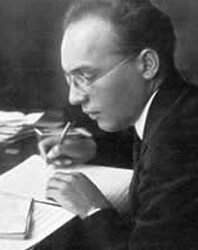
Despite the relative brevity of his life, composer Kurt Weill forged a far-reaching career that challenged the purity of preexisting styles.  As a famous German Jew, he fled Nazi Germany, fending for himself in foreign countries such as America, where versatility of styles, unlike anything in Germany, interested him the most. That these varied styles— music and theater, American and European—in which he worked were (and sometimes still are) hostile to one another, places him less in the role of a unifier, and more in the role of a “crossover” artist.

Many who unconditionally praise Weill’s output typically pick only one of his musical “personalities” and contrive ways of dismissing whatever other body of his work might offend them (whether his German music, Broadway music, “lowbrow” songs or “highbrow” works). Critics and scholars are presented a perplexing task when called upon to classify or evaluate Weill’s importance to music or theater of the 20thcentury, since their critical versatility rarely matches Weill’s creative versatility.

As he was sometimes outspoken, attacking with flare what he declared to be outmoded prejudices, Weill provided many quotable statements that lend support to many of his adherents, as well as his detractors. At other times he seemed to maneuver with stealth, using these very same prejudices to cleverly keep his career vital, nonchalantly but deftly pressing the political buttons of the international music world of the 1920s, 30s and 40s.

He was deceptively shrewd with business, socially charming, despite his shyness, and, above all, planned everything he did with equanimity and without impetuosity. In all these ways, he was the direct opposite of his most famous collaborator, Bertolt Brecht.

Early Life

Born in Dessau March 2, 1900, Kurt Julian Weill was the son of a Jewish cantor. Despite his religious upbringing, he did not ostensibly practice Judaism throughout his life, although these roots came into substantial play at opportune and inopportune moments of his career.

In 1918, he traveled to Berlin and studied philosophy and music, including a brief period with the opera composer Engelbert Humperdinck. A few years later, he took up lessons with Ferrucio Busoni, who would be his primary composition teacher. During these student years, Weill worked industriously on many purely instrumental works and songs, mostly in Post-Romantic style, as well as his first attempts at opera.

As the distinctively chaotic culture of Berlin between the wars began to thrive, Weill found his way into the Novembergruppe, an organization of progressive artists from different disciplines that included musicians such as Hanns Eisler and Stefan Wolpe. In this progressive environment, Weill found collaborators who would help mold his innovative vision of modern music theater, including Yvan Goll and Georg Kaiser (whose assistant, Lotte Lenya, became Weill’s wife and a powerful force in his career).

Weill Finds Brecht / Brecht Finds Weill

While Weill was working as a writer/critic for Der Deutsche Rundfunk, he glowingly reviewed a 1927 radio performance of Bertolt Brecht’s Mann ist Mann. Brecht was so impressed by the review, and by the fact that a composer could have such insights into theater, that he invited Weill to dinner.

Weill must have been further enticed when Brecht presented to him a lengthy published book of poetry with the title Bertolt Brechts Hauspostille (Bertolt Brecht’s Household Breviary—a reference to a work by Martin Luther). In a foldout “appendix” glued to the back lid of the book, notated melodies and lyrics for five songs, known as the “Mahagonny Lieder,” demonstrated Brecht’s interest in putting words to music and evidenced unmistakable influence by cabaret poet and singer Frank Wedekind. In those days, Brecht carried a guitar with him wherever he went, belting out songs, which were often in pidgin English (one of Brecht’s many prophecies was that a form of pidgin English would be the first world language). Some acquaintances even insist he was quite accomplished on the guitar.

A young composer working for Brecht named Franz Servatius Bruinier (1905-1928) is credited with first writing out the melodies of the “Mahagonny Lieder,” and an extant recital program for a vocalist suggests he also arranged them for voice and piano, along with several other songs attributed to Weill/Brecht, including “Seeräuber-Jenny” (“Pirate Jenny”) and “Surabaya-Jonny”. Weill claimed he never considered these (or any other melodies presented to him by Brecht) when writing out his own melodies and arrangements, but these “ur-melodies” by Brecht or Brecht/Bruinier are definitely the seeds from which many of Weill’s early theatrical songs evolved.

The origin of the word “Mahagonny” is unclear: one possible source is a 1922 song by Leopold Krauss-Elka and O. A. Alberts, “Komm nach Mahagonne!,” which was made into a hit by the Norwegian crooner Henry Erichsen; or it could have also been inspired by the Biblical city of Magog. Mahagonny, as a run-amok town in Alaska, partly symbolizes Berlin during its hyperinflation of the 1920s, but draws influence from Jack London’s stories and Charlie Chaplin’s The Goldrush (1925).

Weill added a sixth song to the “Mahagonny Lieder,” provided a stridently dissonant accompaniment while maintaining the cabaret feel, and created the first of the Brecht/Weill collaborations with the title Mahagonny Songspiel. The word “Songspiel” parodied the German tradition of Singspiel, replacing the word “sing” with the American word “song.” Mahagonny Songspiel was staged for the 1927 Donaueschingen Festival (held in Baden-Baden that year), which was organized by Paul Hindemith and emphasized new music theater.

The relationship between Weill and Brecht was famously not a warm friendship, although Brecht frequently avoided overt friendly contact with collaborators (with some exceptions). Nonetheless, Brecht’s influence on Weill must have been enormous, from his ideas on “epic theatre” (i.e., an anti-escapist approach to theater attributed to Brecht’s friend Erwin Piscator that allowed the audience to see stagehands and the mechanics of theater while they functioned) to the prophecies of America’s culture laden with unostentatious gangsters overtaking European culture. Later dubbed “The New Objectivity” (“die neue Sachlichkeit”), the overall theatrical approach emphasizes gesture by the actors/singers and served as a reaction against German Expressionism via realistic, non-distorted images (such as in newspapers). There is also a concerted attempt to put relevant social and political commentary into the productions, no matter how old or exotic the source material is.

Die Dreigroschenoper / The Threepenny Opera

A successful revival in London of John Gay’s 1728 The Beggar’s Opera caught Brecht’s eye, and he instructed his assistant, Elisabeth Hauptmann, to prepare a German translation of it. A Berlin actor named Ernst Josef Aufricht had recently acquired a theater (Theater am Schiffbauerdamm) and offered its première production to Brecht. Brecht agreed and proposed the German version of The Beggar’s Opera, also insisting on discarding the original 18th-century songs and replacing them with new, original songs.

From this simple idea, Weill set new lyrics by Brecht to new songs (one original song from The Beggar’s Opera was retained), and they called the concoction Die Dreigroschenoper (now popularly translated as The Threepenny Opera, even though a “Groschen” is actually a dime). The overwhelming success of this 1928 production (with Lenya playing one of the minor roles) made celebrities out of Brecht and Weill.

Unlike Mahagonny Songspiel, Weill’s music in Die Dreigroschenoper did more than demonstrate influence by the hit songs (or “Schlager”) from America’s then infamous Tin Pan Alley and jazz: it genuinely created a “craze” (referred to as “Dreigroschenfieber” or “Threepenny fever”). Although a simplified arrangement of “The Alabama Song” from Mahagonny Songspiel was published in sheet music form and promoted as if it could be a hit song (it would 40 years later), many songs from Die Dreigroschenoper became hits without much promotion shortly after they were performed, especially the opening number “Die Moritat von Mackie Messer,” which would become one of the biggest hit songs of the 20th-century after both Weill and Brecht had died.

Dreigroschenfieber spread throughout Europe and spawned a popularized version of the work through early sound movies, including G. W. Pabst’s filmed version of Die Dreigroschenoper (1931). Elsewhere, songwriters such as Friedrich Holländer and Rudolf Nelson wrote popular songs for singers such as Marlene Dietrich, creating a culture that the Nazis referred to as “Jewish Bolshevism.” At least one of these famous singers, Kurt Gerron, who played Tiger Brown in the original cast of Die Dreigroschenoper, was murdered along with his family in Auschwitz in 1944. [He had been forced to direct the infamous Theresienstadt propaganda movie for the Nazis.]

Brecht/Weill and Beyond

The next Brecht/Weill collaboration, Happy End, utilizes less music than Die Dreigroschenoper, but is stylistically similar. An attempt to expand the “Mahagonny Lieder” into a full-length opera, Der Aufsteig und Fall der Stadt Mahagonny (The Rise and Fall of the City of Mahagonny), met with many obstacles, including ongoing demonstrations by the Nazis. A radio cantata called Der Lindberghflug and a school opera in two versions based on Japanese Noh drama (Der Jasager/Der Neinsager) were collaborations on a smaller scale.

Despite Weill’s plunge into his own sophisticated version of popular music, he apparently still held on to ambitions of being a more conventional opera composer. While still in Berlin, he composed such an opera, Die Bürgschaft, working with Brecht’s childhood friend and scenic designer Caspar Neher (with whose wife, Erika, Weill was having an open affair).

Georg Kaiser’s and Weill’s Die Silbersee is more a musical, but Weill also considered it an opera. One month after its simultaneous opening in three different German cities in 1933, Weill decided to leave Germany for Paris with little more than a suitcase.

In Paris, Weill collaborated again with Brecht in a ballet chanté (i.e., a ballet with singing) called Die sieben Todsünden (The Seven Deadly Sins), starring dancer Tilly Losch and Weill’s then estranged wife Lenya. The production served as part of the first and only season of George Balanchine’s short-lived troupe known as Les Ballets.

The widely held myth that Weill’s relationship with Brecht had by this time deteriorated beyond repair is not consistent with the evidence that they stayed in contact for the rest of Weill’s life (Brecht outlived him by only six years). In fact, they would make another attempt to collaborate one evening in 1943 at Weill’s house with Schweyk in the Second World War and The Good Woman of Setzuan.


Weill’s American Career

Weill arrived in New York City in 1935, expecting to only work on one gigantic pageant of Judaism with the title The Eternal Road. The enormous Meyer Weisgal production brought together a “dream team” of director Max Reinhardt, librettist Franz Werfel and Weill.

Because of its huge scope, The Eternal Road met with many financial and production setbacks, and Weill had a chance to settle into New York and rub elbows with some of the most influential American theatrical talents of that time. By the time The Eternal Road began its limited run in 1937, Weill had already premièred on Broadway his first American collaboration, Johnny Johnson, with playwright Paul Green (produced by the Group Theatre, led by Cheryl Crawford, Lee Strasbourg, and Harold Clurman).

His friendship with writer Maxwell Anderson (who would also become Weill’s neighbor) led to Knickerbocker Holiday (1938), which included the hit “September Song.” A collaboration with Moss Hart and Ira Gershwin earned him a genuine Broadway hit with Lady in the Dark (1941), followed by another hit with Ogden Nash and S. J. Perelman, One Touch of Venus (1943), at a time when the most renowned Broadway musicals, such as Oklahoma! and South Pacific, were becoming standard fare. Some of the more successful late Weill productions included Street Scene (1947), Love Life (1948) and Lost in the Stars (1949).


Weill’s Posthumous Career

When Weill died of a heart ailment one month after his 50th birthday (3 April 1950), his legacy and estate went into the hands of Lenya, who continued to nurture his career up until her death in 1981. Unexpected prosperity came in 1954 with an English-language version in New York City of Brecht/Weill’s The Threepenny Opera, with help (including a stylish translation) from composer Marc Blitzstein. This production distinguishes itself as one of a handful of productions that became the cornerstone of the phenomenon known as “Off-Broadway.” A few years later, Louis Armstrong made the song “Mack the Knife” into a hit single, followed by a version by Bobby Darrin (1959) that became one of the most famous Grammy-winning hits of all time. Many American television and movie stars, including Jerry Ohrbach, Bea Arthur, Jerry Stiller, and Ed Asner, appeared in this “Off-Broadway” production, which ran at the Theatre de Lys (today, the Lucille Lortel Theatre in Greenwich Village) for almost a decade—one of the longest running shows in New York City history.

Some other cultural barrier crisscrossing addenda to Weill’s career include the fact that Lenya starred as the villain Rosa Klebb in the James Bond film From Russia With Love (1963) and was no doubt the inspiration for the female villain Frau Farbissina in comedian Mike Myers’s successful Austin Powers trilogy of movies (1997, 1999 and 2002). In 1967, The Doors recorded a simplified version of Brecht/Weill’s “Alabama Song” which became a big hit, inspiring other rock stars to cover the song including David Bowie and Marilyn Manson.

In many ways, Weill had just as much, if not more, influence on the second half of the 20th-century than the first. This influence is still widely taken for granted.

Crossover and Its Confusion

Xenophobia between European and American cultures inevitably produce oversimplified viewpoints of Weill’s music, whether assessing it positively or negatively: the Germans (especially Berliners) tend to look upon his American career as less important; and many Americans (especially New Yorkers, such as author Foster Hirsch) insist his German career is less important than what he did on Broadway. In a similar way, the traditional rift between “high” and “low” culture (which in Germany is commonly specified as “E-Kultur” and “U-Kultur”) is illustrated, for instance, by opera purists looking down at Weill’s work as selling out to popular culture, and pop culture purists often treating the notion of “high culture” altogether as some sort of malicious snobbery. Such oversimplifications suffer not only from myopia, but double-vision: a clichéd “two-Weills” approach to assessing his career is common.

Included in this confusion is how to classify Weill’s innovative theatrical works in light of the fact that universal definitions of “opera” and “musical” do not exist. Weill himself called Street Scene an “American opera” almost as a nuance to distinguish or “elevate” it.

Michael Feingold, drama critic for The Village Voice, calls Weill “the most influential composer of the [20th] century,” and this goes beyond a theater critic’s admiration of Weill’s indispensable contribution to the “Off-Broadway” scene in New York. Feingold uses Weill to articulate the view of many pop culture enthusiasts that, in the 20th century, American pop culture became the heir of European “classical” music of the 18th and 19th centuries within a universal musical language that resonates with and within important historical events.

More doctrinaire critiques, such as Virgil Thompson’s, have dismissed Weill’s work as dabbling in popular music, although Thompson typically mitigates this with guardedly positive statements about Weill’s music. Weill’s own composition teacher Ferruccio Busoni, despite their close friendship and mutual admiration, criticized Weill’s work in music theater as “a poor man’s Giuseppe Verdi.” Theodor Adorno dismissed Weill altogether as a mere tunesmith and arranger.

Kim Kowalke, who has served as the President of the Kurt Weill Foundation since Lenya’s death in 1981, strongly asserts that Weill’s significance lies beyond his collaboration with Brecht. He further points out that all of Weill’s works are some sort of hybrid, unrelated to one another. He points to Die Bürgschaft and Street Scenes as Weill’s true legacy as an opera composer.

In all these ways, assessing and reassessing Weill throughout the years produces many differing opinions. Perhaps the difficult task of fairly assessing Weill’s career as a whole will never yield a definitive view. If the multifarious culture of the 20th-century requires such a versatile “crossover” artist, then perhaps Weill is a quintessential representative of this era. Undoubtedly, much of his versatility rested in his ability to adapt, something many of his fellow German émigrés could not do as well.

By Gregg Wager

Bibliography

Bertolt Brecht. Bertolt Brecht’s Hauspostille. Potsdam: [no publisher], 1926.

Hermann Danuser, Hermann Gottschewski (eds.). Amerikanismus, Americanism, Weill: Die Suche nach kultureller Identität in der Moderne. Schliengen: Verlag Ulrich Schmitt, 2003.

David Drew. Kurt Weill: A Handbook. Berkeley: Univ. of Cal. P, 1987.
Albrecht Dümling. Laßt euch nicht verführe:. Brecht und die Musik. Munich: Kindler, 1985.

Michael Feingold. “The Weill Party.” Kurt Weill Newsletter. Vol. 19, No. 1. Spring 2001: 4f.

David Franeth, with Elmar Juchem, Dave Stein. Kurt Weill: A Life in Pictures and Documents. Woodstock, NY: Overlook, 2000.

Ronald Hayman. Brecht: A Biography. New York: Oxford UP, 1983.
Foster Hirch. Kurt Weill on Stage: From Berlin to Broadway. New York: Knopf, 2002.

Kim H. Kowalke. “Mistaken Identities.” Keynote address presented at Kurt Weill Centennial Celebration, Vanderbilt Hall, New York University. 3 Apr. 2000 (50th Anniversary of Weill’s “death day”).

Ibid. “Wie lange noch?: Die Bürgschaft and Its Times.” Kurt Weill Newsletter. Vol. 17, No. 1. Fall 1999: 5f.

Albrecht Riethmüller (ed.). Brecht und seine Komponisten. Spectrum der Musik 6. Laaber: Laaber, 2000.

Hyesu Shin. Kurt Weill, Berlin und die zwanziger Jahre. Sinnlichkeit und Vergnügen in der Musik (= Berliner Musik Studien 23), Berlin: Studio/Sinzig, 2002; also Diss. phil. Free University Berlin, 2000.

Gregg Wager. “Tracing the Origins of Alabama Song: A look at the meaning of a song by Bertolt Brecht and Kurt Weill as interpreted by The Doors.” Doors Collectors Magazine. Ed. Kerry Humphreys. Apr.-Oct. 1996: 15-20.

Kurt Weill. “Bühnenwerke im Berliner Sender: Vor- und Rückschau—Eine Erstaufführung.” Der Deutsche Rundfunk. Vol. 5, No. 11. 13 March 1927. 735f. In Weill, Musik und musikalisches Theater: Gesammelte Schriften. Mainz: Schott, 2000: 348ff.

Viktor Ullmann

Viktor Ullmann

1898-1944

Viktor Ullmann (1898–1944) was born on 1 January 1898 in the garrison town of Teschen in Silesia, in what belonged to the Austro–Hungarian Empire and is now a part of the Czech Republic.  Educated in Vienna, Ullmann made important contributions to both Czech and German cultural life as a composer, conductor, pianist and music critic.  Shaped by his engagement with Schoenberg’s musical philosophy, German aesthetics, as well the anthroposophy of Rudolf Steiner, Ullmann understood the role of art as central to human spiritual and ethical development.  Prior to his death in 1944, he wrote that “[artistic] form” must be understood from the perspective of Goethe and Schiller as that which “overcomes matter or substance [and where] the secret of every work of art is the annihilation of matter through form—something that can possibly be seen as the overall mission of the human being, not only the aesthetic but ethical human being as well.”  Within the context of his own compositions, Ullmann used form as a powerful commentary on his own self–conscious engagement with the traditions of Western art music as he engaged with them in the works of Schoenberg, Mahler and Berg.

Childhood and Youth 1898–1919

The son of Maximilian and Malwine Ullmann, Viktor Ullmann’s birth was registered with the Catholic community in Teschen, where he was later baptized on 27 January.  Prior to Ullmann’s birth, his father, who was of Jewish heritage, had officially renounced his faith and converted to Catholicism in order to advance his military career as an officer in the Austrian army.  In order to avoid the itinerate lifestyle that her husband’s work imposed on the family, when he was dispatched for extended periods to military outposts throughout Silesia, Ullmann’s mother moved with him to Vienna in 1909, where he attended gymnasium until 1916.  Concurrent to his schoolwork, Ullmann studied piano under Eduard Steuermann and received theory and composition lessons from Arnold Schoenberg’s student Josef Polnauer, beginning in 1914.  Although there is little documentation concerning Ullmann’s early musical engagements beyond these lessons, a program from his gymnasium years indicates that Ullmann conducted his school orchestra in 1915 in a concert of works by Mozart, Schubert, and Strauss.

After completing his Kriegsabitur, facilitating his early graduation from the gymnasium in May 1916, Ullmann enlisted for voluntary military service and was sent to the Isonzo–Front, after initially serving in a garrison in Vienna.  Decorated for bravery for his service in the war, Ullmann was made a lieutenant in 1918.  Returning to Vienna that year after two years of military duty, Ullmann not only entered Vienna University as a law student but was also accepted into Arnold Schoenberg’s Composition Seminar, where his classmates included, among others, Hanns Eisler and Josef Travinek.  Resuming piano lessons with his former teacher Steuermann at that time, Ullmann, at Schoenberg’s recommendation, was made a founding member of the committee for the Verein für Musikalische Privataufführungen.

Professional Life in Prague: 1920–1927

In May 1919, after having worked with Schoenberg for less than a year, Ullmann married his fellow composition student Martha Koref, left the university and abruptly moved to Prague, where musical culture in this cosmopolitan European capital was centered around the Czech National and New German Theaters.  Joining the staff at the New German Theater as a choir director and repetiteur in 1920, Ullmann underwent a rigorous training from its director Alexander Zemlinsky, who demanded that he develop a comprehensive grasp of both Czech and German musical repertories.  In his capacity as choir director, Ullmann was responsible for preparing the choruses and soloists for different productions, which included, most notably, performances of Schoenberg’s Gurrelieder and Mozart’s Bastien und Bastienne in 1921.  Appointed as a conductor at the theater in 1922, Ullmann maintained this position until 1927.  During these formative years in Prague, Ullmann witnessed numerous performances of new works, including the Prague premiere of Berg’s Wozzeck at the Czech National Theater in 1926, which became the basis of his life–long admiration of the composer’s work.

Parallel to his activity at the New German Theater, Ullmann was composing new works such as the Sieben Lieder with piano (1923), the Octet (1924), his incidental music for Klabund’s Kreidekreis (1925), the Symphonische Phantasie (1925), as well as the first version of his Variationen und Doppelfuge über ein Klavierstück von Arnold Schönberg (1925), based on the composer’s Op. 19, No. 4.  An orchestrated version of this work later was awarded the prestigious Emil–Hertzka–Gedächtnispreis in 1934.  Although composed in 1923, Ullmann’s First String Quartet, Op. 2, was premiered in 1927 on a program advertised as an “Evening of Prague Composers,” which included works by the composers Hans Krása, Karl Boleslav Jirák, and Fidelio Finke.

Ullmann was appointed as the conductor of the opera house in Aussig (now Ústí nad Labem) for the 1927 season, where he conducted, most notably, Tristan und Isolde, Ariadne auf Naxos, Le nozze di Figaro, and Jonny Spielt Auf.  Returning to Prague at the end of that season, Ullmann remained without a permanent post, actively pursuing his career as freelance composer at that time.  While his Concerto for Orchestra generated interest when performed in Prague in 1929 and in Frankfurt in 1930, it was the second version of his Schoenberg–Variationen, performed by pianist Franz Langer at the 1929 festival of the ISCM in Geneva, which brought Ullmann’s work to international attention.

Although the period between 1929 and 1931 can be seen as a highpoint of Ullmann’s career, when he was engaged by the Zürich Schauspielhaus as a composer of incidental music and his works were being performed throughout Europe, it was also a time of spiritual and intellectual crisis.  As part of facing his inner conflicts, Ullmann not only underwent psychoanalysis in Zürich but also continued his exploration of diverse esoteric paths of knowledge, including the I–Ching, the Freemasons, as well as the anthroposophy of the Austrian philosopher and scientist Rudolf Steiner (1865–1925).  The term ‘anthroposophy,’ meaning ‘the wisdom of the human being,’ was chosen by Steiner to designate a path or epistemology for attaining occult knowledge that he developed through his engagement with Goetheanism, German idealist philosophy, esoteric Christianity, Rosicrucianism, as well the theosophical tradition.  As a prominent intellectual figure in the cultural life of pre– and post–World War I Europe, Steiner lectured widely and developed a large following that included intellectuals, artists, scientists and politicians who drew on his ideas as a basis for their own work.

Ullmann and Anthroposophy 1929–1933

Although Ullmann “encountered” Steiner’s work through friends in 1919 while a student in Vienna, he initially rejected it.  Ten years later at the time of his crisis in 1929, a visit to the Goetheanum—the international center of the anthroposophical movement in Dornach, Switzerland—became the basis for a radical reorientation of his worldview.  Compelled by his new experiences, he eventually joined the Anthroposophical Society in 1931 and subsequently abandoned his musical career for a period of two years in order to manage, and later acquire, an anthroposophical bookstore in Stuttgart.

Despite the complete failure of this entrepreneurial endeavor, which, in his words, “led [him] back to music,” Ullmann’s sojourn in Germany between 1931 and 1933 was an important time of introspection.  During this period, he developed friendships with Hans Büchenbacher and Herman Beckh, who were key figures in the German anthroposophical movement.  Ullmann’s musical engagements within Stuttgart’s anthroposophical circles brought him into contact with the musicologist Erich Schwebsch, as well as with Felix Petyrek, a professor of music at the Stuttgart Academy of Music, whom he had known since secondary school in Vienna.  As Ullmann explained it in a 1931 letter to his friend Alban Berg, he was reading “everything Steiner said […] about music” and working in Stuttgart at the Novalis Bookstore in order “to fulfill an old desire to serve the anthroposophical movement directly.”

Return to Prague 1933–1942

Following the rise of the National Socialists to power in Germany in 1933, Ullmann returned to Prague.  As musicologist Ingo Schultz’ research has demonstrated, Ullmann’s sudden departure was not prompted by the fact that his Jewish identity had been exposed.  Rather, it was due to the fact that a legal process had been initiated against him, because of debts he had accrued in conjunction with his eventual purchase of the Novalis bookstore.  Arriving in Prague in July of that year and unable to secure a permanent position, Ullmann once again established himself as a freelance musician, making important contributions to both Czech and German musical culture there as a composer, conductor, music journalist and educator.  As part of his professional activities, Ullmann lectured regularly at Leo Kestenberg’s Internationale Gesellschaft für Musikerziehung and additionally wrote articles and music reviews for journals such as Der Auftakt, Das Montagsblatt, as well as for Anbruch: Monatschrift für Moderne Musik.

Once in Prague, Ullmann began work on his monumental opera Der Sturz des Antichrist Op. 9, which he based on a drama of the same name by the anthroposophical writer Albert Steffen.  (As a complex archetype of evil in the opera, the Antichrist brings unity to a world ravaged by perpetual war through the formation of a one–world state, which is imposed as the price of individual freedom.)  In the opera, which essentially stages a battle between good and evil, the Artist–Poet— unlike the Priest and the Technician— is the only character able to harness the forces necessary to challenge the hegemony of the Antichrist.  Completed in 1935, the opera was awarded the prestigious Emil–Herztka–Gedächtnispreis in 1936 by a jury that included Alexander Zemlinsky, Ernst Krenek, Egon Wellesz, Karl Rankl and Lothar Wallerstein, all of whom where leading figures in Prague’s cosmopolitan cultural life.

Despite the initial success of the work, however, it was never performed during Ullmann’s lifetime.  With the political movement to the right in Czechoslovakia and Austria after 1933, the work’s anti–totalitarian theme made it problematic for institutions like the Vienna Opera and Czech National Theater that later considered it for their repertories in 1935 and 1937.

Having completed Der Sturz des Antichrist, Ullmann began a two–year composition course with Alois Hába in his quarter–tone techniques (1935–1937),  producing his Sonata für Viertelton–Klarinette und Viertelton–Klavier, Op. 16 in 1936.  Other significant works composed and performed in Prague during this period were his Piano Sonata No. 1, the Sechs Lieder for soprano and piano, Op. 17, with texts by Albert Steffen, as well as his String Quartet No. 2, which was performed at the ISCM festival in London in 1938.  Works composed after 1938, including his Slawische Rhapsodie, the Piano Concerto, as well as his opera Der zerbrochene Krug, did not receive public performances due to the political situation at that time.

Prague: 1938–1942

With the establishment of the Protectorate of Bohemia and Moravia in 1938, which effectively brought Czechoslovakia under German control, the political situation became increasingly dire as the Nuremburg Laws, which had been applied inside the German Reich, were then applied to the regions in Czechoslovakia under jurisdiction of the protectorate.  As a result, the authorities of the occupation introduced anti–Jewish legislation through the puppet government of the protectorate, which, among many other measures, eventually expelled Jews from public life and institutions.  After the invasion and subsequent defeat of Poland on 1 September 1939, the administration made plans for massive transports of the Jewish population to take place out of the occupied territories.

In this climate of escalating political tension and fear, Ullmann no longer attempted to have his Der Sturz des Antichrist staged.  Rather, he directed his efforts towards procuring emigration visas for his family, which now included his second wife Annie Winternitz, whom he had married in 1931, their sons Max and Johannes, as well as their daughter Felicia.  In a series of letters written to friends and colleagues in places as far away as South Africa, Ullmann appealed for help.  By the end of 1939, having exhausted all possibilities for immigration, Ullmann and his wife made the decision to send their two oldest children Felicia and Johannes in a children’s transport to England through the British Committee for Children in Prague.

Although Ullmann continued to compose during this difficult period, even self–publishing several new works during the first two years of the war, his personal circumstances grew increasingly serious.  With the finalization of his divorce from his second wife Annie in August of 1941, Ullmann, who was already stateless, became single, making him particularly vulnerable to the threat of deportation.  By mid–October of 1941, it was known that the administration of the protectorate was making lists for five transports of approximately one–thousand stateless and single Jews from Prague to be deported to the Lodz Ghetto.  In a desperate and last minute effort to prevent his anticipated deportation, Ullmann married his new partner Elisabeth Frank–Meissl on 15 October 1941.  Although Ullmann did receive a deportation notice for Lodz, the Office of Jewish Community Affairs in Prague intervened on his behalf, providing him with a requisite identification card that effectively rescued him from the transport.  This protection was temporary, however, and the following year, on 8 September 1942, Ullmann and his new wife Elisabeth were deported to Terezín, or Theresienstadt as it was renamed by the Nazis, a concentration and transit camp located north of Prague.

Terezín/Theresienstadt: 1942–1944

At Theresienstadt, under the auspices of the Freizeitgestaltung (the Administration of Leisure Activities), a cultural organ of the Jewish self–administration in the camp and officially sanctioned by the SS, Ullmann composed twenty–three works.  These included three piano sonatas, a string quartet, arrangements of Jewish songs for chorus, incidental music for dramatic productions, his one–act opera Der Kaiser von Atlantis, as well as his final work, a melodrama based on Rilke’s Die Weise von Liebe und Tod des Cornets Christoph Rilke, which he completed in 1944.

Parallel to his activity as a composer in Theresienstadt, Ullmann was also influential there as a pianist, conductor, music critic and lecturer and additionally served as the director of the Studio für neue Musik.  In that capacity, Ullmann championed the work of his fellow composers in the camp, including that of Pavel Haas, Hans Krasa, Gideon Klein, and Siegmund Schul, in particular.  Ullmann’s twenty–six surviving reviews of musical events in Theresienstadt, which were a product of his ongoing activity as the official music critic in the camp, provide an important perspective on the astounding cultural life that developed there.  Having begun underground, this cultural activity was later allowed to flourish openly, because it provided the Nazis with a propaganda vehicle to deceive the outside world about the conditions in Theresienstadt, which was portrayed to the Red Cross as a “model camp” during their decisive visit in June of 1944.  Behind the façade created by the regime, however, the prisoners where subjected to the same hardships and brutalities as existed in the larger concentration camps, including disease, starvation, torture, executions and the frequent transports to the extermination camps in the east.

Death serves as both the historical and dramatic backdrop of Ullmann’s 1943 opera Der Kaiser von Atlantis, which he composed while a prisoner in Theresienstadt.  Based on a libretto by the young Czech poet and painter Petr Kien, who was also active in the cultural life in the camp. Der Kaiser von Atlantis is a profound meditation on death that stages a dramatic confrontation between the Emperor of Atlantis and the character of Death. The central problem of the opera develops when the Emperor of Atlantis declares a holy war against evil elements in his empire and seeks “to conscript Death to his cause.”  Insulted by the Emperor’s effort to involve him in his modernized military campaign, Death—who is already offended by the “mechanization of modern life and dying”—refuses to cooperate.  Instead, he decides to teach the Emperor and humanity a lesson that will demonstrate his centrality in regulating existence by making it impossible for anyone to die.

Although Der Kaiser von Atlantis was composed and rehearsed under the auspices of the Administration of Leisure Activities in Theresienstadt, it was never performed in the camp.  The parallel between the despotic character of the Emperor Overall and Hitler appears to have been obvious to the SS, who cancelled the production after observing a rehearsal in the autumn of 1944.  As a critique of modern warfare and the political tyrannies that perpetuate war, Ullmann’s Der Kaiser von Atlantis—like Der Sturz des Antichrist—can be understood as powerful allegory on the despotic nature of power, where the dramatic confrontation with tyranny and death is portrayed as a powerful catalyst in shaping the exigencies of human freedom.

Ullmann’s Musical Language and Aesthetic

In a 1938 letter to his friend Karel Reiner, Ullmann reflected on the development of his musical language, making it clear that his earlier compositions, particularly his Variationen und Doppelfuge über ein Thema von Arnold Schönberg für Klavier, Op. 3a, had been shaped in terms of their harmonic and architectural conception by his engagement with Schoenberg’s teachings.  Although Ullmann’s musical development falls into roughly three periods, with the first extending from 1920 to the early 1930’s, he had already begun to distance himself from the Schoenberg school by 1924 as he came increasingly under the influence of Berg’s work at that time.

Characteristic of Ullmann’s second period is his first piano sonata, composed upon his return to Prague in 1933.  Ullmann termed this work one of his “new endeavors,” where “new harmonic functions within the framework of a tonality […] could be called polytonality.  The principal tonality is three tonalities, but this is not essential.  What is apparently happening is the linking of the twelve tonalities and their related minor keys.”

Acknowledging Berg as the first composer to bridge the historical–musical impasse precipitated by the crisis of tonality at the beginning of the twentieth century, Ullmann strove to further Berg’s path of synthesis between tonality and twelve–tone techniques.  In his own work, Ullmann was striving for a musical language that would, as he explained it in the letter to Reiner, “serve as a twelve–tone system on a tonal basis [and be] similar to the merging of major and minor keys.”

The final stage of Ullmann’s musical development took place in Terezín, where the “formal and expressive mastery” he had achieved during his final years in Prague was harnessed to fulfill the demands of the musical culture in the camp.  In an essay entitled “Goethe and Ghetto,” written during the final months of his life, Ullmann makes it clear that he confronted the desolate landscape of the concentration camp in spiritual and aesthetic terms.  This compelled him to write “Theresienstadt was and is for me a school of form.”  As he explained it, “earlier, when one did not feel the impact and burden of material life because comfort—this magic of civilization—suppressed it, it was easy to create beautiful forms.  Yet, in Theresienstadt, where in daily life one has to overcome matter through form, where everything musical stands in direct contrast to the surroundings: here is true school for masters […]”

During the late summer of 1944, as news filtered into Theresienstadt that the allies had invaded Europe and the Russian front was drawing near, the prisoners waited eagerly to be liberated.  From September to October, however, massive transports from Theresienstadt to the Auschwitz and other death camps in the east effectively liquidated the camp. Ullmann was sent to Auschwitz on 16 October 1944 where he perished two days later along with other key figures from the cultural life in the camp.

Tyberg

Bibliography

Arbeitsgruppe Exilmusik Hamburg, eds. Lebenswege von Musikerinnen im „Dritten Reich“ und im Exil. Musik im Dritten Reich und im Exil–Band 8. Hamburg: von Bockel Verlag, 2000.

Bloch, Max. „Viktor Ullmann: a Brief Biography and Appreciation,” Journal of the Arnold Schoenberg Institute, iii (1979), 150–77.

Blodig, Vojĕch, and Ludmila Chládková and Erik Polák. “Origins of Terezín and its Development until 1941.” In Ghetto Museum Terezín. Trans. Dagmar Lieblová and Rita Mcleodová. Terezín: Memorial Terezín, 1998.

Dostal, Jan. “Stoffenverwandschaften in den Opern Der Kaiser von Atlantis und Der Sturz des Antichrist. In “…Es Wird der Tod zum Dichter: Die Referate des Kolloquiems zur Oper “Der Kaiser von Atlantis” von Viktor Ullmann. Hrsg. Hans–Günter Klein. Hamburg: Von Bockel Verlag: Verdrängte Musik–Band 14,1994.

Geißler, Frank, and Marion Demuth, eds. Musik Macht Missbrauch: Kolloquiem 6.–8. Oktober 1995. Dresden: Dresdner Zentrum für zeitgenössishce Musik, 1995.

Hába, Alois. “Albert Steffens Der Sturz des Antichrist als Oper von Viktor Ullmann.” Das Goetheanum 16 (1937): 210.

Helfert, V. and E. Steinhard: Geschichte der Musik in der Tsechoslovakischen Republik (Prague,1936, 2/1938 as Die Musik in der Tsechoslovakischen Republik).

Herrmann, Matthias, and Hanns–Werner Heister, eds. Dresden und Die Avancierte Musik im 20. Jahrhundert Teil I: 1900–1933. Band–4: Beiträge zur Musik in Dresden im Kontext mit Anderen Europäischen Musikstädten. Dresden: Laaber–Verlag, 1999.

Karas, Joša. Music in Terezín 1941–1945. New York: Beaufort Books Publishers & Pendragon Press, 1985.

Kennedy, Paula. “Viktor Ullmann: The Emperor of Atlantis or Death’s Refusal and the Holderlin–Lieder.“ In Viktor Ullmann Der Kaiser oder Die Tod–Verweigerung and Holderlin Lieder. Berlin Gewandhausorchestra Leipzig. Decca Entartete Musik Series, 1994.

Klein, Hans–Günter, ed. Viktor Ullmann: Materialien. Verdrängte Musik–Band 2 Hamburg: von Bockel Verlag, 1995.

Klein, Hans–Günter, ed. Viktor Ullmann: Materialien. Verdrängte Musik, ii (Hamburg, 1995) [incl. Viktor Ullmann, ‘Der fremde Passagier: ein Tagebuch in Versen mit einem aphoristischen Anhang’, 101–25 and ‘Der 30. Mai 1431, Oper in zwei Akten: Textbuch’, 147–77].

Klein, Hans–Günter, ed. Viktor Ullmann: Die Referate des Symposions Anlässlich des .50 Todestags 14.–16. Oktober 1994 in Dornach und Ergänzende Studien: Verdrängte Musik–Band 12. Hamburg: Von Bockel Verlag, 1996.

Klein, Hans–Gunter, ed. “…Es Wird der Tod zum Dichter: Die Referate des Kolloquiems zur Oper “Der Kaiser von Atlantis” von Viktor Ullmann. Hamburg: von Bockel Verlag: Verdrängte Musik–Band 14, 1997.

Klein, Hans–Günter, ed. „Lebe im Augenblick, lebe in der Ewigkeit”: Die Referate des Symposiums aus Anlaß des 100. Geburtstages von Viktor Ullmann in Berlin am 31. Oktober–1. November 1998. PFAU–Verlag: Saarbrucken, 2000.

Klein, Hans–Günter. ‘Eine Werkliste Viktor Ullmanns aus dem Jahre 1942’, Musica Reanimata–Mitteilungen, no.14 (1995), 1–9.

Ludvová, Jitka. ‘Viktor Ullmann’, HV, xvi (1979), 99–122.

McDermott, Robert A. ed. The Essential Steiner: Basic Writings of Rudolf Steiner. San Francisco, Harper & Row, 1984.

Milan, Kuna. Musik an der Grenze des Lebens: Musikerinnen und Musiker in nationalsozialistischen Konzentrationslagern und Gefängnissen.: Frankfurt, 1993.

Prinz, U., ed. Viktor Ullmann: Beiträge, Programme, Dokumente, Materialen. Kassel, 1998.

Reittererová, Vlasta, and Hubert Reitterer. “Musik Und Politik—Musikpolitik Die Internationale Geselleschaft für Neue Musik im Spiegel des brieflichen Nachlasses von Alois Hába 1931–1938.” Miscellanea Musicologica XXXVI. Prague: Univerzita Karlova v Praze, 1999.