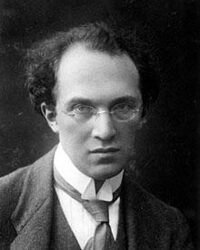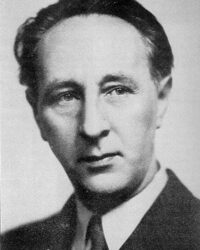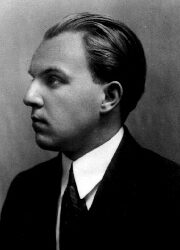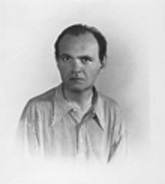
Marcel Tyberg

Marcel Tyberg

1893–1944

Marcel Tyberg (1893–1944) was an accomplished composer, conductor and pianist.  Notable conductors such as Rafael Kubelik and Rodolfo Lipizer premiered his pieces at venues in Prague and Italy.  His eclectic compositional style embraced popular dance music as well as enormous symphonies on the scale of Mahler.  Unfortunately, due to the conditions of World War II, Tyberg, only 1/16th Jewish, was sent to his death and his musical career was prematurely extinguished.  For this reason, many basic details about his life are still unknown.


In the Summer of 2005, Marcel Tyberg’s oeuvre, once remembered only in the hearts and minds of friends, emerged from Enrico Mihich’s Buffalo basement to be reintroduced to the musical community. Thus far, the Foundation for Jewish Philanthropies, in conjunction with Dr. Mihich and JoAnn Falletta of the Buffalo Symphony Orchestra, has funded a performance of three lieder, two piano sonatas, and the copying of his Trio, Sextet and Third Symphony.  These efforts place Marcel Tyberg among the most recently rediscovered composers whose lives and careers were cut short by World War II.

Life

Friends described him as a brilliant musician with an “all–embracing musical knowledge.”  His unique appearance made him easily recognizable in his home of Abbazia.  His “large dark eyes radiated gentleness and childlike joy.”  They gave life to his whole face and filled it with a “clear dreamy gravity.”  “He greatly resembled Beethoven, especially in his mouth and chin,” and some thought in his musical creations as well.  He was a “strange spiritual man,” who seemed to “walk a step further on this earth than was granted to most humans.”

Marcel Tyberg (Jr.) was born in Vienna, Austria on January 27, 1893.  His father, Marcell Tyberg (Sr.), was a prominent violinist, and his mother, Wanda Paltinger Tybergova, was a pianist and colleague of Arthur Schnabel in the Leschetizky school.  Because Marcell was a well–known violinist in Vienna, Jan Kubelik, the famous violinist and musical patriarch, and his family became close to the Tybergs.  Over the years, Marcel became close to the Kubelik daughters and even composed lieder dedicated to them.  Although twenty years stood between Marcel and Rafael, theirs was a friendship that would last to Tyberg’s death and beyond.

As of yet, little is known of Marcel’s education and musical training.  It is assumed not only that Marcel received a musical education from his parents, but he also had formal training in the art of orchestration, counterpoint and harmony, aas evidenced by his works.  His residence in Vienna and future friendship with violinist, conductor, and composition student Rodolfo Lipizner (1895–1974) at the Vienna Musical Academy suggests that Tyberg was a colleague at the Academy.  It was during this time of academic growth that Marcel composed his First Piano Sonata (1920) and First Symphony (1924).

In 1927, the Abbazia Symphony Orchestra appointed Rodolfo as permanent conductor.  Marcel(l) Tyberg (Sr and Jr) and Jan Kubelik were later listed as two of the young conductor’s preferred soloists; perhaps in the case of Marcell, a section member.  This appointment brought the Tybergs to Abbazia, a resort town between Italy and Yugoslavia on the Adriatic Sea.  Later that year, on November 27, Marcell Tyberg died in Fiume, or modern day Rijeka, a major sea port near Abbazia..  Upon the founding of the Gorizia Symphony Orchestra in 1930, Lipizer not only continued to invite Marcel Tyberg and Jan Kubelik to perform as soloists, but also handed the baton of the Abbazia Symphony Orchestra over to Marcel.

After the death of his father, Marcel and his mother remained in their villa on the Adriatic Sea.  As an article by friend Marion Schiffler explains, for the remainder of his life Tyberg “hung on his mother with the greatest love and reverence.  She was described by all as an unusually generous gentle woman.”  In Abbazia, with the help of his mother’s love and impeccable copying abilities, Marcel completed his Scherzo and Finale for Schubert’s Unfinished Symphony (1928), Second Symphony (1931), Sextet (1932), First Mass (1934), Second Piano Sonata (1935), Trio (1936), Second Mass (1941) and Third Symphony (1943).

For a living, Marcel played the organ in local churches, taught harmony to young students, composed dance music under the pseudonym Till Bergmar (rumbas, tangos, slow waltzes, etc.) and performed his music with his inherited orchestra.  To supplement their income, his mother, a well–known pianist whose playing was “especially moving,” taught piano and gave local concerts.  Toward the end of his life, Tyberg, Schiffler wrote, contentedly lived in “indescribable poverty and supported himself and his mother only through lessons.”

Schiffler praised his improvisations and compositions as “simply perfect.”  His unique improvisatory ensemble of piano and voice evoked the sound of a commanding solo orchestra.  When begged to publish his compositions he would always demur.  According to Schiffler, he had refused several offers.  He did not thirst for fame nor did he crave earthly possessions.  Satisfied with the little he owned, he lived happily unknown.  However, he was not entirely secluded from the outside world.  As mentioned above, he sporadically performed as a soloist with the Gorizia Symphony Orchestra, performed his dance compositions with a small orchestra, conducted his Masses and Chamber works with the Abbazia Symphony Orchestra, and even called on his childhood friend Rafael Kubelik to premiere his Second Symphony with the Czech Philharmonic at some point during the 1930’s.

On July 25, 1943, Tyberg revealed his unrestrained piety in a performance of his Te Deum used to consecrate the enlarged Abbazian church.  This historic date for Italy, on which the Italian Grand Council captured and dismissed Benito Mussolini as premier of Italy, occurred only weeks before Italy’s surrender to the Allies, an act that would seal the fate of Marcel and his mother.

In anticipation of the Italian surrender, the Germans reorganized their military command in southeast Europe early in the summer of 1943 so that it would be ready to take over the Italian–held areas and defend them in the event of a Western Allied invasion.  After moving many troops into what is now Croatia, on September 7, 1943, Hitler issued Order No. 26, Improvement in the Defensive Power of Croatia.  Its main objective was to bring about closer collaboration between the German and Croatian armed forces. In addition, Berlin assigned each German corps and divisional command a special Croatian delegate for civil affairs, whose German influence was necessary for the protection of military interests.  Therefore, the Croatian government enforced all Nazi laws pertaining to Jews in the Croatian and German–controlled territories.  One such German–controlled territory was Rijeka/Abbazia.  Eleven days later, Marcel completed his final work, the Third Symphony.

Although Article 6 of the Law Decree on Racial Belonging of April 30,1941, declared some selected Jews honorary Aryans and exempt from Croatian anti–Jewish measures, in the summer of 1943, Marcel’s mother went to the local German officials and registered that her great–grandfather was a Jew, thus making her one–eighth Jewish and Marcel one–sixteenth Jewish.  A few months after this fateful decision that would alter Marcel’s life, his mother died of natural causes.

“For Tyberg,” wrote Schiffler, “the death of his mother was a wound which never closed.”  He now gave those who encountered him the impression of “a man who is not far from the end of his journey on earth and who, unknown perhaps to himself and us, has already raised his glance to that great unknowable which involuntarily frightens us.”  On the back of the Third Symphony’s manuscript, Tyberg stated that he completed the work with tremendous difficulty and grief.  Because he was creatively and emotionally exhausted, this work marked his compositional mortality.

In anticipation of his capture and possible deportation, Marcel entrusted all compositions and personal writings to his friend Dr. Milan Mihich.  In addition, he gave Dr. Mihich a document authorizing him to take any action deemed desirable to preserve his music.  Only a few days before the Gestapo would take Tyberg in a night raid, he shared some of his compositions with his friends on the organ in the church of Volosca.  Schiffler recalls:

Shuddering and shivering, we listened to the uninterrupted flow of sounds that ranged from cheerful pastoral tunes to the greatest Beethoven–like outbursts.  His face shone transfigured and happily smiling out of the dimness.  There was a childlike joy and tenderness in him that is only seen in great souls shortly before their return home.  The tears ran down my cheeks.  We all had the feeling that he will not be with us much longer.  Perhaps he felt it himself, too; he hardly knew any more where he was and who we were.  It seemed as if he had to fulfill some final task—to play for his friends—and then to part and never return. As he ended, we silently embraced the completely exhausted artist and only hesitantly did words of thanks pass across our lips.  It was as if our thanks could wipe out this, his last gift.  We shook his hand, one after the other.  I was not able to utter a word.  He, however, smiled, friendly and ingenuous, as if he wanted once more to let us take part in his unknown greatness.  In that dark old church he stood like a saint in our midst, a strange ray of light— the first moonlight—fell at this moment through the high arched window onto his quiet face.

Several months passed before rumors began to circulate of Tyberg’s suicide.  They were, it seems, erroneous.  Only recently has it been discovered that he was indeed sent to the extermination camps San Sabba and Auschwitz.  His recorded date of death is December 31, 1944.

In 1945, following the end of the War and the occupation of Fiume by the
Communist Yugoslavians, Dr. Milan Mihich and his family fled Fiume to Milan.  With him, he took only precious family possessions, including the entirety of Tyberg’s catalogue.  In 1948, Dr. Mihich died and the music and related responsibilities were left to his son, and Tyberg’s former harmony student, Enrico Mihich, then a medical student at the University of Milan.  Dr. Enrico Mihich later came to Buffalo and became a member of the Roswell Park Cancer Institute.  Dr. Mihich to this day keeps Marcel Tyberg’s music safely secured in his home in Buffalo.

After nearly fifty years of ineffective attempts to have Buffalo Philharmonic conductors premiere the treasure trove of works, as well as an aborted collaboration with Rafael Kubelik in the late 1980’s, Mihich finally found the partner he sought in conductor JoAnn Falletta. In order to obtain the funds required to print the rough, hand-written manuscripts for performance, Dr. Mihich and the Foundation for Jewish Philanthropies in Buffalo, New York, organized the Tyberg Musical Legacy fund.

Because of his persistence and respect for his former teacher, efforts are now underway to perform this forgotten oeuvre and reawaken the spirit of Marcel Tyberg so that all may enjoy these “great and immortal works&#1478 composed by a man “endowed by heaven.”

By Zachary Redler

Works List

First Piano Sonata 1914–1920

Allegro appassionato

Larghetto (Tema con variationi)

Rondo

First Symphony

Allegro molto January 21, 1922

Adagio 1922

Scherzo December 31, 1922

Finale (Allegro, non troppo) April 12, 1924

Scherzo and Finale for Schubert’s Unfinished Symphony 1927–1928

Second Symphony

Allegro appassionato 1927

Adagio 1927

Scherzo 1929

Finale 1931

Sextet 2 violin, 2 viola, cello, contrabass 1931–1932

Allegro non troppo

Scherzo

Adagio molto sostenuto (Tema con variationi)

Scherzo

Finale

First Mass Soprano, Contralto, Tenor, Basso and organ 1933–1934

Second Piano Sonata 1934–1935

Allegro con fuoco

Adagio

Scherzo

Finale

Trio

Piano, violin and cello 1935–1936

Allegro maestoso

Adagio non troppo

Rondo

Second Mass Soprano, Contralto, Tenor, Basso and organ 1941

Third Symphony

Andante Maestoso November 4, 1938

Scherzo September 5, 1939

Adagio September 26, 1939

Rondo September 18, 1943


Lieder

21 Lieder on Heine’s lyric Intermezzo

1 Lieder “Rache“ on words by Poridzky

5 Lieder on words by Daisy von Adelsfeld–Salghetti

1 Ave Maria

6 Lieder “Austrian“ for small orchestra – 3 of them transcribed out of the Heine cycle

4 Lieder in English on words by Moore and others

4 Lieder without words

Bibliography

Ballarini, Almeto and Sobolevski, Mihael. Le vittime di nazionalita italiana a Fiume e dintorni (1939–1947) . Ministero per I beni e le attivita culturali. 2002

Mihich, Enrico. Marcel Tyberg. Unpublished Article 2005

Schiffler, Marion. Tyberg Ein Musik Portrait. Der Standpunkt. January 30, 1948. Trans. Winters, Herbert. December 2005.

Tomasevich, Jozo. War and Revolution in Yugoslavia, 1941–1945. Standford University Press. 2001

Rudolfo Lipizner. http://www.seta.it/lipizer/en/lipizer_bio.htm.;
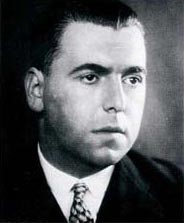
Erwin Schulhoff

Erwin Schulhoff

1894-1942

Erwin Schulhoff (1894-1942) was a prolific and multi-faceted creative figure whose work embraced a full panoply of styles and influences.  Like Kafka and Mahler, a German Jew in a Czech cultural milieu, the composer took full advantage of his “outsider looking in” status to forge a compelling musical personality.  One of the earliest and most successful exponents of art music drawing on jazz, Schulhoff refracts multiple approaches of his time, from Dada to Expressionism, and from a distanced self-mockery to the stolid seriousness of Socialist Realism.

Life

I. Early training through WWI

Erwin Schulhoff, Czech composer and pianist of German descent, was born in Prague on June 8, 1894.  Erwin’s father, Gustav, was a wool and cotton merchant who became very wealthy during World War I, only to lose his fortune to German inflation in the 1920s.  During World War II, Gustav, who was Jewish, was deported to the Theresienstadt concentration camp, where he died in 1942.  There were some musicians in Erwin’s family tree, most notably his great-uncle Julius Schulhoff, a piano virtuoso and composer, who taught in Dresden and Berlin, as well as his mother’s father, Heinrich Wolff, a violinist who was the concertmaster of a Frankfurt theater orchestra.

Schulhoff displayed musical talent at a very early age, picking out tunes at the piano by the age of three.  Dvořák, who had little fondness for (or interest in) child prodigies, was convinced by Schulhoff’s mother to examine the young Erwin in 1901.  After testing Schulhoff’s ability to recognize pitches and harmonies, Dvořák rewarded Schulhoff with two pieces of chocolate, and recommended him for private piano study with a professor at the Prague Conservatory.  Schulhoff studied at the Prague Conservatory until 1906, continuing his study of piano in Vienna to 1908, and piano, theory and composition (with Max Reger) in Leipzig until 1910.  His final student period was from 1911-14, in Cologne, where he studied piano (with Carl Friedberg), composition and conducting.

In addition to his formal studies, Schulhoff was especially impressed by the music of Richard Strauss and Claude Debussy.  Schulhoff attended the Prague premiere of Strauss’ Salome in 1906, and many of his compositions of the next five years show some traces of Strauss’ influence.  Schulhoff was liberated, both from Strauss’ influence and from a rigorous adherence to traditional compositional strictures, by his encounters with Debussy’s music in 1912.  His immediate reaction was to include quartal harmonies, parallel chords and whole-tone scales in his works of early 1913, and to seek out Debussy for composition lessons.  Debussy accepted Schulhoff as a student, but their collaboration was brief and unhappy, for Debussy insisted on enforcing exactly those rules that he had moved beyond in his own compositions.

The most important turning point in Schulhoff’s youth, though, was not a musical event but, rather, the First World War.  Schulhoff was conscripted into the Austrian Army when war broke out and, although initially stationed in Prague, he saw action in Hungary in 1916 (where he suffered a shrapnel wound to his hand and nervous shock) and on the Russian front in 1917, as well as on other fronts through the end of the war.  Schulhoff emerged from the war disillusioned and angry.  Politically, he had become a committed Socialist, and musically he sought an escape from the post-Romantic language of his pre-war works.

II. Expressionism and Dada in Dresden and Berlin

After the War, Schulhoff was torn between two cities and two aesthetic attitudes.  At the beginning of 1919, he moved to Dresden, where he lived with his sister, Viola, who was studying painting.  The Schulhoff siblings moved in a lively circle of artists, musicians and dancers, including the painter Otto Dix, and Erwin became increasingly interested in the visual arts and in left-wing politics.  Musically, he became oriented towards the freely atonal music of the Second Viennese School.  Schulhoff had heard the Prague premiere of Arnold Schoenberg’s Pierrot lunaire in 1913, but became more involved with Schoenberg’s circle after the war.  He struck up a friendly correspondence with Alban Berg, performed Berg’s Piano Sonata in Dresden and in Prague, and also wrote to Schoenberg and to Anton Webern.  In 1919, Schulhoff began a series of concerts, presumably in imitation of the Vienna Society for Private Musical Performances, intended to promote “music of the future,” presenting works by himself, Schoenberg, Berg, and Webern as well as other modernists, including Aleksandr Scriabin and Josef Hauer.  At the same time, though, Schulhoff had met George Grosz (through Dix), and became attracted to the Berlin Dada movement.  Schulhoff helped to organize the first Dada event in Dresden.  After marrying Alice Libochowitz in August 1921, Schulhoff moved to Berlin in early 1922, where he attempted to create musical counterparts to the scandalous provocations of Grosz (now a neighbor) and the Berlin Dadaists.

III. Prague and Jazz

Schulhoff was introduced to American ragtime, dance music and jazz by Grosz, who collected phonograph records of American music.  Dance music figures in some of Schulhoff’s Dada-inspired compositions, but by the early 1920’s, jazz had become an independent source of inspiration and appeared (in various guises) in many of his works from the 1920’s.  In addition to an intensified interest in jazz, Schulhoff abandoned the atonal Expressionism of the Schoenberg circle in favor of music influenced more by French neo-classicism and by Slavonic folk music.  This shift in musical orientation roughly coincided with another personal transition, the 1923 return of the Schulhoffs to Prague.  The next decade was a time of qualified success for Schulhoff.  One the one hand, his compositions were published by Universal Edition and widely performed, and he was very active as a concert pianist.  On the other, he was never financially secure, didn’t land the kind of academic position that could have made his situation more comfortable, and his opera Plameny was a failure.

Part of Schulhoff’s tenuous professional existence during this time can be attributed to his ambiguous position with respect to the Czech and German musical communities in Prague.  Since the end of the War, musical life in Prague had been split between Czechs and Germans, as the Germans moved out of the Prague Conservatory and the National Theater and into parallel institutions.  The German-speaking musical community also had its own music journal.  Raised a German speaker, Schulhoff’s obvious place was with the German camp, and indeed, he succeeded Max Brod as the music critic of the Prager Abendblatt in 1924, and he wrote almost all of his essays in German, for Der AuftaktMusikblätter des Anbruch, and Pult und Taktstock.  Schulhoff, however, consciously saw himself as an intermediary between the German and Czech communities, albeit one who was not welcomed by either side.  Schulhoff worked closely with important Czech musicians, including Václav Talich and the Zika Quartet, Czech writers, including Karel Benež and Vítĕzslav Nezval, and his only opera has a Czech libretto.  Despite Schulhoff’s hopes of a position at the Akademie für Musik und Darstellende Kunst (the German equivalent of the Prague Conservatory), he was never offered work there, and the one minor teaching post that he was offered was teaching harmony and score reading at the Prague Conservatory.  Schulhoff’s financial situation was further complicated by the need to provide for his son Peter, born in 1922, and the disappearance of his father’s wealth.

Despite these difficulties, Schulhoff became a well-established figure internationally as both a pianist and a composer.  His concert appearances included successful engagements in Paris and London in 1927 and a tour of Germany and the Netherlands in 1930, featuring an appearance with the Concertgebouw Orchestra in Amsterdam as one of the soloists in his own Double Concerto.  Schulhoff’s compositions also made regular appearances at the annual festivals of the International Society for Contemporary Music.  The Zika Quartet performed the Five Pieces for String Quartet at the 1924 Festival in Salzburg, and premiered the First String Quartet at the 1925 Venice Festival.  At the 1925 Prague ISCM concerts, Schulhoff not only performed his own First Piano Sonata and an early (1913) Sonata for Violin and Piano, but also played quarter-tone piano works by Alois Hába.  Schulhoff’s compositions were also performed at the summer festivals of contemporary chamber music in Donaueschingen in 1924 and 1925.  Schulhoff also became involved with the mechanical transmission and reproduction of sound during this time.  He made his first phonograph records for Polydor in 1928, choosing to record selections from his jazz-influenced piano works.  Schulhoff also worked with radio.  His concerts were broadcast in Prague and London, and he was regularly heard over Prague Radio from 1930 to 1935 as half of a piano-duo that performed semi-improvised versions of popular music and jazz.  In addition to his radio performances, Schulhoff wrote a piece specifically for the radio the 1930 Concerto for String Quartet and Wind Orchestra.

IV. Socialist Realism

The last decade of Schulhoff’s life was marked by declines in his professional and personal fortunes.  His contract with Universal Edition, begun in 1924, was dissolved in 1931.  In the first five years of the contract, Universal Edition published more new works by Schulhoff than by any other composer, but Schulhoff was too prolific for Universal’s tastes, and the composer was demanding and difficult to negotiate with.  Also, Schulhoff’s belief in a synthesis of jazz and classical traditions as a way forward for modern music was no longer fashionable by the 1930s.  Schulhoff had to look in many directions for income, arranging Czech classical works and writing dance music under pseudonyms, working for the radio and (more happily) appearing from 1933 to 1935 as the pianist in the orchestra of the Liberated Theater, a left-wing cabaret that produced the revues of Jiří Voskovec and Jan Werich, featuring songs by Jaroslav Ježek.  Schulhoff’s family life was also deteriorating.  Relations with his parents, long strained, worsened, and his mother died in 1938.  Schulhoff’s wife became ill at the same time that he was involved with a student, and a difficult divorce ensued.  Schulhoff remarried shortly after his mother’s death.

The greatest change in Schulhoff’s life, though, was a commitment to Marxism and Soviet Communism.  Long an outspoken socialist, Schulhoff turned even farther to the left in the 1930s.  In 1931, he joined the Czech “Left Front” and participated in a workers’ theater group.  Schulhoff traveled to the Soviet Union in 1933 as a delegate to a workers’ theater competition, also concertizing in Moscow and Leningrad.  After returning from Moscow, Schulhoff began to espouse the Soviet doctrine of Socialist Realism.  The immediate musical fruit of Schulhoff’s political convictions was a setting of portions of the Communist Manifesto, in the form of a cantata for soloists, choruses and wind ensemble, composed in 1932.  In addition to other explicitly communist vocal works, Schulhoff increasingly focused his compositional efforts on the symphony, producing pieces intended to be accessible, and to convey politically meaningful programs.

Schulhoff’s life in the Czech Republic quickly became endangered with the German occupation of the Czech lands in 1938 and 1939.  Schulhoff, as a communist of Jewish heritage, was doubly at risk, and he began the process of emigrating to Great Britain, France or the United States.  After the occupation, however, it appeared that Schulhoff’s only hope was to escape to the Soviet Union.  Schulhoff applied for Soviet citizenship for himself, his wife and his son, receiving it in April 1941.  Schulhoff picked up his visa to emigrate on June 13, 1941, but, with the Nazi invasion of the Soviet Union on June 22, leaving the country became impossible, and Schulhoff was arrested the next day.  Unlike other well-known Czech cultural figures, like the composers Pavel Haas, Gideon Klein, Viktor Ullmann and Hans Krása (and like Schulhoff’s father), Schulhoff was arrested for being a Soviet citizen, rather than for being a Jew, and he was not taken to the notorious Theresienstadt camp.  Initially held in the Prague YMCA, Schulhoff was deported to a concentration camp in Wülzburg, Bavaria, where he died of tuberculosis in August 1942.

Works

There is a range of interests, influences and preoccupations that helped to shape Schulhoff’s music.  First were the compositional giants of the time: Strauss, Stravinsky, Schoenberg, Debussy and Ravel; and echoes of these composers can be heard in many places in his scores, along with references to the “locals,” Janáček, Novák and Dvořák.  Notable, of course, was the composer’s use of various idioms associated with jazz.  We should note that this “Euro-jazz” style of Weill, Krenek and others is always a kind of pseudo jazz since it banishes the improvisatory element (though Schulhoff was said to be a brilliant improviser himself).  Attitudinally, the composer was much affected by movements such as Dada and Surrealism, lending much of his work a kind of parodic sharpness. Late in his life, with his full embrace of Communism, there is the pull of a kind of “heroic” socialist realism, when the edginess of the younger works is replaced with a kind of classicizing seriousness.  However, it is a final element in the compositional mix that adds genuine power to the aesthetic project.  Schulhoff, as a Czech Jew moving between cultures in Prague does a brilliant job of drawing on the astonishing musical diversity of the Hapsburg Empire to provide rhythmic vigor, varied sonorities and modalities of all sorts.  Movements are marked “Alla Czeca,” “All’Slovacca,” “Zingaresca,” and Schulhoff clearly delights in providing his listeners with musical snapshots of the Empire, a combination of shorter-winded latter-day Mahler and an edgy Lehar.

Schulhoff’s catalogue also presents a fascinating menagerie of pieces which include such curiosities as a work for contrabassoon called “The Bass Nightingale,” as well as a composition for a female solo speaker which is nothing more than a series of provocative and gradually heightening moans.  There are big band numbers, Czech patter songs, a “Hot Sonata” for Alto Sax and piano and a setting of the Communist Manifesto.

Indeed, it is the very fecundity and fluidity of Schulhoff’s music that sometimes lends ammunition to his detractors, who find some of the music derivative and lacking in profundity.  But this is misleading.  Schulhoff makes serious contributions in almost every genre.  His jazz miniatures, pieces like “Susi” and “Syncopated Pete,” rank with the work of Ježek and Martinů, and demonstrate that Czech jazz-inflected art music was significant and wide-ranging.  His references to local musics, such as the all’Slovacca movement from String Quartet No. 1, are convincing and not at all derivative.  Indeed, though they may strike the listener first as either Janáčekian or Bartókian they are neither, but rather offer an alternative reading of music from similar sources.

Piano pieces, such as those marked “Brutal,” have a vitality and an edge that is forceful and effective, and the symphonies are varied and original, though the heroic seriousness of his socialist realist works takes some getting used to.  Perhaps, though, it is in the chamber works where the composer is most relaxed, most innovative and most profound.

By Derek Katz

Works List

Stage

Die Mitschuldigen (ob, after J.W. von Goethe), 1918–20, unfinished

Ogelala (ballet mysterium) 1922–4

Die Mondsüchtige (La somnambule) (dance grotesque), 1925

Le bourgeois gentilhomme (incid music, Molière), 1926

Plameny [Flames] (op. 2, Beneš), 1927–9


Orchestral and vocal-orchestral

Symphonies

Landschaften (5 poems, after J.T. Kuhlemann), op.26, Mez, orch, 1918–19

Menschheit (5 poems, after T. Däubler), op.28, A, orch, 1919

Symphony no.1, 1924–5

Symphony no.2, 1932

Symphony no.3, 1935

Symphony no.4, 1936–7

Symphony no.5, 1938

Symphony no.6 ‘Symfonie svobody’ [Sym. of Freedom], 1940–41

Symphony no.7 ‘Eroica’, 1941 [piano sketch]; no.8, 1942, unfinished


Other orchestral

3 kusy [3 pieces], op.6, str, 1910

4 Lieder (H. Steiger: Die Garbe), op.2, string orchestra 1911

Lustige Ouvertüre, op.8, 1913

Piano Concerto, op.11, 1913–14

Serenade, op.18, 1914

32 Variationen über ein achssakliges eigenes Thema, op.33, 1919

Suite, op.37, chamber orch, 1921

Piano Concerto. [no.2], piano and chamber orchestra, 1923

Double Concerto, flute, piano, strings and 2 horns, 1927

Slavnostní predehra [Festival Prelude], 1929

Concerto for string quartet and winds, 1930

H.M.S. Royal Oak (jazz oratorio, O. Rombach), speaker, jazz singer (T), mixed chorus, jazz orch, 1930

Das Manifest (cantata with best by Karl Marx), 4vv, double mixed chorus, children’s chorus, wind orch, 1932


Other instrumental

Chamber

Melodie, violin and piano, 1903

Variationen, op.7, violin, cello and piano, 1910

Suite, op.1, violin and piano, 1911

Sonata, op.7 [sic], violin and piano, 1913

Divertimento, op.14, string quartet 1914

Sonata, op.17, cello and piano, 1914

String Quartet in, G, op.25, 1918

Sextet, 2 violins, 2 violas, 2 cellos, 1920–24

5 Stücke, string quartet, 1923

String Quartet no.1, 1924

Concertino, flute, viola and double bass, 1925

Duo, violin and cello 1925

String Quartet no.2, 1925

Divertissement, oboe, clarinet and bassoon, 1927

Sonata, flute and piano 1927

Sonata, violin and piano, 1927

Hot-Sonate, alto saxophone and piano 1930


Piano Works

Sonata, op.5, 1912

5 Vortragsstücke, op.3, 1912

4 Bilder, op.6 [sic], 1913

9 kleine Reigen, op.13, 1913

Variationen über ein eigenes Thema, op.10, 1913; 5 Impressionen, op.12, 1914

10 Variationen über ‘Ah, vous dirai-je, Maman’ und

Fuge, op.16, 1914

3 Präludien und 3 Fugen, op.19, 1915

5 Grotesken, op.21, 1917

5 Burlesken, op.23, 1918

Sonata, op.22, 1918

3 Walzer, op.24, 1918

5 Arabesken, op.29, 1919

5 Humoresken, op.27, 1919

10 Klavierstücke, op.30, 1919 [with lithographs by O. Griebel entitled Zehn Themen, 1920]

5 Pittoresken, op.31, 1919

Ironies, 6 pieces, op.34, pf duet, 1920

Musik für Klavier in 4 Teilen, op.35, 1920

11 Inventionen, 1921

Partita, 1922

Rag-music, op.41 1922

Sonata no.1, 1924

Suite no.2, 1924

Ostinato, 1925; 5 études de jazz, 1926

Sonata no.2, 1926

Suite no.3, pf LH, 1926

Esquisses de jazz, 1927

Sonata no.3, 1927

Hot-music, 10 Studies in Syncopation, 1928

Suite dansante en jazz, 1931 popular compositions for jazz pf duet


Other solo

BassnachtiGáll, 3 recital pieces, dbn, 1922

Sonate, vn, 1927

Other vocal

Single Voice with Ensemble:

3 Stimmungsbilder (H. Steiger), op.12, S, violin and piano, 1913

Die Wolkenpumpe (H. Arp), op.40, Bar, 4 wind insts, perc, 192

Ukolébavka [Lullaby] (J. Hořejší), Mez, flute, viola and cello, 1936

Zebrak [The Beggar] (melodrama, after J. Hora), narrator, flute, viola and cello, 1936

Voice and Piano:

Zigeunerlieder (A. Heyduk), op.12, S, pf, 1910–11

5 Lieder (C. Fleischler, O.J. Bierbaum, M. Dauthendey, H. Hesse, E.A. Herrmann), op.13, 1911

3 Lieder (Fleischler, D. Falckenberg, F. Alder), op.14, S, pf, 1911

3 Lieder (Das Lied vom Kinde), op.18 [sic], S, pf, 1911

Lieder (Steiger: Die Garbe), op.9, Bar, pf, 1913

3 písneĕ (O. Wilde), op.15, A, pf, 1915

5 Lieder (C. Morgenstern), op.20, Bar, pf, 1915, unfinished

5 Gesänge (Expressionen), op.32, 1v, pf, 1919

‘1917’ (P. Bezruc), song cycle, Bar, pf, 1933

Národní písneĕ a tance z Tesínska [Folksongs and Dances from the Tesínsko Region], mezzo and piano, 1936

Other solo: Sonata erotica, 1919; Sym. germanica, 1v, inst acc., 1919

Bibliography

‘Zum Einschlafen gibt ’s genügend Musiken’: Düsseldorf 1994
Bek, J. ‘“Alban Berg nennt sich mein neuer Freund”: Erwin Schulhoff als “musikalischer Futurist” in Dresden’, ÖMz, xlvii (1993), 469–76

Bek. J. ‘“Meine Zähne klappern im Shimmytakt”: der Komponist Erwin Schulhoff’, Fonoforum, no.6 (1994), 34–8

Bek, J. ‘Der Dresdner Aufenthalt Erwin Schulhoffs’, BMw, xxiv (1982), 112–22

Bek, J. ‘Ervín Schulhoff a avantgarda’ [Schulhoff and the avant-garde], Ĉeská hudba svĕtu, svĕt české hudbĕ (Prague, 1974), 247–68

Bek, J. ‘Erwin Schulhoff’, Musik in Theresienstadt (Berlin, 1991), 44–59

Bek, J. ‘Schulhoffovy balety’ [Schulhoff’s ballets], Taneční listy, xxx (1992), nos.7–8, p.10; no.9, p.14

Bek, J. ‘Schulhoffs Wolkenpumpe: Dada in Musik’, Der jüdische Beitrag zur Musikgeschichte Böhmens und Mährens: Regensburg 1992, 92–8.

Bek, J. ‘Schulhoffův projekt revoluční hudby’ [Schulhoff’s project to revolutionize music], HRo, xxx (1977), 504–8

Bek, J. Erwin Schulhoff: Leben und Werk (Hamburg, 1994)

Bösch, K. and I. Vojtĕch, ed.: ‘Der Briefwechsel zwischen Erwin Schulhoff und Alban Berg’, Schweizer Jahrbuch für Musikwissenschaft, nos.13–14 (1993–4), 27–78

Doubravová, J.: ‘Z rané tvorby Ervína Schulhoffa’ [From the early works of Schulhoff], HRo, xxix (1976), 281–5

Erwin Schulhoff: Cologne 1992

Forbáth, I: Ervín Schulhoff (Prague, 1946)

Gregor, V.: ‘Skladatelská tvorba Ervína Schulhoffa v dobĕ jeho ostravského působení (1935–8)’ [The compositional work of Schulhoff during the period of his activity in Ostrava], Slezský sborník, lx (1962), 397–403

Lüdke, M.: ‘Lebenssaft und Lebensnerv: Jazz im Werk Erwin Schulhoffs – zwischen Provokation und Protest’, Musik und Bildung, xxviii (1996), 37–41

Ludvová, J.: ‘Ervín Schulhoff, pianista’, HV, x (1973), 225–32 [with Ger. summary]

Musil, V. ‘Ervín Schulhoff a jeho Komunistický manifest’ [Schulhoff and his communist manifesto], HRo, xxx (1977), 512–17

Očadlík, M.: ‘Erwin Schulhoff zápasí s ideami’ [Schulhoff wrestles with ideas], Klíč, ii (1931–2), 113–17

Pukl, O: Konstanty, dominanty a varianty Schulhoffova skladebného stylu [Constants, dominants and variants in Schulhoff’s compositional style] (Prague, 1986)

Šimáková, N.: ‘Ervín Schulhoff a jeho symfonie’ [Schulhoff and his symphonies], ibid, 237–46

Stará, V. ed.: Ervín Schulhoff (Prague, 1958)

Streller, F.: ‘Erwin Schulhoffs Beziehung zu Berlin’, Studien zur Berliner Musikgeschichte: vom 18. Jahrhundert bis zur Gegenwart (Berlin, 1989), 313–20

Vojtéch, I., ed.: ‘Arnold Schoenberg, Anton Webern, Alban Berg: unbekannte Briefe an Erwin Schulhoff’, Miscellanea musicologica, xviii (Prague, 1965), 31–83

Widmaier, T. ‘Colonel Schulhoff, Musikdada: Unsinn als Ausdruck von Lebendigkeit’, NZM, Jg.155, no.3 (1994), 15–21

Widmaier, T.: ‘Dadaist mit Wolkenpumpe: zur Wiederentdeckung von Erwin Schulhoff’, NZM, Jg.152, no.11 (1991), 5–11

Franz Schreker

Franz Schreker

23 March 1878–21 March 1934

Franz Schreker (23 March 1878–21 March 1934) was an Austrian composer, conductor, teacher and administrator. In his lifetime he went from being hailed as the future of German opera to being considered irrelevant as a composer and marginalized as an educator. During a period when German and Austrian aesthetics were focused on the symphony, Schreker brought innovation to German opera, which at the time labored under the shadow of Richard Wagner. Though the composer was only a few years younger than Schoenberg and Zemlinsky, and a few years older than Berg and Webern, Schreker’s music remained primarily tonal, reflecting late Romantic Expressionism, Impressionism, elements of atonality and polytonality and timbral experimentation. His music in general and his operas in particular featured extensive symbolism and naturalism.

Early Life

The eldest of four surviving children, Schreker was born in Monaco—one of the many places his parents lived before settling in Linz in 1882.  His father, Ignaz Schrecker, a court photographer, was originally from Golc–Jenikau in Bohemia and was born Jewish, though he later converted to Catholicism. His Catholic mother, Eleonare von Clossmann, was from Styria (in the southeast of Austria). His father’s death led the family to move to Vienna in 1888. Schreker began his professional education at the Vienna Conservatory in 1892, initially studying the violin (with Ernst Bachrich and Arnold Rosé) and later composition (with Robert Fuchs). He began conducting in 1895, and during this formative period composed a number of sets of songs and symphonic overtures. His first effort at opera was the one–act Flammen, set to text by a friend, Dora Leen, which concerned the sexual temptation of the wife of an absent crusader. Flammen was performed in 1902, after which Schreker soon began composing his first full–length opera, Der ferne Klang using his own libretto, as he would for all his subsequent operas.

After his conservatory years, he aspired unsuccessfully to a conducting position in opera. He made a lasting contribution to the music scene in Vienna when in 1907 he formed the Philharmonic Chorus, which he conducted until he left the city in 1920. The Philharmonic Chorus gave performances of Mahler’s Third and Eighth Symphonies, Delius’s Mass of Life and Sea Drift, and premieres of Zemlinsky’s Psalm XXIII, and Schoenberg’s Friede auf Erden and Gurrelieder. Schoenberg and Schreker were to remain lifelong friends. In 1909 Schreker married a seventeen-year-old soprano from the Chorus, Maria Binder. Franz and Maria Schreker had two children, Ottilie, born 1912, and Emmanuel, born 1916.

A Mainstream Success

Der ferne Klang (The Distant Sound) debuted in 1912 in Frankfurt and launched Schreker into the top rank of composers. The same year he was appointed to the faculty of the Vienna Academy of Music in the areas of counterpoint, harmony, and composition. His next opera, Das Spielwerk und die Prinzessin, enjoyed simultaneous premieres in Frankfurt and Vienna in 1913. Though not as well–received as Der ferne Klang had been, the work remained one of Schreker’s favorites. The outbreak of the World War limited opera performance including Der ferne Klang which had been performed in Leipzig, Munich, and Hamburg and was about to be performed in Prague and Paris. During this period Schreker composed two of his most successful operas, Die Gezeichneten (1913–1915) and Der Schatzgräber (1915–1918).  The Frankfurt Opera House again premiered both— Die Gezeichneten (The Stigmatized) immediately after the war in April 1918 and Der Schatzgräber (The Treasure–seeker) in January 1920.

These two operas represent the high point of Schreker’s career. He was the subject of the high critical praise of respected music critic Paul Bekker who controversially compared his talent to Wagner. Der Schatzgräber was the most successful opera production of its time and was performed almost 400 times in more than 50 different theaters between 1925 and 1932. In March 1920, Schreker was appointed director of Berlin’s Hochschule für Musik.  Schreker re–energized the distinguished but tradition–bound Hochschule. Among those that taught there during the Weimar years were Kestenberg, Erdmann , Busoni, Schoenberg, Schnabel, Flesch, Zemlinsky, Hindemith, Pfitzner, and Kaminski.  Some of the prominent students of this era were Berthold Goldschmidt, Alois Hába, Jascha Horenstein, Ernst Krenek, Dragan Plamenac, Karol Rathaus, Artur Rodzinski, Josef Rosenstock, Hans Schmidt–Isserstedt, and Grete von Zieritz.

Reversals

Not long after his arrival in Berlin, Schreker began to experience reversals as an artist.  His operas began to receive lukewarm receptions among audiences and critics. His work displayed his Austrian upbringing and sensibilities and, though his most successful operas had appealed to German audiences as well, Schreker was already becoming irrelevant to the more radical young composers. In some ways, Schreker’s music was an extension of nineteenth–century traditions, similar in many ways to Scriabin––certainly he was no an atonalist or serialist. The 1924 Cologne premiere of Irrelohe, was Schreker’s first real failure since emerging as a top composer. In the period 1924–1928, Schreker composed the operas Christophorus, and Der singende Teufel.  The latter was a four–act opera dealing with the theme of a battle between the forces of light and darkness. It was staged in November 1928 in Berlin. The shorter Christophorus dealt with similarly apocalyptic themes, but its planned performance in Freiburg was never realized due to the emerging power of the Nazis.  Hostile demonstrations by the National Socialists curtailed the run of his final opera Der Schmied von Gant after only five performances in Berlin in 1932.

Despite these problems, Schreker also enjoyed some important successes during this period. He became an early pioneer in the application of recording and broadcast technologies as applied to classical music. As late as 1932 he supervised the making of the first concert films. Schreker also took great interest in the development of the electronic music studio at the Hochschule. His non–operatic Kleine Suite was the first work commissioned for German radio. Along with Schoenberg’s Opus 34 (Accompanying music for a film scene), Schreker’s Vier kleine Stücke was recorded for use as film music. His last composition appears to be the Vorspiel zueiner grossen Oper for his own libretto, Memnon.

With the collapse of the Weimar Republic and the ascension of Hitler and National Socialism and the official policy of anti–Semitism, the political atmosphere became toxic for Schreker. Slow to recognize the changing climate, he was forced out of his directorship of the Hochschule für Musik. A less prestigious compensatory post at Prussian Music Academy did not work out, and sent Schreker scrambling, finally, for career opportunities outside of Nazi influence. Due to a combination of bad advice and bad luck, Schreker was unable to obtain a position either in America or elsewhere in Europe. While engaged in a protracted battle over his retirement pension, and concerned over his future—financial as well as professional—Schreker suffered a stroke in late December 1933. He suffered a series of setbacks to his health and died on 21 March 1934.

In the tense atmosphere of the early days of Hitler’s Chancellorship, Schreker’s passing went relatively unnoticed. While Anton Webern, Schoenberg and most of Schreker’s students sent notes of condolence, there was scant notice in the newspapers of the day. Aside for a few positive or neutral obituaries, several newspapers sought to frame Schreker’s rise and fall in terms consistent with the ideological tone of the Third Reich.  The last publicity he was to receive in Nazi Germany was the inclusion of his music in a mocking exhibition of “degenerate” Jewish music in 1938. With his most acclaimed work more than a decade in the past and centered in Vienna, the advance of composers such as Webern, Hindemith, Berg, and Schoenberg in the musical mainstream, and the obscuring cover of pre–war events in Europe, Schreker and his music lapsed into obscurity for several decades. Schreker was almost forgotten, carried only in the memories of his now–scattered students. In 1964, a revival of Der ferne Klang in Kassel attracted some attention in the music journals and the approach of the centennial of his birth in 1978 was an occasion of a re–examination of his life and work.

As a composer, Schreker combined elements of late–19th and early 20th century styles. His music emphasized timbral expressiveness and novel orchestrations. Stylistically, he was linked with the coloristic innovations of Debussy and Richard Strauss, and shared some ties to French Symbolism. This was reflected in Schreker’s librettos, which often dealt with themes of sexuality and eroticism.  In the 1910’s Schreker was considered among the musical avant–garde—and as a conductor he presented premiers of Schoenberg and Zemlinksy—but by the mid–1920’s he was considered by many to be out of fashion in comparison to the composers of the Second Viennese School.  Schreker’s music employs chromaticism, polytonality and advanced orchestration techniques (such as deeply divided strings and percussion scoring)—his work often inspired by visual or auditory sensory images.

Works List

Bibliography

Blackburn, Robert. 1978. Franz Schreker, 1878–1934. The Musical Times 119 (1621):224–228.

———. 1990. [Untitled]. Music & Letters 71 (1):128–131.

Franklin, Peter. 1982. Style, Structure and Taste: Three Aspects of the Problem of Franz Schreker. Proceedings of the Royal Musical Association 109:134–146.

———. 1989. Audiences, Critics and the Depurification of Music: Reflections on a 1920s Controversy. Journal of the Royal Musical Association 114 (1):80–91.

———. 1989. Schreker and the Problem of Opera. The Musical Times 130 (1762):730–731.

———. 1991. Distant Sounds – Fallen Music: “Der ferne Klang” as ‘Woman’s Opera’? Cambridge Opera Journal 3 (2):159–172.

———. 1994. An Open and Shut Case. The Musical Times 135 (1819):564–565.

Hailey, Christopher. Franz Schreker. In Grove music online [electronic resource] Oxford ; New York: Oxford University Press

———. 1993. Franz Schreker, 1878–1934 : a cultural biography, Music in the twentieth century. Cambridge ; New York: Cambridge University Press.

———. 2002. Franz Schreker and the Pluralities of Modernism. Tempo (219):2–7.

Heinsheimer, Hans W. 1978. Schreker Centennial. The Musical Quarterly 64 (2):244–249.

Puffett, Derrick. 1979. The Beginning of New Music? The Musical Times 120 (1636):487–488.

———. 1983. Schreker Restored. The Musical Times 124 (1688):626–627.

Franz Reizenstein

Franz Reizenstein

June 7, 1911 – October 15, 1968

When Franz Theodor Reizenstein (June 7, 1911 – October 15, 1968) left Berlin in 1934, England presented an obvious sanctuary. His uncle Bruno, who had been injured in the First World War and had married the English nurse who tended his wounds, lived in South London in Kingston-upon-Thames. He acted as guarantor for Franz and several other family members, and provided the beginnings of a local circle. Franz, just 23 when he arrived, had already enjoyed some professional success. The son of Albert Reizenstein, a Nuremberg doctor, and Lina Kohn, his prodigious musical gifts (he wrote his first piece at the age of five) were nurtured by a close and artistic family, and cultivated at the Berlin Hochschule für Musik, where he studied composition with Paul Hindemith and piano with Leonid Kreutzer. He had completed his first major piece, a string quartet, by the time he was seventeen. Hindemith insisted that his students have a broad knowledge of instrumental technique. As Reizenstein later wrote:

“He arranged for his students to take up different wind and stringed instruments in turn… We played together regularly and provided most of the music by composing it ourselves. We would not let anyone listen to the ghastly noises we produced–not that anybody wanted to–but we did learn how to write for the various instruments.”

When he arrived in England, Reizenstein was less finished and less experienced a composer than older émigré colleagues like Hans Gál, Karl Rankl, Berthold Goldschmidt and Egon Wellesz. But his solid training, a loyalty to tonality and the musical structures of the nineteenth-century and, particularly, a belief that he was part of its ongoing tradition, provided him with confidence and maturity. In England his composition studies continued with Vaughan Williams at the Royal College of Music, while the illustrious Solomon Cutner refined his piano technique, especially with regard to touch and color. His first published piece, the Suite for piano, Op. 6, was issued in 1936 by Alfred Lengnick, but it was the virtuosic and flamboyant Prologue, Variations and Finale, Op. 12, composed for the violinist Max Rostal, and inspired by an extended tour to South America (undertaken with another legendary violinist, Roman Totenberg) which brought him to prominence. The piano part was later expanded to create an orchestral accompaniment.

Under Vaughan Williams’s tutelage, and with his generous support and encouragement (during and after his internment), Reizenstein’s musical language was freed and broadened. English music began to inform his compositions. Comparing his 1934 Wind Quintet–which is assured, idiomatic and beautifully balanced, but rather sober and unemotional–with the concise Oboe Sonata, Op. 11, composed just three years later, one is struck by the changed sensibility: an incipient pastoral quality, and an Englishness that would become more pronounced over the years that followed.
Reizenstein’s status as a British resident was interrupted (and compromised) by his tour to South America in 1937/38, and so, despite a seven-year residency in London, Reizenstein joined the thousands of German and Austrian Jews interned in requisitioned hotels on the Isle of Man. While he was incarcerated, he organized and performed in concerts for his fellow internees, partnering with Sigmund Nissel, who would later play second violin in the Amadeus Quartet. On his release, Reizenstein’s army application was turned down on account of his poor eyesight, and he eventually found work as a railway clerk. Composing whenever he had a free moment, by the end of the war he had produced the substantial Piano Sonata, Op. 19, and the Violin Sonata, Op. 20, composed for Maria Lidka, a stalwart supporter of new music. This evocative and idiomatic work, with its bold gestures and infectious, Iberian middle movement, together with the Cello Sonata, Op. 22, completed in 1947, both deserve a place on recital programs.

The Piano Quintet, Op. 23, one of the composer’s favorite works, was finished in 1948. Lionel Salter’s 1975 Gramophone review of its only commercial recording (the Melos Ensemble with the pianist Lamar Crowson on l’Oiseau Lyre) maintains that it “stands alongside Shostakovich’s as the most noteworthy of this century’s piano quintets”–a rather rash underestimation of the contributions by Fauré, Elgar, Martinů, Bartók and several others, but praise indeed nevertheless. The critic and musicologist Mosco Carner wrote of the work: “Here style and idea, matter and manner are fused into a complete organic whole, not to mention the brilliant exploitation of the medium.” But despite these plaudits and despite the obvious substance and the musical rewards the Quintet offers both player and audience, it is fair to say the piece has only very occasionally slipped out of obscurity. Its neglect, and that of the cello and violin sonatas, was part of the discrimination that unapologetic traditionalists like Reizenstein suffered–the severance that accompanied an uncompromising dismissal of serial procedure and the avant-garde. His works were certainly marginalized by the BBC during the tenure of William Glock, and by a post-war musical establishment that tended to be both inward-looking and randomly anti-Semitic.

The Piano Quintet is assembled in traditional classical sonata-form: four movements, the outer two and the second, Poco adagio, being of equivalent length; the Scherzo a fleeting hell-for-leather romp that draws on preceding material. Reizenstein’s polytonal technique gives the work a terrific sense of tension, but whatever the distance we are taken harmonically, there is always a return to an unequivocal tonal center, indeed the work is securely cast in D major. The critic and theorist Hans Keller wrote of the Scherzo: “The texture proves to be immaculate […] so that one is left with the impression that this movement may be the best, if not indeed the only, truly piano-quintettish piece ever written.”

Reizenstein’s vocal works include the opera Men against the Sea (1949), Voices of Night, Op. 27 (1951), for soprano, baritone, chorus and orchestra, and the radio opera Anna Kraus, Op. 30 (1952), whose main protagonist is a German refugee, as of course was Reizenstein himself. In 1958 the Three Choirs Festival premiered his highly successful oratorio Genesis, Op. 35. The text was assembled by the actor, poet and dramatist Christopher Hassall, a close friend of Reizenstein’s, who also worked with William Walton, Malcolm Arnold, Arthur Bliss, and perhaps most famously, Ivor Novello. The spirit of Vaughan Willams, who died the same year, is evident in both Genesis and the cantata Voices of the Night (a series of poems that explores the progression of night from dusk to dawn), and there are reminders of his Five Tudor Portraits, the Fantasia on a Theme by Thomas Tallis and the Five Mystical Songs.  Reizenstein also left a significant corpus of music for winds. In addition to the Oboe Sonata, there is a set of variations for Clarinet Quintet, a Trio for flute, clarinet and bassoon, an unfinished Clarinet Sonata, a Flute Quartet and a substantial Serenade for winds that was premiered at the 1951 Cheltenham Festival by Harry Blech (founder and conductor of the London Mozart Players) and the London Winds, who had commissioned the piece.

A consummate pianist as well as a versatile and practical composer, Reizenstein performed regularly with artists of the caliber of violinist Max Rostal and cellist Leslie Parnas, and his work on the concert platform and in the broadcast studio was a major part of his musical career. His compositions for the piano are not numerous, but they include a set of Twelve Preludes and Fugues, Op. 32, dedicated to Hindemith and influenced by his Ludus Tonalis, a piece Reizenstein himself performed. The work is a rigorous exploration of polytonality (where two or more keys are simultaneously suggested) and contrapuntal techniques. There are also two Piano Sonatas, Opp. 19 and 40, the first of which is dedicated to William Walton, the Zodiac Suite, Op. 41, and a number of shorter pieces, including a Fantasy, the Four Silhouettes and an Impromptu, Intermezzo, Scherzo and Legend.

Although Reizenstein’s music is often densely chromatic it never embraced serial processes. An article in The Listener (March, 1964) spelled out the composer’s views in no uncertain terms:

“In all branches of the arts there exists a desire to delve into decadence and revel in the macabre, both things far removed from Hindemith’s ideals. Vociferous advocates of surrealism, who proudly proclaim that they have freed music from the shackles of tonality, tend to minimize Hindemith’s great achievements. […] Any music cast in traditional form or idiom is suspect in their eyes, even if it is of first-rate craftsmanship. They may continue their delicious dance around the serial golden calf indefinitely; this is of little consequence to the general public, who will decide in the long run which kind of twentieth-century music it wants to hear.”

Rather than seize on new compositional systems or a revolutionary set of aesthetic principles, Reizenstein was content to engage with conventional rhythmic ideas, traditional harmonic processes and classical forms. These he nevertheless developed into a highly sophisticated and very individual musical vocabulary. Apart from the music of his teachers, Hindemith and Vaughan Williams, he had a great affection for Walton, Shostakovich and Bartók, although his own works owe much to the German contrapuntal tradition of Bach, Bruckner and Reger.

Reizenstein’s technical mastery, complemented by a brilliant talent for pastiche and a highly developed sense of the absurd, made him a perfect partner for the musical satirist Gerard Hoffnung (Hoffnung, another refugee to London, had left Berlin as a schoolboy in 1939). Reizenstein’s Concerto Popolare – “A Piano Concerto To End All Piano Concertos” – is a concoction in which the piano soloist (Yvonne Arnaud at the premiere) performs on the assumption that she has been hired to play the Grieg Concerto. However the conductor and orchestra are intractably committed to the Tchaikovsky. The ensuing pandemonium, with quotes from unrelated pieces like “Rhapsody in Blue” and “Roll Out The Barrel,” is as brilliantly witty today as it was half-a-century ago. Reizenstein provided a similarly anarchic spectacle with Let’s Fake an Opera, a Britten spoof to a libretto by the Mozart scholar William Mann, that features myriad characters drawn from forty different operas (the compilation recording of all three Hoffnung festivals is fortunately still available).

On a smaller scale, Reizenstein’s Variations on the Lambeth Walk, based on the wildly popular song from Noel Gay’s 1937 musical, Me and My Girl, assigns each variation to a different composer: Chopin, Verdi, Beethoven, Mozart, Schubert, Wagner and Liszt are all represented. While this is a pièce d’occasion, rather than a work for a “serious” piano recital, its sly, perfectly caught accents certainly qualify it as an excellent encore or even an effective educational piece.

During the 1950s, Reizenstein’s foray into film was, musically at any rate, equally as successful, and his atmospheric score to “The Mummy,” a Hammer production starring Christopher Lee and Peter Cushing, is both inventive and fittingly chilling. Other film scores include “The House that Jack Built” (1953), “The Sea” (1953), “Island of Steel” (1955), “Jessy” (1959), “The White Trap” (1959) and “Circus of Horrors” (1960). But apart from his film scores, a handful of orchestral works and his four concertos (two for piano, Opp. 16 and 37, and one each for violin, Op. 31, and cello, Op. 8) about three quarters of his opus numbers are chamber works.

Although Reizenstein accepted a piano professorship at the Royal Academy in 1958, and at the Royal Manchester College in 1964, with the exception of evening classes he gave at a modest music center in London’s suburban Hendon, he never taught composition at an English institution. Even if one acknowledges the primacy of the modernists, there is still something rather disturbing about this – knowing that both Hindemith and Vaughan Williams had held Reizenstein in the highest regard, and that in 1966 Boston University considered him significant enough to invite him for a six-month stay as a visiting professor of composition. In Boston two concerts were dedicated to his music, and it was here that Reizenstein completed his Concert Fantasy for Viola and Piano, Op. 42, which was followed shortly thereafter by the Sonata for Solo Viola, Op. 45. Both were dedicated to Elizabeth Holbrook.

Ironically Reizenstein’s last performance, in September 1968, was a radio broadcast from Nuremberg, the town of his birth. The program included his Second Piano Sonata and the Zodiac Suite. He died the following month, just 57, survived by his wife and son. His last completed work, the Concerto for String Orchestra Op. 43, was premiered a year later.

By Simon Wynberg

Bibliography

H. Coe: Reizenstein, Franz Theodor in The New Grove Dictionary of Music and Musicians ed. Stanley Sadie (London, 1980) Vol. 15, p. 731

H. Cole and M. Miller Reizenstein, Franz Theodor, Oxford Music Online:
http://www.oxfordmusiconline.com/subscriber/article/grove/music/23169?q=reizenstein&search=quick&pos=1&_start=1#firsthit

L. Ochmann: ‘Die Hoffnung-Konzerte,’ Musik und Bildung, xxiii/6 (1991), 43–7

F. Routh: Contemporary British Music (London, 1972), 137ff

F. Routh: ‘The Creative Output of Franz Reizenstein,’ The Composer, no. 31 (1969), 15–17

A. Bush and D. Wilde: ‘Franz Reizenstein,’ RAM Magazine, no.196 (1969), 24–9

F. Reizenstein: ‘Composer and String Player,’ The Listener (2 Mar 1967)

R. Henderson: ‘English by Adoption,’ The Listener (26 Jan 1961)

J. Weissmann: ‘“Genesis” and its Antecedents,’ The Listener lx (1958), 357

J. Weissmann: ‘Reizenstein’s Recent Music,’ The Listener (17 Jan 1957), 133

A. Jacobs: ‘Reizenstein’s “Voices of Night,”’ Musical Times, xciv (1953), 505, 561

J. Weissmann: ‘The Music of Franz Reizenstein,’ The Listener (12 June 1952)

Bohuslav Martinu

Bohuslav Martinu

1890–1959

Despite the fact he spent his last two decades in exile, Bohuslav Martinů (1890–1959) was among the most prolific composers of the twentieth century.  Born in a church tower above the Czech–Moravian Highlands, he established himself in both Prague and Paris before the Nazi invasion of France forced him to flee to the United States.  He became a star in the U.S. during the 1940s, but returned to Europe permanently in 1956.  His folk—cantata The Opening of the Wells (1955) became enormously popular in Czechoslovakia, dealing with themes of purity, rebirth, and the pain of exile.

Life

Bohuslav Martinů was a Czech composer of Austro–Hungarian, Czechoslovak, and then American citizenship.  His father’s dual occupation of fire watchman and shoemaker accounts for his childhood living atop the tower at St. Jacob’s Church in the Eastern Bohemian town of Polička.  Later in life, Martinů explained the objectivity of his music from this early experience, seeing people and places only from afar.  He left Polička for Prague in 1906 to study violin at the Prague Conservatory.  A hopeless student, he was expelled and lived a Bohemian existence in the Czech capital, devoting his time to reading and composition.  He deputized with the Czech Philharmonic before playing three seasons (1920—23) as a full member under Václav Talich.

Feeling restrained by Prague’s musical life, Martinů left for Paris in 1923 and resided there until France’s capitulation to Nazi Germany in 1940.  His success in America and the uncertain situation of the Third Czechoslovak Republic (1945–48) led him to remain in New York after the end of the war.  A crippling accident in 1946 and the communist coup in 1948 further discouraged him from traveling to Czechoslovakia, where, according to Soviet socialist–realist pretexts, he was quickly condemned as a formalist and emigrant traitor.

In 1952, Martinů became a naturalized U.S. citizen, prohibiting him from visiting the countries of the Soviet Bloc.  His one—year engagement at the American Academy in Rome formed the pretext for him to resettle in Europe in 1956.  The Paul Sacher Estate in Switzerland became his final residence; he died in nearby Liestal of stomach cancer in 1959.  Work on his opera The Greek Passion, which resulted in two different versions (1957, 1959), formed the thread of his creative activity throughout his final peripatetic years.

Aesthetic Background and Early Works

Although Martinů’s stylistic development parallels the trajectory of many early twentieth–century modernists, his rationale for breaking with the Romantic tradition was grounded in the debates about Czech national music.  Gaining considerable influence over Czech music criticism in the early twentieth century was the neo–romantic, socialist music critic Zdenĕk Nejedlý and his school.  The Nejedlý School championed Smetana as the single point of departure (to the exclusion of Dvořák) and upheld a system of values reflecting the Wagner–Mahler trajectory.

Martinů actually contributed to this vein of national music with his patriotic cantata Czech Rhapsody (1918); composed in the jubilant atmosphere of national independence, it bears the clear influence of Smetana’s Libuše and the pathos of Mahler’s symphonies.  Otherwise, his development from the 1910s onwards shows his systematic appropriation of French modernisms, beginning with Debussy and Roussel.  After taking residence in Paris to study under Roussel, he was surprised by the extent of Stravinsky’s influence and a general flux in stylistic orientation due to frenetic experimentation.  He became the leading Czech music correspondent in Paris, relating his discoveries about the Parisian music scene to the Czech cultural press.  In his essays from this time, he frequently commented on the “outdated” and “Romantic” musical values he felt still persisted in Prague’s musical life.  Among the earliest results from his Parisian years was his “orchestral–rondo” Half–time (1924), a work clearly inspired by Stravinsky’s Russian ballets.  Although he defended the work from being a Stravinskian plagiarism, his polemical essays imply his desire to provoke the Czech critics with the sounds of the Parisian milieu. Half–time was premiered in Prague in December 1924 by the Czech Philharmonic under Václav Talich, who would remain Martinů’s most powerful ally at home until the fall of the First Czechoslovak Republic in 1938.

The duality of devoting his attention to cosmopolitan developments and his position at home continued throughout his life.  Notable from the later 1920s is a string of Dadaist–inspired stage works that incorporate the sounds of the Parisian cabaret.  His works for the Czech Theater during the 1930s culminated in his surrealist opera Julietta, or the Key to Dreams (1937), premiered under Talich at the Prague National Theater in March 1938.  Dissonant neo–classicism pervades his instrumental works from the 1930s; here the eighteenth–century concerto grosso served as his guiding principle.  His Double Concerto for Two String Orchestras, Piano, and Timpani (1938) forms the climax of this trajectory, a work reflecting the ominous atmosphere as Nazi forces tightened their grip on Czechoslovakia.

The summer of 1938 was his last visit to Czechoslovakia; it was due largely to the fascist and communist regimes that took control at home that he spent the remainder of his life abroad.  For his patriotic cantata The Field Mass (1939), written for the Czechoslovak Army Band in France, he was black–listed by the Gestapo, who broke into Martinů’s apartment one day after he fled Paris for Southern France with his French wife Charlotte.  Following six months of uncertainty, he obtained the necessary paperwork for transit via Spain and Portugal to New York, where he would work for the next thirteen concert seasons.

Years of Exile

Martinů never ranked in the top echelon of Parisian—based composers, but patronage by top musical personalities in the U.S. such as Serge Koussevitsky brought him to the forefront of the American musical world.  Embraced by the major East Coast orchestras were his Symphonies Nos. 1–5, composed each year during the summers from 1942–46.  His numerous new chamber works were published and received regular performances at this time.  A continuously ametrical style, guided by phrasing rather than meter, forms a new characteristic in his music, an influence of sixteenth– and seventeenth–century polyphonic genres; portions of his Symphony No. 1 (1942) and The Madrigal Sonata for flute, piano, and violin (1942) can be cited as examples.  Another new element is a cadential progression borrowed from his opera Julietta, which he continued to employ in numerous works until his death:  the progression, often called the “Julietta Chords,” is a kind of plagal cadence from a dominant 13th chord on the subdominant to the tonic, which he often repeats immediately thereafter a whole–tone lower.

By the 1950s, he developed a more rhapsodic style in a neo–impressionistic idiom; fine examples of such works featuring an expanded orchestral palette and greater focus on instrumental texture include Fantaisies Symphoniques “Symphony No. 6” (1953), Piano Concerto No. 4 “Incantation” (1956), and Estampes (1958).  His renown on the East Coast brought him to many leading music institutions as a pedagogue; by the end of his American period, he had taught at Tanglewood, Mannes, Princeton, and Curtis.  A near–fatal fall from an unprotected terrace in the summer of 1946 while on staff at the Berkshire Music Festival resulted in partial deafness in one ear for the rest of his life.

His defense of French modernism in the Czech press during the inter—war years brought him into direct conflict with the Nejedlý School, but little could he have known that he was sowing the seeds for his later disenfranchisement in communist Czechoslovakia.  From 1945 through the early years of communist dictatorship, Nejedlý held key positions in the cultural ministries, leaving the administration of national musical life to a third generation of Nejedlý disciples.  By this time, the Nejedlý School also took their cues from the latest Soviet decrees.  Martinů’s music was virtually banned during the earliest years of communist totality, and he was in official disfavor throughout the communist era.  Projecting nostalgic sentiment for homeland, his seemingly innocuous folk cantata The Opening of the Wells (1955) was published in Czechoslovakia in 1955 and performed in schools throughout the country; it led to Martinů’s posthumous revival and widespread acceptance in the Czech musical community.

In 1979, Martinů’s remains were transferred with great ceremony from the Sacher Estate to Czechoslovakia for reburial in Polička.  Before her death in 1978, Charlotte Martinů bequeathed the rights to her husband’s music to the Czech Music Fund.  Following the 1989 Velvet Revolution, the Martinů Foundation was extracted from the Czech Music Fund; through its academic branch, the Martinů Institute, it has worked vigorously on the composer’s behalf since this time.

Although his works remain popular among performers and audiences internationally, Martinů has been slow to gain acceptance in the academic world outside of the Czech Republic.  His position at the end of his life as a homeless artist without disciples in the sense of Schoenberg or Stravinsky partially accounts for this, notwithstanding the difficulties scholars faced while conducting work on the composer throughout the communist years.  Provoking confusion and misunderstanding was Martinů’s emotionless exterior and reticence in public situations; he has been recently diagnosed with having suffered from a form of Asperger Syndrome.  His stylistic development, embracing quotation to an increasingly refined degree, will continue to challenge scholars into the future.  And the full nature of his aesthetics, growing increasingly available through translation and study, might yield invaluable insights on his contributions to music history as a whole.

By Thomas D. Svatos

Works List

Operas

Voják a tanečnice (Soldier and Dancer), comic opera in three acts (composed 1927 at Polička)

Larmes de couteau (Tears of the Knife), opera in one act (1928 Paris)

Les Trois Souhaits our Les vicissitudes de la vie (Three Wishes or Inconstancy of the Life), film–opera in 3 acts with prelude and postlude (1929 Paris).

Der Wohltätigkeitstag (Day of Kindness), opera in three acts (1931 Paris)

Hry o Marii (The Miracles of Mary) (1934 Paris)

Hlas lesa (The Voice of the Forest), radio–opera in 1 act (1935 Paris)

Veselohra na mostĕ (Comedy on the Bridge), radio–opera in 1 act (1935 Paris)

Divadlo za branou (Theatre Behind the Gate), opera–ballet in 3 acts (1936 Paris)

Julietta (Snář) (Julietta (The key to Dreams)), lyric opera in 3 acts (1937 Paris)

Dvakrát Alexandr (Alexandre Bis, Alexander Twice), opera buffa in 1 act (1937 Paris)

What Men Live By, opera–pastorale in 1 act (1952 New York)

The Marriage, Comic Opera in 2 Acts (1952 New York)

Plainte contre inconnu (Accusation Against the Unknown), Opera in 3 Acts (1953 Nice)

Mirandolina, comic opera in 3 acts (1953 Nice)

Ariane, lyric opera in 1 act (1958 Schönenberg–Pratteln)

The Greek Passion, Opera in 4 Acts (1957, 2nd version 1959)


Ballets

Noc (Night), ballet in 1 act (1914 Polička)

Tance se závoji (Dances with a Veils), meloplastic dance scenes (1914 Polička)

Stín (The Shadow), ballet in 1 act (1916 Polička)

Koleda (Christmas Carol), ballet in 4 acts with singing, dancing and recitation (1917 Polička)

Istar, ballet in 3 acts (1921 Polička, Prague)

Kdo je na svĕtĕ nejmocnĕjší? (Who is the Most Powerful in the World?), ballet comedy in 1 act (1922 Prague)

Vzpoura (The Revolt), ballet sketch in 1 act (1925 Paris, Prague)

Motýl, který dupal (The Butterfly that Stamped), ballet in 1 act (1926 Paris)

Le Raid merveilleux (The Amazing Flight), a mechanical ballet (1927 Paris)

La Revue de Cuisine (The Kitchen Revue), jazz–ballet in 1 act (1927 Paris)

On Tourne, ballet in 1 act (1927 Polička)

Check to the King, jazz–ballet in 2 act (1930 Paris)

špalíček (The Chap–Book), ballet with singing in 3 acts (1932 Paris)

Le jugement de Paris (The judgement of Paris), ballet in 1 act (1935 Paris)

The Strangler, ballet for three dancers (1948 New York)


Orchestral Symphonies

Symphony No. 1 (1942)

Symphony No. 2 (1943 Darien, Conn.)

Symphony No. 3 (1944 Ridgefield, Conn.)

Symphony No. 4 (1945 New York)

Symphony No. 5 (1946 New York)

Symphony No. 6 Fantaisies symphoniques (1953 New York, Paris)


Others

Half–time, rondo for large orchestra (1924 Polička)

Rhapsody (Allegro Symphonique), for large orchestra – H. 171 (1928 Paris)

Sinfonia Concertante for Two Orchestras (1932 Paris)

Concerto Grosso, for chamber orchestra (1937 Paris)

Double Concerto for Two String Orchestras, Piano, and Timpani (1938 Vieux Moulin, Schönenberg)

Sinfonietta Giocosa for piano and chamber orchestra – H. 282 – 1940 – Aix–en–Provence

Memorial to Lidice (1943 New York)

Thunderbolt P–47, scherzo for orchestra (1945 Cape Cod)

Toccata e Due Canzoni (1946 New York)

Sinfonietta La Jolla for piano and chamber orchestra in A major – H. 328 – 1950 – New York

The Frescoes of Piero della Francesca (1955 Nice)

The Parables – H. 367 (1958 Rome, Schönenberg)

Estampes (1958 Schönenberg)


Concertos Piano

Concertino for Piano and Orchestra – H. 269 – 1938 – Paris

Piano Concerto No. 1 in D – H. 149 – 1925 – Polička

Piano Concerto No. 2 – H. 237 – 1934 – Paris (Malakoff)

Piano Concerto No. 3 – H. 316 – 1948 – New York

Piano Concerto No. 4 “Incantations“ – H. 358 – 1956 – New York

Piano Concerto No. 5 “Fantasia concertante“ in B major H. 366 – 1958 – Schönenberg/Pratteln

Divertimento (Concertino) in G for left–hand piano and small orchestra – H. 173 – 1926, 1928 – Paris

Violin

“Concerto da Camera“ for violin and string orchestra with piano and percussion H. 285 – 1941 – Edgartown, Mass.

Violin Concerto No. 1 – H. 226 – 1933 – Paris

Violin Concerto No. 2 – H. 293 – 1943 – New York

Czech Rhapsody for violin and orchestra (see H. 307) – H. 307 A – 1945 – Cape Cod, South Orleans, Mass. (USA)

Suite Concertante for Violin and Orchestra in A major – 276 (2 versions) – 1st version: year unknown – Paris, 2nd version: 1944 – New York


Cello

Cello Concerto No. 1 (1930 Polička, 1939 Paris, 1955 Nice)

Cello Concerto No. 2 (1945 New York)


Others

Harpsichord Concerto, for harpsichord and small orchestra (1935 Paris)

Oboe Concerto (1955 Nice)

Rhapsody Concerto, for viola and orchestra (1952 New York)


Multiple Instruments

Concerto for String Quartet and Orchestra (1931 Paris)

Concertino for Piano Trio (Violin, Cello and Piano) and String Orchestra (1933 Paris)

Concerto for Flute, Violin and Orchestra (1936 Paris)

Sinfonia Concertante for Violin, Cello, Oboe, Bassoon, Orchestra and Piano (1949 New York)

Concerto for Violin, Piano, and Orchestra (1953 New York)

Concerto for Two Pianos and Orchestra (1943 New York)

Concerto for Two Violins and Orchestra in D (1950 New York)


Vocal

Polní mše (Field Mass), cantata for baritone, male chorus and orchestra (1939 Paris)

Gilgameš (The Epic of Gilgamesh), cantata for soli, mixed chorus and orchestra (1955 Nice)

Otvírání studánek (The Opening of the Springs), cantata for soli, female chorus and instrumental accompaniment (1955 Nice)

Legenda z dýmu bramborové nati (Legend of the Smoke from Potato Fires), cantata for soli, mixed chorus and instrumental accompaniment (1956 Rome)

Romance z pampelišek (The Romance of the Dandelions), cantata for mixed chorus a cappella and soprano solo (1957 Rome)


Chamber Duos

Duo No. 1 (Preludium – Rondo) for Violin and Cello

Duo No. 2 for Violin and Cello

Five Madrigal Stanzas for violin and piano H297 (1943)

Three Madrigals for Violin and Viola (1947 New York)


Trios

String Trio

String Trio No. 1, H. 136 (1923 Paris)

String Trio No. 2, H. 238 (1934 Paris)

Piano Trio

Piano Trio No. 1, H. 193 (1930 Paris)

Piano Trio No. 2 in D minor, H. 327 (1950 New York)

Piano Trio No. 3 in C major, H. 332 (1951 New York)

Bergerettes, five pieces for piano trio, H. 275 (1939 Paris)

Two Violins and Piano

Sonatina for Two Violins and Piano, H. 198 (1930 Paris)

Sonata for Two Violins and Piano, H. 213 (1932 Paris)

Flute, Violin and Keyboard

Sonata for Flute, Violin and Piano, H. 254 (1937 Paris)

Promenades for Flute, Violin and Harpsichord, H. 274 (1939 Paris)

Madrigal–Sonata for Flute, Violin and Piano, H. 291 (1942 New York )


Other Trios

Serenade No. 2, for two violins and viola, H. 216 (1932 Paris)

Trio for Flute, Violin and Bassoon, H. 265 (1937 Nice)

Four Madrigals, for oboe, clarinet and bassoon, H. 266 (1938 Nice)

Trio for Flute, Cello and Piano, H. 300 (1944 Ridgefield, Conn.)


Quartets

String Quartets

String Quartet No. 1 (1918 Polička)

String Quartet No. 2 (1925 Paris)

String Quartet No. 3 (1929 Paris)

String Quartet No. 4 (1937 Paris)

String Quartet No. 5 (1938 Paris)

String Quartet No. 6 (1946 New York)

String Quartet No. 7 Concerto da camera (1947 New York)

Three Riders, H. 1 (1902 Polička)

String Quartet, H. 60 (1912 Polička)

Two Nocturnes, H. 63 (1912 Polička)

Andante, H. 64 (1912 Polička)

String Quartet in E–flat minor, H. 103 (1917 Polička)

Oboe Quartet (oboe, violin, cello, and piano) 13‘

Mazurka–Nocturne (oboe, 2 violins, cello) 7‘

Piano Quartet

Quintets

Serenade (violin, viola, cello, & 2 clarinets)

String Quintet (2 violins, 2 violas, and cello) 18‘

Piano Quintet No. 1, H. 229 (1933 Paris) 19‘

Piano Quintet No. 2, H. 298 (1944 New York)

Piano Quintet, H. 35 (1911 Polička)

Sextets

Musique de Chambre No. 1 (violin, viola, cello, clarinet, harpe, and piano) 18‘

Septets

Fantasia (for theremin –also played with Ondes Martenot– with oboe, string quartet and piano)

Nonets

Nonet No. 1, for string trio, wind quintet, and piano (1925 Paris)

Nonet No. 2, for string trio, double bass, and wind quintet (1959 Schönenberg)

Stowe pastorals, nonet for five recorders, clarinet, two violins and violoncello, H. 335 (1951 New York)

Instrumental

Violin and Piano

Violin Sonata in C major (1919)

Violin Sonata in D minor (1926)

Violin Sonata No. 1, H. 182

Violin Sonata No. 2, H. 208

Violin Sonata No. 3, H. 303

Czech Rhapsody for Violin and Piano, H. 307

Cello and Piano

Cello Sonata No. 1, H. 277 (1939 Paris)

Cello Sonata No. 2, H. 286 (1941 Jamaica, Long Island)

Cello Sonata No. 3, H. 340 (1952 Vieux–Moulin)

Ariette, H. 188B (1930 Paris)

Nocturnes, H. 189 (1931 Paris)

Pastorals, H. 190 (1931 Paris)

Miniature Suite, H. 192 (1931 Paris)

Seven Arabesques, H. 201 (1931 Paris)

Variations on a Theme of Rossini, H. 290 (1942 New York)

Variations on a Slovak Folk Song, H. 378 (1959 Schönenberg–Pratteln)

Other Instrumental Works

Viola Sonata (1955), H. 355

Flute Sonata (1945), H. 306

Scherzo for Flute and Piano

Clarinet Sonatina, H. 356

Trumpet Sonatina, H. 357

Harpsichord Sonata

Deux Pieces pour Clavecin (harpsichord) (1935 Paris)

Piano

Sonata for Piano, H. 350 (1954 – Nice, France)

Loutky (Puppettes) (3 books, numbered by Martinů in reverse chronological order) [1]

Loutky I, H. 137 (1924 – Polička, Czechoslovakia/Paris, France)

Loutky II, H. 116 (1918 – Polička, Czechoslovakia)

Loutky III, H. 92 (1914 – Polička, Czechoslovakia)

Etudes and Polkas, H. 308 (1945 – South Orleans, Cape Cod, MA, USA) [3 books]

Dumka (unnumbered), H. 4 (1909 – Polička, Czechoslovakia)

Dumka No. 1, H. 249 (1936 – Paris, France)

Dumka No. 2, H. 250 (1936 – Paris, France)

Dumka No. 3, H. 285bis (1941 – Jamaica, NY, USA)

Bibliography

Beckerman, Michael. Martinů’s Mysterious Accident: Essays in Honor of Michael Henderson. Pendragon Press, 2008.

Březina, Aleš; Nekvasil, Jiří. Martinů and America. Documentary film. Prague: Czech Television, 2000.

Crump, Michael. Martinů and the Symphony. Toccata Press, forthcoming.

Halbreich, Harry. Bohuslav Martinů – Werkverzeichnis und Biografie. Zweite, revidierte Ausgabe. Mainz: Schott Music, 2007.

Large, Brian. Martinů. London: Gerald Duckworth & Co Ltd, 1975.

Martinů, Bohuslav. Domov, hudba a svĕt [Homeland, Music, and the World]. Ed. Miloš Šafránek. Prague: Státní hudební vydavatelství, 1966.

_______. Martinů’s Letters Home: Five Decades of Correspondence with Family and Friends. Ed. Iša Popelka. Toccata Press, forthcoming.

Mihule, Jaroslav. Martinů: osud skladatele [Martinů: The Fate of a Composer]. Prague: Nakladatelství Karolinum, 2002.

Mucha, Jiří. Podivné lásky [Strange Loves] . Prague: Mladá Fronta, 1988.

Renton, Barbara. “Martinů in the United States: Views of Critics and Students.” Bohuslav Martinů Anno 1981: Papers from an International Musicological Conference. Ed. Jitka Brabcová. Prague: Česká hudební společnost, 1990, 268–276.

Rentsch, Ivana. Anklänge an die Avantgarde. Bohuslav Martinůs Opern der Zwischenkriegszeit. Stuttgart: Franz Steiner Verlag, 2007.

Rybka, F. James. A Composer’s Mind — Bohuslav Martinů and his American Friends, forthcoming.

Rybka, F. James; Ozonoff, Sally. “Martinů’s ‘Impressive Quiet.’” The Journal of the Dvořák Society for Czech and Slovak Music. 23 (2003—4): 31—49.

Smaczny, Jan. “Martinů.” The New Grove Dictionary of Music and Musicians. Second Edition. Ed. John Tyrrell. London: Maxmillan Publisher Limited, 2001.

Svatos, Thomas D. “A Clash over Julietta: The Martinů/Nejedlý Political Conflict and Twentieth—Century Czech Critical Culture.” ex tempore (2010).

_______. Martinů on Music and Culture: a View from his Parisian Criticism and 1940s Notes. Ph.D Dissertation. UC, Santa Barbara, 2001.

_______. “Reasserting the Centrality of Musical Craft: Martinů and his American Diaries.” The Musical Times 2 (2009): 55—70.

_______. “Sovietizing Czechoslovak Music: The ‘Hatchet—Man’ Miroslav Barvík and his Speech The Composers Go with the People.” Music and Politics. Winter (2010).

Šafránek, Miloš. Bohuslav Martinů: His Life and Works. Tr. Roberta Finlayson–Samsourová. London: Allan Wingate, 1962.

_______. Bohuslav Martinů: The Man and his Music. London: Dennis Dobson Limited, 1946.

_______. Divadlo Bohuslava Martinů [Bohuslav Martinů’s Theater]. Prague: Editio Supraphon, 1979.

Ernst Krenek

Ernst Krenek

1900-1991

Ernst Krenek (1900-1991) was one of the most prolific musical figures of his time.  Born with the century in 1900, he lived until 1991 and was active as a composer for more than seven decades.  During that time he played a part in many of the century’s significant artistic movements, from atonality to neoclassicism and from jazz-influenced writing to total serialism, with turns to Schubertian lyricism and avant-garde electronic music at various points.  In addition to his astonishing productivity as a composer (his work list includes 242 compositions), he was also a prolific writer and critic as well as an avid educator.  Virtually the only figure of his time to have had both superstar popular success (with his opera Jonny spielt auf) and credibility as a major modernist, the experience of exile was particularly difficult for Krenek, who continued to be productive until the very end of his life without ever recovering his earlier stature.

Early Career

Krenek was born in Vienna in 1900 and, like his compatriot Korngold, was a prodigy, beginning his composing career at the age of six (though his Op.1 dates from his seventeenth year).  A decade later he began his studies with Franz Schreker at the Vienna Music Academy.  Though Krenek would eventually break with Schreker as his music became more atonal, the composer played a major role in his early thinking about music.  His first works are written in a late Romantic style, and already Krenek displays an almost Mozartian reach, writing pieces for keyboard, chamber ensemble, orchestra and operatic forces (in his career he wrote twenty-two operas).

In 1920 Krenek moved to Berlin to continue his studies with Schreker, and there he met such influential musicians as Busoni, Hermann Scherchen and Artur Schnabel.  Though he had begun his career writing in a late Romantic idiom, by the early 1920’s he adopted an uncompromising atonal style.  In 1922 he completed his Second Symphony, Op.12, a major work of epic proportions that reveals the young composer at his most original.  Two massive outer movements, each more than twenty-five minutes in length and characterized by slow introductions, where ideas and concepts slowly emerge out of a kind of primordial ooze, surround a motoric Allegro half that length, consisting of a series of contrapuntal expositions.  While it has been noted that there is much Mahler in this composition (to make the comparison more tempting, Krenek had married the composer’s daughter Anna just before he began composing the symphony), the work also stands apart from the spirit of Mahler and moves in what are, arguably, even riskier directions.  Around this time Krenek also completed his first dramatic work, the scenic cantata Die Zwingburg based on a work by Demuth and a libretto by Werfel, a classic expressionist work of alienation and social commentary.

A Major Success

Between 1923 and 1925 Krenek spent time in Switzerland, where he met such figures as Friedrich Gubler (an editor of the Frankfurter Zeitung) and the poet Rainer Maria Rilke.  He also met Theodor Adorno at this time, and their lively polemics on the subject of new directions in music is one of the most exciting intellectual exchanges of its time.  During this period he also visited Paris, where he became acquainted with Stravinsky’s neoclassical style, particularly Pulcinella, and with the music of Les Six.  Returning from France, he befriended Berg, Webern and Schoenberg.

Out of this ferment and virtual explosion of styles came the only work that Krenek could count as an unequivocal public success: the opera Jonny spielt auf (Johnny Plays On).  Combining the eclecticism of the times with a nod at a kind of “Euro jazz” as cultivated by Stravinsky and Milhaud in La Boeuf sur le toit, the piece was an instant hit and gave rise to hoards of imitations.  Set in nightclubs, glaciers and trains, and referencing almost all the available styles of the time in some guise or other, the opera tells the story of the lovers Max and Anita and their travels through the demimonde, and especially their connection with the black violinist Jonny, who steals an Amati violin.  The symbolic aspects of the tale, especially the contrast between the self-absorbed Central European intellectual and the “free man” Jonny caught the imagination of audiences throughout Europe.  The opera was performed in dozens of different opera houses, and made its way to New York as early as 1929.

Years of Turmoil

Ironically, it was the very success of Jonny, in particular its use of “jazziness,” that made things difficult for Krenek later on.  As the Nazis continued their inexorable rise to power, certain vernacular styles became convenient targets for the Nazis, and it was inevitable that Jonny would end up being considered what some started calling “degenerate music.”

Of course, despite the runaway success of the work, it was hardly typical of Krenek.  More characteristic, one could argue, was his other major operatic work of the period, Karl V, commissioned by the Vienna State Opera and completed in 1933.  The work deals with the life and ideals of the Holy Roman Emperor Charles V, who ruled Austria in the 16th century (1500-1558).  As he did research for the project, Krenek became convinced that the emperor embodied a kind of Christian humanism that could oppose the barbarity of current political movements. For this special project, the composer used a musical approach that was to color his works for the remainder of his career: the twelve-tone system.  Though he took a different attitude towards dodecaphonic music than Schoenberg, he believed greatly in its rigor, its uncompromising standards and its possibilities for further development.  The opera was due to be performed in 1934, but was cancelled and not performed until almost fifty years later as a major gesture of reconciliation.

Exile

Krenek remained productive throughout the 1930’s, devoting a great deal of time to writing essays and lecturing.  It was in 1937 that he first visited the United States.  He made a second trip to the US the following year and was intending to return to Austria when the Anschluss of 1938 made that impossible.  Krenek ended up staying in the United States and accepting a position in the Department of Music at Vassar College.  Despite the fact that he had been a rising superstar in European musical circles, in the United States he was just another exile, and despite good connections, he struggled to find a position that would allow him both the freedom to compose and an environment where he could put his pedagogical theories into practice.  Some of the conflicts that were to dog his career appeared early on in Vassar, where the assumption was that he would contribute to teaching music as a liberal art.  Krenek felt strongly that even as such, it was important for students to understand the rigor of composition, particularly twelve-tone composition, even if they never became composers, and in his high-minded but probably inflexible style, he alienated the rest of the music faculty and was forced to leave.

Lamentations

Despite these conflicts, he was characteristically prolific.  His continued efforts to freshly exploit the twelve-tone system and comment, through the lens of Christian humanism, on ongoing events led to the composition of Lamentatio Jeremiae Prophetae in 1942.  Based on the biblical writings of the Prophet Jeremiah, the Lamentations is an astonishing work for a cappella voices.  It explores intersections of various historical musical tendencies, and invokes a special musical spirit through the linkage of twelve-tone and modal tendencies.  In this work, contemporary style and basic principles of Netherlandish counterpoint mesh with an expressive power that is sustained for more than an hour.

Moving West Then Further West

In 1942 Krenek received an offer to become a professor and head of the Department of Music at Hamline University in St. Paul, Minnesota.  Despite the small size and budget of the institution, this proved a productive time for the composer.  Not only were the teaching conditions at the college congenial, but the conductor of the Minneapolis Symphony Orchestra, Dimitri Mitropoulos, took a keen interest in Krenek’s compositions and performed several of his works with the orchestra including the Second Symphony (which got a frosty reception) and the Piano Concerto No. 3 (which was a hit).  Krenek also helped to found a local chapter of the International Society for Contemporary Music that played a major role in local musical life and offered many significant premieres.  Despite these activities, Krenek never really reconciled himself to the region (He once remarked: “I wonder what desperation drove people to settle in this latitude”) and rather suddenly departed for the West Coast in 1947, leaving a good deal of bad feeling behind.  Aside from a visiting stint here and there, Krenek was to spend the rest of his life in California, in Los Angeles and Palm Springs.  During this period he continued to compose conduct, teach and write.

Late Wine

Krenek’s California years cannot be characterized by a single style or approach; indeed, the period contains over 100 compositions, including experimental works such as From Three Make Seven (1961) and Fibonacci Mobile (1964), takes in electronic works inspired by his visit to Cologne in 1955, and includes such autobiographical pieces such as The Dissembler (1978) and Spätlese (1972).  The latter in particular is a fine example of emotionally intense but technically more relaxed later style.  Beautifully written for the voice, and profoundly expressive, the six poems reflect on the joys and bitterness of life, and on coming to terms with oneself.

Starting in the 1960’s, and continuing for the remainder of his life, Krenek was honored in many ways, most appropriately, as far as the composer was concerned, through a production of Karl V in Vienna in 1983.  Many festivals of his work were mounted, especially in California.  His last work, a Suite for Mandolin and Guitar was written in 1989.  The composer died in 1991.

By Michael Beckerman

Bibliography

Bowles, G.H. Ernst Krenek: a Bio-Bibliography (New York, 1989)

Erickson, R. “Krenek’s Later Music”, Music Review, ix (1948), 29–44 Grandi, W. Il sistema tonale ed il sontrappunto dodecafonia di Ernst Krenek (Rome, 1954)

H.K. Metzger and R. Riehn, eds.: Ernst Krenek, Musik-Konzepte, xxxiv/xxxx (1984)

Hogan, C.: “Threni: Stravinsky’s “Debt” to Krenek”, Tempo, cxli (1982), 22–9

Hughes, J.: “Ernst Krenek Festival Concerts”, Musical Quarterly, lxi (1975), 464–70

Knessl, L. Ernst Krenek, Österreichische Komponisten des XX. Jahrhunderts, xii (Vienna, 1967)

Knoch, H. Orpheus und Eurydike (Regensburg, 1977)

Maurer- Zenck, C. “The Ship Loaded with Faith and Hope: Krenek’s Karl V and the Viennese Politics of the Thirties”, Musical Quarterly, lxxi (Munich, 1985), 116–34

Maurer-Zenck, C. Ernst Krenek, ein Komponist im Exil (Vienna, 1980)

Newsletter of the Ernst Krenek Archive (La Jolla, CA, 1990–)

Rogge, W. Ernst Kreneks Opern (Wolfenbüttel, 1970)

Rubey, N. Musikhandschriften in der Wiener Stadt- und Landesbibliothek: Ernst-Krenek-Archiv (Vienna, 1996)

Scook, S.C. Opera for a New Republic: the Zeitopern of Krenek, Weill and Hindemith (Ann Arbor, 1988)

Staehle- Laburda, M. Ernst Krenek and the 12-Tone Technique (diss., U. of California, San Diego, 1989)

Stewart, J.L: Ernst Krenek (Berkeley, 1991)

There is a complete Krenek bibliography available on the Krenek Institute Website (http://www.krenek.com as well as additional commentary and a complete wordlist.)