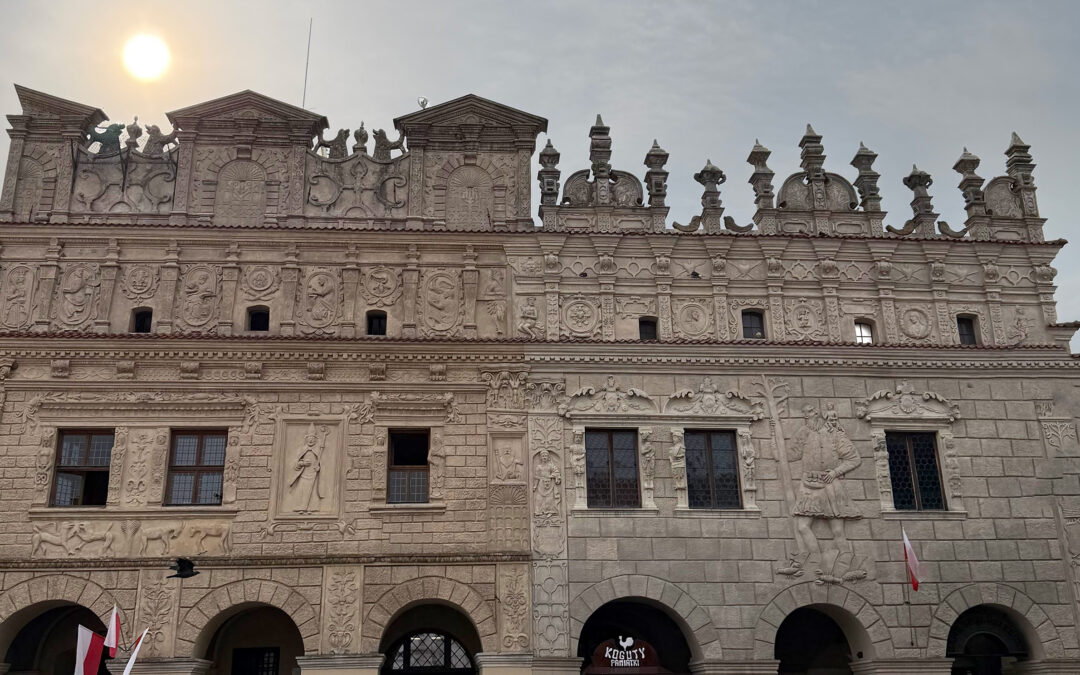
How My Trip to Poland Reaffirms the Mission of Music Restored
Kazimierz Dolny, Poland
From performing works by Music Restored composers to finding inspiration for a scholarly journal, a trip to Poland this summer made a profound impression on Program Director Adam Millstein and his dedication to Music Restored: The Ziering-Conlon Center for Exiled and Suppressed Composers.
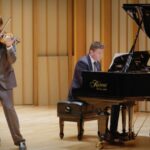
For eight days this summer, I had a life-changing experience visiting Poland. I was invited by Irina Prinzessin zu Sayn-Wittgenstein-Berleburg, a tirelessly dedicated supporter of the arts and member of Colburn’s Global Council, to perform as a guest artist in her IMAGINE Culture Without Borders Festival in Kazimierz Dolny. Whenever I have the agency to curate concert programming, my goal is always to introduce works of composers featured in Music Restored: The Ziering-Conlon Center for Exiled and Suppressed Composers. For this occasion, I proposed compositions by Schulhoff, Korngold, and Milhaud, which were greeted with great enthusiasm. Also, I was elated to learn the amazing musicians I’d be collaborating with were presenting music by Weinberg, Tansman, and Ben-Haim, three more composers who were all exiled to different corners of the world due to the oppressive policies of the Nazi regime.
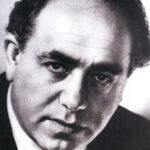
I was excited to visit Poland for the first time for multiple reasons. I was thrilled to have the opportunity to represent Music Restored to musicians and audiences in Europe. Additionally, I knew Warsaw was the birthplace of Mieczsyław Weinberg. Prior to his exile following the Nazi invasion of Poland in 1939, Weinberg spent his formative years in Warsaw, the capital city that boomed with musical life before the war. From a young age, he was exposed to traditional Jewish music by his father, Shmuel, a Moldovan emigre musician who was the head of a traveling Jewish musical theatre group. The young Weinberg absorbed this folkloric musical style that influenced many of his works later in life.
Also, not long before this trip, I had been asked to write my first scholarly review of a new book, Mieczysław Weinberg: Between East and West for the Journal of Musicological Research, published by the British Academy. This collection of fascinating essays spans subjects that cover the composer’s aesthetic interests and provides deep analyses of lesser-known epochs of his life. The timing of this trip, in conjunction with my intensive study of this book and scholarly review writing, felt like something greater than pure coincidence. I was profoundly moved by writing about this composer, whose music I deeply love, in his place of birth.
For the festival, I had the great fortune to collaborate extensively with violinist Karolina Mikołajczyk and accordionist Iwo Jedynecki, who drove me to Kazimierz-Dolny, and with whom I became fast friends. The festival audiences were beyond enthusiastic and I was able to collaborate with other fantastic musicians including Bishara Haroni, a member of Duo Amal, an Israeli–Palestinian piano duo.
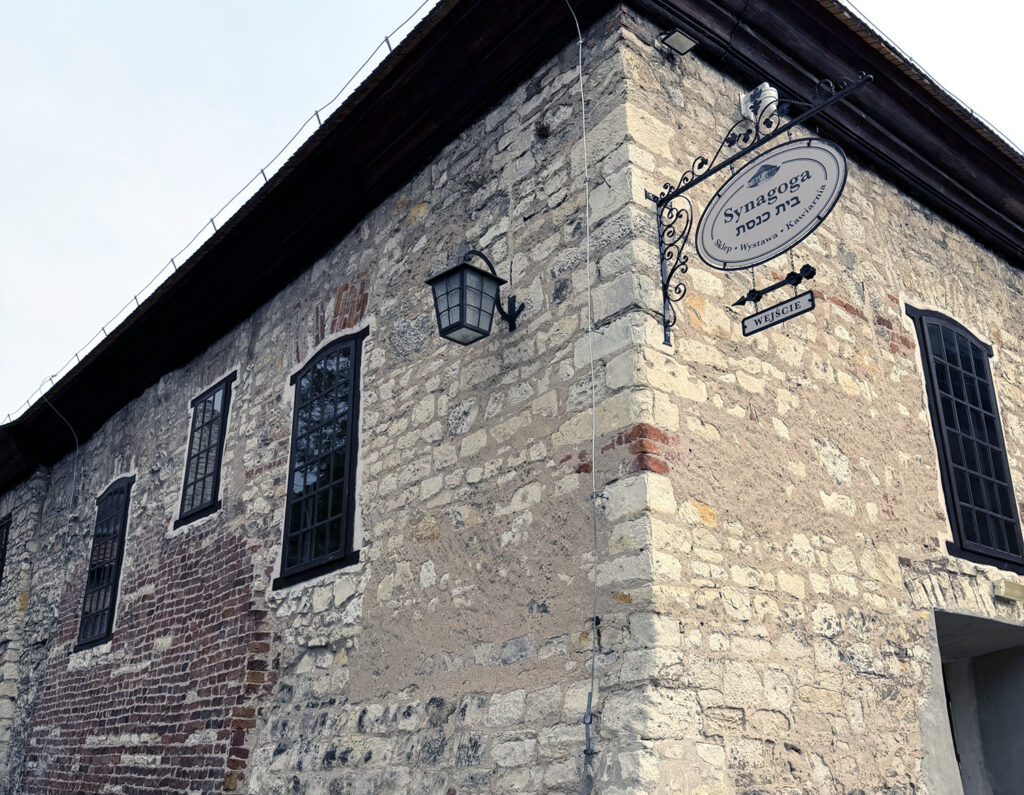 Surviving synagogue in Kazimierz Dolny, Poland
The town of Kazimierz Dolny is gorgeous. It consists of beautifully preserved Renaissance-era buildings and churches. Out of all of the historic sites in town, one struck me to my core, the old synagogue right off of the town’s square—many synagogues across Europe were destroyed by the Third Reich. However, the synagogue in Kazimierz was not spared from the blatant disrespect of the occupying forces. This sacred space was turned into a horse stable and centuries old Jewish gravestones were ripped from the cemetery to pave the road for members of the National Socialist party to tread upon, as explained by commemorative plaques. Today, the synagogue houses a small museum.
Prior to World War II, Poland was home to one of the largest Jewish populations in Europe that subsequently suffered unfathomable losses during the Holocaust. The Jews in Kazimierz consisted of an estimated 1,400–1,800 people, approximately half the population of the town, and were forced into a ghetto by the Nazis. Those who survived those conditions were then sent to the Bełźec concentration camp where they were murdered immediately upon arrival. It is likely that fewer than 20 Kazimierz Jews survived the war. To read about horrific history such as this in books is one thing, but to experience these places in the flesh is indescribably powerful.
Following our final concert in Kazimierz, Mikołajczyk and Jedynecki, drove me back to Warsaw with a stop at the prison in Lublin where we performed for approximately 30 inmates who are members of a special program run by a local Catholic university that offers courses to incarcerated individuals. We were joined by the wonderful Polish soprano Ewa Leszczyńska and performed works by Weill, Szymanowski, Chopin, Piazzola, and Korngold. I was nearly brought to tears by this performance. As much as I am reticent to use cliches, I could feel through every inch of my being the powerful potential of music to speak to audiences everywhere—music truly is an international language. After leaving the prison, we silently reflected on the experience as we drove to Warsaw.
I found talk of the war to be understandably ubiquitous in Poland. This was particularly evident when I arrived in the capital, nicknamed “The Phoenix City,” following the Warsaw Uprising when the Nazis destroyed 85–90% of the city. From the rubble, the Polish people rebuilt Warsaw, even recreating the Old City brick by brick utilizing pre-war photos, paintings, and other visual references.
It was within this environment that I finished my article on Weinberg. I also was able to meet with brilliant Polish scholars who have contributed significantly to the study of composers suppressed by both the Nazis and totalitarian communist regimes.
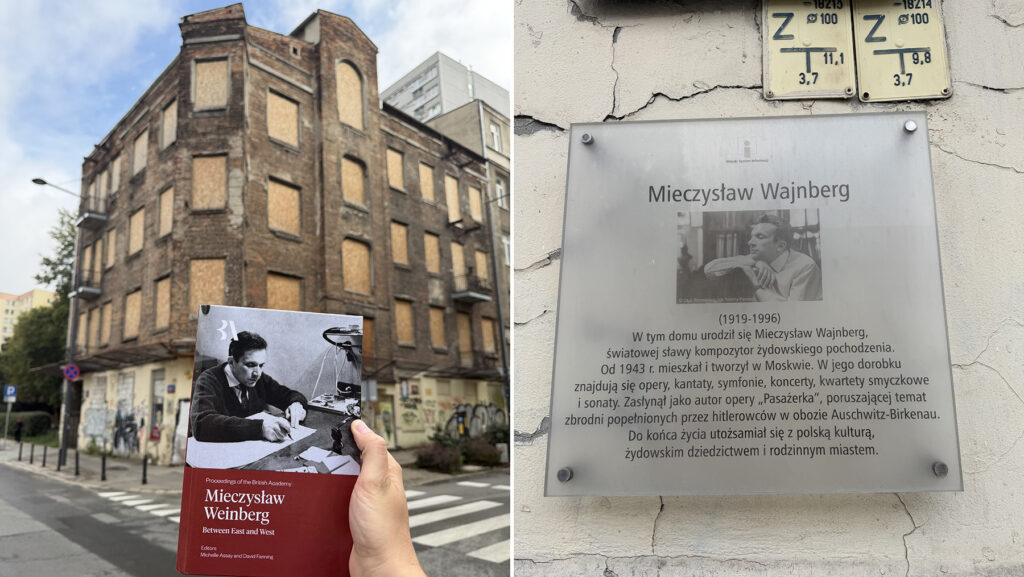 Birthplace of Mieczysław Weinberg in the former Jewish Ghetto of Warsaw
I learned that of the few remaining pre-war homes that survived, Weinberg’s birthplace miraculously stands intact. On my first morning in the city, I made a pilgrimage to visit the remains of the humble multi-story brick tenement in the Warsaw Ghetto. A small plaque adorns the abandoned building that recognizes the composer, and a few blocks away, a street recently was named in honor of Weinberg.
As I stood outside of his home, I was overcome with emotion. I put my hands on the bricks and quietly prayed. Here stands the home from where the teenage Weinberg had to flee his family—the family he would never see again—the city he called home, the city he returned to just once in his life only to be shunned by the Polish musical intelligentsia who frowned upon his compositional style. I left Poland with a deeper understanding of the composer.
Upon reflection of those eight days, I’m filled with tremendous gratitude. I was grateful to make music and also experience the profundity of these places that were imbued with a confusing mixture of unfathomable historic tragedy, thriving contemporary life, and the eternal echoes of a determination to rebuild a city once reduced to rubble. I left Poland with a deeper understanding of the composer Weinberg and an immediate desire to visit again.
I’m also left further convinced of the importance of the Music Restored mission to bring the music and legacies of these unjustly suppressed composers to their rightful place in the canon of art music. It takes patience, resilience, and tireless advocacy from musicians around the world to complete this mission. I am fully convinced our efforts at Music Restored: The Ziering-Conlon Center for Exiled and Suppressed Composers can sincerely create a positive impact in the musical world by correcting this historic and artistic injustice.